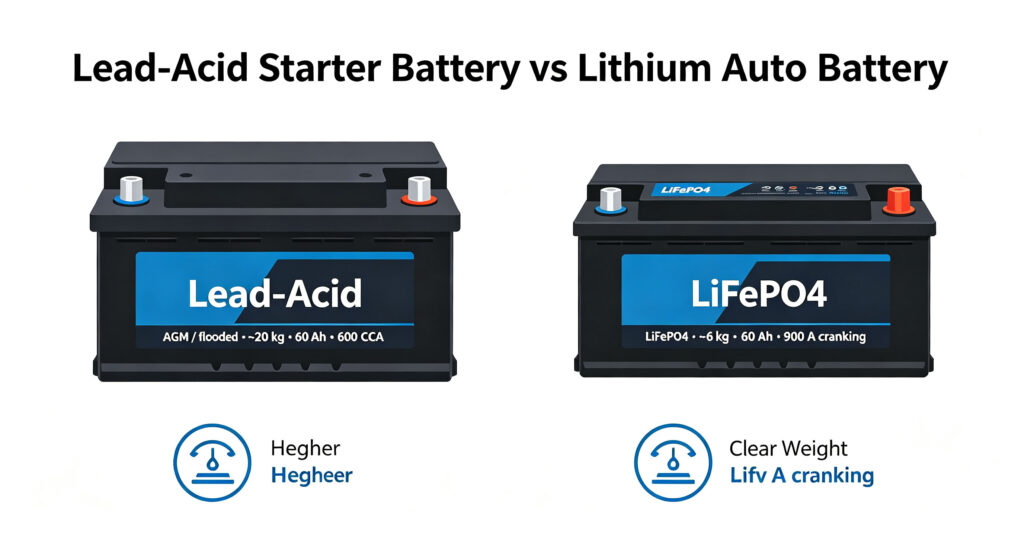
A lithium auto battery is a 12V LiFePO4 starting battery that replaces a conventional flooded or AGM lead-acid starter battery in a car, van, truck or specialty vehicle. The specification that matters is not amp-hours but cranking current: a lithium auto battery has to deliver several hundred amps for a few seconds at low temperature, then recover immediately as the alternator recharges it. That duty profile is the opposite of a deep-cycle application, and it is where most lithium starter swaps either work well or fail in ways that look mysterious. The three checks that decide the outcome are the cranking current rating at the lowest expected temperature, the BMS low-temperature charge behaviour, and whether the vehicle’s charging system stays inside the battery’s voltage and current limits.
Starting duty is not cycling duty
A deep-cycle battery is designed to deliver a moderate current for hours and to be recharged from a partially discharged state, hundreds or thousands of times. A starter battery does something else entirely: it delivers a very large current for a few seconds, loses a small fraction of its capacity, and is immediately recharged at a high rate by the alternator. It then sits at float for hours or days.
Those two duty profiles produce opposite design priorities, and mixing them up is the most common specification error in a vehicle lithium conversion.
| Parameter | Starter duty | Deep-cycle duty |
|---|---|---|
| Key rating | Cranking amps at temperature | Amp-hours and cycle count |
| Discharge depth | A few percent per event | 50–90% per cycle |
| Peak current | Hundreds of amps for seconds | Fraction of C-rate, sustained |
| Recharge source | Alternator, high rate, immediate | Controlled charger or solar |
| Dominant failure mode | Voltage collapse in cold; BMS cutoff | Capacity fade from cycling and heat |
The practical consequence: buying a lithium auto battery on amp-hours alone is meaningless. Two batteries with the same Ah rating can differ by a factor of two in the current they will actually deliver to a starter motor at -10 °C, and the one that delivers less will leave the vehicle immobilised even though its capacity is nominally adequate.
Cranking current: reading the number honestly
Lead-acid starter batteries are rated in cold cranking amps, a standardised test that specifies current, voltage floor, temperature and duration. Lithium starter batteries are often quoted with a peak or pulse current figure measured under conditions the datasheet may not fully state. Comparing the two requires care.
Three questions make the comparison meaningful. What is the duration — a 3-second pulse and a 30-second crank are not the same claim. What is the voltage floor — a figure measured down to a lower cutoff voltage is not equivalent to one measured at the higher cutoff a starter needs. And at what cell temperature was it measured — a lithium battery’s internal resistance rises as it gets cold, so a cranking figure quoted at 25 °C says little about a January morning.
Reputable suppliers publish a cranking curve or a table by temperature. A single headline number with no temperature and no duration should be treated as a marketing figure, not a specification. The general practice for reading a specification sheet honestly, including how to compare ratings that are quoted differently, is set out in #115 how to read LiFePO4 battery specs.
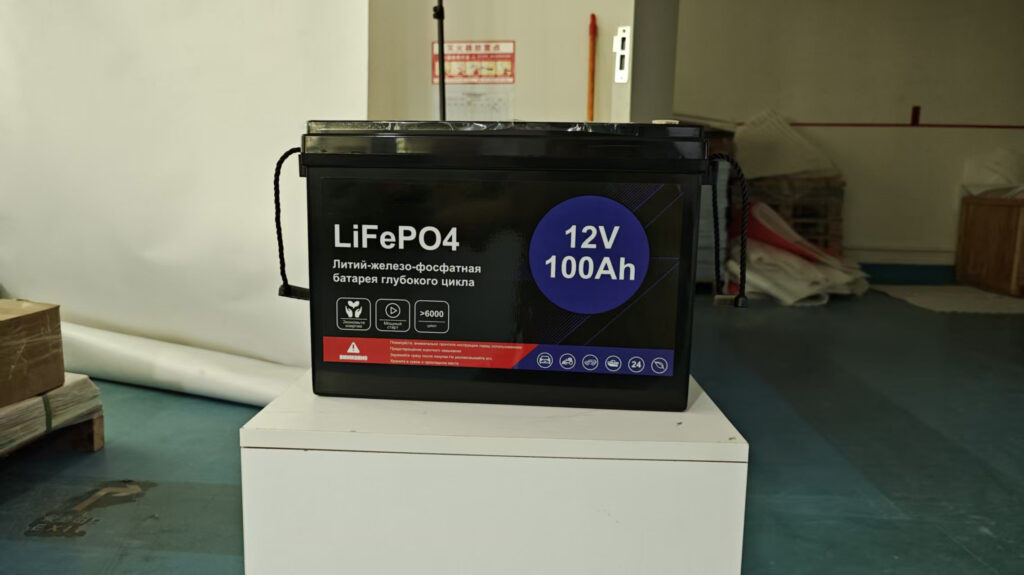
Cold weather: the two separate problems
Cold causes two distinct issues in a lithium auto battery, and conflating them is why some vehicles fail to start in winter even with a battery that works fine in autumn.
Discharging in the cold is usually fine. A LiFePO4 battery can deliver current well below freezing; internal resistance rises, so available cranking current falls, but the chemistry still works. This is why a battery that has been warmed slightly by a first crank attempt often succeeds on the second — the current flow itself warms the cells.
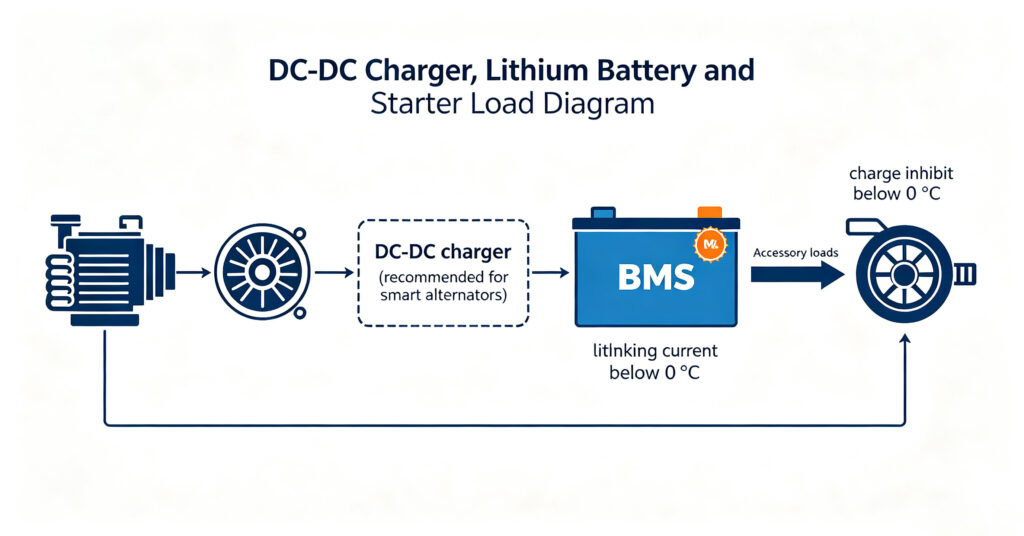
Charging in the cold is not fine. Charging a lithium cell below 0 °C can plate metallic lithium onto the anode, which permanently reduces capacity and can create an internal short. Every credible lithium auto battery therefore includes a BMS that inhibits charging below a set temperature threshold. The failure mode this creates is specific and worth understanding: if the BMS blocks charging, a vehicle that started successfully may not accept recharge from the alternator until the battery warms up, and the driver sees a flat battery the next morning.
Two product features address this. A self-heating battery includes a heating element that warms the cells before allowing charge current, drawing power from the alternator or from its own reserve. A battery without self-heating needs the installer to accept the limitation and plan for it — which in a fleet context means knowing which vehicles operate in which climates. The battery protection logic that governs this is explained in #49 BMS protection functions.
Alternator and charging system compatibility
The alternator was designed around a lead-acid battery’s charging behaviour, and three of its habits need checking before a lithium swap.
- Voltage. A typical alternator regulates around 14.0–14.4V, which sits comfortably inside a LiFePO4 battery’s acceptable absorption range. Problems arise with older regulators that run hotter, or with systems that apply a periodic equalisation voltage well above what a lithium pack tolerates.
- Current. A deeply discharged lithium battery has low internal resistance and will accept a very large charge current. An alternator asked to deliver its maximum output continuously, into a battery that never signals “full”, can overheat. A battery with a correctly sized BMS current limit, or a DC-DC charger between alternator and battery, prevents this.
- Smart alternators. Modern vehicles with regenerative charging vary the target voltage and may drop to a low float voltage on the overrun. A lithium battery that expects a steady absorption voltage may finish a journey only partially charged, which accumulates across short trips.
Vehicles with stop-start systems, regenerative braking or a battery management sensor on the original battery terminal add a further check: the vehicle’s own monitoring may expect a lead-acid charge signature and log a fault if it does not see one. That is a vehicle integration question rather than a battery question, and it belongs on the pre-install checklist rather than being discovered in the field.
What the fleet actually saves
The purchase case for a lithium auto battery in a commercial fleet rests on four items, and only one of them is the sticker price.
- Weight. A lithium starter battery is typically a third to a quarter of the weight of the lead-acid equivalent. For a vehicle where payload is the constraint, that is revenue capacity recovered; for a motorsport or specialty build it is a handling change.
- Service life. A lead-acid starter battery in commercial duty is commonly replaced every two to four years. A LiFePO4 starter battery is expected to last considerably longer on the same duty, which removes replacement events, disposal handling and the vehicle downtime each one causes.
- Self-discharge. Vehicles that sit — seasonal equipment, backup units, dealer stock — lose a lead-acid battery to sulphation during storage. Lithium’s much lower self-discharge rate means a vehicle that has stood for months is more likely to start.
- Downtime. For a fleet, the cost of a vehicle that will not start is usually larger than the cost of the battery. Fewer no-start events is the item that actually shows up in the operating budget.
The honest counterweight is upfront cost: a lithium auto battery costs several times more than the lead-acid unit it replaces, and the payback depends entirely on the replacement interval it displaces and on how expensive a no-start event is for that fleet. Fleets with high annual mileage, harsh climates or expensive downtime recover the premium fastest; fleets with gentle duty and cheap downtime may not.
The same arithmetic, applied to the marine and RV side where dual-purpose starting and house loads share a bank, is covered in #97 marine and RV deep-cycle battery guide, and the pure cycling comparison is in #24 lithium vs lead-acid deep cycle.
Q. Can I replace my car battery with a lithium auto battery?
In most cases yes, provided three conditions are met: the battery’s cranking current rating covers your engine’s requirement at your coldest expected temperature, its BMS and charge profile are compatible with your alternator’s output voltage, and the physical group size and terminal orientation fit the battery tray. Vehicles with smart alternators or battery-sensor-based monitoring may need a DC-DC charger or an interface module.
Q. Why won’t my lithium car battery charge in winter?
Because the BMS is protecting the cells. Charging a lithium cell below freezing can plate metallic lithium and permanently damage it, so the BMS inhibits charge current until the cells warm above its threshold. A self-heating battery solves this by warming the cells itself; without that feature, the battery may crank the engine but then refuse alternator recharge until it warms up.
Q. Is a lithium auto battery safe in an engine bay?
It can be, but engine bay heat is a real derating factor. LiFePO4 tolerates discharge at high temperature better than charging, and sustained under-hood heat shortens calendar life. A battery mounted in the cabin, the boot or a ventilated enclosure away from the exhaust manifold will outlast one sitting next to the engine block. Check the datasheet’s operating and charging temperature range before choosing a mounting location.
Q. How many cranking amps do I need?
Start from the vehicle manufacturer’s specified cold cranking amps for the original battery and match or exceed it, then apply a margin for cold operation because available cranking current falls as temperature drops. Engines with high compression, diesel engines with glow plugs and large displacement engines all sit at the demanding end of the range.
Q. Do I need a special charger for a lithium auto battery?
For alternator charging, usually no — most alternator voltage ranges suit LiFePO4. For workshop or maintenance charging, yes: use a charger with a LiFePO4 profile rather than a lead-acid or automatic mode, because a lead-acid mode may apply a desulphation or equalisation voltage that a lithium BMS will reject or that exceeds the cells’ limit.
Next step: match the battery to the coldest morning, not the average one
A starter battery is specified against its worst day. The three numbers that decide a fleet conversion are the cranking current requirement at the lowest operating temperature, the charge-inhibit threshold of the BMS, and the alternator’s actual output voltage range.
- Read the ratings correctly in #115 how to read LiFePO4 battery specs
- Understand the protection logic in #49 BMS protection functions
- Compare against AGM in #86 AGM vs LiFePO4 upgrade
- Ask leekooenergy for a vehicle-class starter battery specification that states cranking current by temperature, the BMS charge-inhibit threshold and whether self-heating is included, the accepted alternator voltage and current window, the group size and terminal orientation, and the recommended mounting location for your under-hood temperature profile — so the conversion is validated against your fleet’s actual cold-start conditions rather than a room-temperature datasheet