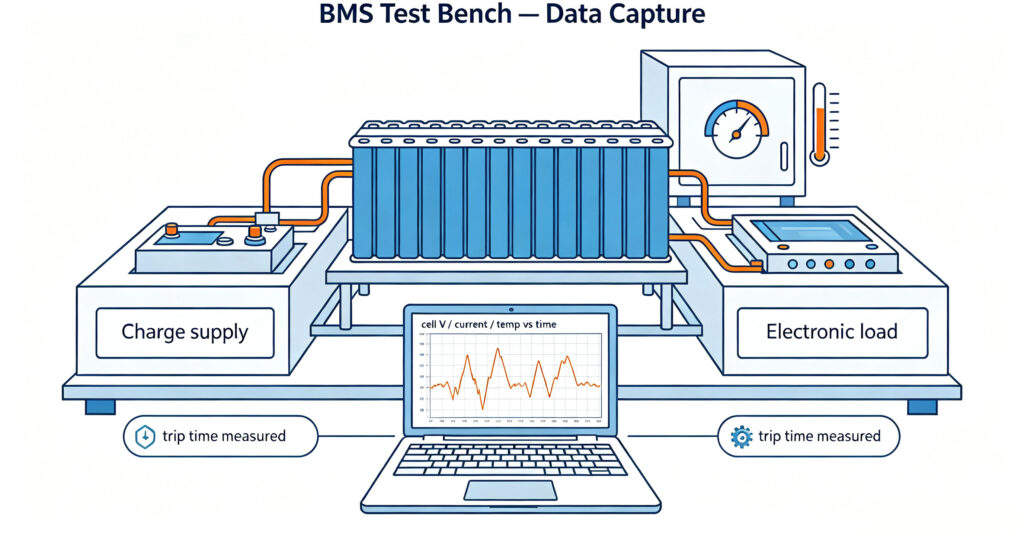
Battery management system testing is the set of measurements and functional checks that confirm a BMS actually performs the protections, measurements and communications its datasheet claims — at the thresholds, currents and temperatures your application will impose. It happens at four levels: design verification on the BMS board, end-of-line testing on every finished pack, type testing on sample units for environmental and electromagnetic compliance, and acceptance testing on delivered goods before you sign them off. For a B2B buyer the part that matters most is the acceptance layer, because it is the only one you control: it is where you confirm that protection thresholds trip at the stated values, that balancing actually reduces cell spread, that state-of-charge reporting matches reality, and that the communication protocol behaves the way your inverter or monitoring system expects.
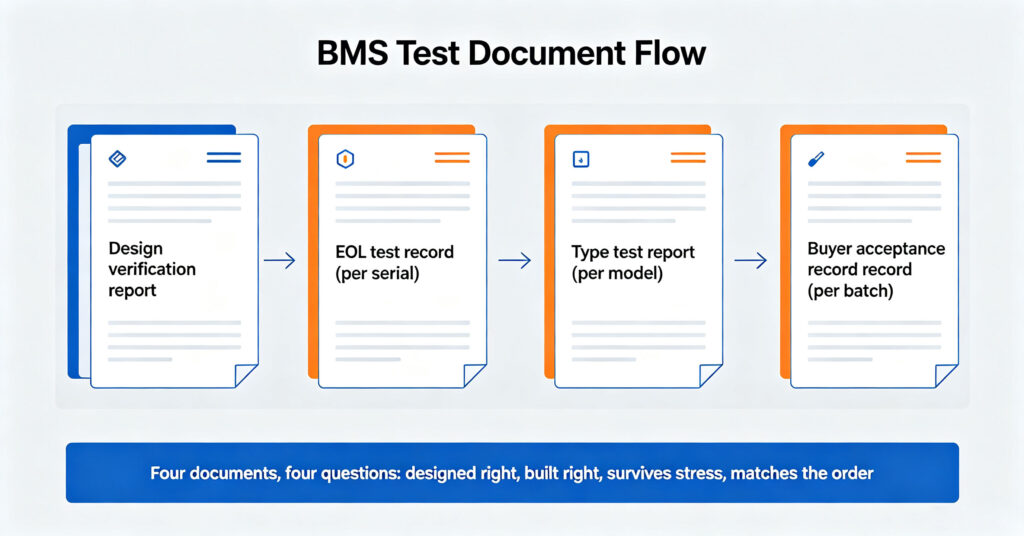
Four test levels and who owns each
| Level | When | What it proves | Who owns it |
|---|---|---|---|
| Design verification | During development | The protection logic and measurement algorithms work across the specified range | BMS designer / battery maker |
| End-of-line (EOL) | Every unit, at factory | This specific pack is wired correctly, calibrated and free of assembly defects | Battery maker |
| Type testing | On samples, per model | The model survives environmental, electrical and EMC stress | Battery maker, often with a third-party lab |
| Acceptance testing | On delivery, by you | The delivered batch matches the specification you bought | Buyer |
The four are not substitutes for one another. A supplier can hold a complete type test report for a model and still ship a pack with a mis-wired temperature sensor, because type testing was done on a different unit in a different month. Conversely, a thorough EOL test cannot tell you whether the protection thresholds were chosen correctly for your application. The buyer’s own acceptance test exists to catch the gap between the two.
Nine things to test, and how
Battery management system testing is best organised by function. Each item below has a failure mode that is common enough to be worth testing for explicitly, rather than trusting the datasheet line.
- Over-voltage protection. Charge the pack while monitoring cell voltages; confirm the BMS stops charge at the stated threshold and within the stated response time. The common failure is a threshold that is correct but a response that is too slow to protect the cell during a fast charge.
- Under-voltage protection. Discharge under load; confirm cutoff at the stated threshold and that the pack recovers according to the documented behaviour rather than latching permanently.
- Over-current and short-circuit protection. Apply a step load beyond the rating and confirm the current limit or disconnect operates. This is the test most often omitted at incoming inspection and the one whose absence shows up as a melted connector rather than a BMS fault code.
- Temperature protection. Verify both the high-temperature cutoff under load and the low-temperature charge inhibit. The charge inhibit is the one that causes field confusion: it is correct behaviour that looks like a fault to an operator who has not been told about it.
- Cell balancing. Start from a deliberately unbalanced pack and measure cell voltage spread before and after a full charge cycle with balancing enabled. Confirm the spread narrows, and note how many cycles it takes — a balancing circuit that is technically present but too weak to converge within a normal charge window is a real and common defect.
- State-of-charge accuracy. Compare the reported SoC against coulomb counting over a full discharge at a known rate. Large divergence at the ends of the range is the usual symptom of a poorly calibrated current sensor or an SoC algorithm tuned for a different duty profile.
- State-of-health reporting. Confirm SoH is reported at all, and ask how it is derived. A number that is only a cycle counter is not a state-of-health estimate, and the distinction matters for warranty and replacement planning.
- Communication conformance. Connect the pack to the actual inverter, gateway or monitoring platform you will deploy and confirm it enumerates, reports the expected registers and does not drop off during a charge-discharge cycle. Protocol conformance on a bench with the vendor’s own tool proves much less than interoperation with your hardware.
- Firmware version and regression. Record the firmware version on every delivered unit and confirm it matches the version that was validated. A silent firmware change between batches is a change in protection behaviour that no amount of electrical testing will reveal from the outside.
The functions themselves and the reasoning behind each threshold are set out in #49 BMS protection functions; the balancing mechanisms you are testing are compared in #106 active vs passive cell balancing.
What to ask the supplier for
Six documents, and the specificity matters — a generic report is easy to produce and hard to rely on.
- EOL test record per serial number, showing the measured values rather than a pass/fail tick. A record that only says “pass” tells you nothing about margin.
- Protection threshold table with measured trip points, at the temperature extremes you specified, not only at room temperature.
- Balancing convergence data, showing cell spread before and after a defined number of cycles.
- Communication protocol documentation and interop test reports with the specific inverter or gateway models you use.
- Firmware version log, with change notes and a commitment to notification before a version change.
- Type test and certification reports for the model: transport, cell and pack safety, and electromagnetic compatibility as your market requires. The certification landscape is summarised in #107 battery export certification.
These requests also function as a supplier filter. A manufacturer that treats battery management system testing as a real discipline A manufacturer with a real quality system can produce per-serial EOL data within a day; one that cannot will offer a generic certificate instead. That difference is itself a useful signal, and it is the same signal the supplier evaluation process in #125 evaluating BMS suppliers is designed to surface. The traceability infrastructure behind per-serial records is described in #133 OEM battery quality control and traceability.
Batch consistency: testing the sample versus the shipment
Acceptance testing is statistical by nature, and it is the layer of battery management system testing you control:, so the plan matters as much as the tests. Three practices make it meaningful.
- Test across the batch, not just the first unit. Draw samples from different pallets and different production dates within the shipment. The first unit off the line is the least representative one.
- Compare EOL data across units. A tight spread in measured capacity and internal resistance across the batch is a stronger quality signal than any individual unit’s result.
- Re-test after firmware updates. Any firmware change invalidates the previous validation for the protection behaviour it touched, even if the hardware is unchanged.
Once the packs are in service, the same measurements become the monitoring baseline: cell voltage spread, temperature rise under load and SoC drift are the signals that distinguish a pack that is ageing normally from one that is failing. The parameters worth tracking continuously are set out in #112 BMS monitoring, and the field symptoms that follow a missed test are catalogued in #108 common BMS faults.
Q. How do you test a battery management system?
By exercising each protection function and measurement at the threshold your application uses, and recording the actual trip point and response time rather than a pass/fail result. A minimum set covers over-voltage, under-voltage, over-current and short-circuit, high-temperature cutoff, low-temperature charge inhibit, balancing convergence, state-of-charge accuracy, and communication interoperability with the target inverter or gateway.
Q. What is end-of-line testing for a battery pack?
End-of-line testing is the automated test every finished pack passes before it leaves the factory. It verifies wiring correctness, sensor calibration, insulation resistance, protection function response and communication, and it produces a record keyed to the pack’s serial number. It is distinct from type testing, which is performed on samples to demonstrate environmental and electromagnetic compliance.
Q. Should I trust a supplier’s type test report?
Trust it for what it proves — that the model survived a defined set of stresses — and not for what it does not: that your specific delivered units were built correctly. Type testing is done on samples, often from an earlier production run, so it should always be paired with per-serial end-of-line records and your own acceptance testing on the delivered batch.
Q. How often should delivered batteries be acceptance tested?
Every shipment, with sample size scaled to the batch and to the supplier’s demonstrated consistency. A supplier with tight, well-documented EOL data and a stable process warrants a lighter incoming plan; a new supplier or a new model warrants full functional testing on a meaningful sample drawn from across the shipment.
Q. Can BMS protection thresholds be changed after delivery?
Sometimes, through firmware configuration, and that is precisely why firmware version control matters as a test item. A threshold change is a change in protection behaviour, so any reconfiguration should be followed by re-validation of the affected functions rather than assumed correct.
Next step: ask for measured values, not pass/fail ticks
The gap between a supplier who can produce per-serial measured data and one who can only produce a certificate is the cheapest quality signal you will ever get. Ask for it early, before the order rather than after the fault.
- Compare the supplier evaluation criteria in #125 evaluating BMS suppliers
- Understand what the protections should do in #49 BMS protection functions
- Plan the post-installation monitoring in #112 BMS monitoring
- Ask leekooenergy for a validation pack for your application that includes the protection threshold table with measured trip points at your operating temperature range, balancing convergence data, communication interop reports with your inverter or gateway models, per-serial end-of-line records with measured values, and the firmware version log with change notification — so your acceptance test is run against measured evidence rather than a datasheet claim