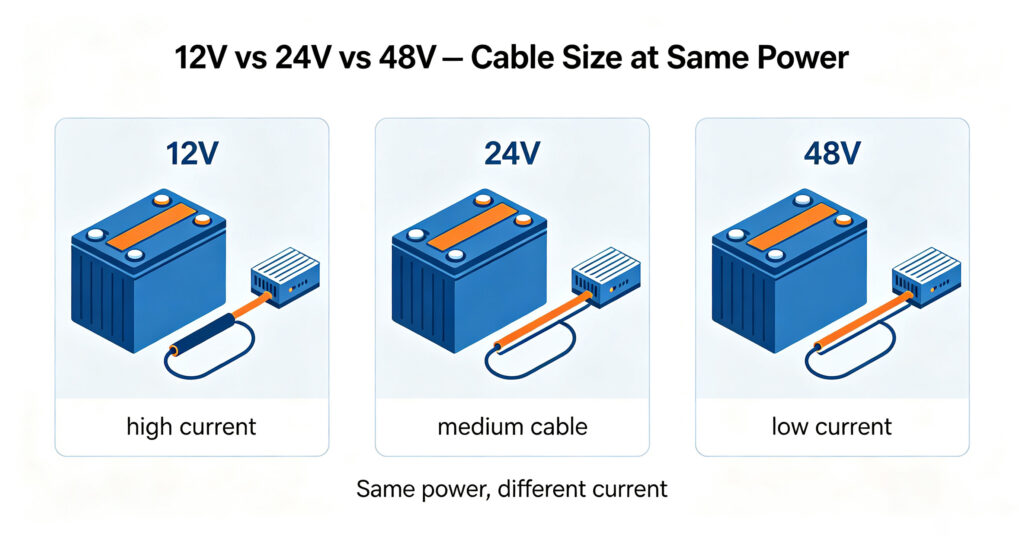
A 24V solar battery bank is a storage bank whose nominal system voltage is 24V — built either from two 12V batteries in series or from a native 24V lithium pack, typically eight LiFePO4 cells in series. It sits between the 12V systems used in small mobile applications and the 48V systems that dominate residential and commercial storage. The reason to choose it is that it halves the current of a 12V system at the same power, which halves the cable cross-section and quarters the resistive loss, while keeping access to a wide range of affordable 24V inverters, charge controllers and DC loads. The reason to step past it to 48V is the same arithmetic applied once more: above roughly 2–3 kW of continuous load, or where the cable run between battery and inverter is long, 48V becomes the cheaper and more available choice.
Why voltage decides cable size
For anyone choosing a 24V solar battery, the whole question reduces to one relationship: power equals voltage times current. At a fixed power, doubling the voltage halves the current, and because resistive loss scales with the square of current, the same cable loses a quarter as much energy.
That produces three practical consequences for a 24V design.
- Cable cost and weight. A 24V bank needs roughly half the copper of an equivalent 12V bank for the same run and loss target. On a boat or a vehicle, where every kilogram counts and cable routing is difficult, this is often the deciding factor.
- Voltage drop. Long DC runs at 12V lose a meaningful fraction of the system voltage before the load sees it. At 24V the drop is smaller for the same cable, which makes a 24V system more forgiving of a battery that has to sit further from the inverter.
- Component current ratings. Breakers, fuses, shunts and busbars are rated in amps. Halving the current moves the design into a smaller, cheaper and more widely available bracket of components.
The system-level version of this argument, including where high-voltage architectures take over entirely, is laid out in #89 high-voltage vs low-voltage storage.
Three platforms compared
| Dimension | 12V | 24V | 48V |
|---|---|---|---|
| Typical system size | Up to ~1 kW | Roughly 1–3 kW | Above ~3 kW |
| Relative current | High | Half of 12V | Quarter of 12V |
| Cable cost | Highest per kW | Moderate | Lowest |
| Inverter availability | Very wide, cheap | Wide | Widest at higher power |
| DC load ecosystem | Largest (automotive, marine) | Moderate (truck, marine, industrial) | Smaller, mostly telecom and industrial |
| Typical application | Van, small boat, tiny cabin | Medium RV, boat, small off-grid, remote site | Home, commercial, telecom, data |
The column that most often decides it in practice is not the electrical one but the ecosystem row. A 12V system can power automotive and marine accessories directly off the battery with no converter. A 24V system covers truck and marine equipment but needs a DC-DC converter for 12V accessories. A 48V system has the smallest direct-DC ecosystem and usually runs everything through the inverter.
How a 24V bank is built
A 24V solar battery bank can be built two ways, with quite different consequences.
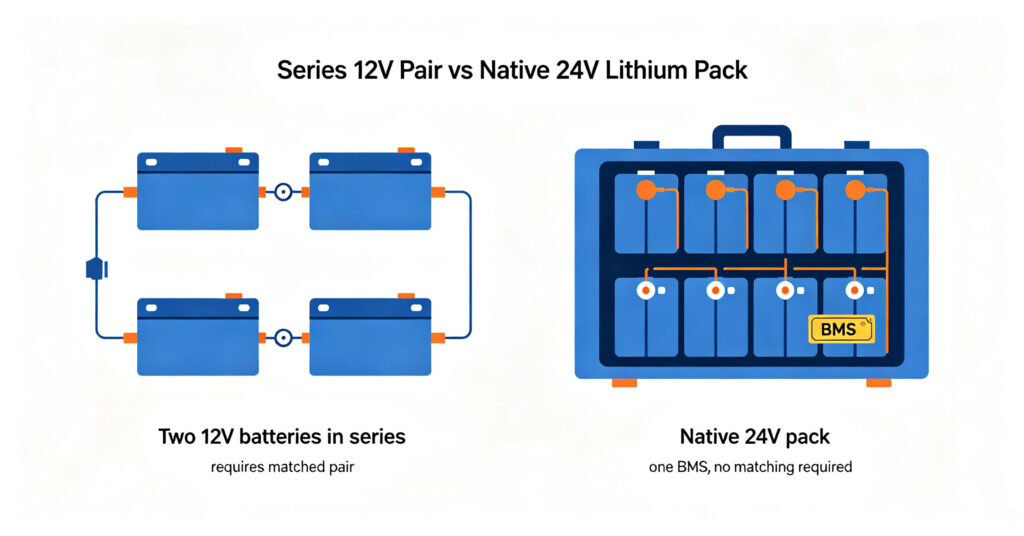
- Two 12V batteries in series. The positive of one connects to the negative of the other; the free terminals become the 24V output. Capacity in amp-hours stays the same as a single battery, voltage doubles, so watt-hours double. This route is familiar and flexible, but it requires the two batteries to be matched: same model, same age, same state of health. An unmatched pair will drift apart in state of charge and one will be overworked.
- A native 24V lithium pack. A single enclosure with eight LiFePO4 cells in series and one BMS managing all of them. This removes the matching problem entirely, because there is only one battery and one BMS. For lithium in particular this is the better route: series-connecting two 12V lithium batteries each with their own BMS creates a situation where the two BMSs can disagree about when to stop charging.
The series-versus-parallel decision and its effect on bank behaviour is worked through in #93 parallel battery packs, and the 12V lithium product perspective is in #70 12V LiFePO4 battery.
Where 24V is the right answer
Four application patterns account for most 24V installations.
- Medium RV and camper builds. Enough capacity for a fridge, water pump, lighting and an inverter running small mains loads, without the current levels that make 12V wiring expensive and bulky. Many truck-based platforms already have 24V electrical systems, which makes 24V storage a natural match.
- Boats in the mid-size range. Windlass, bow thruster and inverter loads benefit from halved current, and 24V is a standard marine distribution voltage on vessels of this size.
- Small off-grid cabins and sheds. A system in the one to three kilowatt band with modest cable runs is the classic 24V fit — large enough that 12V wiring becomes awkward, small enough that 48V offers little additional benefit.
- Remote monitoring and small telecom sites. Where the native equipment voltage is 24V, matching the storage voltage avoids a conversion stage entirely.
The off-grid system design that surrounds these applications is covered in #23 off-grid solar system batteries, and the inverter sizing that pairs with a 24V bank is in #79 hybrid inverter sizing vs battery capacity.
When to step up to 48V instead
Three signals say a 24V solar battery design is the wrong side of the line, and all three are cheap to check before buying.
- Continuous power above roughly 3 kW. Beyond this point the current at 24V pushes cable and component sizes into the range where 48V is both cheaper and better supported by inverter product ranges.
- Cable run longer than a few metres. Voltage drop at 24V becomes the constraint before it does at 48V. If the battery has to sit well away from the inverter, the higher platform saves copper and improves regulation.
- Planned expansion. A system that starts at 2 kW and is expected to grow should be designed at 48V from the start, because changing system voltage later means replacing the inverter and the battery bank rather than adding to it.
The 48V platform itself, including the 48V versus 51.2V naming question that comes up with LiFePO4, is explained in #12 48V vs 51.2V solar battery and in #35 48V lithium batteries explained.
Q. Is 24V better than 12V for solar?
For systems above roughly one kilowatt, yes. A 24V bank halves the current of an equivalent 12V bank at the same power, which means smaller and cheaper cables, less voltage drop over the same run, and lower resistive loss. Below that size, or where the loads are natively 12V automotive or marine devices, a 12V system remains simpler and cheaper.
Q. How do I build a 24V battery bank?
Either connect two matched 12V batteries in series — positive of one to negative of the other, taking output from the free terminals — or use a single native 24V pack. For lithium, the native pack is strongly preferable: it has one BMS managing all cells, whereas two series-connected 12V lithium batteries each carry their own BMS and can disagree on charge termination.
Q. Can I use 12V devices on a 24V system?
Yes, through a DC-DC converter that steps 24V down to 12V. Size the converter for the continuous current of the 12V loads plus margin, and treat it as a real component cost and a small efficiency loss rather than an afterthought. Devices that draw significant current are usually better run from the inverter’s AC output.
Q. Should I choose 24V or 48V for a small off-grid cabin?
Choose 24V if the continuous load is under about three kilowatts, the cable run is short and no major expansion is planned. Choose 48V if any of those three is not true — particularly if expansion is likely, because changing system voltage later means replacing the inverter and the bank rather than adding modules.
Q. Do I need a special solar charge controller for 24V?
You need a controller that supports a 24V battery bank, which most MPPT controllers do via auto-detection or a configuration setting. The two ratings that still have to be checked are the controller’s maximum input open-circuit voltage from your PV array configuration, and its output current rating against the bank’s charging requirement.
Next step: let the load and the cable run pick the voltage
Voltage is not a preference, it is a consequence of two numbers: the continuous power the system must deliver and the distance between the battery and the inverter. Those two plus any expansion plan decide between 12V, 24V and 48V.
- See the 48V alternative in #35 48V lithium batteries explained
- Read the architecture argument in #89 high-voltage vs low-voltage storage
- Size the inverter against the bank in #79 hybrid inverter sizing vs battery capacity
- Ask leekooenergy for a voltage platform recommendation that states your continuous and peak load, the battery-to-inverter cable run, the native voltage of your DC loads, the inverter models available at each candidate voltage, and the cost comparison including cable, components and conversion losses — so the platform is chosen on your numbers rather than on habit