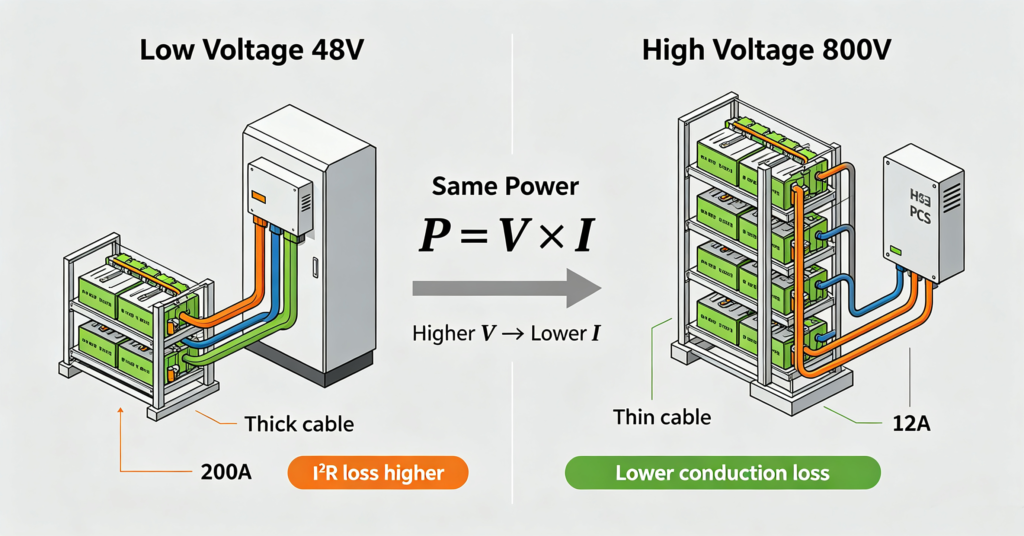
High voltage battery storage systems operate at DC bus voltages typically above 200V — commonly 400V, 800V or 1500V for commercial and utility-scale BESS — while low-voltage battery storage systems operate at 12V, 24V or 48V (51.2V for LiFePO4), typical for residential and small commercial installations. The voltage level determines the current for a given power output: because power equals voltage times current (P = V × I), a higher-voltage system delivers the same power at a lower current, which reduces cable size, lowers I²R conduction losses, and allows longer cable runs between the battery and the inverter. The trade-off is that high-voltage systems require more cells in series, more complex battery management, higher-voltage-rated components, and additional safety considerations — which increases system cost and complexity. The right voltage level depends on the system power rating, the cable run length, the available inverter/PCS options, and the application’s regulatory requirements.
The voltage level of a battery energy storage system is one of those specifications that looks like a technical detail but actually shapes the entire system architecture. It determines how many cells are wired in series, what gauge of cable connects the battery to the inverter, how much energy is lost as heat in those cables, what class of inverter is needed, and even what electrical codes and safety standards apply. A residential installer who chooses 48V because it is familiar may find that a 30-metre cable run to a garage-mounted inverter costs more in copper and energy loss than a higher-voltage system would have. Conversely, a commercial project that specifies 800V because it is “modern” may pay for high-voltage switchgear and insulation that a 400V system could have delivered at lower cost. This guide explains the trade-offs and helps match the voltage level to the application.
The BESS definition and basic architecture are in #8 what is battery storage (BESS); the types of energy storage systems are in #11 types of energy storage systems; the residential perspective is in #14 residential energy storage systems; the 48V vs 51.2V question is in #12 48V vs 51.2V solar battery. This article stays on the system-level voltage architecture decision.
Why voltage matters: the P = V × I relationship
The fundamental relationship that drives the high-vs-low-voltage decision is simple: electrical power equals voltage multiplied by current (P = V × I — see the for background). For a given power output — say, 10 kW — a 48V system must deliver approximately 208A of current (10,000W ÷ 48V), while a 400V high voltage battery storage system delivers only 25A (10,000W ÷ 400V). That eightfold reduction in current has cascading effects throughout the system design.
The most immediate effect is on cable sizing. Cable ampacity (the maximum current a cable can safely carry) is determined by its cross-sectional area. A 208A circuit requires a very thick cable — typically 70mm² or larger for DC battery circuits — which is expensive, heavy, and difficult to install. A 25A circuit can use a much smaller cable — 4mm² or 6mm² — which costs a fraction as much and is far easier to route. For installations where the battery and inverter are separated by more than a few metres, the cable cost difference alone can justify a higher-voltage architecture.
The second effect is conduction loss. Energy lost as heat in a cable is proportional to the square of the current (I²R), where R is the cable resistance. A 208A current generates roughly 69 times the I²R loss of a 25A current in the same cable. Even with a much larger cable (which reduces R), a low-voltage high-current system will lose more energy as heat in the cables than a high-voltage low-current system delivering the same power. Over thousands of charge-discharge cycles, those losses add up to a measurable reduction in round-trip efficiency and a higher total cost of ownership.
High voltage battery storage vs low voltage: a six-dimension comparison
| Dimension | Low-voltage (12V/24V/48V/51.2V) | High-voltage (200V/400V/800V/1500V) | Which wins |
|---|---|---|---|
| Current at 10kW | 208A (48V) — very high | 25A (400V) — low | High-voltage |
| Cable size & cost | Thick, heavy, expensive cables | Thin, light, low-cost cables | High-voltage |
| Conduction (I²R) loss | Higher (even with large cables) | Lower | High-voltage |
| Cells in series | 4–16 cells (48V = 16× 3.2V) | 63–469 cells (400V = 125× 3.2V) | Low-voltage (simpler BMS) |
| Component cost (inverter/PCS, switchgear) | Lower-voltage-rated, lower cost | Higher-voltage-rated, higher cost | Low-voltage |
| Safety & regulatory complexity | Lower voltage = lower shock hazard, simpler codes | Higher voltage = greater shock/arc-flash hazard, stricter codes | Low-voltage |
| Maximum practical power | ~5–10 kW (limited by current/cable) | 100 kW–MW+ (limited by voltage/cell count) | High-voltage |
| Cable run length | Short (≤5–10m recommended) | Long (50m+ practical) | High-voltage |
The comparison shows that high-voltage systems win on current, cable cost, conduction loss, maximum power and cable run length, while low-voltage systems win on BMS simplicity, component cost and safety/regulatory complexity. The decision is therefore not about which is “better” in the abstract — it is about which set of trade-offs matches the specific project constraints.
Voltage levels by application: what the industry actually uses
The BESS industry has converged on de facto voltage ranges for each application segment, driven by the trade-offs above and by the availability of compatible inverters and grid-connection equipment.
Residential and small commercial (3–15 kWh, 3–10 kW): 48V or 51.2V is the dominant standard. This voltage is low enough to be safe for residential installers, compatible with a wide range of hybrid inverters, and sufficient for power levels up to ~10 kW. The 51.2V nominal (16 cells in series × 3.2V per cell) is the LiFePO4 equivalent of the legacy “48V” nominal, and the two terms are often used interchangeably. Cable runs are typically short (battery and inverter in the same room or adjacent rooms), so conduction loss is manageable.
Commercial and industrial (30 kWh–2 MWh, 30 kW–500 kW): High-voltage DC buses in the 200V–800V range are common. Many C&I systems use 400V or 480V DC, which matches the voltage range of standard three-phase inverters and allows power levels up to several hundred kilowatts with reasonable cable sizes. Larger C&I systems may use 800V or 1000V DC to reduce current further and allow longer cable runs between battery containers and the PCS (power conversion system).
Utility-scale (1 MWh+, 500 kW–MW+): 1500V DC has become the dominant standard for new utility-scale BESS installations, driven by the solar PV industry’s adoption of 1500V arrays and the availability of 1500V-rated inverters and switchgear. At 1500V, a 1 MW system operates at only ~667A, which allows reasonable cable sizes even for multi-MW systems. The higher voltage also reduces the number of parallel strings needed, which simplifies system architecture and reduces balance-of-system costs.
How to choose the right voltage level for your project
The voltage decision should be made early in the project design, because it affects nearly every other component selection. Use this decision framework:
- Step 1 — Determine the required power output. The continuous charge/discharge power (in kW) is the primary driver. Below ~10 kW, 48V/51.2V is almost always the most cost-effective choice. Above ~50 kW, a high-voltage architecture (400V+) is typically necessary to keep current and cable sizes manageable. Between 10–50 kW, either can work depending on cable run length and inverter availability.
- Step 2 — Estimate the cable run length. Measure the distance between the battery location and the inverter/PCS location. If the run is longer than ~10 metres at 48V, the cable cost and conduction loss may justify a higher-voltage system. At 400V, runs of 50–100 metres are practical without excessive loss.
- Step 3 — Check inverter/PCS availability. The voltage level must match a commercially available inverter or PCS. There is no point specifying a 600V DC bus if no inverter supports that input voltage. Standard voltage ranges (48V, 400V, 800V, 1500V) have the widest equipment availability and the lowest costs.
- Step 4 — Evaluate safety and regulatory requirements. Higher-voltage systems require additional safety measures: DC disconnect switches rated for the voltage, arc-flash protection, insulated cable trays, and potentially restricted access to the battery room. The local electrical code and the authority having jurisdiction (AHJ) may impose specific requirements for systems above certain voltage thresholds. Factor these into the cost comparison.
- Step 5 — Compare total installed cost. The right choice is the one with the lowest total installed cost over the project life, including equipment, cables, installation labour, safety systems, and energy losses. A high-voltage system may cost more for the inverter and switchgear but save enough on cables and energy to come out ahead on a 10–15 year horizon.
Q. What is considered high voltage for battery storage?
In stationary energy storage, systems above 48V DC are generally considered high voltage. Common high-voltage platforms include 96V, 192V, 384V, 400V, 600V, 800V and 1500V DC. Residential systems typically use 48V (low voltage) or 192–400V (high voltage). Commercial and utility-scale systems use 600–1500V DC. The threshold matters because higher voltages require additional safety measures (isolation monitoring, arc-fault protection, qualified personnel, dedicated enclosures).
Q. Why does higher voltage reduce cable loss?
Cable loss is governed by P = I²R, where I is current and R is cable resistance. For a given power (P = V × I), doubling the voltage halves the current, which reduces resistive loss by 75% (since loss scales with the square of current). For example, delivering 10kW at 48V requires 208A and thick cables; at 400V it requires only 25A and much thinner cables. This is why long-distance transmission and high-power systems use high voltages — it dramatically reduces cable size, cost, and energy loss.
Q. Can I use a 48V battery with a high-voltage inverter?
No, not directly. A 48V battery cannot power a 192V or 400V inverter because the inverter’s DC input stage is designed for a specific voltage range. Connecting a lower-voltage battery will cause the inverter to report under-voltage and shut down, or may damage the inverter. You would need a DC-DC converter to step up the voltage, but this adds cost, complexity, and efficiency loss. It is almost always better to match battery voltage to inverter voltage from the start.
Q. What voltage is used for utility-scale battery storage?
Utility-scale BESS typically uses 600V, 800V, or 1500V DC battery systems connected to a central or string inverter that outputs medium-voltage AC (4.16kV, 12.47kV, or 34.5kV) through a transformer. The 1500V DC platform has become the industry standard for new utility-scale installations because it reduces cable losses, allows longer string lengths, and lowers balance-of-system costs. Some newer systems are exploring 3000V DC, but 1500V remains dominant.
Q. Is high-voltage battery storage more dangerous than low-voltage?
High-voltage systems carry greater electrical shock and arc-flash risk, but when properly designed and installed, they are not inherently more dangerous. High-voltage BESS include safety features like DC isolation monitoring, rapid shutdown devices, arc-fault circuit interrupters, fused disconnectors, and locked enclosures. The key risks are electric shock (voltages above 60V DC can be lethal) and arc flash during maintenance. Low-voltage 48V systems pose minimal shock risk but still carry fire risk from short circuits. Both require proper installation and maintenance.
Next step: specify the voltage level before you specify the components
The voltage level is the architectural decision that every other component selection depends on. Get it right, and the cables, inverter, switchgear and safety systems all fall into place at the lowest total cost. Get it wrong, and you either overpay for high-voltage equipment you don’t need or struggle with excessive cable loss and installation complexity on a system that should have been higher voltage.
- Read the BESS definition and architecture in #8 what is battery storage (BESS)
- Review the types of energy storage in #11 types of energy storage systems
- See the residential 48V/51.2V perspective in #12 48V vs 51.2V solar battery
- Understand commercial and industrial applications in #15 industrial battery storage
- Ask leekooenergy for a BESS voltage-level specification that includes: your required continuous and peak power (kW), the cable run length between battery and inverter (metres), the available inverter/PCS input voltage ranges, the local electrical code requirements for the proposed voltage level, the total installed cost comparison between candidate voltage levels (including cables, inverter, switchgear, safety systems and estimated 10-year energy loss), and the recommended voltage level with justification — so your system architecture is optimised for the actual project constraints rather than a default assumption