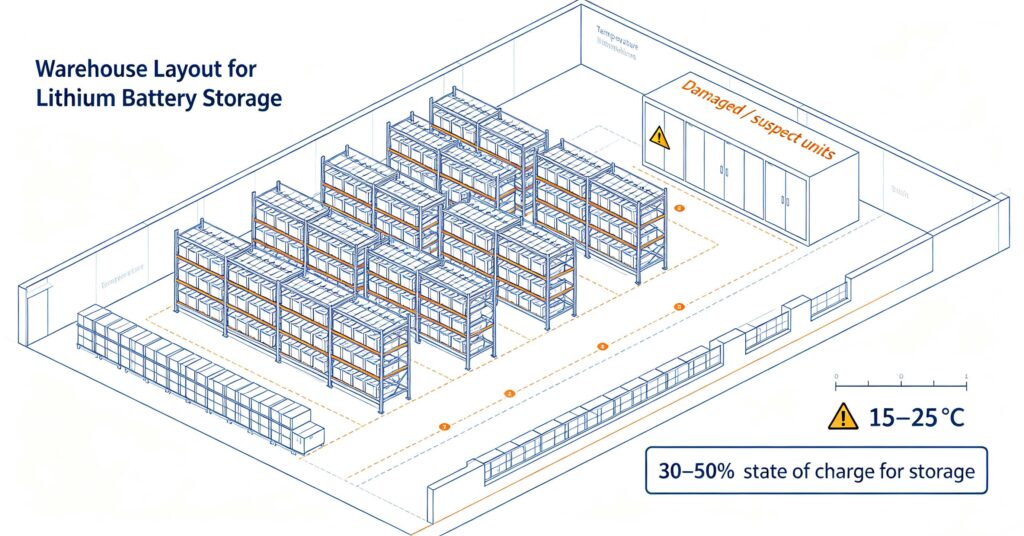
Where to store lithium batteries safely comes down to six variables: a cool, dry, ventilated indoor area away from combustible materials and direct sunlight; a partial state of charge rather than full or empty; solid shelving that prevents crushing, shorting and falling; separation between storage groups and from other stock; a dedicated quarantine location for damaged or suspect units; and a fire response plan that everyone on site has been shown. Storage is not the same as installation — a battery in storage is not connected, not supervised by a BMS in a charging circuit, and often not checked for months, which is why the storage rules focus on keeping the battery chemically stable and on limiting the consequence if one cell does fail.
Storage is not installation
Knowing where to store lithium batteries starts with whether they are in storage or in service. The distinction matters because the two states have different risks and different rules. An installed battery is connected to a managed circuit: a BMS watches cell voltages, a charger follows a profile, and a monitoring system reports anomalies. A stored battery has none of that. It sits at whatever state of charge it arrived with, in whatever temperature the room happens to be, with nobody watching.
Three consequences follow, and they are the reason storage rules exist separately from installation rules.
- The state of charge you store at is the state of charge it keeps. Nothing tops it up and nothing draws it down except self-discharge, so a pack stored at full charge stays at full charge — which is the condition that accelerates calendar ageing most.
- Nobody notices a slow problem. A cell drifting out of balance, a small mechanical damage, or a slightly swollen case will not announce itself without an inspection.
- The consequence of one failure is shared with everything stored beside it. Separation and containment exist because storage density, not battery quality, is what turns a single cell failure into a warehouse event.
Once a battery is installed, the maintenance regime in #84 solar battery maintenance takes over, and the installation-period rules in #128 battery installation safety requirements apply instead.
Six storage variables
| Variable | What good looks like | Why it matters |
|---|---|---|
| State of charge | Partial, typically around 30–50% | Full charge accelerates calendar ageing; empty risks over-discharge below the safe floor |
| Temperature | Cool and stable, within the manufacturer’s stated storage range | Heat accelerates ageing; freezing can damage cells on a subsequent charge |
| Moisture | Dry, low humidity, no condensation | Moisture drives corrosion on terminals and can create leakage paths |
| Physical protection | Solid shelving, no crushing, terminals protected from contact | Mechanical damage and external shorting are the leading storage incidents |
| Separation | Spaced groups, clear aisles, distance from combustible stock | Limits propagation if one unit fails |
| Supervision | Periodic inspection and a documented quarantine path | Catches damage and swelling before they escalate |

State of charge: the most-contested number
Ask three suppliers what charge level to store at and you may get three answers, but the reasoning converges. Storing at full charge keeps the cells at their highest voltage, and high voltage combined with temperature is what drives the chemical side reactions that consume cycle life even when the battery is not being used. Storing at empty is worse: self-discharge over months can push cells below the minimum safe voltage, and a cell taken below that floor may be permanently damaged or unsafe to recharge.
The practical guidance is a partial charge — commonly quoted around 30 to 50 percent — with a periodic check to confirm the pack has not drifted down during long storage. The check interval depends on the pack’s self-discharge rate and the BMS’s own quiescent draw, both of which the manufacturer should state. Packs stored for many months should be on a documented re-check schedule rather than assumed stable.
The same reasoning applies to the fleet in service: vehicles and equipment that sit for long periods do better stored at partial charge than left flat or held at full. The care schedule that covers this is set out in #84 solar battery maintenance.
Temperature, and why stability matters more than the setpoint
Manufacturers publish a storage temperature range, and staying inside it is the first rule. Within that range, the second rule is to avoid cycling: a room that swings between extremes daily causes condensation, which is worse for terminals and electronics than a steady temperature at the edge of the acceptable band.
Two specific traps appear in practice. A battery stored in a container or an uninsulated shed can exceed the storage range on a summer afternoon even when the seasonal average looks fine. And a battery stored cold must be allowed to warm before being charged, because charging a cold lithium cell can plate metallic lithium and cause permanent damage — the same mechanism the BMS protects against with its low-temperature charge inhibit, described in #49 BMS protection functions.
Layout, separation and containment
The physical arrangement of a storage area does two jobs: it prevents incidents from starting, and it limits them if they do.
- Shelving. Metal racking with solid shelves, batteries stored upright as the manufacturer specifies, and nothing stacked in a way that crushes the case below. Terminals should be covered or oriented so nothing conductive can bridge them.
- Separation. Storage groups divided by aisles or by distance, and lithium stock kept away from combustible materials, flammable liquids and heat sources. The separation logic is the same one that governs installation fire safety, covered in #44 BESS safety codes.
- Containment. For larger inventories or higher-risk stock, a dedicated fire-rated cabinet or container isolates the risk from the rest of the building. The cabinet and enclosure options are compared in #104 fireproof battery storage cabinet.
- Fire response. Understand what the local fire service expects and what extinguishing media are appropriate for a lithium battery fire. Water in large quantities is generally used to cool a lithium battery fire, which surprises people who assume electrical fires must never be wetted. The failure mechanism and suppression discussion is in #87 thermal runaway and fire suppression.
Damaged and suspect units
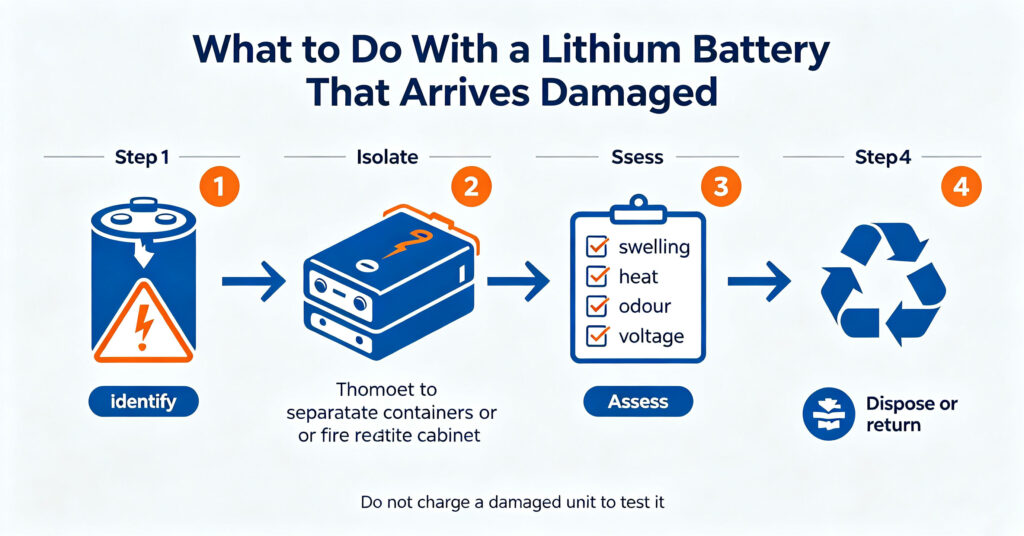
This is the single most important procedure in a storage area, and the one most often missing. A battery that has been dropped, crushed, punctured, exposed to water or involved in a vehicle incident should not go on the shelf with the good stock.
- Identify. Train anyone receiving goods to recognise the signs: dented or swollen case, damaged terminals, leaking electrolyte, unusual odour, or heat.
- Isolate. Move the unit to a designated quarantine location — a fire-rated cabinet, a container, or a separated outdoor area — away from stored stock and away from occupied spaces.
- Assess. Record the condition, including voltage and temperature if they can be measured safely, and contact the supplier with the serial number and photographs before taking any further action.
- Dispose or return. Follow the supplier’s instruction and the local waste regulations for lithium batteries. Do not place a damaged lithium battery in general waste or in a standard metal recycling stream.
The rule that prevents most escalation is simple: never charge a damaged battery to see whether it still works. Charging is the activity that turns latent internal damage into a thermal event. End-of-life routing, including second-life and recycling paths, is covered in #94 battery second life and recycling.
Shipping and the paperwork that travels with the goods
Storage and transport share one requirement, and it is the same question of where to store lithium batteries while in transit: the battery must be in a state and a packaging that the relevant dangerous-goods rules accept. For lithium batteries that means UN38.3 test evidence for the cell and pack, correct packaging and labelling, a state of charge limit for air transport in many cases, and documentation that matches the consignment. The certification set a buyer should hold on file is summarised in #107 battery export certification.
For larger containerised systems delivered to site, the storage question becomes a site layout question — where the container sits, what clearance it has, and what the commissioning sequence is. That is covered in #121 containerized BESS buyer’s guide and in #110 battery installation site assessment.
Q. What is the best place to store lithium batteries?
A cool, dry, well-ventilated indoor area with stable temperature, away from direct sunlight, heat sources, flammable materials and combustible stock. Batteries should sit on solid shelving at a partial state of charge, with terminals protected, groups separated by aisles, and a separate quarantine location reserved for damaged or suspect units.
Q. What state of charge should lithium batteries be stored at?
Around 30 to 50 percent is the commonly recommended range. Storing at full charge accelerates calendar ageing, and storing near empty risks self-discharge taking cells below the safe minimum. Long-term storage should include a periodic check to confirm the pack has not drifted down.
Q. Can lithium batteries be stored in a garage or a shed?
Only if the space stays inside the manufacturer’s stated storage temperature range and remains dry. An uninsulated shed or a metal container can exceed that range on a summer afternoon and can condense moisture overnight, both of which make it a poor storage location despite being convenient.
Q. How should a damaged lithium battery be handled?
Isolate it immediately in a designated quarantine area away from other stock and occupied spaces, do not charge or test it, record the condition and serial number, contact the supplier, and follow local regulations for disposal or return. Never place a damaged lithium battery in general waste.
Q. How long can lithium batteries be stored before use?
Within the manufacturer’s stated storage conditions, lithium batteries can be held for many months with modest capacity loss, and the loss is smaller at a partial state of charge and a cool stable temperature. Beyond the stated storage window, or outside the stated conditions, capacity and safety margins should be verified before the battery is put into service.
Next step: write the storage rule down before you need it
Most storage incidents are not caused by bad batteries. They are caused by nobody having decided where to store lithium batteries and under what rule. They are caused by no written rule about state of charge, temperature, separation and what to do with the one unit that arrived dented.
- Choose containment in #104 fireproof battery storage cabinet
- Understand the failure mode in #87 thermal runaway and fire suppression
- Check the paperwork in #107 battery export certification
- Ask leekooenergy for a storage and handling sheet for the specific models you hold, stating the recommended storage state of charge and re-check interval, the storage temperature and humidity window, the stacking and shelving limits, the damaged-unit quarantine procedure, and the transport documentation set — so your warehouse rule is written against the actual product data rather than a generic guideline