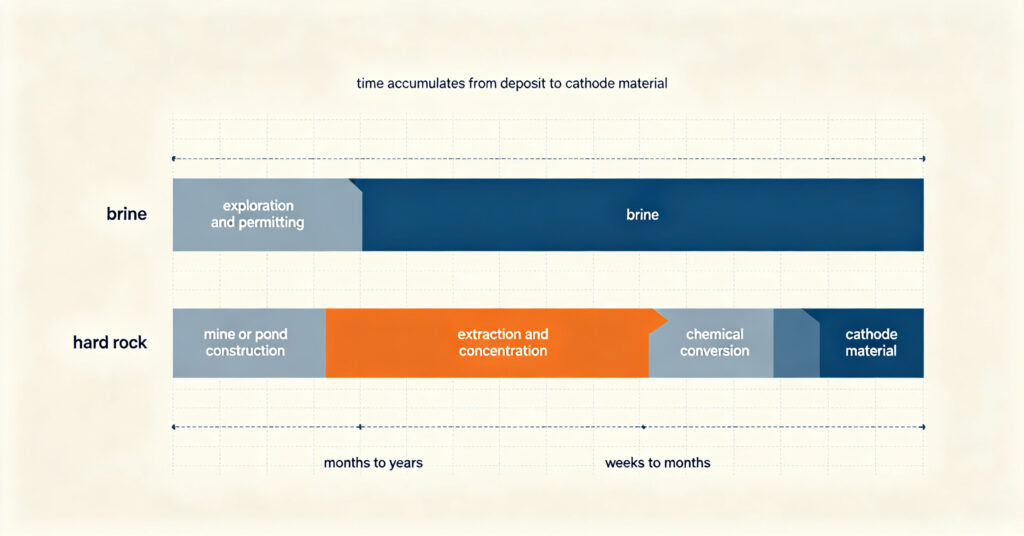
How is lithium made? Lithium is not synthesised; it is extracted and refined. Two upstream routes supply almost all of it: brine deposits, where lithium-bearing salt water is pumped from beneath a salt flat and concentrated by solar evaporation over many months, and hard rock, where lithium-bearing spodumene ore is mined, crushed and concentrated by flotation. Both routes then feed a chemical conversion plant that produces one of two battery-grade products — lithium carbonate or lithium hydroxide — which in turn feed the cathode precursor and cathode material plants that supply cell factories. The one-line version worth quoting: a cell price is downstream of a process that takes years to build and months to run, which is why lithium costs swing far harder than the cost of making the cell itself.
This guide is for buyers who need to understand where their raw material risk actually sits — procurement leads negotiating multi-year supply, product managers setting price assumptions, and engineers who have to explain a quote increase to someone else. It follows the material from the deposit to the cathode, and ends with the questions worth asking a supplier. Cell manufacturing from the cathode onwards is in #135 how are batteries made; the equipment side is in #145 battery manufacturing equipment.
Route one: brine
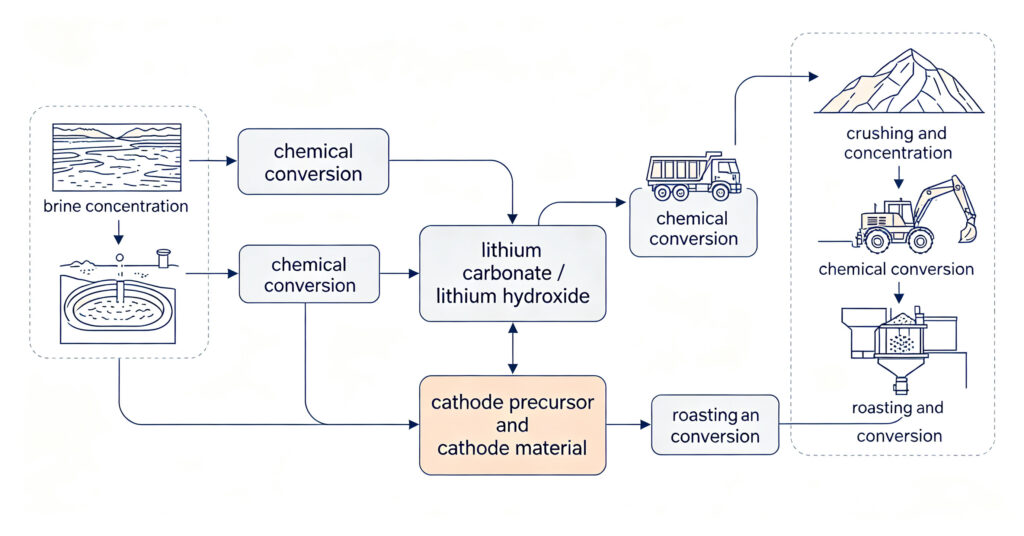
Brine operations sit on salt flats where groundwater with a high dissolved salt content lies close to the surface. Wells pump the brine into a series of shallow ponds, and the sun does most of the work: over many months, water evaporates and the remaining liquor becomes progressively more concentrated while other salts precipitate out and are removed. When the lithium concentration is high enough, the liquor goes to a conversion plant where reagents precipitate lithium carbonate, which is filtered, washed, dried and milled to a battery-grade powder.
Two properties of this route drive its economics. The first is time: evaporation is a weather-dependent process measured in months, so production cannot be ramped quickly in response to a price signal. The second is water and land: brine operations consume water in arid regions and occupy large areas, which makes permitting and community consent a real part of the timeline rather than a formality.
Route two: hard rock
Hard rock lithium is mined from pegmatite deposits, most commonly as spodumene. Ore is drilled, blasted and hauled, then crushed and milled and separated by flotation into a concentrate with a few percent lithium oxide content. That concentrate is either shipped for conversion or processed locally: it is typically roasted to change the mineral structure, then leached with acid to put the lithium into solution, and finally precipitated as carbonate or converted further to hydroxide.
| Dimension | Brine | Hard rock |
|---|---|---|
| Typical lead time to first production | Long — years from discovery through pond construction | Shorter than brine, still measured in years |
| Time from start of processing to saleable product | Months, weather-dependent evaporation | Weeks to months, plant-controlled |
| Main cost drivers | Land, water, reagents, evaporation time | Mining cost, energy for roasting, reagents |
| Responsiveness to price | Slow — cannot evaporate faster | Faster — throughput can be adjusted |
| Typical product | Lithium carbonate | Carbonate, or hydroxide after extra conversion |
Neither route to answer how is lithium made is inherently better, and mature supply chains use both. What matters to a buyer is that the two routes have different cost floors and different response times, so a price spike does not bring new supply online quickly from either one. Recycling is the third route and still the smallest; where it fits is described in #94 battery second life and recycling.
Carbonate versus hydroxide
The two battery-grade products are not interchangeable, and which one a cathode plant needs depends on the chemistry it makes. Lithium carbonate is the traditional feed and suits cathode chemistries processed at lower temperatures; lithium hydroxide is required for certain high-nickel cathode materials because it reacts at the temperatures those materials need, and carbonate would leave residue that harms cell performance. Either product can be made from either upstream route, but hydroxide needs an additional conversion step, and that step carries its own cost and its own plant capacity constraint.
For a buyer of LFP cells this distinction matters less than it does for a buyer of high-nickel cells, because LFP cathode production runs on carbonate and therefore sits on the shorter conversion path. That is part of the reason LFP supply has been less exposed to the tightest parts of the hydroxide market.
From chemical to cathode
The last upstream step is where lithium stops being a commodity chemical and becomes a battery material. Iron phosphate cathode material is made by combining a lithium source with an iron and phosphate source under controlled conditions to produce a powder with a defined particle size, carbon coating and impurity level; the properties of that powder carry directly into the cell’s capacity, rate capability and cycle life.
This is also the step at which most of the value added in the chain is concentrated, and it is the step where suppliers differ most. Two cell makers using nominally the same cathode chemistry can produce cells that age differently, and the difference usually traces back to precursor quality rather than to the lithium. Reading the resulting cell specification is covered in #115 how to read LiFePO4 battery specs, and cell-level selection is in #136 LFP battery cells.
What this means for procurement
Understanding how is lithium made changes five decisions on the buy side.
- Price volatility is structural, not opportunistic. A supply chain that takes years to add capacity cannot respond to a quarterly price move. Expect swings and plan for them.
- Index-linked pricing is a risk transfer, not a discount. A contract tied to a published lithium price moves the exposure to you; a fixed-price contract moves it to the supplier, who will price the risk in.
- Ask which step your supplier sits at. A cell maker with a cathode plant is exposed differently from one buying cathode on the spot market.
- Lead times lengthen upstream first. When the chain tightens, conversion and cathode capacity tighten before cell capacity does, so cell lead times are a lagging indicator.
- Qualify a second source before you need it. Alternative cell qualification takes months; doing it during a shortage means accepting worse terms. The commercial levers are set out in #124 MOQ, lead time and payment terms.
Traceability is the sixth question and increasingly the one that decides tenders: buyers are asked to show where the raw material came from and under what conditions. The documentation and audit expectation is described in #133 OEM battery quality control and traceability. Longer-term views on where the industry is heading are collected in #92 energy storage trends 2026.
Q. How is lithium made?
Lithium is extracted and refined rather than manufactured. It comes mainly from two sources: brine beneath salt flats, concentrated by solar evaporation, and spodumene ore, mined and concentrated by crushing and flotation. Both feed a chemical conversion plant that produces lithium carbonate or lithium hydroxide, which then becomes cathode material for battery cells.
Q. Where does lithium come from?
Mostly from brine deposits under salt flats and from hard rock pegmatite deposits mined for spodumene. A growing but still small share comes from recycling spent batteries. The two primary routes differ in lead time, cost structure and responsiveness to price, and mature supply chains use both.
Q. What is the difference between lithium carbonate and lithium hydroxide?
Both are battery-grade lithium chemicals, but they suit different cathode processes. Carbonate suits cathode materials processed at lower temperatures, including lithium iron phosphate. Hydroxide is required for certain high-nickel cathodes because it reacts at the higher temperatures those materials need, and making it requires an extra conversion step.
Q. Why does the lithium price move so much?
Because new supply takes years to build and months to process, so production cannot respond quickly to a change in demand. When demand rises faster than conversion and cathode capacity can expand, the price of the chemical moves far more than the cost of mining it, and the swing is transmitted to cell prices.
Q. Can lithium be made without mining?
Not at commercial scale today. Recycling recovers lithium from spent batteries and is growing, but the volume available is limited by the number of batteries reaching end of life, which lags today’s sales by many years. Recycling is a supplement to primary supply, not a replacement.
Next step: put the raw-material risk in the contract
How is lithium made explains the volatility. How your contract handles it decides whether that volatility lands on you or on your supplier.
- Read the cell specification in #115 how to read LiFePO4 specs
- Negotiate terms in #124 MOQ, lead time and payment terms
- Set the traceability bar in #133 quality control and traceability
- Ask leekooenergy for a quote that states the cell maker and cathode source, whether pricing is fixed or index-linked, the validity window, and the lead time measured from order to ex-works — so the raw-material exposure is visible before you sign rather than after