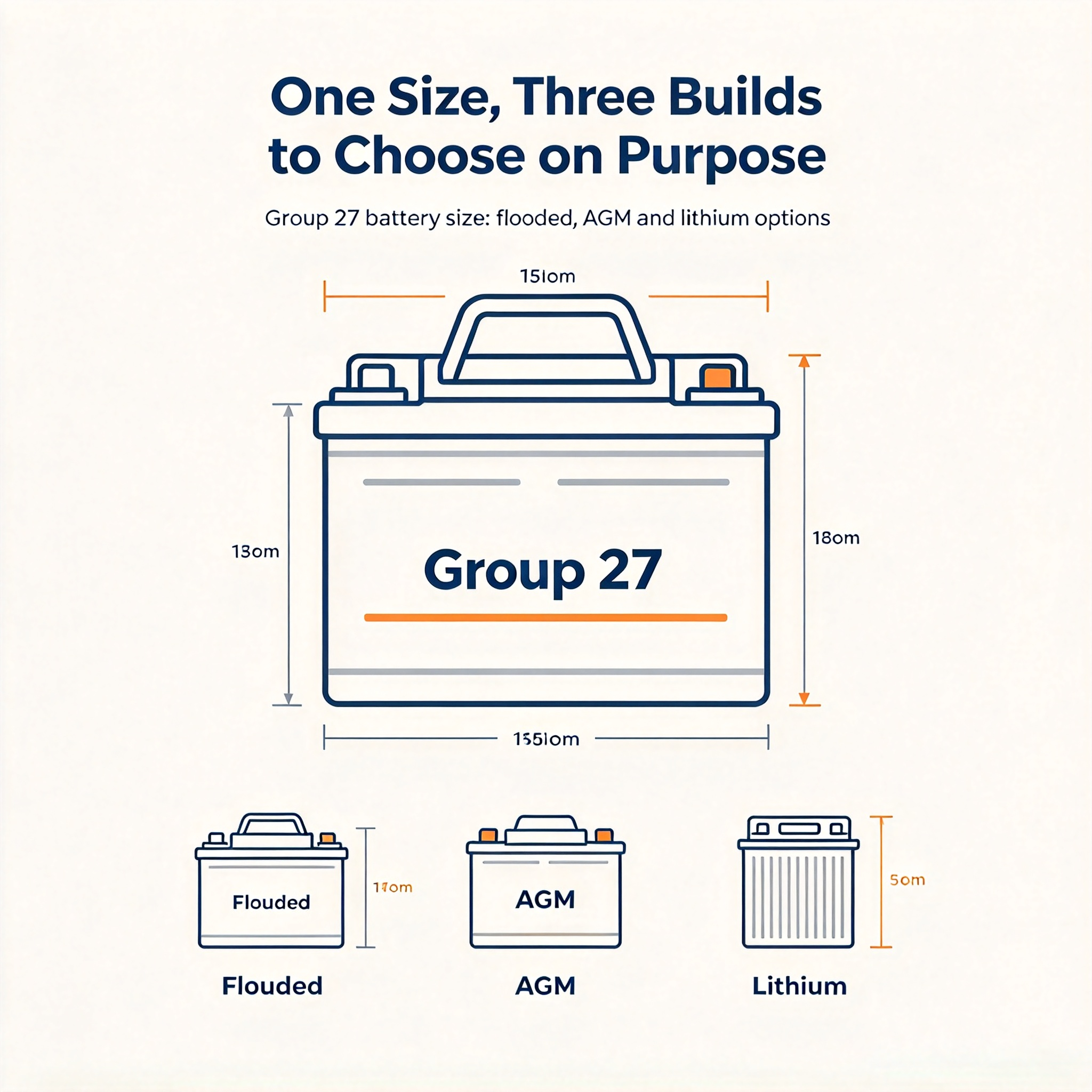
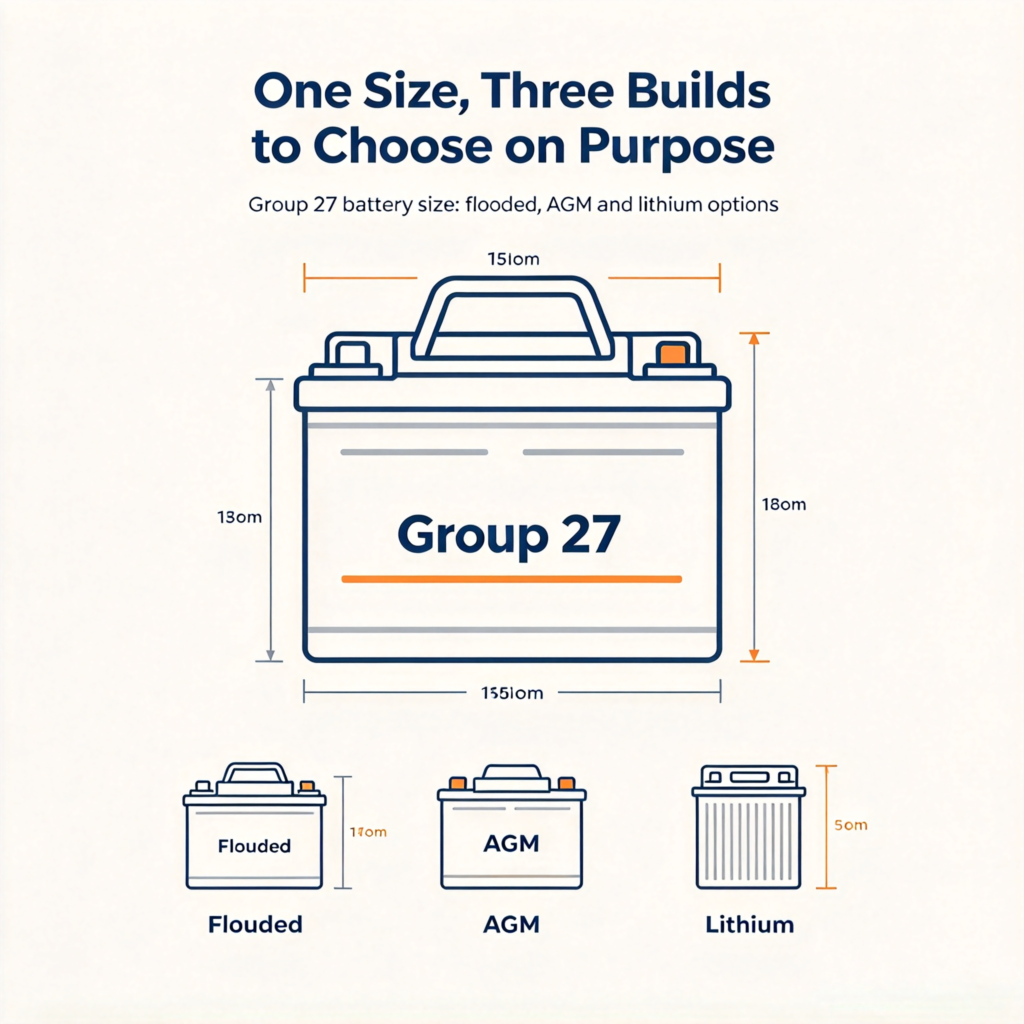
A group 27 deep cycle battery is a battery built to the BCI Group 27 physical size standard — roughly 12.1 inches long, 6.8 inches wide and 8.9 inches tall — and rated for repeated deep discharge rather than short engine cranking. This guide covers the real dimensions, the typical amp-hour window you can expect, and the flooded, AGM and lithium options that all ship in that footprint, so you can pick the right replacement without guessing.
The “Group 27” label tells you almost nothing about chemistry and everything about fit. Two batteries that both wear the Group 27 badge can be a flooded lead-acid unit and a drop-in lithium, and their behavior under load is nothing alike. Get the size right first, then choose the chemistry for how you actually use it.
What the Group 27 size actually means
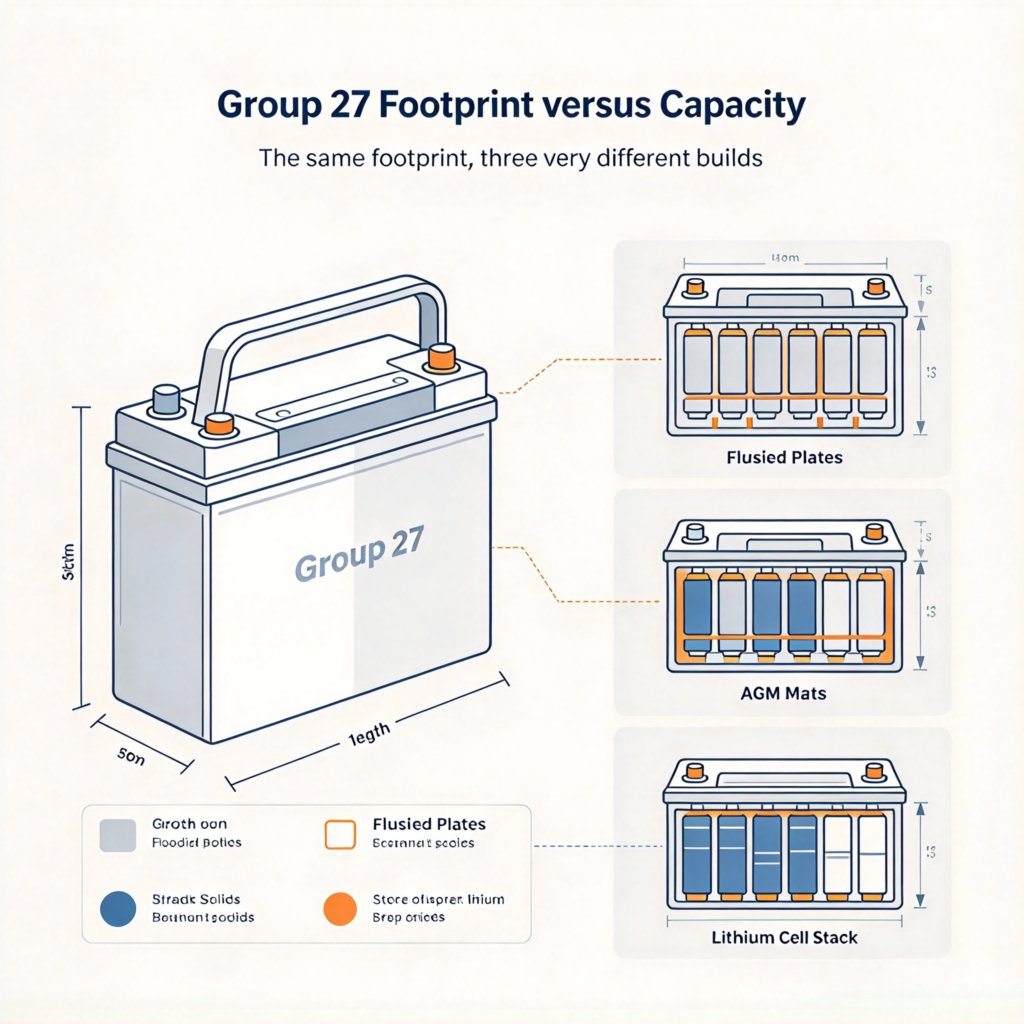
The group 27 deep cycle battery size is a BCI (Battery Council International) footprint, not a performance rating. It fixes the outer envelope so a tray, box or bracket designed for one Group 27 accepts the next one. Within that envelope, capacity, weight and chemistry vary widely, which is why the same label appears on starter batteries and on deep-cycle units that are not interchangeable.
Typical amp hours you can expect
A group 27 deep cycle battery in flooded lead-acid form usually lands in a capacity window of about 85 to 110 amp hours at the 20-hour rate, while AGM versions sit in a similar band with lower internal resistance. Lithium (LiFePO4) units in the same case commonly quote a usable capacity near 100 to 120 amp hours because nearly all of it is usable, versus only about half for lead-acid. Treat those figures as a planning band, not a guarantee — the exact number is on the label of the unit you buy.
When you compare, read the 20-hour amp-hour rating and the reserved capacity, not just the group size. A heavier plate design trades cranking burst for deeper, slower discharge, which is what a deep-cycle duty actually needs.
Flooded, AGM and lithium options side by side
The group 27 deep cycle battery category spans three builds. Flooded lead-acid is the low-cost, vented option that needs watering and upright mounting. AGM is sealed, spill-proof and vibration resistant, which is why it dominates RV and marine drop-ins. Lithium (LiFePO4) is the lightest and longest-lived, often outlasting the vehicle, but it needs a compatible charger and a battery management system. The deep-cycle comparison in the lithium vs lead acid deep cycle guide lays out the chemistry trade more broadly, while the agm vs lifepo4 deep cycle upgrade piece focuses on the AGM versus lithium upgrade path.
| Build | Typical Ah window | Maintenance | Best for |
|---|---|---|---|
| Flooded lead-acid | ~85–110 Ah (20h) | Watering, upright only | Lowest cost, vented boxes |
| AGM | ~80–105 Ah (20h) | Sealed, spill-proof | RV, marine, vibration |
| LiFePO4 | ~100–120 Ah usable | None, BMS built in | Weight, cycle life, frequent deep use |
Drop-in replacement and fit checks
Before you swap, confirm three things: the tray length and the terminal type (top post versus side post), the weight your bracket or floor can hold, and whether your charger or alternator is lithium-aware if you move to LiFePO4. A group 27 deep cycle battery that physically fits but trips the charge profile will underperform or degrade. The 12v lifepo4 deep cycle battery hub hub covers 12V deep-cycle options including lithium, and the 12v lifepo4 battery guide explains the 12V lithium side in more detail.
Common applications
The group 27 deep cycle battery shows up wherever a known footprint meets a deep-discharge duty: RV house banks, trolling and starting support on small boats, off-grid solar buffers in a fixed box, and backup for gate or pump loads. It is not the unit for engine cranking as a primary job — the deep cycle vs starting battery guide explains the deep-cycle versus starting distinction that matters here.
For chisidal projects, send the application, the available tray size and the charge source, then ask for the Group 27-class drop-in — flooded, AGM or LiFePO4 — matched to that duty as one documented unit.
Read the label before you buy
When you shop, the printed label tells you more than the group number. Look for the 20-hour amp-hour rating, the reserve capacity in minutes, the cranking amps if starting is part of the job, and the terminal type. A group 27 deep cycle battery with a higher Ah number is not automatically better if its plates are thin; check the cycle-life rating and the warranty length, because deep-cycle duty lives or dies on repeated discharge, not on a single burst.
Size-wise, Group 27 is smaller than Group 31 and larger than Group 24, so do not assume a Group 31 tray will accept a 27, or vice versa, without measuring. If you are upgrading from flooded to lithium, confirm the charger or alternator is lithium-aware before you install; a group 27 deep cycle battery in LiFePO4 form needs a charge profile that matches its BMS, or it will sit partly filled. For chisidal projects, send the label photo and the tray dimensions so the right class is matched as one documented unit.
Group 27 in a solar buffer, warranty and end-of-life
For off-grid solar, a group 27 deep cycle battery works as a small fixed buffer where space is tight and the load is modest. Size it against two days of typical draw rather than the occasional peak, and pair it with a charge controller that tapers correctly so the bank tops off without boiling. Because the case is a known size, it drops into existing boxes that were never designed for lithium.
Warranty and end-of-life matter as much as price. A flooded unit may carry a shorter prorated warranty but costs less up front; a LiFePO4 unit costs more yet often outlasts the application and may be recycled through cell-recovery streams. For chisidal-supplied projects, the Group 27 class is offered with the documentation that lets you compare true cost per cycle, not just sticker price.
Matching the battery to its charge source
Whatever build you choose, the charge source decides how happy the battery is. A group 27 deep cycle battery on a solar tender wants a controller with a proper absorption and float stage; on alternator charging it wants a lithium-aware isolator if it is LiFePO4. Mismatched charging is the most common way a good battery dies young, so spec the source with the battery, not after it.
Installation is mostly about the bracket and the terminals. Use a tray that matches the Group 27 footprint with the correct hold-down, torque the terminals to spec rather than by feel, and keep the top clean so creepage current does not slowly drain the bank. A tidy install outlasts a clever one. For chisidal-supplied units, the Group 27 class ships with the mounting and charge guidance so the first install is also the right one.
Q. group 27 deep cycle battery?
A group 27 deep cycle battery is a deep-cycle battery built to the BCI Group 27 physical size standard (about 12.1×6.8×8.9 inches) and rated for repeated deep discharge rather than short engine cranking. The label fixes the footprint, not the chemistry.
Q. What are the dimensions of a group 27 deep cycle battery?
The standard Group 27 envelope is roughly 12.1 inches long, 6.8 inches wide and 8.9 inches tall, with minor variation by manufacturer. Always check the exact length and terminal position against your tray before ordering.
Q. How many amp hours is a group 27 deep cycle battery?
Flooded and AGM versions typically rate about 85 to 110 amp hours at the 20-hour rate; LiFePO4 units in the same case often quote near 100 to 120 usable amp hours because almost all of it is usable. Read the label for the exact number.
Q. Is a group 27 battery flooded, AGM or lithium?
All three ship in the Group 27 footprint. Flooded is cheapest and vented, AGM is sealed and vibration resistant, and LiFePO4 is lightest and longest-lived but needs a lithium-aware charger. Choose by duty and charger, not by the size badge.
Q. Can I replace a group 27 lead-acid with lithium?
Often yes, if the tray fits and your charger or alternator is lithium-aware; otherwise the battery may not fill or may be stressed. Confirm the charge profile and the battery management system before the swap.
Q. What is a group 27 deep cycle battery used for?
Common uses are RV house banks, small-boat trolling and house loads, fixed off-grid solar buffers, and backup for gates or pumps — anywhere a known footprint meets a deep-discharge duty.
Next step: match the Group 27 class to the duty
Size fixes the fit; chemistry fixes the life. Confirm the tray, the terminal type and the charge source, then choose flooded, AGM or LiFePO4 on purpose.
- Read the how to choose a solar battery bank solar battery bank guide before sizing a replacement bank
- For chisidal, send your usage and site details, and we will come back with product prices, lead time and warranty information.