
solar panel maintenance is the routine of inspecting, cleaning and verifying a PV array so it keeps producing what it was designed to produce — and for most systems it is mostly inspection rather than repair. This guide sets out what to look at each season, how to decide whether cleaning is actually needed, how to read a drop in output, and the tasks that should stay with a qualified technician rather than the owner.
A grid-tied array has no moving parts and no consumables, which is why “maintenance-free” became a selling line. Low-maintenance is more accurate: things go wrong slowly and quietly, and a short solar panel maintenance routine catches them cheaply.
What actually needs doing, and how often
For most sites, the practical rhythm is a visual inspection twice a year and a production review continuously. The inspection is a walk-down: look for new shading, physical damage, discoloured cells, loose or rubbing cabling, and anything nesting under the array. The production review is a comparison of what the system is generating against what it generated in the same month last year, normalised for weather where your monitoring allows it.
Frequency should follow the site rather than a rule of thumb. A dusty or agricultural location needs more attention to soiling; a coastal site needs more attention to corrosion and fixings; a site with nearby trees needs more attention to shading growth. Write the first inspection down and let subsequent ones compare against it. The solar panel lifespan guide explains what normal degradation looks like so you can tell it apart from a fault.
Cleaning: when it pays and when it does not
Clean only when soiling is actually costing you output. Rain handles light dust on a tilted array, and cleaning a panel that is already performing normally costs time and risks the glass for no gain. The signs that cleaning is warranted are a visible film or deposit, a production drop that persists across several dry days, or a site with a known soiling source such as pollen, bird activity, agricultural dust or industrial fallout.
When you do clean, do it gently. Use water and a soft brush or a soft cloth, work early or late in the day rather than on hot glass, and avoid abrasive pads and aggressive detergents that can mark the anti-reflective coating. Never spray cold water on hot glass. The solar panel cleaning brush guide covers the kit that is safe to use, and it is worth reading before anyone puts a pressure washer near an array.
| Sign | Likely cause | Action |
|---|---|---|
| Gradual year-on-year drop | Normal degradation | Log it, compare to warranty |
| Sudden step down | Shading, fault, disconnect | Inspect and check monitoring |
| One string underperforms | Soiling or connection | Compare strings, isolate |
| Output near zero | Inverter trip or isolation | Check inverter, then call technician |
Reading a drop in output
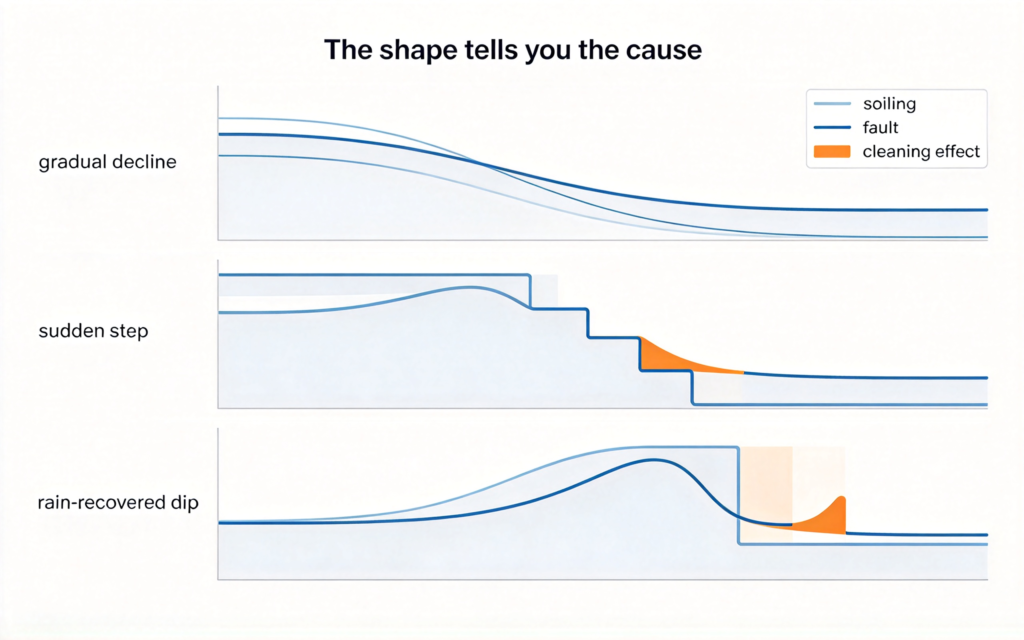
Separate three patterns. A slow decline across years is normal degradation and should be inside the warranty curve. A sudden step that never recovers is a fault — shading, a failed connection, a tripped protection, or an inverter problem. A dip that recovers when it rains is soiling, and it tells you the cleaning interval is too long.
Compare like with like. A week of cloud is not a fault, and comparing this July to last July is more useful than comparing to last week. Where monitoring allows per-string comparison, that view is the fastest way to find a single problem row or a connector that has developed resistance. The MC4 connector guide explains why connectors are the most common electrical failure point, and the how an inverter turns DC into AC guide covers the inverter side of the same reading.
Electrical and structural checks
Look at what you can see safely: conduit and cable runs for rubbing or UV damage, the fixings and rail clamps for movement or corrosion, and the roof penetrations for sealant condition. Do not open enclosures, do not remove covers, and do not work on a live array. Anything involving terminations, torque checks or insulation testing belongs with a qualified technician.
Structure deserves as much attention as the electrical side. Wind loading works on fixings year after year, and a clamp that has backed off is a hazard long before it becomes a production problem. The solar panel racking system guide covers what to look for on the mounting side, and the commercial solar panel installation guide guide is the reference for larger rooftop and ground arrays where access planning matters.
Warranty and records
Keep a simple log: inspection dates, what was found, what was done, and the production figures you compared. That log is what turns a warranty conversation from an argument into a claim, and it is also what lets a technician see a trend rather than a snapshot. Photograph anything you find before you fix it.
Know what the warranty actually covers. Product warranty covers defects in the panel; performance warranty covers output against a stated degradation curve; workmanship warranty covers the installation. They are different documents with different claim paths, and soiling and physical damage are generally excluded from all three. The solar panel warranty guide guide sets out how to read each one before you need it.
What it costs and what it saves
solar panel maintenance is inexpensive compared with the yield it protects. The recurring costs are inspection time, occasional cleaning, and periodic professional electrical checks; the avoided costs are a soiling loss that runs for months unnoticed, a connector that burns before anyone sees it, and a warranty claim that fails for want of records. On a commercial array those avoided losses dwarf the inspection budget.
The one cost to avoid is unnecessary servicing. Paying for quarterly cleaning on a tilted array in a wet climate buys nothing that rain does not, and every visit carries a small risk of damage to the glass or the roof. Spend the budget where it changes the outcome: inspection, monitoring, and professional checks on the electrical side.

Safety boundaries for owners
Owner-safe tasks are visual inspection from the ground, monitoring review, and clearing debris that is not touching the array. Everything else — roof access, working near the array, anything electrical — should go to a professional. A PV array is energised whenever there is light, which is not the behaviour most people expect from equipment that has no switch.
If a panel is cracked, delaminating, or showing a hot spot or browning, stop treating it as a cleaning problem and have it assessed. Damaged glass admits moisture, and moisture inside a laminate is a progressive failure. For chisidal-supplied systems, send the inspection photos and the production history, and ask for the assessment against the warranty curve rather than a guess.
A maintenance rhythm that holds yield
Solar panel maintenance is a short inspection on a regular rhythm, cleaning only when soiling demonstrably costs output, and a production log that lets you tell normal degradation from a fault. Most of the value is in noticing change early.
Q. solar panel maintenance?
Solar panel maintenance is the routine of inspecting, cleaning and verifying a PV array so it keeps producing as designed. For most systems it is mostly inspection rather than repair — visual checks twice a year plus a continuous production review.
Q. How often should solar panels be cleaned?
Only when soiling demonstrably costs output. Light dust on a tilted array is usually handled by rain. Clean when there is a visible deposit, when output stays depressed across several dry days, or when the site has a known soiling source.
Q. Do solar panels need regular maintenance?
They need periodic inspection rather than scheduled servicing. There are no consumables and no moving parts, but shading growth, soiling, connector faults and fixing movement all develop slowly and are cheap to catch early.
Q. What causes a sudden drop in solar output?
New shading, a failed connection, a tripped protection or an inverter fault. A drop that recovers when it rains is soiling instead. Comparing output to the same month last year separates a fault from weather.
Q. Can I clean solar panels myself?
Ground-level cleaning with water and a soft brush is reasonable if access is safe. Roof access, working near the array and anything electrical should go to a professional, and pressure washers and abrasive pads should be avoided entirely.
Q. What should an inspection include?
Shading changes, soiling, glass damage and discoloration, cable and conduit condition, fixings and rail clamps, roof penetration seals, and the inverter or monitoring readout. Record findings with photographs.
Q. Does maintenance affect the warranty?
Neglect can, and records help. Keep inspection dates, findings and production figures — that log turns a warranty conversation into a claim. Soiling and physical damage are generally excluded from product and performance warranties.
Next step: start the log, then compare
Most faults are found by noticing change, not by scheduled servicing. Send the production history and inspection photos for an assessment.
- Compare your reading against the expected degradation curve to separate ageing from fault
- Check solar panel warranty guide before you need to claim
- For chisidal, send your usage and site details, and we will come back with product prices, lead time and warranty information