
The lifepo4 battery temperature range is the band of ambient and cell temperatures within which the battery will discharge, charge and hold its rated life — and the boundaries that matter most are on the charging side, not the discharging side. This guide explains the typical discharge and charge windows, why charging below freezing is the failure everybody meets first, how heat accelerates ageing, and what to check when siting a bank.
Temperature quietly decides how long a lithium iron phosphate bank lasts. It is easy to ignore until the first winter morning the charger refuses to start, or the first summer a sealed cabinet cooks the cells. Designing around the lifepo4 battery temperature range is far cheaper than retrofitting it.
Discharge and charge are two different windows
A LiFePO4 cell will discharge across a wider temperature band than it will safely accept charge. Discharging in the cold is largely a capacity question — the battery simply delivers less than rated and recovers when it warms. Charging in the cold is a different problem entirely, because lithium ions can plate onto the anode as metal instead of intercalating into it, and that plating is permanent and can create an internal short path.
That asymmetry is why every credible battery management system enforces a charge cutoff below a low-temperature threshold and a separate one above a high-temperature threshold. Those thresholds are the practical edge of the lifepo4 battery temperature range, and they are enforced by the BMS rather than by the charger. Confirm both numbers on the data sheet for the exact model, because they vary by cell construction.
Cold weather: the failure everyone meets first
Charging a LiFePO4 battery below freezing is the single most common way owners damage one. The BMS on a well-built unit simply refuses, which looks like a fault but is the protection working. The practical answers are to keep the bank in a conditioned space, to use a battery with an integrated low-temperature cutoff and heating, or to size the system so the bank is charged during the warm part of the day.
Cold also reduces the usable capacity temporarily. A battery that reads low on a winter morning is often not degraded — it is cold, and the available capacity returns as it warms. Discharge performance recovers first; charging must wait until the cells are inside the allowed band. The LiFePO4 battery charger guide covers what the charger and the BMS each control in that situation, and the how home battery charging works guide explains where the charge actually comes from.
| Condition | What happens | What to do |
|---|---|---|
| Below charge cutoff | BMS blocks charging | Warm the bank or use a heated model |
| Cold but above cutoff | Less usable capacity | Expect recovery when warm |
| Hot, near high cutoff | Derating, faster ageing | Improve ventilation or shade |
| Above high cutoff | BMS blocks or trips | Fix the siting, not the setting |
Heat: the quiet life-shortener
High temperature does not usually trip a protection and announce itself; it shortens life silently. Elevated cell temperature accelerates the side reactions that consume active lithium and grow the surface film on the anode, and the effect compounds — a bank that runs warm every summer ages materially faster than one that does not, even at identical depth of discharge.
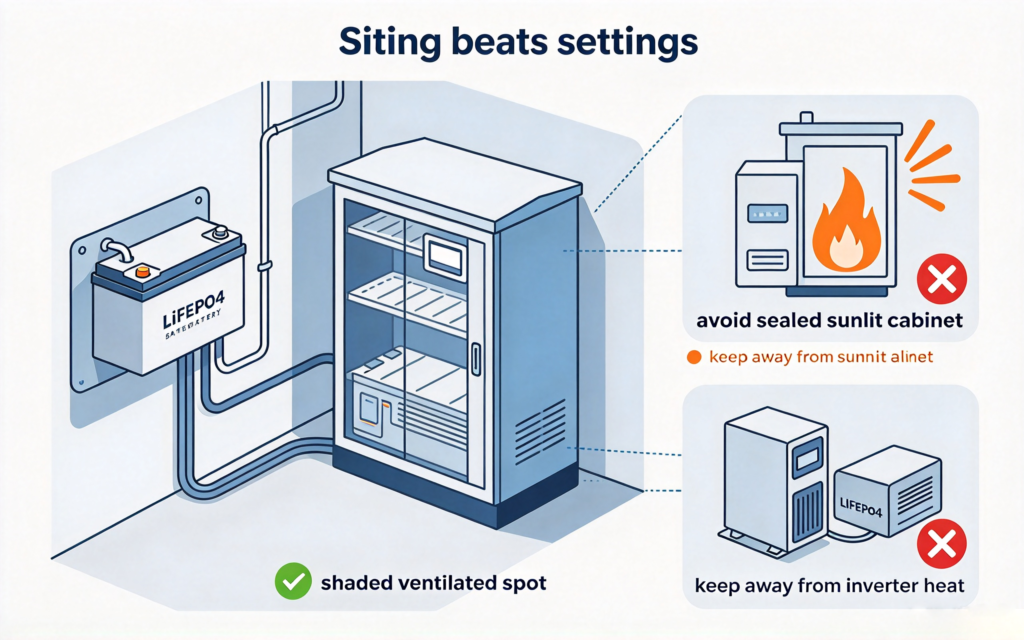
The causes are almost always siting: a sealed cabinet, a wall in direct afternoon sun, a roof space with no ventilation, or a bank mounted immediately beside an inverter that dumps its waste heat into the same enclosure. The fix is physical rather than electrical. Move the bank, ventilate the enclosure, or separate it from the heat source. The LiFePO4 battery voltage chart is useful for reading state of charge when you are diagnosing, but it will not tell you why a bank is hot.
Reading the numbers on a data sheet
Look for three separate lines rather than one: the discharge temperature range, the charge temperature range, and the storage temperature range. They are not the same, and a supplier quoting a single number is usually quoting the widest of the three. Ask which one it is. Also look for whether the low-temperature cutoff is a charge-only block or a full disconnect, because that determines whether your loads still run on a freezing night.
Derating behaviour matters as much as the limits. A battery that holds full current right up to its cutoff behaves very differently from one that tapers well before it, and that taper is what keeps the cells inside a safe band during a hot afternoon of high charge current. The how to read LiFePO4 battery specs walks through how to separate marketing numbers from the ones that matter.
Where to put the bank
Choose a location that stays inside the lifepo4 battery temperature range without intervention: an interior wall out of direct sun, a garage that does not freeze, or a ventilated enclosure with the battery separated from the inverter’s heat. Avoid sealed boxes, avoid south-facing external walls in hot climates, and avoid anywhere that drops below freezing if you cannot guarantee the bank will be charged during warm hours.
If the bank must live outdoors, use an enclosure rated for the site and ventilated for the heat load, and choose a battery with a documented low-temperature charging strategy rather than hoping the ambient never crosses the line. For chisidal-supplied systems, send the site’s seasonal ambient range and the enclosure plan, then ask for the model and heater configuration that matches it.
Storage matters as much as operation. A battery laid up for a season should be held at a partial state of charge in a moderate environment rather than left fully charged in a hot shed, and it should be checked periodically rather than forgotten. Confirm the manufacturer’s storage temperature range and the state of charge recommended for long idle periods.

Monitoring and what to do when it trips
Log cell temperature, not just pack voltage. A BMS that reports temperature lets you see a bank trending hot before it trips, which turns an outage into a maintenance item. Many units expose this through a display or a monitoring interface, and it is worth enabling.
When a low-temperature charge cutoff trips, do not bypass it — that is the one intervention that causes permanent damage. Warm the bank and let it charge normally. If a high-temperature cutoff trips repeatedly, treat it as a siting problem and fix the enclosure rather than raising a threshold. The inverter not charging troubleshooting guide covers the related case where the battery never seems to take charge, and the LiFePO4 UPS battery piece covers standby duty where the bank sits for long periods.
Designing around the temperature window
Temperature, not cycling, is what usually ends a LiFePO4 bank early. Respect the charge window in winter, keep the cells out of heat in summer, and verify all three temperature lines on the data sheet before you choose where the battery lives.
Q. lifepo4 battery temperature range?
The lifepo4 battery temperature range is the band within which the battery will discharge, charge and hold its rated life. The charging window is narrower than the discharging window, and the low-temperature charge cutoff is the boundary owners meet most often.
Q. Can a LiFePO4 battery charge below freezing?
Not safely, and a well-built BMS will block it. Charging below freezing can plate lithium metal onto the anode, which is permanent damage. Warm the bank or use a model with a documented low-temperature strategy.
Q. What happens if a LiFePO4 battery gets too hot?
It derates first and then trips at the cutoff. Repeated high-temperature operation shortens service life even when it never trips, because heat accelerates the side reactions that consume active lithium.
Q. Does cold reduce LiFePO4 capacity?
Yes, temporarily. A cold battery delivers less than rated and recovers as it warms. That is different from degradation and it is not permanent.
Q. Where should I install a LiFePO4 battery?
Somewhere that stays inside the temperature band without intervention: out of direct sun, ventilated, separated from inverter heat, and above freezing if you cannot guarantee warm-hour charging.
Q. Do I need a heated battery?
Only if the bank will sit below the charge cutoff while it needs to charge. In a conditioned space a standard model with a BMS cutoff is sufficient; outdoors in a cold climate, a heated model is the reliable answer.
Q. How do I check the limits for my model?
Read three separate lines on the data sheet — discharge, charge and storage range — and confirm which one a quoted single number refers to. Also check whether the low-temperature cutoff blocks charging only or disconnects the pack.
Next step: check the site before the spec
Temperature limits are a siting problem long before they are a settings problem. Send the seasonal ambient range and where the bank will live.
- Confirm charging behaviour with LiFePO4 battery charger guide before winter
- Review how to read LiFePO4 battery specs to separate the three temperature lines
- For chisidal, send your usage and site details, and we will come back with product prices, lead time and warranty information.