Solar panels for commercial buildings follow a different rulebook from residential kits, and the difference is not just scale. A commercial roof is a structural question before it is an electrical one, the economics are driven by the tariff — demand charges in particular — and interconnection is a permitting exercise with a utility on the other end. This guide walks the assessment sequence: roof and load capacity, the load profile that sizes the array, the economics, and the utility and procurement path.
Commercial solar is a capital project with a payback, not an appliance purchase. The order of the questions matters more than any single answer.
Why a commercial roof is a different problem
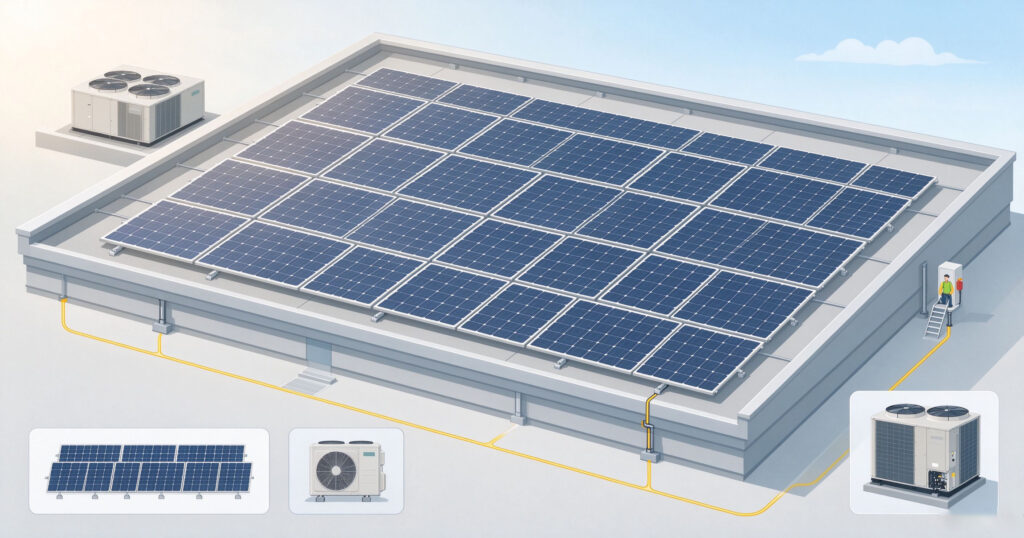
Three things separate a commercial project from a residential one. The first is structure: commercial roofs are larger, often flat, and frequently already carrying HVAC plant, vents and older equipment, so the available area is rarely the whole roof and the remaining structure may need reinforcement. The second is the load: a business consumes on a schedule — opening hours, production shifts, refrigeration cycles — and that schedule decides how much of the array’s output is used on-site rather than exported. The third is the tariff: commercial rates commonly include a demand component billed on the highest peak draw in the month, which changes what a kilowatt of solar is worth.
None of this makes the project harder in kind; it makes it a project. A homeowner can often treat an array as a product decision. A business owner is making an infrastructure decision with a balance sheet attached, and the commercial battery storage guide guide covers the storage half of that decision.
Roof assessment: structure, area and age
The assessment starts with the roof itself. Membrane age matters: an array will outlive most single-ply membranes, so a roof with a few years left should be replaced before the array goes on it, because removing and reinstalling panels to re-roof is pure cost. Structural capacity matters next — ballasted racks add dead load without penetrations, which suits many membranes, but the structure must be checked for the added weight including wind uplift calculations, which are a code requirement in most jurisdictions.
Layout is the practical constraint. Setbacks for fire access, walkways around HVAC plant for maintenance, shading from parapets and adjacent buildings, and the orientation of each available plane all reduce the usable area well below the gross roof area. Any credible proposal for solar panels for commercial buildings should begin with that reduced number, not the gross one — the gap between them is where optimistic projects go wrong. The solar panel mounting brackets guide covers the racking options that follow from that assessment, and the solar panel tilt angle guide covers the geometry on flat roofs where tilt racks recover orientation at the cost of row spacing.
Sizing for the business load
Commercial sizing starts from interval data, not from an annual bill. Fifteen-minute or hourly consumption data shows the shape of the load: the baseline that runs all day, the daytime peak that solar can offset directly, and the evening or weekend trough that it cannot. The array should be sized against the daytime consumption, because exported energy is usually worth materially less than self-consumed energy.
The self-consumption fraction is the single most important number in the business case. A factory running a day shift can often absorb most of an appropriately sized array’s output. A office building with a daytime load that is mostly lighting and plug load can absorb a surprising amount too, but the evening and weekend baseline is lost. Where the load profile and the solar profile diverge sharply, storage is what closes the gap — and the microgrid battery storage guide guide covers that combination for larger sites.
| Load profile | Typical self-consumption | Sizing implication |
|---|---|---|
| Day-shift manufacturing | High | Size to daytime kWh; battery optional |
| Retail with daytime trade | Moderate to high | Size to trading-hours consumption |
| Office, weekdays only | Moderate | Size to weekday daytime; weekends export |
| Cold storage / 24h process | Very high | Size to total consumption; strong case |
The commercial economics frame
Three revenue streams decide the payback, and they price differently. Offset energy is the most valuable: every kilowatt-hour consumed on-site is a kilowatt-hour not purchased at the full retail rate. Demand-charge reduction is the second and is often underrated — solar that shaves the afternoon peak can reduce the billed demand for the whole month, which in some tariffs is worth more than the energy it offsets. Exported energy is the least valuable, credited at a fraction of retail in most markets, which is why oversizing for export rarely pays.
Against those streams sit the costs: capital, installation, permitting, and ongoing maintenance and insurance. Ownership structures change the arithmetic — direct purchase, a loan or lease, and third-party power purchase agreements each shift the capital risk differently, and the choice is a finance decision as much as an engineering one. The whether solar panels work at night guide explains why none of this output arrives at night, and the 400 watt solar panel guide covers the module class that dominates these roofs.
Permits, utility and interconnection
The path to switch-on runs through the utility. Commercial systems above a size threshold typically require an interconnection application, an agreement, and in many markets an export limitation or a study if the local feeder is already loaded. Anti-islanding protection, utility-visible disconnects and, increasingly, export power quality control are standard requirements. The timeline is measured in months, not weeks, and it is the item most often underestimated in a project schedule.
Permitting runs in parallel: structural sign-off where racks alter load paths, electrical permits for the AC side, fire-code review of the layout and access walkways, and in heritage or designated areas an additional aesthetic review. None of it is exotic, but it is sequential, and a project manager who sequences it properly is worth their fee. The solar panel maintenance guide covers what keeps the array producing once it is on.
Procurement notes
Compare proposals on the same basis: installed cost per watt, expected annual production for your specific roof rather than a generic figure, equipment warranties split between modules and inverters, and the monitoring package that lets you verify production against expectation. Ask for the production estimate’s assumptions — shading, soiling and availability — because optimistic assumptions are the most common way a commercial proposal flatters itself. A proposal that will not state its assumptions in writing is telling you something.
Ask also about the O&M structure. A commercial array is expected to run for decades, and the difference between a monitored system with scheduled cleaning and inspections and an unmonitored one compounds quietly. The solar panel lifespan guide guide covers the degradation side of that expectation, and it is the reference point any long-term plan for solar panels for commercial buildings should be written against.
solar panels for commercial buildings?
Solar panels for commercial buildings are photovoltaic arrays sized and engineered for business premises — flat or low-slope roofs, daytime load profiles and tariff structures that differ from residential installations.
Q. How many solar panels does a commercial building need?
It follows the daytime load, not the roof. A small retail or office building might use a few dozen mainstream modules; a large manufacturing site can run into the hundreds. The interval consumption data decides.
Q. Is my commercial roof strong enough for solar panels?
Usually yes, but it must be verified. Ballasted racking adds dead load without roof penetrations, and wind uplift must be calculated to code. A structural review is a standard part of the assessment.
Q. What is the payback period for commercial solar?
It varies widely with tariff, load profile and financing structure. Systems with high self-consumption and demand-charge exposure typically pay back fastest; export-heavy systems with low retail rates take much longer.
Q. Can a commercial building run on solar at night?
Not from the panels alone. Storage covers the evening and overnight load where the economics justify it; otherwise the grid supplies the difference, as it does for any grid-tied building.
Q. Do commercial solar systems need utility approval?
Yes, above size thresholds. Expect an interconnection application and agreement, anti-islanding protection, and in some markets export limitation — a process measured in months.
Q. What happens to production if the roof needs replacing?
Panels must be removed and reinstalled, which is pure cost. That is why roof condition and remaining life are assessed before the array is designed, and why re-roofing first is often the cheaper sequence.
Next step: start from the interval data
The business case is built on the load profile, not the roof area. Send the interval consumption data and the roof details.
- Match the hardware with the solar panel mounting brackets guide
- Get the geometry right with the solar panel tilt angle guide
- For chisidal, send your usage and site details, and we will come back with product prices, lead time and warranty information.