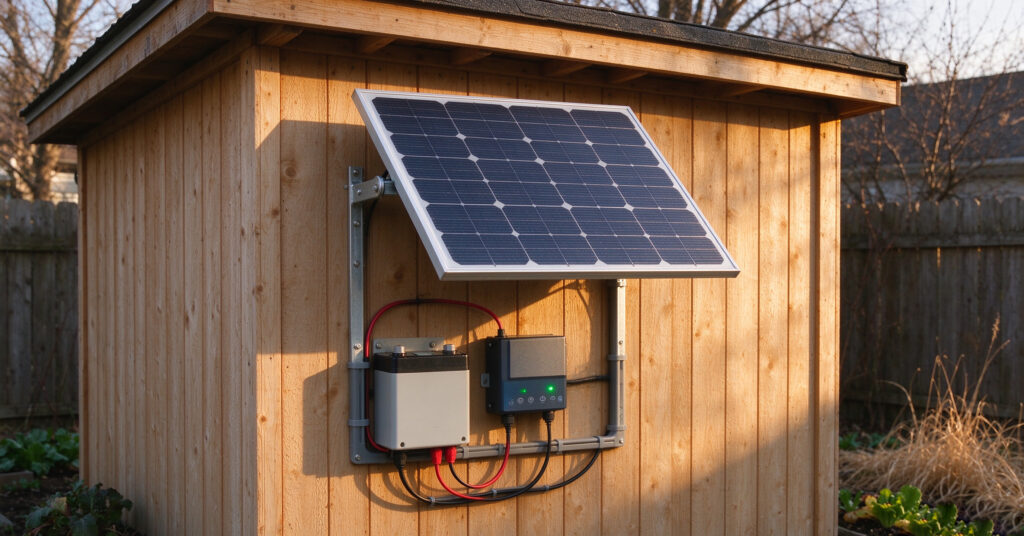
A 100 watt solar panel is the smallest module class that does real work. It will not run a household, but it keeps a battery bank alive, feeds a gate or a camera, and teaches the fundamentals of solar on hardware cheap enough to replace. This guide explains what the 100 W class is genuinely for, the loads it covers, how it differs from the 200 W and 400 W classes, and what separates a good small module from a disposable one.
The 100 W class is where most people meet solar for the first time, and where the gap between marketing and physics is widest. Knowing what the class is for prevents the most common small-system disappointment.
What the 100 W class is actually for
Small modules divide into two jobs. The first is maintenance charging: keeping a seasonal bank — a boat, a stored vehicle, a cabin that sits empty between visits — topped up so it survives the winter ready to work. The second is small DC loads that never needed a mainstream module at all: gate openers, trail cameras, weather stations, communications repeaters, signage and sensor packages.
Neither job is heroic, and that is the point. A 100 watt solar panel sized for a maintenance duty runs cheaply for a decade without drama, while the same module pressed into service as a household supply is a guaranteed disappointment. The class fails in two ways: buyers who expect too much, and kits that pair a capable module with a charge controller that cannot use it. The group 24 deep cycle battery guide covers the bank side of the maintenance pairing.
The loads a 100 W module actually covers
On a good summer day a 100 watt solar panel produces on the order of half a kilowatt-hour to two-thirds; in winter, a quarter of that or less. That is a refrigerator compressor’s daily duty, a long evening of lighting and device charging, or a steady trickle into a bank that only needs to stay full. It is not a pump, not a heater, and not a workshop.
| Load | Fits a single 100 W module? | Notes |
|---|---|---|
| LED lighting evening use | Yes, comfortably | The classic first load for the class |
| Phone and laptop charging | Yes | Small daily energy, easy to cover |
| Trail camera or gate opener | Yes, with a small battery | Low average draw, standby friendly |
| Refrigerator (efficient 12 V unit) | Marginal, season dependent | Works in summer, falls behind in winter |
| Water pump or power tool | No | Surge-heavy; exhausts a small bank fast |
The pattern is consistent: the class serves low-average, low-surge loads. Anything with a motor belongs to a larger array or a different energy source entirely, and the how to size a home battery method is the honest way to find out which side of that line a load list falls on.
Where 100 W sits on the watt ladder
The ladder runs from the 100 W trickle class through the 200 W supplemental class to the mainstream 400 W residential module and the large-format commercial units above it. Each step roughly doubles or halves the physical size, the current and the price, and each class earns its own guide because the buying mistakes are different at every rung.
The 100 W class is also the most kit-dominated. Because the module is cheap, most buyers purchase it as part of a kit with a matched controller, brackets and cables, and the quality of those accessories — not the panel — decides whether the system survives two seasons. The 200 watt solar panel guide covers the next rung up for buyers whose loads outgrow the class, and the 400 W mainstream rung above that.
Kits versus bare panels
A kit’s appeal is that everything fits: the controller is rated for the module, the cables are the right length, and the brackets suit the frame. The risk is that kit controllers are often the cheapest component in the box, and a controller that fails takes the battery with it. A bare panel plus a separately chosen controller costs more and demands more knowledge, but every component can be replaced when it fails.
Check the controller’s charging algorithm and its compatibility with the battery chemistry, not just its amperage. A pulse-width controller that suits a flooded bank can mistreat a lithium one, and the cheapest kits ship with the former regardless of what battery the buyer plans to connect. Where the bank is lithium, a matched charger or a controller with a lithium profile is not optional.
Mounting and placement for small modules
Small modules are easy to mount badly. The common failure is a flat or near-flat installation on a roof or a wall where the angle guarantees summer underperformance and winter snow accumulation, and where one corner shade costs a disproportionate share of output because the module has no room to spread the loss.
Two habits fix most of it. First, aim the module properly and seasonally: an adjustable mount that can be tilted steeper for winter recovers a meaningful share of the seasonal loss for very little money. Second, watch shade hour by hour rather than at a glance — a single branch or a vent pipe that shadows the module for two afternoon hours costs more than most buyers expect, because the whole module is one electrical unit. The solar panel tilt angle guide covers the geometry, and the solar panel mounting brackets guide the hardware.
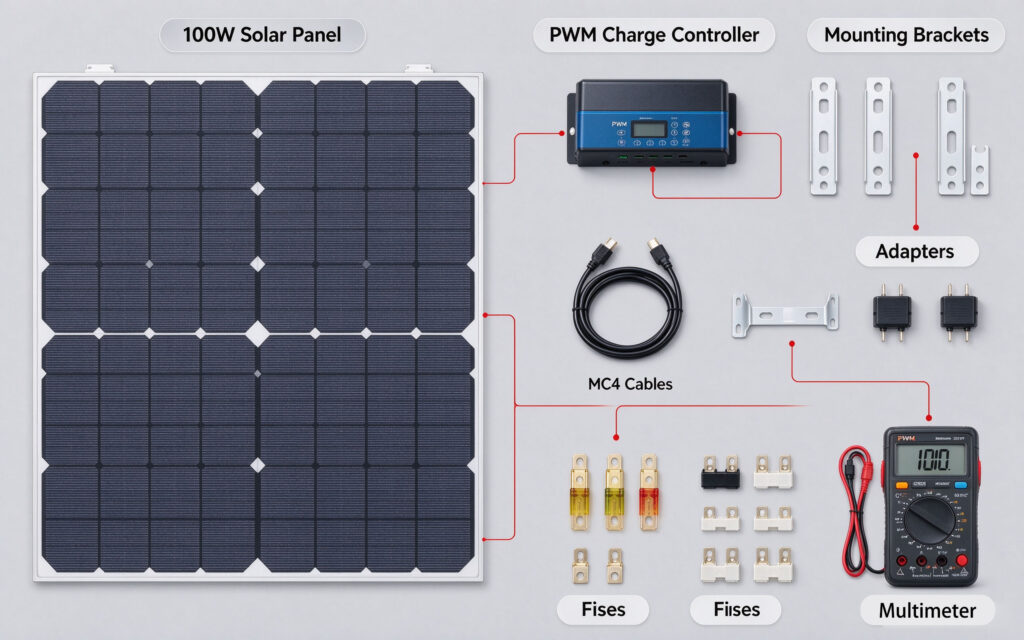
One more habit separates a small array that performs from one that disappoints: measure it. The controller’s own display, or a cheap inline meter, turns output into a number that can be compared across seasons and against the spec sheet. A module producing materially below its seasonal expectation is telling you something — shade, a loose connection, a degrading cell — and the earlier that is caught, the cheaper the fix.
Buying notes for the 100 W class
The 100 W market is flooded with house-brand and unbranded modules whose spec sheets borrow from each other. Three checks separate the durable from the disposable. Look for a real output warranty with a stated degradation figure rather than a vague promise. Look for bypass diodes on modules that will see partial shade. And look for a junction box with potted, sealed connections rather than exposed terminals, because the box is where small modules usually fail first.
Frame and glass matter too: an anodised frame and tempered glass survive weather and handling, while thin painted steel and plastic-backed laminates do not. And resist the upgrade reflex — the jump from 100 W to 200 W doubles the price for double the output, which is only worth it when the load list genuinely needs it. Sites where the bank sits in an unheated space should check the LiFePO4 battery temperature range temperature windows as well.
100 watt solar panel?
A 100 watt solar panel is a small photovoltaic module rated at 100 watts under standard test conditions, used mainly for maintenance charging and small DC loads such as lighting, cameras and gate openers.
Q. What can a 100 watt solar panel run?
LED lighting, device charging, trail cameras and gate openers comfortably; an efficient 12 V refrigerator marginally in summer. Pumps, heaters and power tools are out of reach for the class.
Q. How many amps does a 100 watt solar panel produce?
Roughly three to six amps into a 12 V battery depending on sun conditions, peaking near the rated current in strong midday sun and falling sharply in the morning and evening shoulders.
Q. Is a 100 watt solar panel worth it?
For maintenance charging and small DC loads, yes — the class is cheap, durable and simple. As a household supply it is not, and buyers who expect that are the source of most small-system disappointment.
Q. Do I need a battery with a 100 watt solar panel?
For almost every use, yes. The module produces when the sun shines and loads run when it does not, so a small battery buffers the difference. Size it modestly and keep it topped up rather than trying to store a day’s surplus.
Q. Can a 100 watt solar panel charge a car battery?
It can maintain one, which is the classic use. For a deeply discharged automotive battery, a 100 W module is a slow trickle — fine for keeping a stored vehicle ready, inadequate for recovering a flat one quickly.
Q. How long do 100 watt solar panels last?
Quality units typically carry output warranties measured in decades with gradual degradation. Real lifespan depends on mounting, climate and the controller, which is usually the first component to fail.
Next step: size the load before the module
The 100 W class earns its keep on honest, small load lists. Send the loads, the battery size and the mounting location.
- Compare the mainstream option in the 400 watt solar panel guide
- Match the bank against the 100 amp hour deep cycle battery capacity guide
- For chisidal, send your usage and site details, and we will come back with product prices, lead time and warranty information.