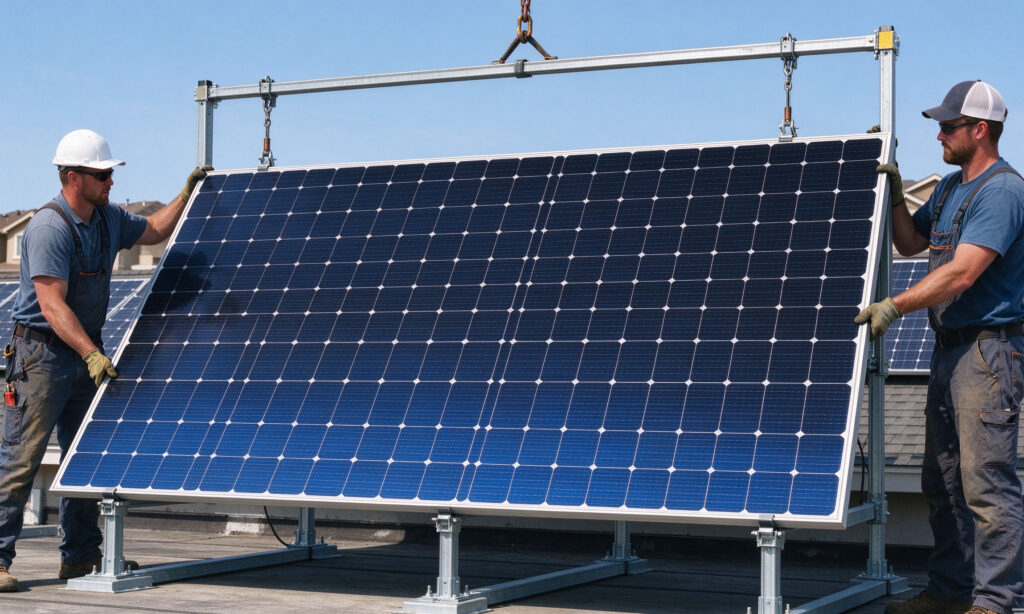
A 1000 watt solar panel is two different products sharing one search. As hardware, it is a kilowatt-class module — a large, heavy panel used mainly on commercial roofs and ground mounts, handled with equipment rather than by hand. As a query, it usually means a 1 kW solar system: a small array sized for a shed, a cabin or a meaningful slice of a home. This guide separates the two, covers what each actually delivers, and explains where the kilowatt class genuinely fits.
Half the searches for kilowatt-class panels are really system questions wearing module clothing. Answering both is the only way the page is useful.
The 1000 W module versus the 1 kW system
Start with the distinction, because everything else depends on it. A 1000 watt solar panel as a single physical module exists — large-format bifacial units have pushed past the kilowatt mark — but they are specialised commercial product, sold through project supply channels and installed with lifting equipment. The far more common intent behind the search is a 1 kW system: three or four mainstream modules, a small inverter, and an array sized for modest loads.
The confusion is understandable, because the number is the same and the use cases are not. A buyer who orders a kilowatt-class module expecting a household system gets a panel that will not fit their roof; a buyer who orders a small system expecting a single panel gets three modules and an inverter. This guide covers both so the distinction is explicit: module facts first, system economics second, and the 500 watt solar panel guide the rung below on the module ladder.
What the module rating measures
Kilowatt-class modules reach their rating the same way every module does — rated power under standard test conditions — but they get there through sheer area and modern cell architecture rather than any new physics. The practical consequences are all downstream: higher current per module, substantially more weight, a larger glass area that catches more wind, and a physical size that turns handling into a two-person or equipment-assisted job.
Most buyers will never touch one. The class exists because commercial rooftops and ground mounts are priced by connection count and labour hours, and a kilowatt-class module halves both relative to a mainstream array of the same target. That is a project-economics argument, not a residential one, and the solar panels for commercial buildings guide covers the setting where it applies.
Where 1000 W sits on the watt ladder
The ladder now spans two orders of magnitude, and the top rungs are a different market from the bottom ones. The 100 W trickle class serves maintenance duty; 200 W and 300 W serve supplemental and replacement work; 400 W is the mainstream residential module; 500 W opens the large-format tier; and the kilowatt class sits at the top, mostly on commercial roofs.
| Class | Primary market | Handling | Typical buyer |
|---|---|---|---|
| 100–300 W | Maintenance, supplemental, replacement | One person | Owners, small installers |
| 400 W | Mainstream residential | Two people | Residential installers |
| 500 W | Large-format entry, space-tight roofs | Two people, care needed | Residential and small commercial |
| 1000 W and up | Commercial rooftops, ground mounts | Equipment-assisted | Project developers, EPCs |
For the residential reader the useful takeaway is that the ladder’s top rungs are not an upgrade path — they are a different market. Buying “up” the ladder for a house trades away handling ease and inverter compatibility for parts-count economics that only matter at commercial scale.
What a 1 kW system actually delivers
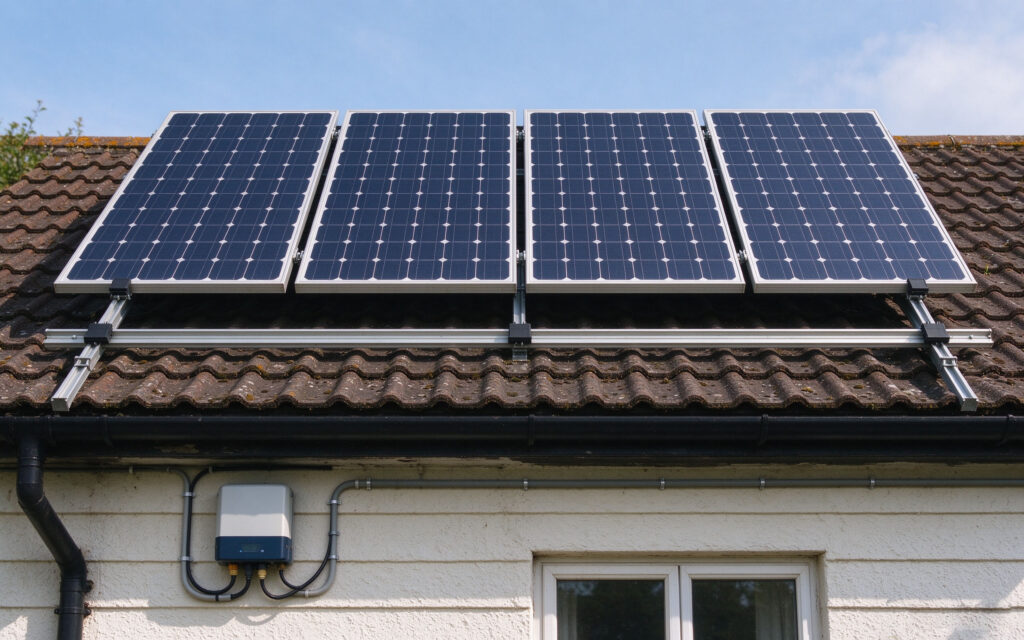
The system interpretation is the useful one for most readers. A 1 kW array built from three or four mainstream modules produces, on a good summer day, somewhere in the range of four to six kilowatt-hours depending on region and season; in winter, roughly half that or less. That is a meaningful amount of energy — a refrigerator plus lighting plus device charging with headroom, or a solid daily contribution against a larger household’s baseline.
What it is not is a household supply. Cooking, water heating, space conditioning and electric vehicle charging all dwarf a kilowatt of array on their own, which is why the honest framing of a 1 kW system is a meaningful slice of a home’s daytime use, or a complete supply for a small off-grid build with disciplined loads. The how to size a home battery method is the right way to find out which of those two the reader’s load list actually is, and the whether solar panels work at night guide covers what happens to the arithmetic after sunset.
Pairing a 1 kW array with storage changes the arithmetic again, and in the smaller direction. A kilowatt of panels producing four to six kilowatt-hours on a good day can refill a 5 kWh class bank over a summer afternoon, which is why the pairing is common in small off-grid builds — but the same array in winter produces less than half that, and the bank then depends on the grid or on disciplined loads. The honest framing is seasonal: the array is a daytime contributor, and the bank is what carries the evening.
Handling and mounting kilowatt-class modules
Where the module interpretation is the real intent — a ground mount, a barn roof, a small commercial project — the constraints are mechanical rather than electrical. Kilowatt-class modules weigh enough that two people are the minimum and lifting equipment is the norm, and the glass area turns wind from a footnote into the governing load. Certified clamp zones, rail spacing and structural review stop being formalities at this size.
Ground mounting suits the class better than roofs do: no handling height, no roof loading questions, and the option to tilt for seasonal output. Steep ground mounts also shed snow, which matters in the markets where the class is most often specified — the solar panel snow removal guide covers the winter case. The ground mounted solar panels guide covers the ground-mount option in full, and the mounting brackets deserve their own guide.
Buying notes for the kilowatt class
Buying a kilowatt-class module as a residential buyer is almost always a mistake, and the first piece of buying advice is to check which of the two products the search actually needs. Where the module genuinely is the intent — a commercial or ground-mount project — the supply chain is different from residential retail: modules come through distribution, arrive on pallets, and carry warranties negotiated at project level rather than clicked through a checkout.
For the system interpretation, the buying questions are the mainstream ones: inverter sizing and window, racking quality, and whether the array will ever expand. A 1 kW system designed with expansion in mind — a slightly oversized inverter, a rail layout with room — costs little more at install and saves a re-roof later. And for either interpretation, the solar panel lifespan guide is the right companion read, because at this scale the array is a decade-long asset rather than a seasonal purchase.
1000 watt solar panel?
A 1000 watt solar panel can mean a kilowatt-class module — a large commercial unit handled with equipment — or, more often, a 1 kW solar system of three or four mainstream modules sized for modest loads.
Q. Does a 1000 watt solar panel exist as a single panel?
Yes. Large-format bifacial modules have passed the kilowatt mark, but they are commercial product sold through project supply channels, not residential retail.
Q. How much power does a 1 kW solar system produce per day?
Roughly four to six kilowatt-hours on a good summer day in a sunny region, and about half that in winter. The exact figure depends on location, orientation and shading.
Q. What can I run with a 1 kW solar system?
A refrigerator, lighting and device charging with headroom, or a complete supply for a small off-grid build with disciplined loads. Cooking, water heating and climate loads are out of reach.
Q. How many panels are in a 1 kW system?
Typically three or four mainstream modules, depending on the module class chosen — more for smaller modules, fewer for large-format ones.
Q. Can I install a 1000 watt solar panel myself?
The module is a two-person or equipment-assisted lift with substantial wind loading, so it is professional work. A 1 kW system of mainstream modules is within reach of a competent DIY installer.
Q. Is a 1 kW solar system worth it?
As a meaningful slice of a home’s daytime use, or a complete small off-grid supply, yes. As a whole-house solution it is undersized by an order of magnitude, which is the mistake the page exists to prevent.
Next step: decide which product you actually need
Module or system — the answer changes every downstream decision. Send the target use, available area and the loads to be covered.
- Compare the mainstream option in the 400 watt solar panel guide
- Size the strings with the solar panels in series or parallel guide
- For chisidal, send your usage and site details, and we will come back with product prices, lead time and warranty information.