shade tolerant solar panels is more of a marketing phrase than a category: no module makes energy from shadow. What differs is how a module behaves when part of it is shaded — how much of the string it drags down, and whether the array is wired so shade on one panel stops the rest. This guide explains why shading hurts more than its area suggests, what bypass diodes, half-cut cells and module-level electronics actually change, and when a shaded site is worth building on at all.
Shade is the one site problem that no amount of panel quality fixes, because the physics is about the string rather than the module.
Why shade costs more than its area
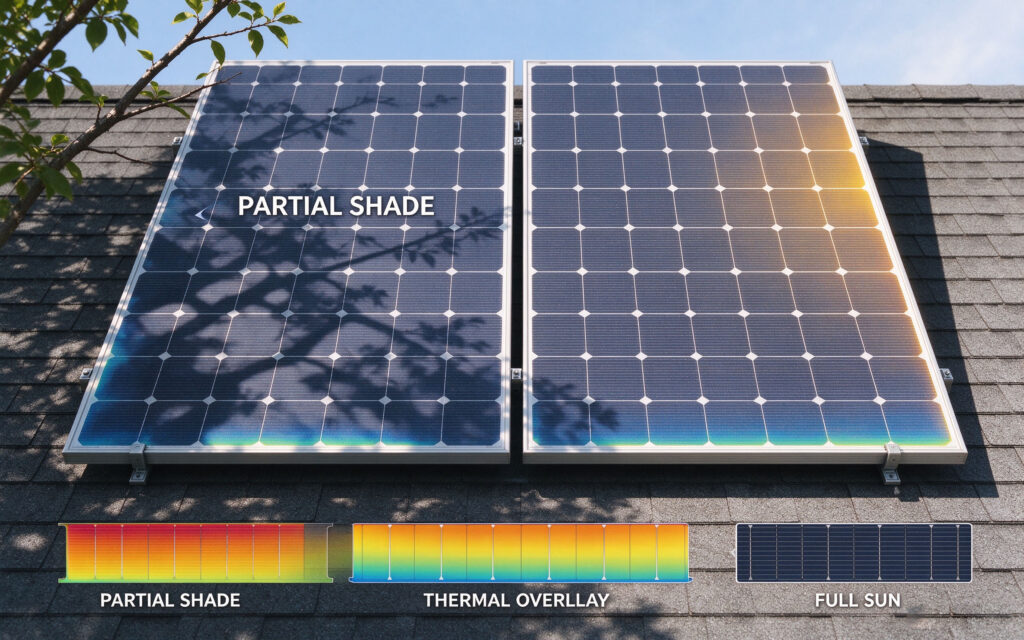
A shadow covering a tenth of a module can cost far more than a tenth of the output, and the reason is electrical rather than optical. Cells in a module are wired in series, so the current through them is shared: a shaded cell that cannot pass the string’s current becomes a resistor, dropping voltage and heating up rather than producing. That is the mechanism behind hot spots, and it is why shading is treated as a reliability issue as well as an output one.
That gap is what the market for shade tolerant solar panels is trying to close: not making shade productive, but stopping a local shadow from becoming a loss across the whole string.
The same logic scales up. Modules in a string are in series too, so one badly shaded module limits the whole string’s current. This is the single most important thing to understand about shade: the loss is set by the worst module in the string, not by the average across the array. The solar panels in series or parallel guide works through the string arithmetic in full, and the solar panel orientation guide covers how orientation decides which obstacles matter at which hour.
What “shade tolerant” actually refers to
Three real technologies hide behind the phrase, and none of them makes shade productive. Bypass diodes give the current a path around a shaded section, so the rest of the module keeps working instead of being dragged down by the dark cells. Half-cut cells split a module into two independent halves, so a shadow on one half does not take the other half with it.
| Feature | What it does under shade | What it does not do |
|---|---|---|
| Bypass diodes | Route current around a shaded section so the rest of the module still produces | Recover the output of the shaded section itself |
| Half-cut cells | Limit a shadow to one half of the module | Make the shaded half produce |
| Module-level electronics | Let each module run at its own maximum power point | Create energy from a covered module |
| None of the above | — | Overcome a shadow that covers the whole array |
The useful reading of the table is that these features limit the damage rather than remove it. A module described as shade tolerant will lose less of the array than a basic one under the same shadow, and in partial shade across many modules that difference compounds into a real annual number — which is where the marketing claim is legitimately earned.
Module-level electronics and where they earn their cost
Shade tolerant solar panels and module-level electronics answer the same problem at different layers — one at the cell layout, one at the array management — and on a genuinely shaded site the second usually matters more than the first.
The strongest answer to a shaded site is not a special module but a change in how the array is managed. In a conventional string, every module is forced to run at the same current, so the shaded one sets the pace. Module-level electronics — microinverters or optimisers — let each module run at its own maximum power point, so a shaded module contributes what it can without capping its neighbours.
That is a real gain on a genuinely shaded site and a wasted expense on a clear one, which is why the decision is site-specific rather than a default upgrade. The solar panel micro inverters guide covers the microinverter route in detail, and the MPPT inverter guide explains what the tracking is doing in a conventional string. The honest test is simple: if the array has no shading at the hours it is supposed to produce, the electronics buy nothing.
Designing around shade instead of through it
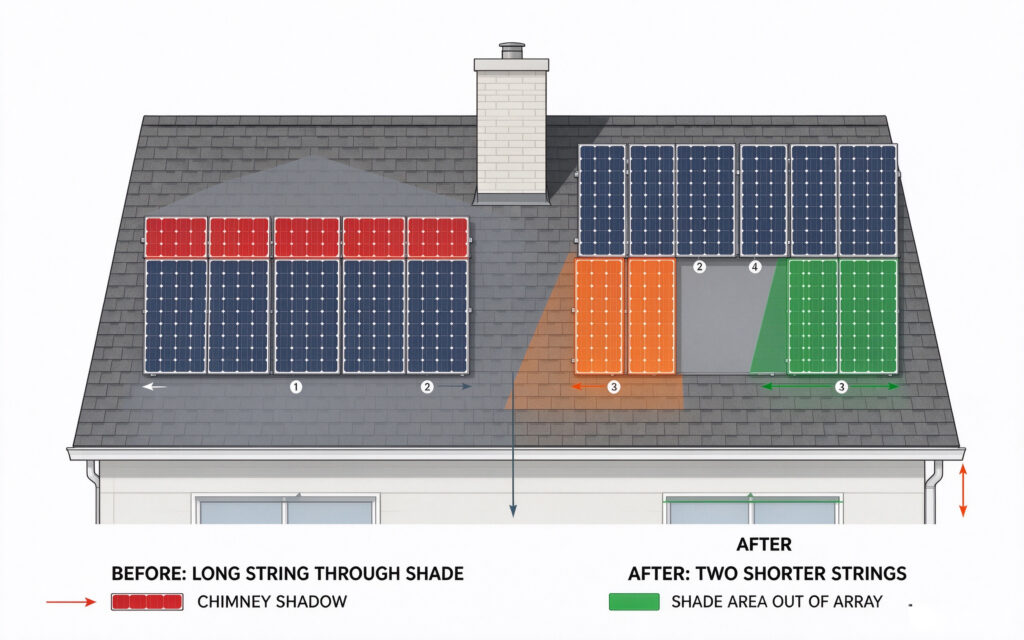
The first move on a shaded site is layout, not hardware, and shade tolerant solar panels do not change that order of operations. Keep the shaded area out of the array entirely where the roof allows it — a shorter string on the clear part of the roof often beats a longer one that reaches into the shadow. Group modules with similar exposure into the same string, so a shaded module is not mismatched against clear ones on the same input. And where the shadow moves through the day, aim the strings so the shading hits whole strings rather than parts of several.
Trimming the obstacle is usually the cheapest intervention of all, and the one installers mention last. A branch removed costs a fraction of module-level electronics and recovers the full output rather than a share of it. Where the obstacle is fixed — a chimney, a neighbouring building, a parapet — the layout answer stands, and the solar panel maintenance guide covers keeping the array free of the debris and growth that create new shade later.
When a shaded site is not worth building on
Some sites should be declined or redesigned rather than optimised. Shade tolerant solar panels do not rescue this case. An array shaded for most of the productive hours by a structure that cannot be moved or trimmed will not pay back regardless of which modules go on it, and the honest answer at survey stage is worth more than a sale. The same applies where the shade is seasonal and severe — a deciduous tree that is bare in summer is a different problem from an evergreen one.
Where the roof is wrong but the site is not, ground mounting usually solves it, because the array can be placed away from the obstacle entirely; the ground mounted solar panels guide covers that option. And where shade comes with an awkward roof plane, the solar panels on a metal roof guide and the solar panels on a flat roof guide cover the two roof cases that give the most layout freedom.
Reading a shade-tolerant claim on a spec sheet
Three questions separate a real claim from a marketing one, and they are the ones worth asking a supplier who describes shade tolerant solar panels as a category. How many bypass diodes does the module have, and are they paired with cell sections rather than whole-module sections? Is the cell format half-cut or a split variant, which limits the shadow to part of the module? And does the manufacturer publish any test data for partial-shade behaviour rather than only a standard test condition figure, because standard test conditions have no shade in them at all.
The reason to read the claim carefully is that shade tolerant solar panels carry a price premium, and that premium only pays back where partial shade is a regular feature of the site rather than an occasional one.
Then compare it against the alternative: on a moderately shaded site, spending the same money on module-level electronics usually beats spending it on premium modules. And on a heavily shaded site, neither is the answer — moving or removing the obstacle is. The solar panel lifespan guide guide is the right frame for the long view, since shade-related heating is one of the mechanisms that ages a module faster than its neighbours.
Q. shade tolerant solar panels?
Modules described as shade tolerant limit how much a shadow on one part of the module drags down the rest, usually through bypass diodes, half-cut cells or split cell layouts. No module produces meaningful energy from a fully shaded area.
Q. Do solar panels work in the shade?
They produce much less. Shade on a small part of a module can cost far more than that share of output, because shaded cells restrict the current of the whole series string.
Q. Why does a small shadow cost so much output?
Cells and modules are wired in series, so they share one current. A shaded cell that cannot pass that current becomes resistance, which drops voltage and can create a hot spot rather than simply producing less.
Q. What are bypass diodes for?
They give the string current a path around a shaded section so the unshaded part of the module keeps producing, instead of the whole module being dragged down by its dark cells.
Q. Are microinverters worth it for a shaded roof?
On a genuinely shaded site, often yes, because each module then runs at its own maximum power point. On a clear roof they add cost without adding energy, so the decision is site-specific.
Q. Can I just trim the tree instead?
Usually that is the cheapest and most effective fix. Removing the obstacle recovers the full output rather than a share of it, and costs a fraction of module-level electronics.
Q. How do I know if my site is too shaded?
Walk it at the hours the array is meant to produce and look for obstacles that cannot be moved or trimmed. If most of the productive window is shaded, the site should be redesigned or declined rather than optimised.
Next step: assess the shade before the hardware
Shade is a site problem first and a module problem second. Send the site exposure and the obstacles.
- Work the string arithmetic in the solar panels in series or parallel guide
- Compare the electronics route in the solar panel micro inverters guide
- For chisidal, send your usage and site details, and we will come back with product prices, lead time and warranty information.