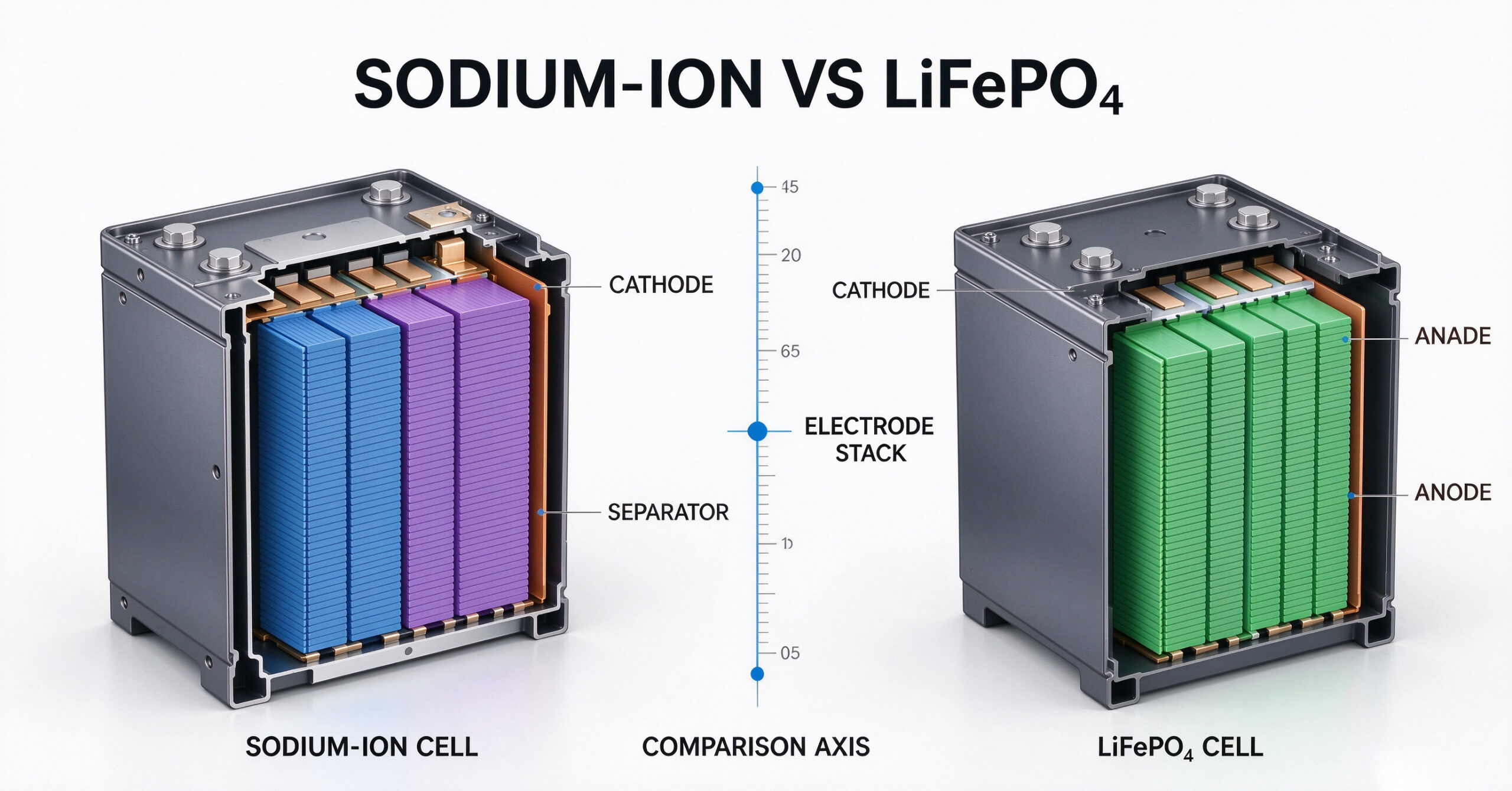
sodium-ion battery vs lifepo4 compares two intercalation chemistries that share an architecture and differ in ion size, cell voltage, energy density, cold behaviour and supply maturity. Sodium trades lower density for cheaper materials, better low-temperature charging and simpler transport. LFP trades material cost for density, scale and a long field record. This guide compares them in the order a buyer meets them.
Both chemistries ship today, so the real question is which constraint the site actually has: volume, cold, financing or supply risk. This comparison works through those four in the order a buyer meets them, and ends with what to ask a supplier.
How each chemistry moves its working ion
Both cells are intercalation devices: a working ion shuttles between two host structures through an electrolyte, and the host is not consumed. That shared principle is why the sodium-ion battery vs lifepo4 comparison is a fair one — same architecture, different ion.
One consequence reaches the electrical design. Sodium cells sit at a lower nominal voltage than LFP cells, so a 48 V bank or a high-voltage string built on sodium needs a different cell count and a different balancing strategy than the LFP design it replaces. A sodium bank is not a drop-in swap, and treating it as one is the most common early mistake in a sodium-ion battery vs lifepo4 evaluation.
Energy density, volume and the weight ledger
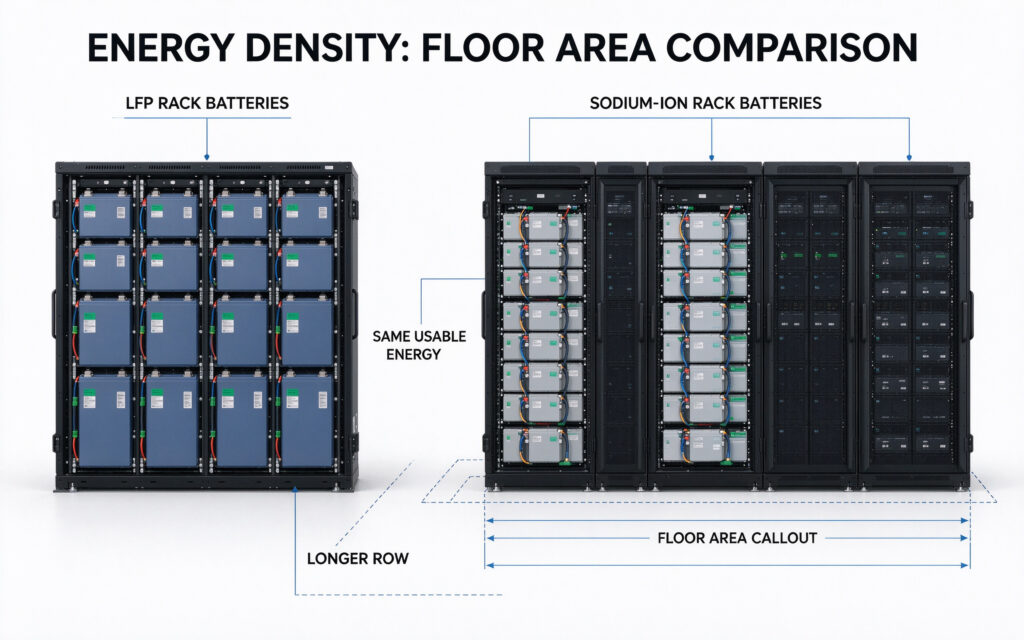
Energy density is where LFP keeps its clearest lead. At cell level LFP sits in a band above where sodium-ion cells sit today, and the gap widens at pack level because the lower cell voltage forces more series connections and more overhead per kilowatt-hour. A sodium bank of the same usable energy takes noticeably more floor area and mass.
Whether that matters depends entirely on the site. A ground-mounted plant on owned land treats volume as nearly free. A wall-mounted residential unit or a rooftop plant room treats every litre as a constraint. This is the first branch of any honest sodium-ion battery vs lifepo4 decision, and it often settles the question before cost is discussed at all.
For chisidal, the framing that works is usable energy per rack position and per square metre of pad at the temperature and rate the site will actually run.
Cold behaviour and rate capability
Low-temperature performance is sodium’s strongest claim, and it is a real one. LFP cells are limited on charge more than on discharge in the cold: charging a lithium cell near or below freezing risks plating lithium onto the anode, which is permanent capacity loss as well as a safety concern, so cold-climate LFP banks carry heating, insulation or a charge derating. Sodium cells accept low-temperature charging far better and keep more of their room-temperature capacity when cold. The LiFePO4 battery temperature range guide sets out where the LFP boundary sits and what the usual mitigations cost.
On rate, both chemistries comfortably serve the duty cycles that dominate stationary storage: daily solar self-consumption, peak shaving and backup. Sodium cells often show good power capability relative to their energy, which suits short-duration, higher-power service; LFP has a longer record at both ends of the range and a deeper base of field data. In a sodium-ion battery vs lifepo4 comparison for a 0.5C-class daily-cycling project, neither chemistry is rate-limited, and the decision should be made on other grounds.
Cycle life and the shape of the fade curve
LFP has the longest and best-documented cycling record in stationary storage. Thousands of cycles to a defined end of life is a routine claim, the warranty structures behind it are mature, and lenders understand them. That record is a commercial asset as much as a technical one, and it is why LFP remains the default on financed projects.
Sodium is newer and improving quickly: early products were quoted below LFP on cycle count, and current offerings claim ranges that overlap mainstream LFP tiers. The problem is not that the claims are implausible but that they rest on far fewer independent field years, so the number carries less weight in a sodium-ion battery vs lifepo4 review.
That makes the definition behind the number decisive. What share of nameplate counts as end of life, at what depth of discharge, temperature and rate — and does the warranty pay on cycles or on years, whichever comes first. A bank that reaches its cycle count in year six under a ten-year warranty has not delivered ten years. The discipline in the LiFePO4 versus lithium ion NMC guide — always ask what a claim is measured against — applies with more force here, not less.
Fade shape matters as much as the endpoint. LFP tends to hold capacity and then turn down, which makes end-of-life planning tractable; sodium’s long-horizon curve is still being written in the field. Ask for the curve rather than a figure, and ask what the bank holds in year ten.
Cost, supply chain and how mature each route is
The sodium pitch on cost is about inputs. Sodium is abundant and widespread, the chemistry needs no lithium, nickel or cobalt, and aluminium foil on both electrodes removes copper from the anode. In principle that means lower material cost and far less exposure to lithium price swings.
For a distributor or a brand owner, maturity is the deciding variable: a qualified second source, format stability across product generations, certification routes authorities already accept, and a service network able to honour a warranty in year eight. The sodium ion battery companies in the USA overview is a useful read on who is producing at volume and where.
Safety behaviour and transport classification
Both chemistries are far more thermally stable than the nickel-based lithium cells that dominate electric vehicles, and both suit occupied buildings when installed to code. Sodium’s lower energy density means less stored energy per volume, and its zero-volt tolerance means a cell can be discharged for transport, which reduces the hazard in shipping and in warehouse storage.
One more point about a sodium-ion battery vs lifepo4 safety review: the installed system is what the authority inspects, not the cell. Enclosure, spacing, detection and commissioning records decide the outcome more often than the chemistry does.
Where sodium wins and where LFP still holds the line
Sodium fits sites where volume and mass are cheap: ground-mounted plant rooms, container pads, industrial sites with spare floor area, and cold installations that would otherwise pay for heating or accept a winter derating. Projects that value material-price stability, domestic-content rules or the simpler logistics of zero-volt shipping lean the same way. The sodium-ion home energy storage systems guide covers the residential end of that case in more depth.
LFP still holds the line wherever the binding constraint is space, weight or demonstrable long life. Wall-mounted residential units, rooftop plant rooms, mobile or relocatable systems, and any project whose financing depends on a long, bankable field record all favour LFP today. So does any deployment that must plug into an existing LFP ecosystem of management profiles, spares and training.
| Site condition | Favours | Why |
|---|---|---|
| Volume and mass unconstrained | Sodium-ion | Lower density costs little when floor area is cheap |
| Cold climate without heated enclosure | Sodium-ion | Better low-temperature charge acceptance and capacity retention |
| Space, wall or roof loading limited | LiFePO4 | Higher density per litre and per kilogram |
| Financing or insurer scrutiny | LiFePO4 | Longer field record and mature warranty structures |
| Second source and spares critical | LiFePO4 | Standardised formats and a deeper supplier base |
Most B2B portfolios end up carrying both, allocated per application rather than per brand. The useful output of a sodium-ion battery vs lifepo4 review is not a winner but a rule for which applications go to which chemistry: sodium where the site is cold and the volume is free, LFP where the site is tight and the warranty must be defensible.
Questions to put to a manufacturer before ordering
Seven questions separate a serious supplier from an optimistic one. Which cell format and cell maker, and is there a qualified second source. What end-of-life capacity share, at what depth of discharge, temperature and rate, does the cycle claim use. What are the charge limits at the minimum site temperature, and what heating or derating is recommended. Which certificate numbers — cell, module, pack, transport — apply to this SKU. What is the warranty in years and in cycles, and which binds first. What is the lead time on a replacement module in year seven. And what is the cost per usable kilowatt-hour over the service life rather than per nameplate kilowatt-hour today.
The last question is the one that changes decisions: a chemistry that wins on purchase price and loses on usable lifetime or spares availability is not cheaper, and only the full service window shows it. The discipline in the LFP battery cell selection guide guide transfers directly — qualify the cell, then the module, then the system, and never accept a single number at any layer.
Then write the answers into the purchase specification rather than the brochure file.
Q. sodium-ion battery vs lifepo4?
Sodium-ion battery vs LiFePO4 compares two intercalation chemistries. Sodium-ion offers cheaper raw materials, better low-temperature charging and simpler zero-volt transport at lower energy density. LiFePO4 offers higher density, a longer field record and a far more mature supply chain.
Q. Is sodium-ion cheaper than LiFePO4 today?
Not reliably at pack level. The raw materials are cheaper and more stable in price, but LFP manufacturing scale is much larger, so the invoice price per kilowatt-hour is often closer than the material argument suggests.
Q. Which chemistry lasts longer in cycle life?
LiFePO4 has the longer documented record, and mainstream LFP products claim higher cycle counts than most sodium products. Sodium cycle-life claims are improving quickly but rest on fewer independent field years, so the warranty definition matters more.
Q. Does sodium-ion work better in cold climates?
Generally yes. Sodium cells accept charge at lower temperatures and retain more capacity when cold, where LFP needs heating or a charge derating near freezing. The exact limit is product-specific, so ask for the curve at your site temperature.
Q. Can a sodium battery replace an LFP battery in an existing system?
Usually not directly. Sodium cells run at a lower nominal voltage, so the cell count, the balancing strategy and the management profiles all change. Treat it as a new design rather than a drop-in swap.
Q. Which chemistry is safer for a building installation?
Both are far more stable than nickel-based lithium cells and both are used in occupied buildings when installed to code. What decides the outcome is the installed system — enclosure, spacing, detection and commissioning — rather than the chemistry alone.
Q. When should a project still choose LiFePO4 over sodium-ion?
Where space or weight is limited, where financing needs a long bankable field record, or where a second qualified source and a mature spares network are required. LFP remains the lower-risk default on those projects.
Next step: match the chemistry to the site constraint
Send the site envelope, the temperature profile and the duty cycle. The chemistry choice follows from those three.
- Compare the residential formats in the 5kwh battery guide
- Run the capacity method in the how to size a home battery guide
- For chisidal, send your usage and site details, and we will come back with product prices, lead time and warranty information.