gel vs agm battery is a choice between two ways of immobilising the same electrolyte: gel thickens the acid with silica, AGM wicks it into a glass mat. That mechanical difference sets the charging voltage each one needs, how deep it can cycle, how it behaves in heat and what it costs.
Sealed lead-acid is not one product, and the two designs inside it are not interchangeable. The difference decides what charger the bank needs, how deep it can cycle and how it ages in a hot enclosure. This comparison covers where each belongs.
How gel and AGM hold the same electrolyte differently
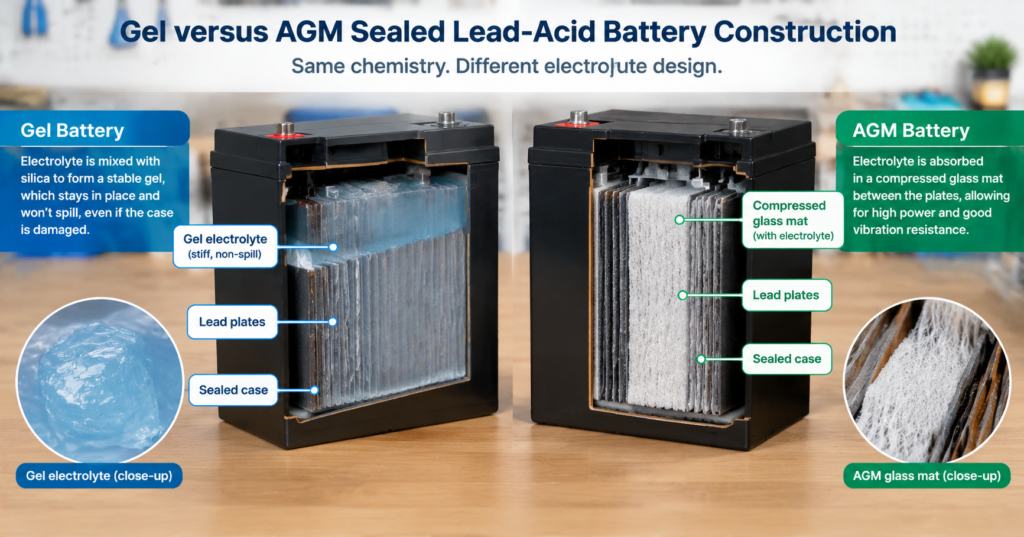
Both designs are valve-regulated lead-acid: they recombine the gas generated during charging instead of venting it, and neither needs water added in service. The difference between them is mechanical rather than chemical. A gel battery mixes the acid with a silica additive that sets it into a stiff mass, so the electrolyte cannot move, stratify or spill. An AGM battery leaves the acid as a liquid but wicks it into a fine glass mat compressed between the plates, held there by capillary action. Nearly everything a buyer cares about follows from that one distinction: charge acceptance, internal resistance, thermal behaviour and tolerance of abuse.
For a distributor stocking both, the useful framing is that neither design is a universal upgrade over the other. The deep cycle lead acid battery category covers what deep-cycle construction means across lead-acid generally; what follows here stays on the gel vs agm battery comparison itself rather than on the category.
Charging voltage windows that decide charger compatibility
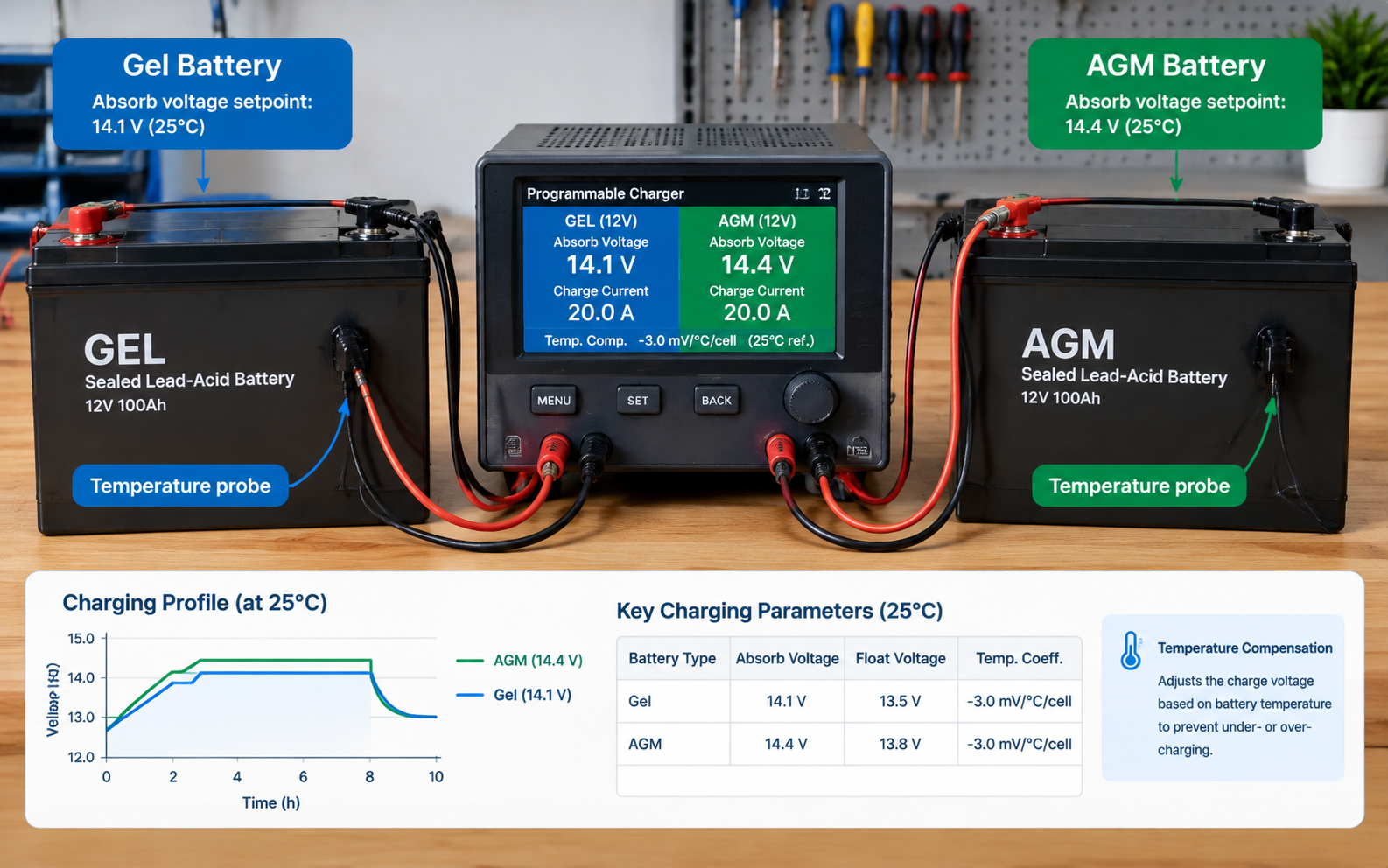
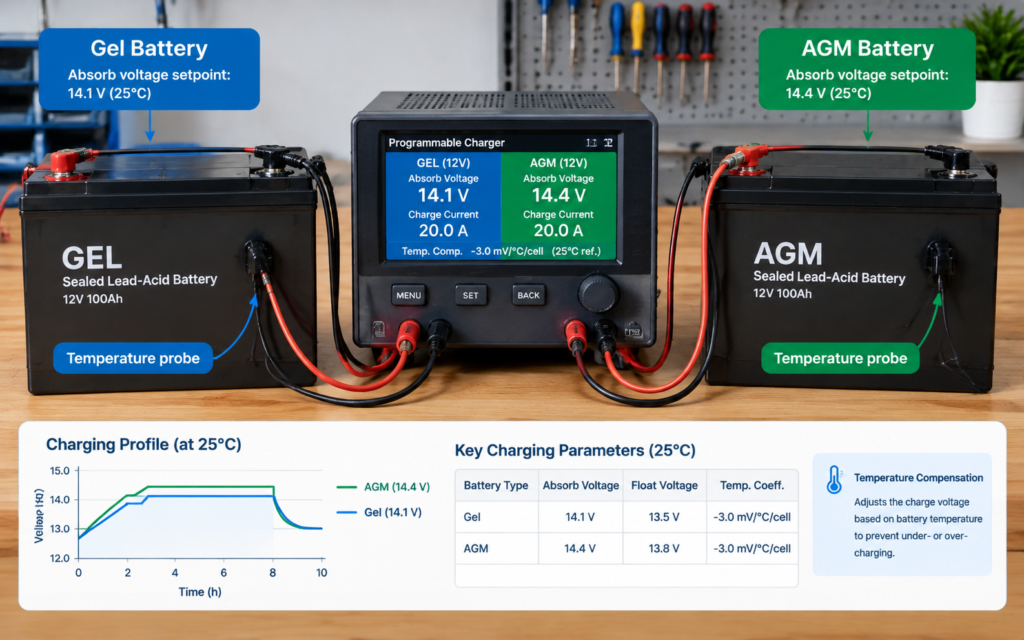
The most expensive mistake in sealed lead-acid is charging a gel battery on an AGM profile. Gel cells begin to gas at a lower voltage than AGM cells, so the bulk and absorb setpoints that suit AGM push gel into gassing, and because gas moves slowly through a set mass, the recombination loop cannot keep pace. The result is venting, progressive drying and a battery that fails early without any visible external fault.
Temperature compensation belongs in the same conversation. Both designs need the setpoint reduced as temperature rises, and omitting that correction in a hot enclosure accelerates the same drying mechanism by a wide margin. The question to put to a supplier is therefore not whether a charger is included, but what the bulk, absorb and float voltages are, whether they are adjustable, and whether the unit compensates for temperature. Where the answer is a fixed-voltage supply with no adjustment, gel is usually the wrong specification.
That constraint also decides retrofits. A bank dropped into an existing system with a fixed alternator or a sealed power supply inherits that profile, and the cheapest outcome is to specify the chemistry that matches it rather than to change the charging source. In retrofit work the gel vs agm battery choice is usually settled by the charger that is already installed. The AGM versus LiFePO4 deep cycle upgrade comparison covers the neighbouring case, where leaving lead-acid altogether changes the charging requirement more sharply still.
Depth of discharge and the cycle life each design survives
Cycle life in lead-acid is a function of how far the battery is discharged, and the relationship is steep rather than linear. A bank cycled lightly will outlast an identical product cycled deeply by a wide margin, and every published cycle figure is quoted at one specific depth — so two datasheets tested at different depths cannot be compared directly, whatever their headline numbers suggest. Both gel and AGM sit in the same broad range, with gel preferred where cycling is regular and moderate, and AGM preferred where bursts of higher current are expected.
Construction matters as much as chemistry here. A surprising share of sealed batteries sold into storage duty are closer to starting construction than buyers expect, and the deep cycle versus starting battery distinction explains why the plate design behind the label changes the answer more than the gel vs agm battery decision does.
| Behaviour | Gel | AGM | What it means in practice |
|---|---|---|---|
| Charge acceptance | Slower, lower voltage limits | Faster, higher rate tolerated | Charger profile must be matched before purchase |
| Typical duty | Slow, repeated cycling | High rate, standby and starting | Solar favours gel; UPS and engine start favour AGM |
| Main ageing path | Drying after overcharge | Shedding and grid corrosion | Different warranty claims, different prevention |
| Tolerance of abuse | Poor tolerance of overvoltage | Better tolerance, poorer deep-cycle recovery | Set the charger correctly and log it |
Heat, cold and where each design fails first
Temperature is the dominant ageing factor in both, and the practical difference is where the weakness sits. AGM, with its lower internal resistance, generally delivers more current at low temperature and is the safer pick for cold starts and unheated enclosures where a large draw is expected shortly after a cold night. Gel is often the more tolerant of sustained ambient heat in moderate duty, but it is also the more sensitive to overcharge — and overcharge is precisely what a hot enclosure produces when the voltage is not compensated.
That combination is worth stating plainly, and it is why a gel vs agm battery comparison read off a datasheet misleads: a gel bank in a hot, uncompensated environment is the failure case that shows up repeatedly in warranty returns, and it is almost always a charging problem presenting as a chemistry problem. Venting, dry-out and rising internal resistance follow in sequence, and by the time capacity is visibly down the damage is not recoverable by recharging.
Where the site runs hot, the comparison shifts to a different chemistry entirely rather than to the other sealed design. The LiFePO4 battery temperature range guide covers what a lithium bank does across the same temperature band, including the low-temperature charging limit that lead-acid does not share.
Vibration, mounting orientation and handling on site
AGM is the stronger choice where the battery will be shaken. Because the electrolyte is held in a compressed mat rather than suspended in a set mass, the plate stack stays supported under vibration and the battery tolerates mounting on its side in many constructions. Gel is more tolerant of slow deep discharge but less forgiving of mechanical abuse, and a gel block that has been dropped or mounted in a high-vibration bay tends to develop voids in the mass that become local hot spots.
Price, availability and what the shelf actually offers
AGM is close to a commodity: it is stocked in a wide range of group sizes, sourced from many factories, and priced competitively at most distribution tiers. Gel usually carries a premium and is stocked in fewer formats, which means a gel specification can constrain the replacement path for years after the original purchase. For a distributor, that cuts both ways — gel holds margin better, while AGM turns over faster and is easier to substitute when a customer is waiting on a delivery.
When lead-acid is the wrong answer and lithium is the buy
There is a point at which the gel vs agm battery comparison stops mattering. If the bank will cycle daily at meaningful depth, if the site is hot, if the duty window runs for a decade rather than a few seasons, or if the cost of a visit to the site is high, then both sealed lead-acid designs are the expensive answer and lithium is the cheap one on a cost-per-usable-kilowatt-hour basis. Lead-acid wins where the bank sits mostly idle, where the upfront budget is the binding constraint, or where the operating environment is cold and the duty is occasional standby.
The reason is usable energy rather than nameplate. A lead-acid bank that should not routinely go below half its rated capacity delivers far less usable capacity than its label, so the per-kilowatt-hour comparison that looks close on a purchase order is not close at all once depth of discharge is applied. The lithium versus lead acid deep cycle comparison works through that arithmetic properly, and it is the right read before a large sealed order is placed.
Where the answer is still lead-acid, the choice between gel vs agm battery then comes back to the charger, the duty profile and the temperature — in that order — rather than to the datasheet headline.
A specification checklist for gel or AGM procurement
Procurement goes wrong when the gel vs agm battery decision is made before the operating conditions are written down. Six items settle it, and they are worth putting on the enquiry form rather than deciding over the phone. Record the charging source and whether its voltages are adjustable and temperature compensated. Record the expected depth of discharge per cycle and how often the bank cycles. Record the ambient temperature range and whether the enclosure is ventilated. Record the mounting orientation and any vibration source. Record the replacement path, including who stocks the same format in three years. And record what happens when the bank is unavailable, because that is what sets the real cost of the cheap option.
- Match the charger profile to the electrolyte before comparing brands; gel on an AGM profile fails early and quietly.
- Quote cycle life at one stated depth of discharge, and refuse datasheets that do not say which depth was tested.
- Apply temperature compensation, and log the setpoint at commissioning so later faults can be traced to it.
- Choose AGM for high rate, cold and vibration; choose gel for slow, moderate, repeated cycling.
- Check stock depth and format continuity before committing a project to the premium design.
- Re-run the comparison against lithium whenever the duty is daily, deep and long-lived.
Q. gel vs agm battery?
Gel thickens the electrolyte with silica so it cannot move, while AGM holds liquid acid in a compressed glass mat. That mechanical difference sets the charging voltage, the charge rate and the duty each design suits.
Q. Can I charge a gel battery with an AGM charger?
Not safely. Gel gasses at a lower voltage than AGM, so an AGM profile overcharges it, and the set electrolyte cannot recombine the gas fast enough. The battery vents, dries out and loses capacity.
Q. Which lasts longer in deep-cycle service?
Both sit in a similar range when cycled at the same depth, and depth matters far more than the design. Gel is generally favoured for slow repeated cycling, AGM for higher-rate and standby duty.
Q. Which handles high temperature better?
Gel tolerates sustained heat reasonably but is more sensitive to overcharge, which is what a hot enclosure actually causes. AGM delivers better in the cold. Either way, temperature compensation is required.
Q. Is AGM better for vibration and side mounting?
Yes in most cases. The compressed mat supports the plate stack under vibration, and many AGM constructions tolerate non-upright mounting where gel does not.
Q. Why is gel more expensive?
It uses more processed electrolyte and is produced in fewer formats, so volumes are lower. The premium buys slow-cycling behaviour, not a general performance upgrade.
Q. When should I skip lead-acid and specify lithium?
When the bank cycles daily at meaningful depth, runs hot, or must last a decade with few site visits. Usable capacity per cycle, not purchase price, is what makes lithium cheaper there.
Next step: match the electrolyte to the charger before ordering
Send the charging profile, the duty cycle and the enclosure temperature, and the chemistry choice follows.
- Start with the construction basics in the group 27 deep cycle battery guide
- Check the duty profile in the off grid battery backup for cabins and farms guide
- For chisidal, send your usage and site details, and we will come back with product prices, lead time and warranty information.