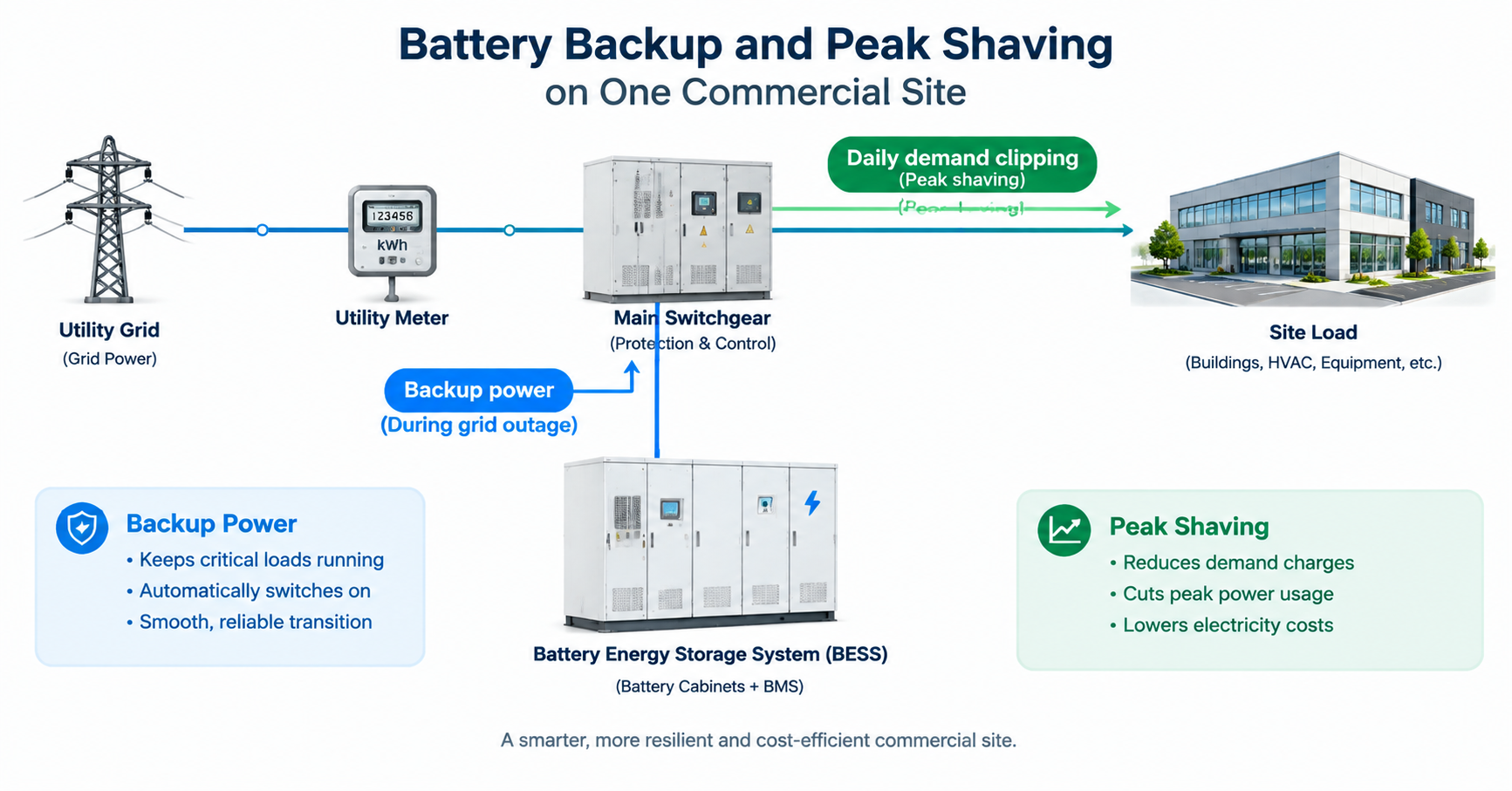
battery backup vs peak shaving are two business cases that can run on the same bank: backup is a power problem measured in kilowatts for minutes, peak shaving is an energy problem measured in kilowatt-hours against a demand window. They size differently, cycle differently and pay back from different lines on the bill.
One asset, two revenue models, and they size a battery in different units. Backup buys power for outages, peak shaving buys energy against a demand window. This comparison answers whether the two duties can share one bank.
Two revenue models running on the same hardware
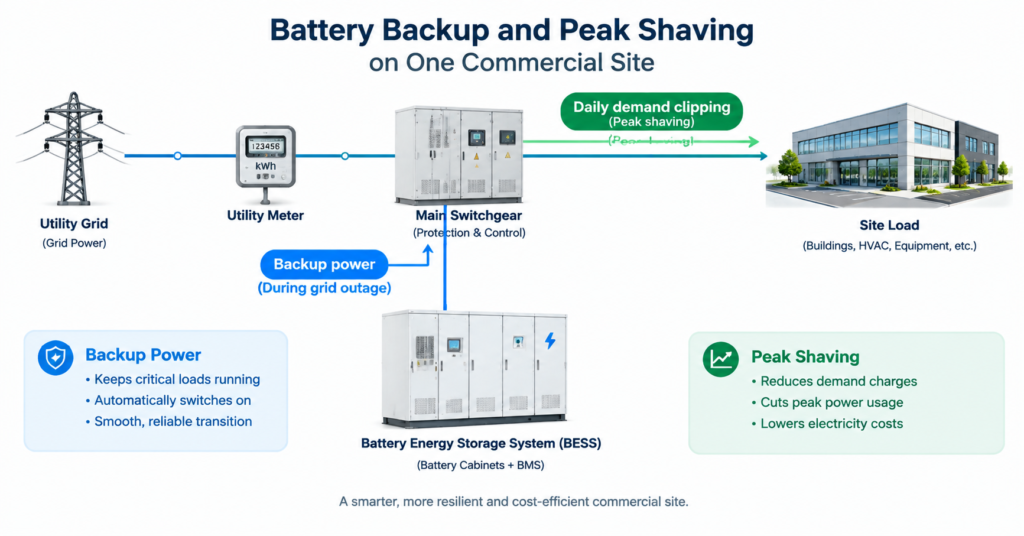
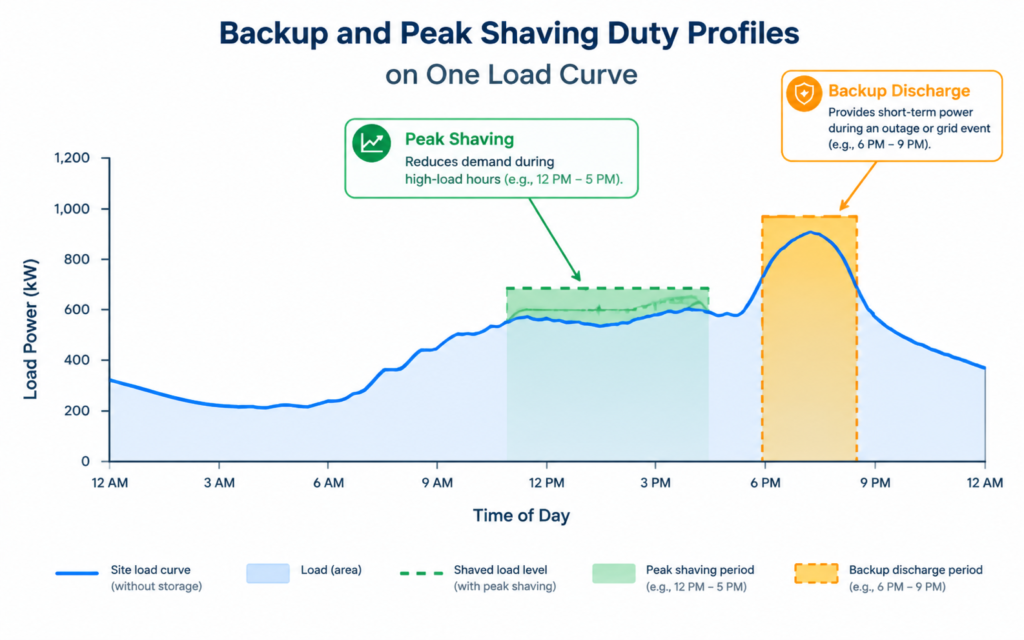
Backup and peak shaving ask a battery to do different things, and the confusion between them is the reason so many commercial proposals disappoint. Backup is an insurance product: the bank sits at a high state of charge for weeks, then delivers a large power pulse for minutes or hours when the grid fails. Peak shaving is an operating product: the bank discharges on a predictable schedule every day, clipping the top of the site load so the recorded demand peak stays lower. The first is paid for by avoided outage cost, the second by a line item on the monthly bill.
The hardware is genuinely shared: cells, racks, inverters and the site connection are the same either way. What differs is the power-to-energy ratio, the control logic and the contract that governs what the battery is permitted to do. The peak shaving and demand charges guide covers the demand-charge mechanics in detail; the battery backup vs peak shaving comparison stays on why the two duties conflict and how they can stack on one bank.
Why backup is a power problem and peak shaving is an energy problem
Sizing a battery backup vs peak shaving project starts from different units. A backup specification begins with the critical load in kilowatts and the required ride-through in minutes, and the energy figure falls out of multiplying them. A peak-shaving specification begins with the shape of the daily load curve and the size of the peak to be clipped, which is an energy question with a duration attached. Because the ratio between power and energy differs, a bank optimised for one is usually poorly proportioned for the other.
The practical consequence is that a combined bank is rarely the sum of two optimised banks, and it is rarely as cheap as either. Where the two duties are both genuinely required, stacking is still worth it, because two separate batteries on one site would cost more in balance-of-system and connection than the oversizing does.
How each duty cycle ages the same bank differently
The cycling profiles are close to opposite. Backup is calendar ageing with rare events: the bank floats at a high state of charge, degrades slowly with time and temperature, and is exercised occasionally to prove it works. Peak shaving is cycle ageing with a predictable schedule: the bank goes through a substantial part of its capacity most days, and the cycle count accumulates fast enough to become the binding limit on service life.
That matters because warranty terms are usually written against one of the two. A warranty expressed in years with a throughput clause suits backup and quietly penalises daily shaving. A warranty expressed in cycles or megawatt-hours suits shaving and leaves a backup bank under-used. Reading the two together — years AND throughput, whichever comes first — is the only honest way to compare offers, and it is the clause that decides whether a stacked battery backup vs peak shaving duty is permitted under the warranty at all.
State of charge management is the other conflict. Backup wants the bank full. Shaving wants the bank partly discharged, and the controller must leave headroom to catch a demand peak that has not happened yet. Reserving capacity for an outage that may never come means the shaving duty can only use part of the nameplate, which reduces the revenue the shaving case was supposed to produce. The battery energy storage cost and ROI guide covers how that reserved share changes the payback arithmetic.
EMS logic: what the controller is actually asked to do
The energy management system is where the two cases meet, and it is where poorly specified projects fail. A backup controller is simple: monitor the grid, detect a failure, transfer to island mode, and hold until the grid returns. A peak-shaving controller is predictive: it must forecast the day’s load, decide when to discharge, keep enough charge to cover the remaining risk and never let the recorded peak exceed the target.
Forecast quality is the variable that decides whether the shaving half works at all. A controller that discharges too early misses the real peak and records a higher demand charge than doing nothing would have; a controller that discharges too late leaves money unspent. Sites with a smooth, repeatable daily curve are easy, and sites with a lumpy, weather-driven or process-driven load are where the forecast earns or loses its keep.
Stacking both cases and where the conflicts sit
Stacking a battery backup vs peak shaving duty on one bank is feasible on most commercial sites, and it is usually the right answer when both duties are real. The conflicts are specific rather than fundamental. Reserved capacity reduces shaving revenue. The power rating must cover the full critical load, which can oversize the inverter relative to what shaving needs. Cycle throughput from daily shaving consumes the life that the backup warranty assumed was being held in reserve. And the reserve floor itself is a commercial decision: every kilowatt-hour held back for an outage that never happens is a kilowatt-hour not earning.
Where the two duties genuinely cannot be reconciled, the fallback is a smaller backup bank alongside a larger shaving bank, each optimised, sharing a site connection. That costs more in enclosures and controls, and it is still often cheaper than one bank oversized to satisfy both. The peak shaving and energy arbitrage ROI guide covers how a shaving duty is valued once it starts competing with other revenue streams.
Metering, tariff structure and what the contract permits
None of the above works without the right meter and the right tariff. Demand charges are recorded against a defined window, and the window definition — a fixed monthly peak, a rolling average, or a ratchet carried forward from a previous month — changes the strategy completely. A ratchet clause, where a single bad month sets the floor for months afterwards, makes missing one peak expensive enough that the reserve policy should be rewritten around it.
Then there is the permission question, which is contractual rather than technical. Some standby tariffs and some interconnection agreements restrict what a battery behind the meter may do, and exporting or importing in particular patterns can breach a contract that was written before storage existed. Checking the tariff and the interconnection agreement before the business case is built saves a redesign later.
Building the case an owner can actually approve
Owners approve numbers they can audit, and the battery backup vs peak shaving cases produce different kinds of number. Backup produces a probability-weighted avoided loss, which is defensible when the outage history and the cost per incident are documented, and weak when they are not. Peak shaving produces a deterministic monthly saving, which is easy to model and easy to verify against the bill afterwards — and easy to over-claim if the model assumes a perfect forecast.
Sensitivity is the part usually skipped and the part that decides the deal. Run the shaving case against a bad month, run the backup case against zero outages, and show what the payback does in each. A business case that only works under favourable assumptions is not a business case, and owners know it. The liquid cooled BESS 0.5C versus 1C guide covers the thermal side of running a bank hard enough to make these numbers work.
Choosing one configuration when both duties apply
The battery backup vs peak shaving decision sequence is short once the load data and the tariff are in hand. Fix the critical load and ride-through first, because that sets the power rating and the reserve floor and neither can be compromised later. Then overlay the shaving duty on the remaining energy and check whether the residual revenue still clears the hurdle. If it does, stack, and write the reserve into the design basis. If it does not, either accept backup only, or split into two banks.
Two checks close out the battery backup vs peak shaving decision. Confirm the warranty permits the throughput the shaving duty implies, in writing, before signing — a warranty that voids under daily cycling turns the whole case upside down. And confirm the utility tariff and interconnection terms allow the strategy, because a contract restriction discovered after commissioning has no engineering fix.
Where the site also has resilience needs beyond a simple outage, the off grid battery backup for cabins and farms guide covers the off-grid end of the same continuum, in which the bank is the only source rather than a standby one and the sizing logic changes accordingly.
Q. battery backup vs peak shaving?
Backup covers a grid outage and is sized by power and ride-through time. Peak shaving clips the daily demand peak and is sized by energy against a billing window. Both can share one bank, with a reserve held for the outage case.
Q. Can one battery do backup and peak shaving?
Yes, provided the power rating covers the full critical load and the controller holds a state-of-charge floor for outages. The cost is that some capacity is reserved and cannot earn shaving revenue.
Q. Why does backup need a higher power rating?
An outage transfers the whole critical load to the bank at once, so the inverter and the cells must carry that peak. Shaving discharges more slowly across a window and needs less power for the same capacity.
Q. How much capacity should be reserved for backup?
It depends on outage tolerance and whether a generator backs the site. A site with a generator can reserve little and shave hard; a site with a process that cannot stop needs a large floor.
Q. Does daily peak shaving shorten battery life?
Yes, because cycle throughput becomes the binding limit rather than calendar age. Check whether the warranty is written in years, cycles or throughput, and expect whichever comes first.
Q. What metering is required for peak shaving?
Real-time interval data at a resolution fine enough to see the peaks being clipped. Where the utility meter cannot be read directly, a revenue-grade submeter at the point of common coupling is the usual answer.
Q. What most often breaks a stacked business case?
Forecast error and contract restrictions. Discharging at the wrong time misses the peak, and a tariff or interconnection clause can prohibit the strategy entirely, so both must be checked before the design is fixed.
Next step: size the reserve before sizing the bank
Send twelve months of interval load data and the tariff, and both cases can be modelled on one page.
- Start from the commercial frame in the commercial battery storage guide guide
- Compare the enclosure options in the BESS container versus cabinet guide
- For chisidal, send your usage and site details, and we will come back with product prices, lead time and warranty information.