centralized vs distributed energy storage is a topology choice rather than a technology one: one large plant at a single connection point, or several smaller units placed where the loads are. The same cells and power conversion hardware can serve either. What changes is the wiring losses, the fault domain, the interconnection scope and how fast capacity can be added.
Architecture is decided before the equipment is specified, and it determines what a single failure costs. This guide is written for owners and EPC teams choosing between the two on a real site, where the plot and the loads already exist.
What centralized vs distributed energy storage each means in practice
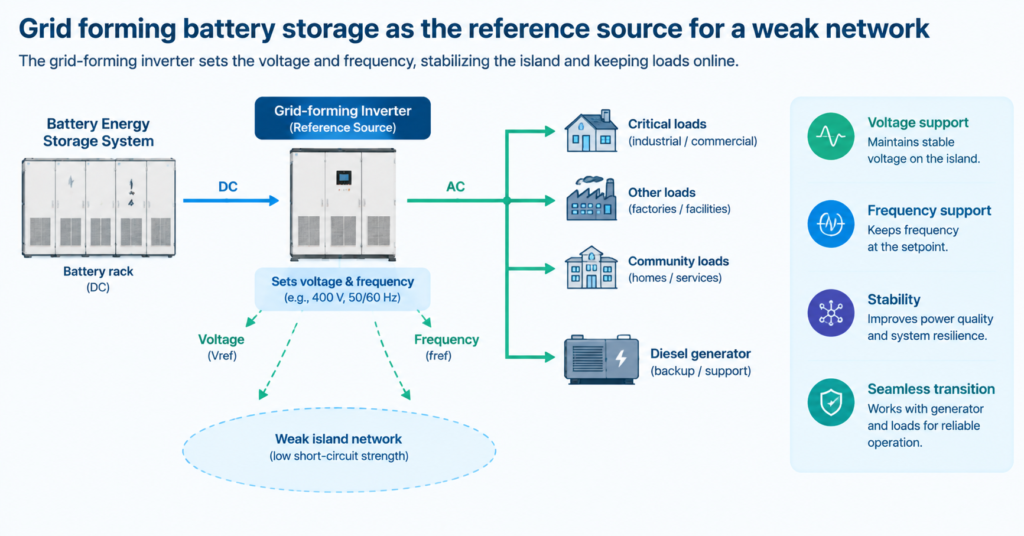
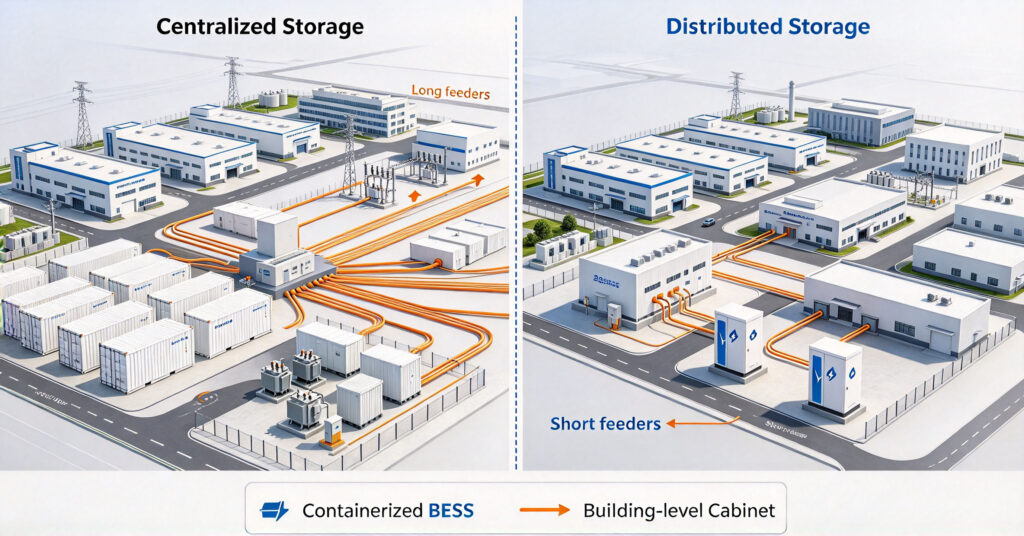
Centralized energy storage puts the whole capacity at one point: one bank of enclosures, one power conversion block, one connection to the site’s main bus or to a substation, and one plant controller. Distributed energy storage spreads the same total across several locations — a cabinet in each building, a rack in each switch room, a unit behind each service — each with its own connection point and its own local control, coordinated by a site or cloud layer above them.
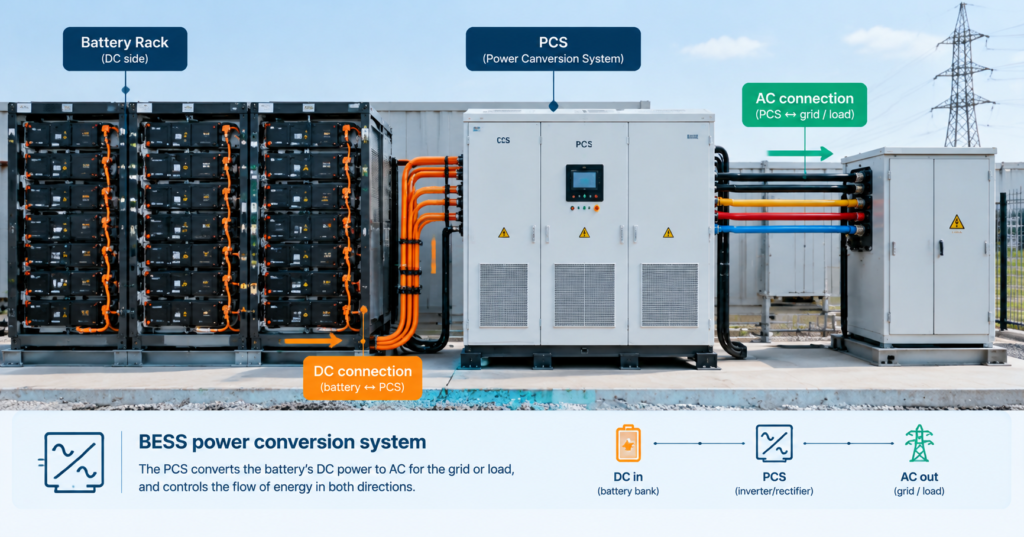
The centralized vs distributed energy storage distinction is about topology rather than equipment. Both architectures can use the same cells, the same racks and the same power conversion hardware, and the chemistry question is settled separately. What differs is where the energy physically sits relative to the loads and the grid connection, how the protection is arranged, and what happens when a single piece of equipment stops working.
Scale is the usual shorthand but not the definition. Centralized plants are typically the larger ones, because there is little reason to build a single-point plant for a small capacity, and distributed deployments are typically smaller per unit. The defining test is simpler than size: can one fault remove all of the capacity, or only a share of it?
Grid connection, metering and where the intertie sits
A centralized plant has one intertie. That means one protection scheme, one metering point, one interconnection study and one set of utility documents — and it also means the whole interconnection risk sits inside a single approval. Where the utility study is the long pole in the project, that concentration is an advantage: the engineering is harder, but there is only one of it.
Metering follows the topology. A single point of connection usually means a single revenue meter and a single settlement arrangement, with energy measured at the boundary rather than at each load. Distributed units are usually behind the meter at each building, so each one measures against its own load, and the site-level picture has to be assembled from several meters rather than read from one.
That difference matters for tariffs. Where a tariff charges on demand measured at the service entrance, a centralized plant sees the aggregate and can discharge against the whole-site peak. Where the tariff or the tenancy arrangement makes each building its own account, distributed units are the only way to manage each peak separately — a point the commercial battery storage guide frame develops further for the commercial case.
Line losses and round-trip efficiency in centralized vs distributed energy storage
Energy that travels further loses more. A centralized plant serving loads at the far end of a large site pushes power through long low-voltage runs on the way out and again on the way back, and those resistive losses are paid twice — once charging the plant and once discharging it. Distributed units sit next to their loads, so the runs are short and most of that round-trip penalty never appears.
The net effect depends on the site’s geometry and its duty cycle. On a compact site with short cable runs, the central plant’s conversion advantage wins. On a sprawling campus or a portfolio spread across several buildings, the wiring advantage of distributed units usually wins — which is why the honest answer on centralized vs distributed energy storage efficiency is a site survey rather than a rule of thumb.
Fault domains: single point versus spread risk
Reliability is the argument that most often decides it. A centralized plant concentrates the fault domain: one inverter block, one controller, one connection. A fault in any of those removes the entire capacity, and the site is without storage until it is fixed. The mitigation is redundancy inside the plant — n+1 conversion, separate strings, a spare unit — which costs money but is well understood and easy to model.
Footprint, fire safety and siting constraints by architecture
A centralized plant needs one large plot: enough for the enclosures, the transformer and the switchgear, plus the separation distances the fire code requires and vehicle access for installation and removal. Finding that plot is frequently the hardest part of the project, and on a built-out site it is sometimes the reason the centralized option is dropped before the engineering starts.
Enclosure form interacts with both. Containerized plants are the centralized default, and the BESS container versus cabinet comparison covers where a cabinet is the better unit; the C&I storage rack, cabinet and container piece walks through the three form factors in sequence. Distributed deployments almost always land on cabinets or racks, and the siting rules for a cabinet inside a building are not the ones that apply to a container in a yard.
Monitoring, communications and how O&M scales
One plant means one thing to monitor. A centralized deployment has a single SCADA point, a single historian, and a technician visit that covers the whole capacity. Alarm handling, firmware updates and spare-parts stocking are all simpler, and the operations team carries a mental model of one plant rather than a fleet.
A distributed fleet is a monitoring problem before it is an energy problem. Each unit needs connectivity, the site controller needs to coordinate them without fighting the local controllers, and the operator needs a fleet view that makes twenty units behave like one asset. Communications become part of the availability calculation: if the coordination layer goes down, each unit should keep doing something sensible on its own rather than stopping.
Where the deployment is genuinely islanded or off-grid, this layer becomes the whole design, and the microgrid battery storage guide covers that case in full. Where it is grid-connected behind a single service, the coordination problem is smaller but still real, and the commissioning scope is noticeably larger than for a single-plant project of the same total capacity.
Phasing and expansion pace for centralized vs distributed energy storage
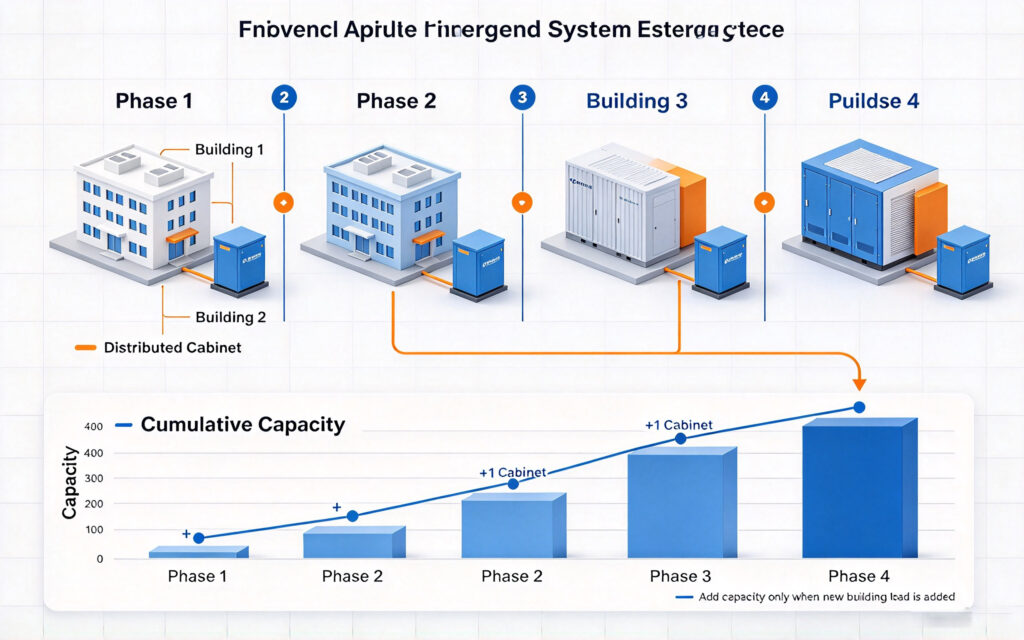
Centralized capacity is bought in blocks. Civil works, the transformer, the switchgear and the interconnection study are all sized for the plant, so the economic move is to build toward the final capacity early and reserve both the space and the interconnection headroom for it. Expanding later is possible, but it tends to mean reopening the utility conversation and redoing part of the civil work.
Distributed capacity is bought in steps. A unit goes in where the load is, the next goes in when the next building is occupied or the next tranche of capital is released, and each step is independently useful from the day it is commissioned. For a site developed in phases, or where capital comes out in tranches, that cadence matches the money far better than a single large build does.
The cost per kilowatt-hour usually favours the larger single plant, because balance-of-system cost per unit of capacity falls as size rises. That gap is the price of the flexibility, and it is worth quantifying rather than assuming: on some sites the difference is small enough that the phasing advantage decides the question outright.
Choosing an architecture for C&I duty
For commercial and industrial duty the decision usually turns on three things: whether the storage is protecting a whole-site peak or individual buildings, whether one contiguous plot exists, and whether the capacity will be built in one phase or several. A whole-site peak, a plot, and a single phase all point at centralized. Per-building peaks, no plot, and phased capital all point at distributed.
Duration shifts the weighting. Where the duty is short and power-dense — peak shaving measured in an hour or two — the distributed case is strong, because the units sit where the peaks are actually measured. Where the duty is long, the value of concentrated capacity and single-point control grows, and the long duration storage technologies comparison is the right frame for what long duration demands of the plant.
Then write the requirement down in a form bidders can price: total usable energy at the point of delivery, an availability target with a stated fault assumption, expansion steps with dates, and the site’s single-line diagram. Most architecture arguments resolve themselves once those four are on paper, and the centralized vs distributed energy storage question stops being a matter of taste and becomes an arithmetic one.
Q. centralized vs distributed energy storage?
It is a comparison of system topologies. Centralized storage puts all the capacity at one connection point with one plant controller; distributed storage splits the same total across several units placed near their loads. Both can use identical cells and power conversion hardware.
Q. Which architecture is more reliable?
Distributed storage usually gives higher availability, because one failed unit removes only its own share of capacity. Centralized plants need internal redundancy to reach the same level. Both remain exposed to correlated failures such as a firmware defect.
Q. Is distributed storage more efficient?
Often yes on wiring, because units sit close to their loads and the round-trip cable losses are small. A single large plant converts power slightly more efficiently and has lower standby draw, so the answer depends on the site’s layout.
Q. Which is cheaper per kilowatt-hour?
Centralized, as a rule, because balance-of-system cost per unit of capacity falls with size. The gap is the price of the phasing and siting flexibility that distributed units buy, and it is worth quantifying on the actual site.
Q. Which is easier to interconnect with the utility?
Centralized, in the sense that there is only one study, one protection scheme and one meter. It is also a single point of approval risk, so a delay there holds up the whole project rather than part of it.
Q. Does distributed storage need more monitoring?
Yes. Each unit needs connectivity and the fleet needs a coordination layer that keeps units working sensibly if communications fail. Commissioning scope is larger than for a single plant of the same capacity.
Q. How should I document the requirement for bidders?
State total usable energy at the point of delivery, an availability target with a stated fault assumption, the expansion steps with dates, and supply the site single-line diagram. Those four usually settle the architecture choice.
Next step: decide the topology before the plot is chosen
Architecture fixes the fault domain and the interconnection scope. Send the single-line diagram and the phasing plan.
- Price the business case against the battery energy storage cost and ROI model
- Confirm the duty the plant must serve in the battery backup versus peak shaving comparison
- For chisidal, send your usage and site details, and we will come back with product prices, lead time and warranty information.