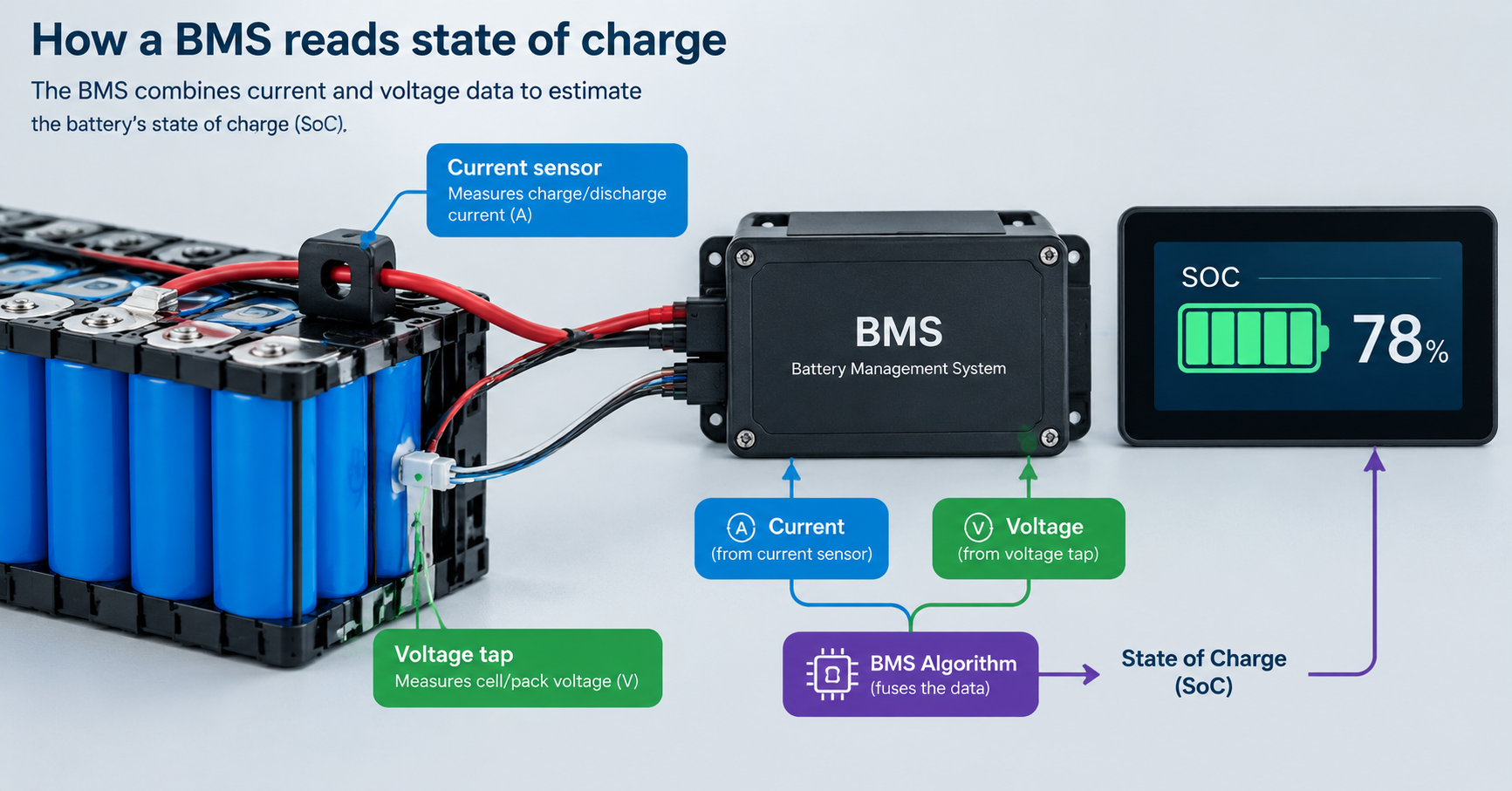
battery state of charge estimation is the process a battery management system uses to convert raw voltage, current and temperature readings into a single usable percentage of remaining capacity. It works by blending a current count with a voltage reference and a cell model, then correcting drift as the pack rests and ages. A good result stays stable across load, temperature and cycle life rather than jumping with every reading.
For a buyer, the number on the screen is only as trustworthy as the method behind it. Two packs with the same nameplate can show very different remaining energy once load, temperature and age are taken into account, and the gap is decided by how the controller infers charge rather than by the cells alone. The practical questions are not about the chemistry but about what the system measures, what it assumes, and where those assumptions break down in real use. This guide walks through the meaning of the figure, the methods in common use today, the field conditions that corrupt it, and the steps a controller takes to keep the reading close to reality across a long service life.
What does battery state of charge estimation actually mean?
battery state of charge estimation is the translation layer between the raw signals a cell produces and the single percentage a system acts on. A cell only ever presents voltage, current and temperature; it does not present a ready-made figure such as “42 percent left.” The controller has to infer that number, and the quality of the inference is what separates a reading you can plan around from one that drifts hours before the pack actually empties.
The distinction matters because state of charge is a model output, not a direct measurement. Treat it as a measured value and you design around a number that moves with temperature and load; treat it as an estimate and you start asking which method produced it, how it was validated, and what the controller does when its inputs disagree. Those are the questions that decide whether a spec sheet figure holds up once the system is installed and running under real conditions.
Why does SOC accuracy decide how much capacity you can actually use?
A conservative system leaves a buffer so it never reports empty before the cells are, and an over-confident one cuts the buffer too thin and risks a hard shutdown. Both behaviours are driven by the same root: uncertainty about the true state of charge. The wider that uncertainty, the larger the safety margin a designer must hold, and the larger the margin, the less of the nameplate the user can ever touch in daily operation.
In a rack-sized storage project the effect scales with every module. A few percent of guarded capacity per pack becomes a visible slice of the usable bank, and the project that sized against nameplate rather than usable ends up short when it matters. Reading the BMS monitoring outputs alongside the SOC figure is the quickest way to see whether the headroom is real or merely assumed by the controller.
Which methods do battery systems use to estimate state of charge?
Four approaches cover almost everything shipped today, and most controllers run more than one at once. The table below sets out what each method needs and where it gives way, so a spec can be read for the right trade rather than for a single headline number that hides the conditions attached to it.
| Method | Strength | Weakness |
|---|---|---|
| Coulomb counting | Tracks real charge in and out, so it follows load second by second | Drifts with sensor offset and self-discharge; needs a reset reference |
| Open-circuit voltage | Gives an absolute anchor from a rested cell voltage | Needs a long rest and a flat, temperature-corrected curve |
| Model-based (Kalman) | Fuses inputs and handles noise, good under varying load | Needs tuning per cell model and more compute |
| Impedance tracking | Reveals aging through resistance change | Sensitive to contact and temperature; weaker as a sole method |
No single row is the answer on its own. Coulomb counting is the workhorse but wanders; open-circuit voltage is trustworthy but only when the pack has sat still; model-based fusion is the bridge between them. A system that names only one method on the spec is worth a second question, because the honest answer is usually several methods working together, each covering the other’s weak moment in the duty cycle.
Coulomb counting versus open-circuit voltage: what each one gives up
The contrast between these two is the one most buyers should understand, because it explains why a reading is trustworthy at one moment and not another. Coulomb counting integrates current over time: it knows exactly how much charge has moved, which makes it responsive under active load. Its blind spot is the start point and the leak — any offset in the current sensor, and any self-discharge the count never sees, accumulates as error that only a rest can remove.
Open-circuit voltage takes the opposite deal. Measure a cell that has rested, compare its voltage to a known curve, and you get an absolute figure that needs no history. The cost is the rest itself: a pack under continuous load rarely sits still long enough, and the voltage-to-charge curve is shallow near the middle, so small voltage noise becomes large charge error there. Most designers use coulomb counting live and open-circuit voltage as the periodic correction, which is the practical shape of cell balancing methods and recalibration working side by side.
What quietly corrupts battery state of charge estimation in the field?
battery state of charge estimation loses credibility for a short list of reasons, almost all of them physical rather than algorithmic. Current-sensor offset shifts the count from the first cycle. Temperature swings move the open-circuit curve the controller compares against, so a cold pack reads differently from a warm one even at equal charge. Aging raises internal resistance and shrinks usable capacity, yet a fixed model keeps assuming the younger cell it was first tuned for.
Self-discharge and small parasitic loads add error the integrator never accounts for, and poor contact at a sense lead injects noise that the filter smooths into a slow bias. None of these is a software bug; each is a real signal the method cannot fully see. The fix is rarely a better formula and usually a better reference — a periodic rest, a temperature correction, and a capacity update as the pack ages. Field teams logging common BMS faults will recognise most of these as the same symptoms they already track.
How does a BMS keep battery state of charge estimation honest?
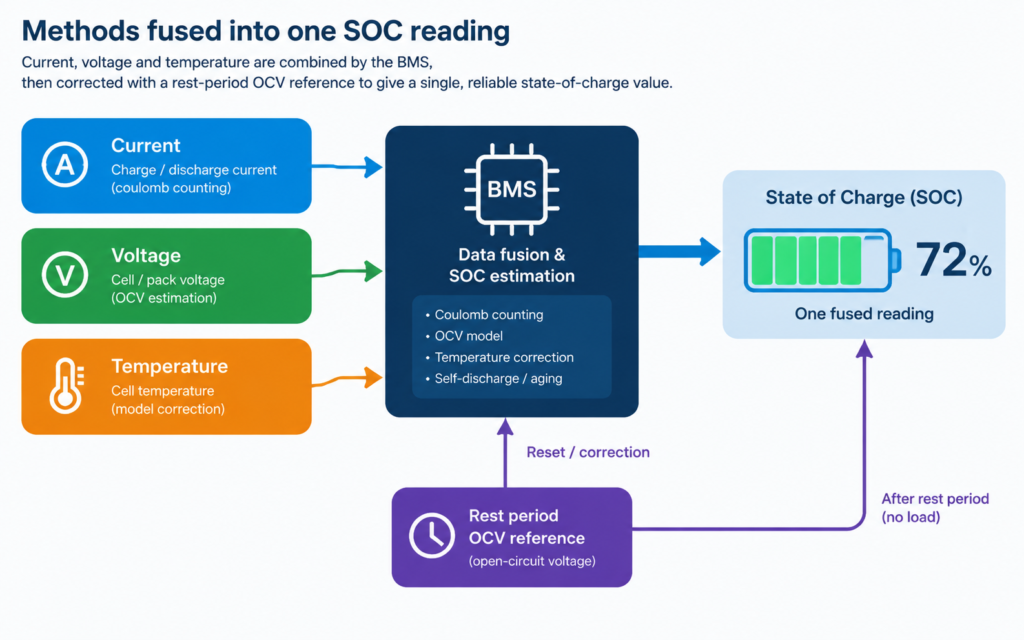
battery state of charge estimation stays useful because the controller does not trust any one input. It fuses the live count with voltage and temperature, then resets the count against an open-circuit anchor whenever the pack rests — typically at the top or bottom of a cycle where the voltage curve is steepest and the reading is least ambiguous. That recalibration is what stops a slow drift from becoming a permanent one across seasons of use.
Aging is handled by periodically relearning capacity rather than assuming it, and by weighting recent behaviour over old. Temperature corrections keep the voltage reference honest across seasons, and a sanity check against the measured energy actually delivered closes the loop. The result is a figure that wanders a little under stress but returns to truth at rest, which is the behaviour a battery lifecycle plan can be built on with confidence rather than guesswork.
Mistakes buyers should check in a state-of-charge spec
Five checks catch most of the gaps. Ask which methods the controller actually runs, not just whether it “calculates SOC” — a named fusion beats a vague claim. Ask the stated accuracy and the conditions it was measured under, because a percent figure without a temperature and load range is a slogan. Ask how and how often it recalibrates, since a count with no reset drifts by design rather than by accident in the field.
Then check whether the spec distinguishes nameplate from usable capacity, whether aging is relearned or assumed fixed, and whether the SOC output is logged for the how to size a home battery exercise rather than shown only on a screen. A spec that answers all of these is one you can size and warranty against; one that cannot is a number you will learn to distrust once the system is running.
Q. battery state of charge estimation?
battery state of charge estimation is how a BMS turns voltage, current and temperature into a usable percentage. It blends a live current count with a voltage reference and a cell model, then corrects drift during rest and aging.
Q. How does a BMS calculate SOC during discharge?
A BMS integrates the current leaving the pack to track charge drawn, then corrects it against voltage and temperature. The live count follows the load; the voltage and model stop it drifting. The two work together, not one replacing the other.
Q. What is the most accurate SOC estimation method?
No single method is most accurate in every condition. Coulomb counting leads under active load, open-circuit voltage leads at rest, and model-based fusion leads across changing conditions. The accurate answer for a storage system is several methods combined, with recalibration to keep them aligned over time.
Q. Why does temperature affect state of charge estimation?
Temperature shifts the open-circuit voltage curve a cell is compared against and changes internal resistance, so the same true charge reads differently when cold or warm. Without a temperature correction the estimate carries a seasonal bias that grows with the size of the climate swing.
Q. How often should a BMS recalibrate state of charge?
Recalibration happens whenever the pack rests long enough for a clean open-circuit reading, typically at the top or bottom of a cycle. Frequent shallow use delays it, which is why a system that rarely reaches a full rest drifts more than one with regular complete cycles.
Q. Does cell aging change how SOC is estimated?
Yes. Aging raises internal resistance and shrinks usable capacity, so a fixed model slowly overstates remaining energy. A controller that relearns capacity periodically tracks the older cell; one that assumes the original capacity will report a fuller pack than reality allows.
Q. Can state of charge estimation be wrong on a new battery?
It can, mainly from sensor offset, poor temperature correction or a mismatched cell model rather than wear. A new pack with a badly tuned estimator can drift as fast as an aged one, so the method matters more than age.
Request pricing for your project
Send us your usage and site details. For chisidal, we can share product prices, lead time and warranty information. Feel free to contact us for a quote.
- battery state of health
- battery thermal management system
- For chisidal, send your usage and site details, and we will come back with product prices, lead time and warranty information.