
grid forming battery storage is a way of operating a battery system so its inverter creates the grid’s voltage and frequency rather than matching a signal it receives from a stronger source. It gives a battery the role of a synchronous generator, holding the network steady during disturbances and after a blackout. For chisidal, this matters most on weak grids, islands and microgrids where no firm generator sets the reference.
Most battery systems sit quietly and follow whatever the grid tells them to do. That works well where a strong network already holds voltage and frequency steady, but it leaves the battery unable to help when the network itself is the problem — during a fault, a fast load swing, or the moments after a blackout when nothing is generating. Grid-forming control turns that relationship around. Instead of tracking a reference, the inverter establishes one, so the rest of the system can lock onto it. The result is a battery that can start a network on its own, ride through events a following inverter would trip on, and keep fragile networks inside safe limits.
What does grid forming battery storage actually mean?
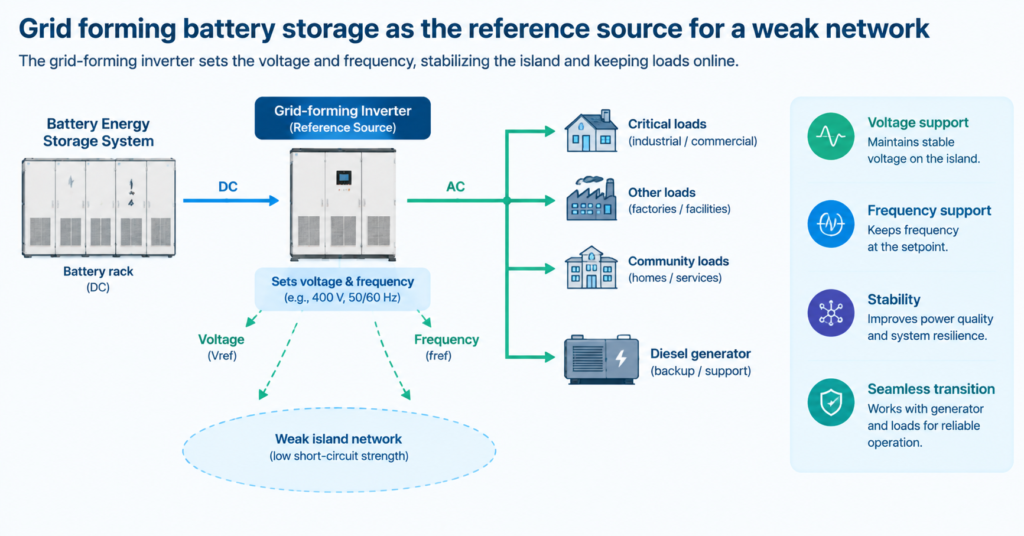
At its core, grid forming battery storage describes an inverter that behaves like a voltage source behind a controlled impedance, deciding the AC waveform it outputs rather than synchronising to an external one. A conventional, or grid-following, inverter measures the network and injects current at the right phase; a grid-forming inverter sets the phase itself. The distinction is small in a sentence and large in a blackout. Where a following inverter needs a live grid to know what to do, grid forming battery storage can define the grid from zero, which is what makes black start and island operation possible.
The mental model is a generator. A spinning machine does not ask the grid what voltage to produce; it produces one. A forming inverter emulates that in power electronics, so the battery becomes the reference other equipment follows — the same cells that were passive can now anchor a network.
Why do weak grids and islanded sites depend on grid-forming behavior?
A weak grid is one where adding or removing a load moves voltage and frequency sharply, because there is little behind the socket to absorb the shock — few rotating machines, long lines, or a high share of inverter-based generation. On such a network a grid-following inverter has nothing stable to follow, and the whole system can collapse into a cascade of trips. Grid forming battery storage supplies the stiffness that is missing: it holds voltage after a disturbance and provides the short-circuit current that protective relays expect. For chisidal, these are exactly the sites where a following design quietly fails and a forming design quietly holds.
On remote sites the same logic applies without a utility at all. An off-grid battery backup arrangement that relies on following inverters still needs a reference machine to start; a forming battery can be that reference, so the load comes up in a controlled sequence instead of hunting for a signal that never arrives. The difference shows up as fewer manual restarts and a network that recovers on its own.

Which grid services does grid forming battery storage provide?
Beyond simply storing energy, grid forming battery storage can deliver the services a network operator normally buys from spinning plant. It supports frequency by injecting or absorbing power within milliseconds of a deviation, and it supports voltage by holding the AC level at its terminals. Because the inverter emulates inertia, it slows the rate at which frequency moves, buying time for slower reserves to act. Black start is the headline service: after a total outage the battery can build a voltage waveform from nothing and bring other units back in sequence.
A grid-tied solar system paired with forming storage gains the same stabilising backbone that a conventional plant would have supplied. The solar array still produces energy, but the battery now provides the reference and the reserves, so a high-renewable site can survive the loss of the utility feed without a total collapse. Grid forming battery storage therefore turns a passive renewable connection into an active, supportive one.
Grid-forming versus grid-following: what changes in practice?
The choice is not about quality but about fit. A strong mainland network with ample thermal plant already has the stiffness a following inverter needs, so adding grid forming battery storage there is optional rather than essential. Move to a feeder with a high solar share, a remote island, or a microgrid storage project, and the reference source weakens to the point where forming control stops being a nice-to-have. The two modes can also coexist: forming units anchor the network while following units handle bulk shifting, under the coordination of the controller.
| Aspect | Grid-forming | Grid-following |
|---|---|---|
| Reference source | Sets voltage and frequency itself | Follows an external reference |
| System inertia | Emulated, supports stability | None, relies on the grid |
| Black start | Yes, can energise a dead network | No, needs a live grid first |
| Best fit | Weak grids, islands, microgrids, high-renewable networks | Strong, stiff grids with firm generation |
The decision comes down to whether a stable reference already exists. Where it does, following inverters are simpler and cheaper. Where it does not, forming control is the missing piece.
Where is grid forming battery storage now required?
Regulators and grid codes in several regions now expect new renewable and storage connections to contribute to stability rather than assume it. Islands and remote communities with limited generation have adopted forming control because the alternative is frequent diesel running or outright outages. Mission-critical sites — a hospital, a data centre, a defence installation — value the black-start and ride-through capability. And large renewable zones where thousands of inverters would otherwise behave as one passive block are increasingly asked to act as a forming fleet. grid forming battery storage is now written into specifications for exactly these cases.
A containerized BESS deployed at such a site is usually specified with forming mode enabled from commissioning, because retrofitting later means re-testing the whole connection. The earlier the requirement is understood, the cheaper it is to meet.
How does grid forming battery storage work with the PCS and EMS?
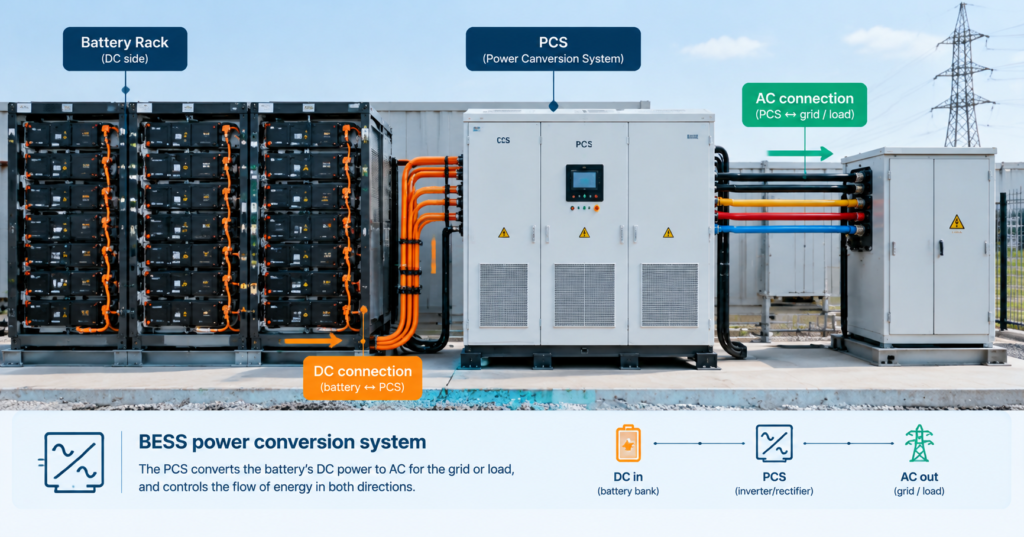
The forming behaviour lives in the power conversion system, but it is pointless without something telling it the operating point. The PCS carries the grid-forming control loops; the energy management system sets frequency setpoints, power limits and when to switch between grid-connected and islanded modes. A storage hybrid inverter that supports forming mode exposes these settings through its controller, and the EMS decides when the battery should hold the network versus when it should simply charge or discharge.
Because the inverter can form a perfect waveform while the site still trips if the EMS has not been told the plan, the two must agree. The PCS answers what waveform; the EMS answers under what rules. grid forming battery storage only delivers value when both answers are consistent, so treat the controller as half the product rather than an accessory.
What should you confirm before specifying grid-forming storage?
Before you write forming mode into a specification, confirm a few things that are easy to assume and expensive to get wrong. Check that the chosen inverter and PCS actually support grid-forming control, not just a marketing label. Confirm the grid code or island requirement that demands it, so the design matches the rule rather than a generic claim. Agree the transition between grid-connected and islanded operation, including how the battery reacts the instant the utility disappears. And verify the EMS can manage the mode change without operator action.
For chisidal, we can review these points against your site and share what a forming configuration would require in practice. The aim is to avoid specifying a capability on paper that the installed controller cannot deliver under the disturbance your network actually faces. A short pre-tender review catches most of those gaps before they reach commissioning.
grid forming battery storage?
Grid forming battery storage is a system whose inverter sets the grid’s voltage and frequency rather than following a reference. It lets the battery act like a generator, holding network steady and restarting it after an outage. This matters most on weak grids, islands and microgrids.
Q. How is grid-forming different from grid-following?
A grid-following inverter measures the grid and injects current, so it needs a live grid to copy. A grid-forming inverter creates the voltage waveform and is the reference. The difference shows during faults and blackouts, where a following unit trips and a forming unit rebuilds.
Q. Can grid forming battery storage restart a dead grid?
Yes. Black start is a defining service of grid-forming control. After a total outage the battery builds voltage and frequency, then brings generators and loads back. A grid-following inverter cannot do this because it has no reference until something else energises the network.
Q. Where is grid-forming control required today?
It is required or strongly expected on weak grids, islands and renewable zones with high inverter shares. Some grid codes now ask new connections to support stability. Mission-critical sites adopt it for ride-through and black-start. Strong mainland networks usually do not need it.
Q. Does grid-forming replace the need for a diesel generator?
Not always. A forming battery can start and hold a network without diesel. But for very long outages a generator may cover energy the battery cannot store. The two are complementary: the battery forms the grid instantly, and the generator supplies sustained energy.
Q. What does the EMS need to control in a forming system?
The energy management system sets the frequency reference and power limits. Without it the inverter can produce a perfect waveform while the site still trips, because no one set when to change state. The EMS and PCS must agree on the plan before commissioning.
Q. How do I confirm an inverter truly supports grid forming?
Ask for the grid code that proves forming control, not just a label. Confirm black-start and ride-through for your site, and check that the EMS manages the mode transition. For chisidal, we can review the inverter and controller against your requirement before you specify it.
Request pricing for your project
Send us your usage and site details. For chisidal, we can share product prices, lead time and warranty information. Feel free to contact us for a quote.
- bess energy management system
- bess power conversion system
- For chisidal, send your usage and site details, and we will come back with product prices, lead time and warranty information.