A battery purchase contract has to do more than fix a price and a date, because most disputes on a battery order are about whether the packs met the specification. This guide walks through the clauses that decide the outcome: acceptance criteria, delivery liability, warranty and claims, tooling ownership, confidentiality, price movement, and the law that applies.
Battery orders fail in ways a generic goods contract does not anticipate, which is why the template matters more here than buyers expect. The clauses below are the ones that decide the outcome when a shipment is late or a pack does not measure up.
Why a battery order cannot run on a generic template
A generic goods contract assumes the product either arrives or does not, which is the first reason a battery purchase contract needs its own drafting. A battery pack can arrive on time, pass a visual check and still be wrong in ways that only show up under load, in cycle testing, or several months after commissioning. That gap between delivery and discovery is what most battery disputes are actually about, and it is the reason the contract has to carry testable criteria rather than a description.
The second reason is documentation. A pack travels with a certificate set, a test report and, in many markets, a transport declaration, and the obligation to produce those belongs somewhere in the agreement. The battery export certification guide covers what that documentation usually comprises, and the contract should simply say who provides it and by when.
Specification and acceptance criteria that can actually be enforced
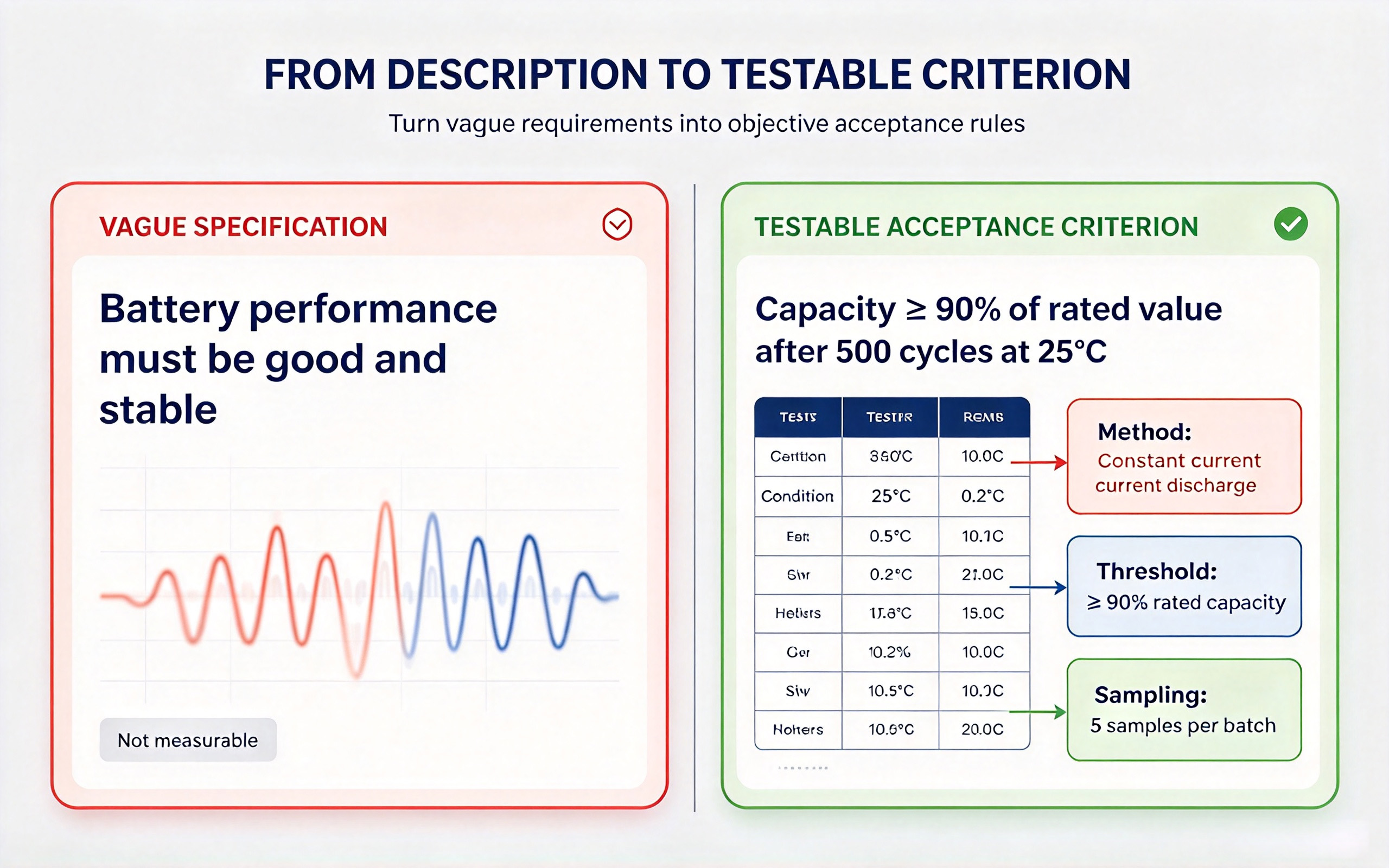
This is the clause that decides most outcomes, and the test of a good one is simple: could a third party run it and reach the same answer? “Meets agreed specification” is not enforceable. “Capacity measured at the terminals under the stated discharge rate and temperature, with the result not less than the stated minimum” is. The pattern is always the same — a measured quantity, a method, a condition, and a pass threshold.
Sampling belongs in the same clause. State how many units are tested, how they are selected, who pays for the test, and what happens on a fail: re-test, rework, replacement, or rejection of the lot. Without that, an acceptance argument drifts into goodwill. Where a buyer has no test capability of its own, an independent inspection before shipment is the usual substitute, and the process is worth agreeing before the first lot ships.
Acceptance also needs a clock. A contract that lets a buyer reject packs indefinitely is one no supplier will sign, and one that gives a buyer three days to find a latent defect is not worth having. The workable structure is a short window for visible and documented non-conformance, and a longer window for defects that only appear in service.
Delivery dates, delay liability and what counts as late
“Delivery” needs a definition before it can be enforced. On a cross-border order the meaningful events are the date the goods are ready, the date they are handed to the carrier, and the date they clear into the buyer’s market — and a contract that names only one of these leaves the other two open. The trade term chosen elsewhere in the agreement allocates those handover points, and the contract should use exactly the same language in both places.
Title is worth separating from risk as well. An agreement can pass risk at one point and title at another, and where the buyer has paid in advance that gap decides who owns goods sitting in a warehouse or on a vessel. Most standard templates handle this adequately; the check is simply that both points are stated rather than assumed to be the same.
Delay liability is usually the hardest part to settle and the easiest to write badly. The workable version sets a grace period, a daily rate capped at a share of the order value, and a point at which the buyer may cancel and recover what has been paid. Unlimited liability for delay is rarely accepted, and an unspecified “penalty” is rarely enforceable, so a capped rate with a clear trigger is the pragmatic ask.
Warranty windows, claims and the evidence trail
Warranty on a battery is a measurement problem before it is a legal one. A claim depends on what was measured, under what conditions, and by whom — which means the contract should say which test method establishes capacity and who bears the cost of that test. The battery warranty cycles versus years guide covers how cycle count and calendar years interact, and the contract should pick one basis rather than implying both.
The claims route matters as much as the window. State what the buyer must submit, how quickly the supplier must respond, who pays for return freight on a valid claim, and whether the remedy is repair, replacement or credit. The battery warranty claim process guide walks through that sequence, and aligning the contract with it avoids the common failure where a valid claim stalls because nobody owns the logistics.
Intellectual property, tooling and confidentiality
Three separate things are usually bundled into one vague clause, and they are better written apart. Design IP is who owns the pack design and whether the supplier may sell the same design to anyone else. Tooling is who owns the mould and whether exclusivity follows it. Confidentiality is what may be disclosed, to whom, and for how long after the relationship ends.
Tooling is the one most often left unsaid and most often argued about, because a buyer who funds a mould does not automatically own it. The ownership and recovery options behind that are a commercial question in their own right; the contract here only needs to state title, exclusivity and transfer. Confidentiality should survive termination by a defined period, and exclusivity should say whether it is permanent, time-limited, or tied to a volume commitment.
Exclusivity is the clause buyers over-ask for and suppliers under-deliver. A blanket bar on selling the same pack to anyone else is rarely granted, and where it is, it is usually priced. A narrower version — exclusivity in a defined territory, for a defined period, or while a volume commitment is being met — is both easier to obtain and easier to enforce, because it can be tested against something.
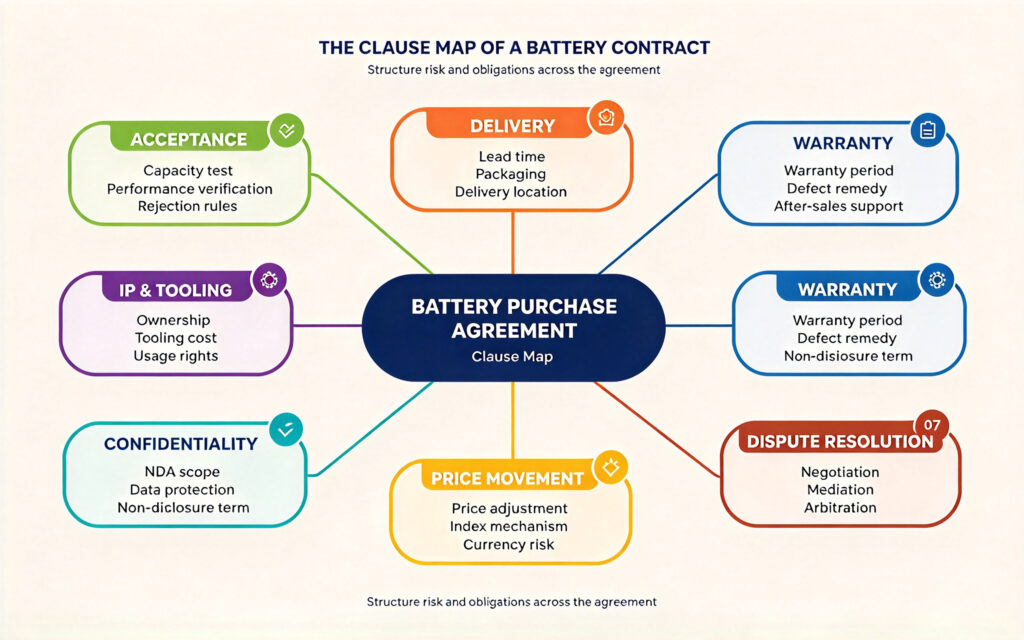
Force majeure, price movement and governing law
Force majeure is standard, but on a battery order it is worth narrowing: a clause broad enough to cover any supply disruption removes the supplier’s obligation to plan. The useful version lists qualifying events, requires prompt notice, requires the affected party to mitigate, and gives the buyer a right to cancel if the event runs beyond a stated period.
Raw material price movement is the clause buyers forget. Where a long-term supply arrangement is being signed, a price adjustment mechanism tied to a published index or to a re-quotation at agreed intervals is more workable than a fixed price nobody can hold. Governing law and dispute resolution should be named explicitly — which law applies, where disputes are heard, and in what language — because an unnamed forum turns every disagreement into a preliminary argument about venue.
The checklist to run before signing
Six checks catch most of what goes wrong. Does every specification line have a method, a condition and a threshold? Is sampling and the consequence of a fail written down? Are delivery, risk transfer and the trade term described in the same language? Do the warranty basis and the claims route match the warranty offered in the quote? Are tooling title, exclusivity and confidentiality stated separately? And are law, forum and language named? Where a commercial package is being settled at the same time, the battery MOQ, lead time and payment terms guide covers the MOQ, lead time and payment side; choosing the counterparty before drafting is covered in the how to evaluate battery manufacturers guide.
Two clauses in a battery purchase contract do most of the work once a dispute starts: the acceptance clause, because it decides whether the goods were ever right, and the claims clause, because it decides what happens next. Everything else is context around those two.
One final check belongs on the annexes rather than the body of the agreement. Specifications, test methods, drawings and certificate lists usually live in attachments, and an annex that is not expressly incorporated is an annex that may not bind either party. Naming the annexes and stating that they form part of the agreement is a one-line fix for a gap that appears more often than it should.
Q. battery purchase contract?
A battery purchase contract is the agreement covering specification, acceptance testing, delivery, warranty, tooling and liability on a battery order. It needs testable criteria rather than a product description, because most disputes concern whether the packs met the specification.
Q. What should an acceptance clause say?
A measured quantity, the test method, the conditions, a pass threshold, how many units are sampled and what happens on a fail. If a third party could not run the test and reach the same answer, the clause is not enforceable.
Q. Who owns the tooling paid for under the contract?
Whoever the contract names. Paying for a mould does not transfer title by default, so state ownership, exclusivity, transfer rights and how long an idle tool is stored.
Q. How should delay liability be written?
With a grace period, a daily rate capped at a share of the order value, and a point at which the buyer may cancel and recover payment. An uncapped or unspecified penalty is rarely accepted and rarely enforceable.
Q. Should warranty be based on cycles or on years?
Pick one basis and define how it is measured. Mixing cycle counts and calendar years without saying which governs is the most common source of warranty argument.
Q. Do I need a price adjustment clause?
On a long-term supply arrangement, usually yes. A mechanism tied to a published index or to re-quotation at agreed intervals holds better than a fixed price that cannot be sustained.
Q. What should the dispute clause name?
The governing law, the place and method of dispute resolution, and the language of the proceedings. Naming all three prevents a preliminary argument about venue before the substance is reached.
Next step: turn the specification into a testable clause
The clause that decides the outcome is acceptance. Send the specification and the test capability you have.
- Align handover points with the incoterms for battery orders guide
- Separate the tooling lines using the battery tooling costs guide
- For chisidal, send your usage and site details, and we will come back with product prices, lead time and warranty information.