incoterms for battery orders decide the point at which risk and cost move from seller to buyer — who books the vessel, who clears export, who insures the cargo and who pays when something goes wrong in transit. This guide compares EXW, FOB, CIF and DDP on a lithium shipment, explains how dangerous goods status narrows the choice, and shows what to write into the contract.
The term on the quotation is not a formality: on a battery shipment it decides who is exposed when a lithium consignment is held at a port. The four terms compared here cover almost every battery quote a buyer will see.
What a trade term actually allocates
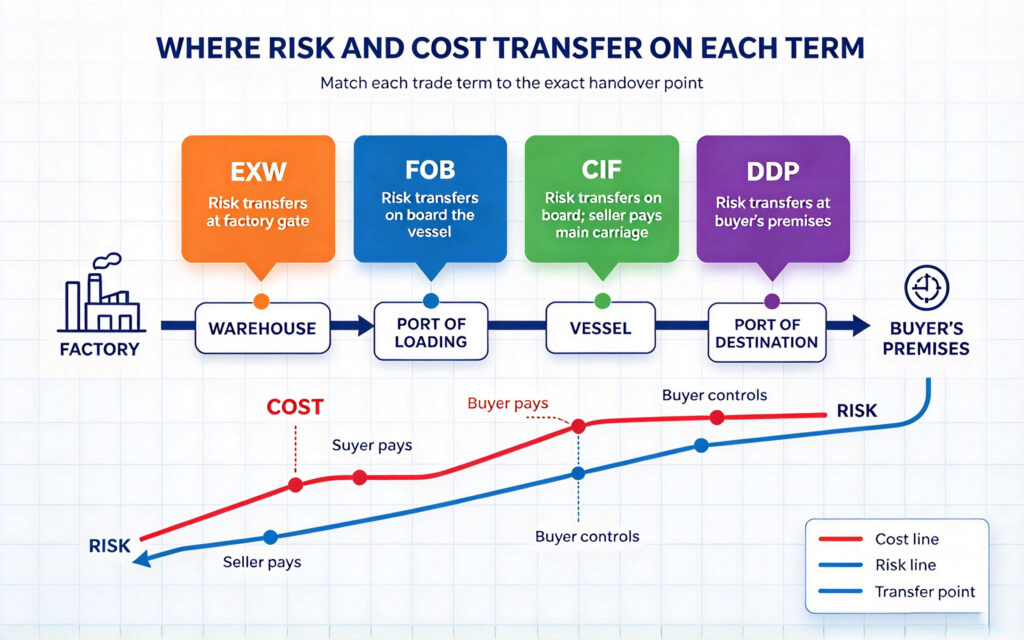
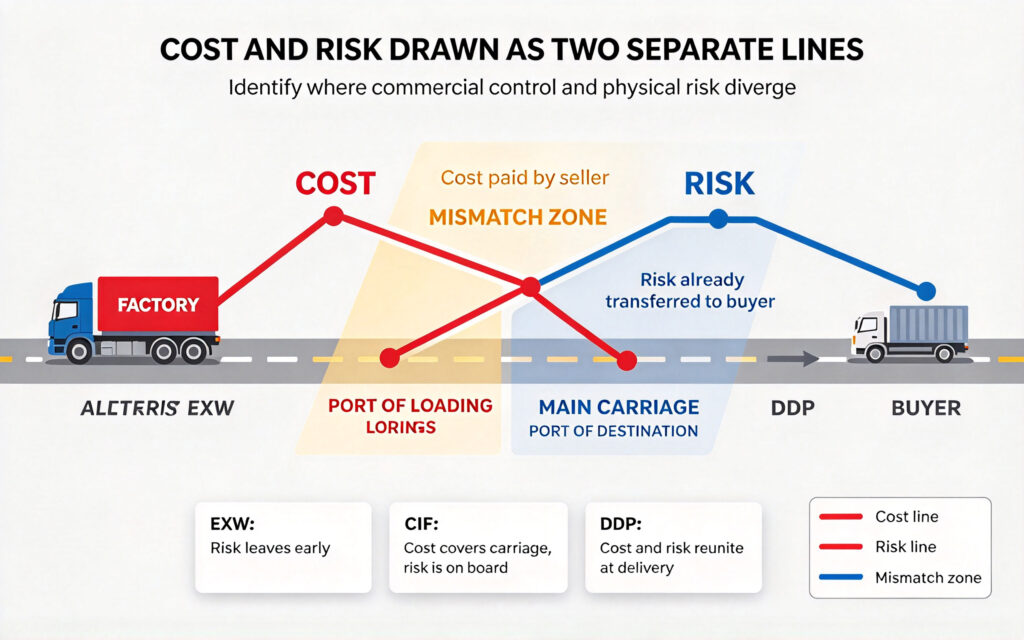
A trade term answers two questions that are easy to confuse: where cost transfers, and where risk transfers. They are not the same point, and most surprise bills come from assuming they are. A buyer can be paying for freight on cargo they do not yet own, or carrying risk on cargo somebody else is still moving, and both arrangements are legitimate — but only if the buyer understood them when the order was placed.
The second thing a term allocates is obligation: who books the carrier, who files the export declaration, who insures the leg, and who handles import clearance. On a battery order those obligations are heavier than on ordinary goods, because lithium consignments carry documentation and carrier restrictions that not every party is equipped to handle.
EXW, FOB, CIF and DDP on a battery order
The four terms a battery buyer meets most often sit on a spectrum of how much the seller does. At one end the buyer collects at the factory gate and owns everything from that moment; at the other the seller delivers to the buyer’s door and carries the whole chain. In between, the seller’s obligation ends at the vessel or extends to the port of arrival with insurance bought on the buyer’s behalf.
| Term | Who books the main leg | Where risk transfers | Who clears import |
|---|---|---|---|
| EXW | Buyer | At the seller’s premises | Buyer |
| FOB | Buyer | On board at the load port | Buyer |
| CIF | Seller | On board at the load port | Buyer |
| DDP | Seller | At the named destination | Seller |
The row worth reading twice is CIF. The seller pays the freight and buys insurance, but risk still transfers at the load port — so the buyer carries the transit risk while the seller controls the carrier. That is not a bad arrangement, but it is a specific one, and it is the term most often chosen without the buyer realising what it does not cover.
EXW deserves a note as well, because it is often quoted as the cheapest option and is frequently the most expensive in practice. The seller’s obligation ends at the factory gate, which leaves the buyer responsible for export clearance in the seller’s country — a step that normally needs a local entity or an agent, and one new importers routinely underestimate when comparing quotes.
Lithium as dangerous goods: which forwarders will even quote
Here is the constraint that separates battery orders from every other category: lithium cells and packs are regulated dangerous goods, and the set of carriers and freight forwarders willing and certified to move them is much smaller than the general market. A buyer who takes a term that puts booking in their own hands is also taking on the job of finding a forwarder who will accept the cargo at all.
That is the practical argument for letting the seller control the main leg on a first order. An exporter shipping lithium regularly already holds the carrier relationships, the packing declarations and the trained staff to complete the documentation, and the cost of that capability is usually lower inside an existing shipping programme than bought once by a new importer. The lithium battery shipping guide covers what the physical shipment requires.
The buyer-side obligations do not disappear under a seller-controlled term, either. Classification, packing and marking have to be correct before the carrier accepts the consignment, and a rejection at that stage delays the order regardless of which party was supposed to book it.
Where cost and risk stop matching
Three mismatches cause most of the surprise invoices. The first is insurance: a term under which the seller buys cover often buys the minimum level, which may not match the value of the cargo or the exposure the buyer is carrying. The second is destination charges — terminal handling, storage and demurrage — which frequently sit outside a freight figure that looked complete on the quotation.
The third is the gap between the named place and the real one. A term that names a port is not a term that delivers to a warehouse inland, and the leg between them belongs to somebody. Reading incoterms for battery orders carefully means checking that the named place matches where the goods actually need to arrive, not where the shipment nominally ends.
How the term ties to payment timing and customs clearance
The trade term and the payment schedule are usually negotiated together, and they should be drafted together. Where the buyer pays a large share before shipment, the term decides how much protection that payment has: paying in full under a term where risk has already transferred to the buyer leaves little leverage if the consignment is held. The battery MOQ, lead time and payment terms guide covers how that commercial package is put together.
Clearance is the other half. Importing lithium batteries involves its own documentation and, in many markets, its own licensing or notification steps, and the importing lithium batteries guide covers that process. Whichever term is chosen, the buyer should confirm who the importer of record is, because the obligations that follow — duties, declarations and any local registration — attach to that party regardless of who booked the vessel. Local duty and tax treatment varies by market, so confirm it with a broker before fixing the term.
Choosing a term by your own capability
The right term is a function of what the buyer can actually do, not of which one sounds safest. A buyer with an established forwarder, a broker and experience with dangerous goods can take a factory-gate term and often save money doing it. A first-time importer usually cannot, and the saving is rarely worth a consignment held at a terminal.
A reasonable progression is to let the seller handle the chain on early orders, learn where the costs actually fall, then move toward a buyer-controlled term once the forwarder and broker relationships exist. Where the buyer is sourcing through a supplier with its own export programme, the lithium battery suppliers in China guide covers what to check on that capability. Documentation requirements then follow the shipment, and the battery export certification guide covers the certificate set.
Two questions usually settle the choice quickly. Can the buyer name a forwarder that has already moved lithium consignments for them, and can the buyer name a broker who has cleared those consignments before? If the answer to either is no, a seller-controlled term is the honest answer for the first few orders, whatever the quoted difference appears to save.
Writing the term into the contract, with its version
Three details finish the job. Name the term and the place — a bare three-letter code is not enough, because the place decides where the obligation ends. Name the version of the rules being referenced, since the edition changes and the allocation differs between editions. And state what happens to charges that fall outside the term: storage, demurrage, re-delivery and any cost arising from a consignment held for inspection.
That last line is the one worth insisting on, because incoterms for battery orders allocate the ordinary chain and say nothing about the exceptional one. Where the buyer also wants a check before the goods leave, that inspection should be named as its own clause rather than assumed to be included, and the term itself belongs inside the wider supply agreement.
Q. incoterms for battery orders?
Incoterms for battery orders are the trade terms that set where cost, risk and the shipping obligations move from seller to buyer. EXW, FOB, CIF and DDP differ in who books the carrier, who insures the cargo and who clears import.
Q. What is the difference between FOB and CIF on a battery shipment?
Under FOB the buyer books the main leg; under CIF the seller does and buys insurance. Risk transfers on board at the load port under both, so CIF leaves the buyer carrying transit risk while the seller controls the carrier.
Q. Is DDP the safest option for a first battery import?
It is the most complete, because the seller carries the chain to the named destination. It is not always available or cheap, and the buyer should still confirm who is importer of record and what happens to charges outside the term.
Q. Why does lithium being dangerous goods change the choice?
Fewer carriers and forwarders will accept lithium consignments, and the documentation is stricter. A term that puts booking in the buyer’s hands also hands over the job of finding a forwarder who will take the cargo at all.
Q. Who pays insurance under CIF?
The seller buys it, but often at a minimum level, and the risk has already transferred to the buyer at the load port. Check what the cover actually extends to before relying on it.
Q. Should the term be written with a version number?
Yes. The rules are revised by edition and the allocation differs between editions, so naming the version alongside the term and the place avoids an argument later.
Q. Do trade terms cover storage and demurrage?
Usually not. Those charges often fall outside the term, so state in the contract who bears storage, demurrage, re-delivery and any cost from a consignment held for inspection.
Next step: match the term to what you can actually handle
The cheapest term is rarely the safest on a first lithium shipment. Send the route and the capability you have.
- Work the clearance side in the importing lithium batteries guide
- Add a pre-shipment check with the battery pre-shipment inspection guide
- For chisidal, send your usage and site details, and we will come back with product prices, lead time and warranty information.