battery quotation is the supplier’s priced response to a sourcing request, and almost everything that matters about it sits above the total. Cells, BMS, enclosure, labour and certification are folded into one number, and the number only means something once you know what was included. This guide takes the document apart line by line and sets out the basis on which two quotes can actually be compared.
Two quotes for the same pack can differ by a wide margin without either supplier being wrong. The difference usually lives in the lines nobody reads, and those lines are where a sourcing decision is actually made.
What sits inside a battery quotation before you reach the total
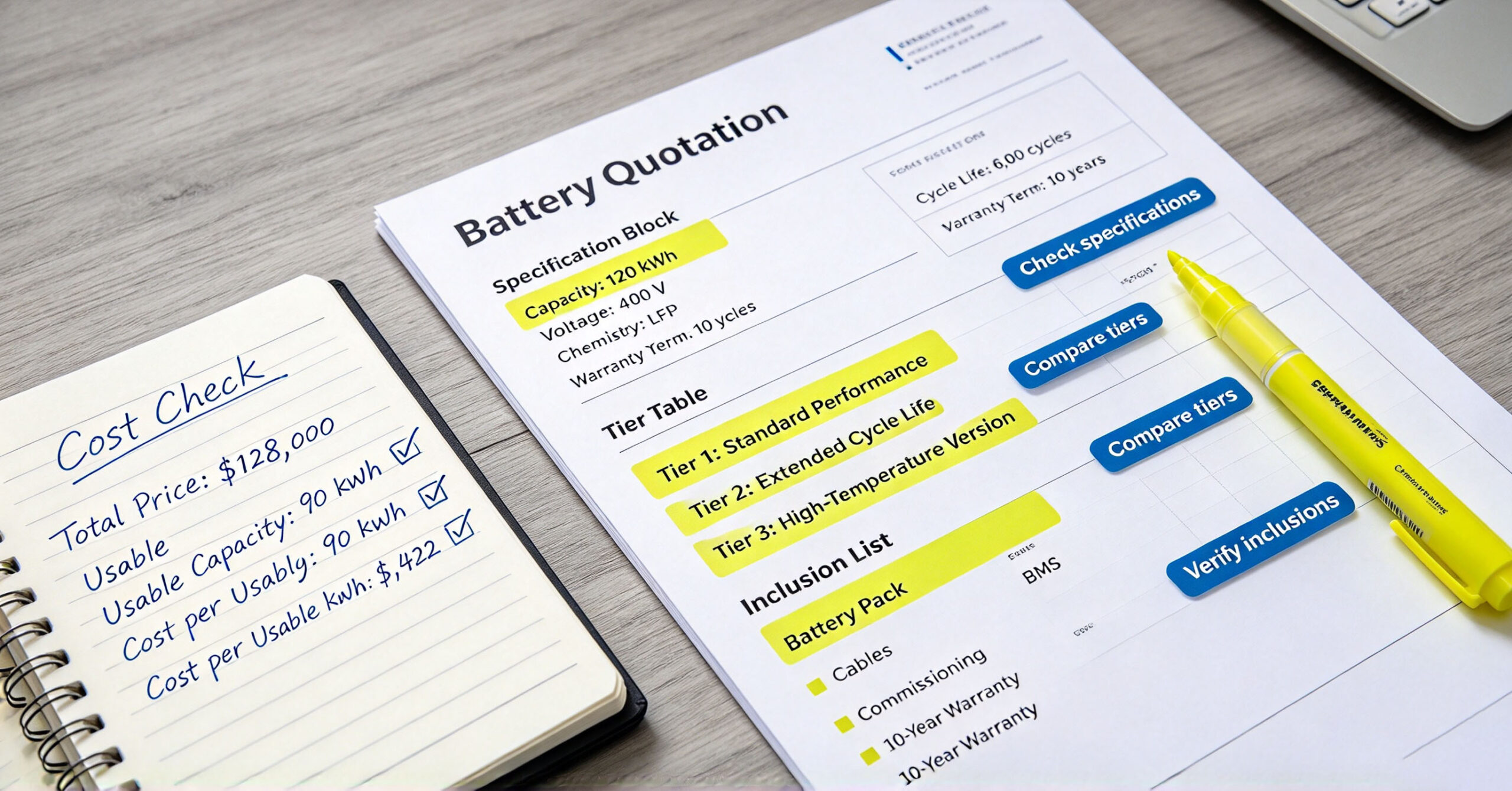
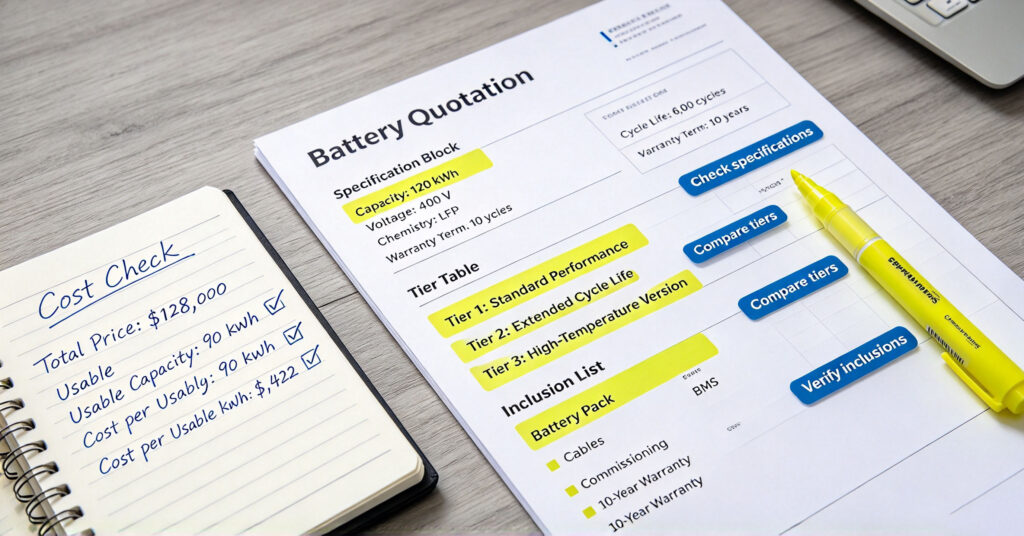
A workable battery quotation has four blocks: a specification block that restates what is being priced, a commercial block with unit price, tiers and validity, a scope block listing what is included and what is not, and a terms block covering payment, currency and delivery. The total is the last thing to read, because it is the only line that cannot be checked on its own.
Start with the specification block instead. If the restated capacity, chemistry, voltage or rate differs from what you asked for, every number below it is pricing something else — and that mismatch is far more common than a deliberate error. Where the restatement is vague, ask for it to be rewritten before discussing price at all.
The commercial and scope blocks are where the comparison actually happens. A battery quotation that gives one figure for a system and nothing else is not a quote, it is an opening position, and the useful response is to ask for the breakdown rather than to negotiate against the total. Background on what a system costs at market level sits in the how much a solar battery costs guide.
Where the unit price in a battery quotation comes from
Five inputs make up most of the unit price, and they behave differently when volume or specification changes. Cells are the largest single share and the most volatile, because cell pricing tracks raw material markets rather than factory efficiency. The BMS is a smaller, steadier line that scales with complexity rather than with capacity. Structure, enclosure and thermal hardware scale with physical size.
| Cost block | Scales with | How it behaves |
|---|---|---|
| Cells | Capacity and chemistry, and the cell maker chosen | Largest share; tracks raw material markets |
| BMS | Functional complexity, not size | Steady line; rises with communication and protection scope |
| Structure and enclosure | Physical size and ingress rating | Falls per unit with volume once tooling exists |
| Labour and test | Assembly time and the test regime agreed | Partly fixed; amortised across the run |
| Certification | Number of markets and standards | Mostly fixed; amortised, sometimes billed separately |
The value of reading the build-up rather than the total is that it tells you which lever is worth pushing. Where cells dominate, the argument is about chemistry and cell source; where certification dominates, the argument is about how many markets really need to be covered in one filing.
Volume tiers and how quantity moves a battery quotation
Price steps rather than glides, and the steps sit where production changes character — a fresh cell lot, a different fixture, a full shift instead of a partial one. A battery quotation showing a tier table is worth more than one showing a single figure, because the table tells you what the next order would cost and how much of the discount is already available to you.
Read the tiers against your real annual volume rather than against the first order alone. A price that looks high at a small quantity may sit just below a break, and committing to a slightly larger first order can cost less in total than buying twice. Conversely, a tier that only improves at a quantity you cannot sell through is not a discount, it is a storage problem.
Validity windows and raw-material linkage in a battery quotation
Every battery quotation carries a validity period, and the period is a statement about risk rather than about politeness. A short window usually means the supplier is exposed to cell pricing and does not want to hold a number across a quarter. A long window may mean the number carries a margin buffer instead.
Ask what happens at the end of it. Some suppliers hold the price regardless, some re-quote against the cell market, and some link the number to a published index in the terms block. None of the three is wrong, but they are very different commitments, and the difference only becomes visible when the order actually slips. Where a project will be priced months before it is ordered, this line matters more than the unit price does.
What a battery quotation includes, and what it quietly leaves out
The scope block is where most comparisons go wrong, because exclusions are usually printed in smaller type than inclusions. Freight and insurance are the obvious pair, and whether the quote is on an ex-works or a delivered basis changes the number substantially. Certification is the second: some suppliers fold it into the unit price, others bill it as a separate project, and a quote that looks cheaper may simply have moved that cost below the line.
Then the three that are easiest to miss. Tooling and moulding cost, where the enclosure or a bracket is new rather than existing. Spare parts and a recommended spares holding for the first year. And commissioning support, documentation and drawings, which are sometimes included and sometimes billed by the day. Ask for a written inclusion list; if a supplier will not produce one, assume the narrower reading.
Payment rhythm and currency on a battery quotation
Payment terms are a price, just not one that appears in the unit figure. A deposit ahead of production, a balance against documents, and a retention held until after commissioning each carry a different financing cost for the buyer, and the difference between them is often larger than the gap between two suppliers’ headline prices.
Currency matters for the same reason. A battery quotation priced in a currency the buyer does not earn in transfers an exchange risk that has a real cost over a multi-month order, and the quote should say whether the rate is fixed, floating or renegotiated at invoice. How these terms are negotiated — deposits, milestones and currency together — belongs to the battery MOQ, lead time and payment terms guide rather than to reading the quote itself.
The basis on which a battery quotation should be compared
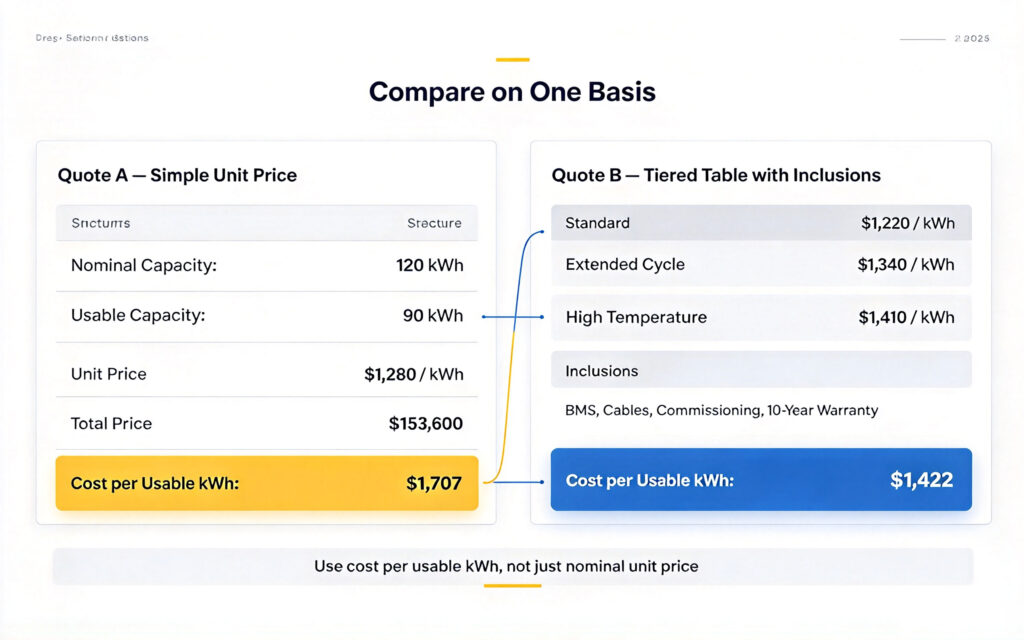
The defensible comparison is cost per usable kilowatt-hour over the service life, not the unit price on the front page. That means normalising three things first: capacity basis, since a pack quoted on nameplate and one quoted on usable are different products, which the usable versus nameplate battery capacity guide sets out; cycle life, because a cheaper pack that reaches its end-of-life threshold sooner is not cheaper per delivered kilowatt-hour, and the cycle life versus price guide covers that trade directly; and scope, so that freight, certification and spares sit on the same side of the line in every column.
Once those three are aligned, the comparison usually gets much easier — most genuine gaps close, and the ones that remain are real differences in cell source or build quality rather than in presentation. Where the purchase is a project rather than a product, the battery energy storage cost and ROI guide is the right frame for what the delivered kilowatt-hour is worth.
Red flags in a battery quotation, and how to answer one
Five patterns are worth slowing down for. A restated specification that quietly differs from what you sent. A single figure with no breakdown and no inclusion list, which makes the number impossible to check. A validity window far shorter than the decision timeline, which usually means the price will move before you can accept it. Certification listed as “as required”, which is not a commitment to anything.
The fifth is a tier structure that improves only at quantities with no relationship to your actual demand — a sign the table was copied rather than built. The right answer to any of these is not a counter-offer but a request: ask for the breakdown, the inclusion list and the specification restated in your own words, then compare again.
Q. battery quotation?
A battery quotation is a supplier’s priced response to a sourcing request. It usually contains a specification block, a commercial block with unit price and tiers, a scope block listing inclusions and exclusions, and a terms block covering payment and delivery.
Q. What should a battery quotation include?
The restated specification, unit price and volume tiers, validity period, delivery terms, a written inclusion list covering freight and certification, and payment terms with currency stated. A single figure with none of these is an opening position, not a quote.
Q. Why do two battery quotations for the same pack differ?
Mostly through scope and assumptions rather than through margin. Different capacity bases, different cell sources, and freight or certification sitting inside one price and outside the other account for most of the visible gap.
Q. How long is a battery quotation valid?
It varies by supplier and by how exposed they are to cell pricing. Short windows usually signal raw-material exposure; longer ones may carry a buffer. Ask what happens to the price when the window closes.
Q. What is usually excluded from a battery quotation?
Freight and insurance are the common pair, followed by certification, tooling for new enclosures, spare parts and commissioning support. Ask for the exclusion list in writing rather than inferring it from the total.
Q. How do I compare battery quotations fairly?
Normalise capacity basis, cycle life and scope first, then compare cost per usable kilowatt-hour over the service life. Comparing headline unit prices without that alignment is the main source of bad award decisions.
Q. Should I negotiate the first battery quotation I receive?
Ask before negotiating. Request the cost breakdown and the inclusion list, because the first counter-offer is usually better spent correcting scope than pushing the number down.
Next step: get the quote broken down before you compare
The useful response to a single figure is a request, not a counter-offer. Ask for the breakdown, the inclusion list and the specification restated.
- Write the request that produces it in the battery rfq guide
- Fix the outcome in writing in the battery purchase contract guide
- For chisidal, send your usage and site details, and we will come back with product prices, lead time and warranty information.