battery sample order is the small, paid-for first batch a buyer validates before committing to volume — and it is the last point at which a design problem is still cheap to fix. It covers three different things: an existing catalogue unit, a modified version of one, or a newly developed pack. This guide sets out what to test, how to record the result, and what has to be true before production is released.
Everything after the sample round is expensive to undo. That is the only reason the stage exists, and it is worth spending a few weeks on rather than a few days, because the results set the reference for the production order.
Why the battery sample order is the last gate before volume
Once a production run starts, every unresolved question becomes a change order rather than a test. Cell matching, thermal behaviour under the real load, communication handshakes with the inverter, and whether the protection logic trips where the specification says it should — all of these can be checked on a handful of units and none of them can be checked once several hundred are on a container.
The economics are lopsided in the buyer’s favour. A sample round costs a small fraction of a production order and consumes a few weeks; discovering the same problem after delivery costs the order, the freight and the relationship. The battery sample order is not a formality to be got through, it is the stage where the project is still cheap to change.
Three kinds of battery sample order, and why they differ
The same phrase covers three quite different pieces of work, and the differences drive both cost and lead time. A catalogue sample is an existing product pulled from stock or from the next production slot. A modified sample takes an existing platform and changes something — the enclosure, the terminal layout, the communication protocol or the label. A new-build sample is developed from the requirement.
| Sample type | What changes | Typical lead time | What it proves |
|---|---|---|---|
| Catalogue | Nothing; an existing unit | Shortest | That the product performs as published |
| Modified | Enclosure, terminals, protocol or labelling | Moderate | That the change works without breaking the platform |
| New build | Developed from the requirement | Longest | That the design meets the requirement at all |
State which of the three you are asking for, because the answer changes what the supplier has to do and what you should expect to pay.
Cost, payment and quantity on a battery sample order
Samples are usually charged at a premium per unit rather than at production price, because the line is being interrupted rather than run. Whether that premium is credited back against the first production order is a commercial question worth asking before the order is placed, and the answer should be written down rather than agreed verbally.
Quantity is a testing question before it is a cost question. Enough units to see spread across a batch — capacity variation and internal resistance between units matter as much as the absolute figure on any one of them — and enough to run the destructive or semi-destructive checks separately from the units you intend to keep. One unit tells you almost nothing about consistency.
Where certification is planned, ask whether the sample units can be drawn from the same build that will later be submitted, because a sample built on a different cell lot or a different BMS revision will not support a filing made later. The battery export certification guide covers what has to be true for that to hold.
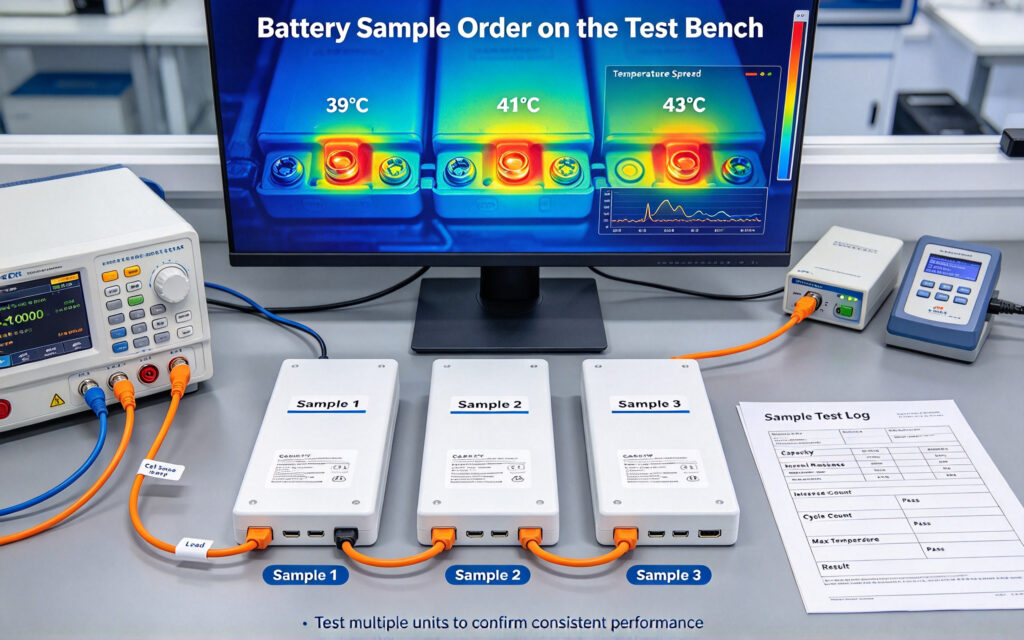
What to test on a battery sample order
Six checks cover most of the risk. Delivered capacity against the stated figure, measured on a full charge and discharge cycle at the rate the project will actually use rather than at the datasheet rate. Internal resistance, read per unit so that spread across the batch is visible. Consistency, meaning the gap between the best and worst unit on both of the above — this is usually more informative than any single reading.
Then thermal behaviour: temperature rise at the terminals and at the cell surfaces under sustained load, and whether the enclosure sheds that heat at the ambient temperature the site actually sees, which the LiFePO4 battery temperature range guide covers in detail. Communication, meaning whether the pack actually handshakes with the inverter or the monitoring system you intend to use, rather than with the one the supplier tested against. And protection: over-voltage, under-voltage, over-current and temperature cut-offs, checked by driving the unit to the trip point and confirming it trips where the specification says.
The protection and monitoring functions sit with the BMS, so the BMS technology guide is the right companion read when defining what “correct” means for the last two.
How to run the tests: equipment, records and pass criteria
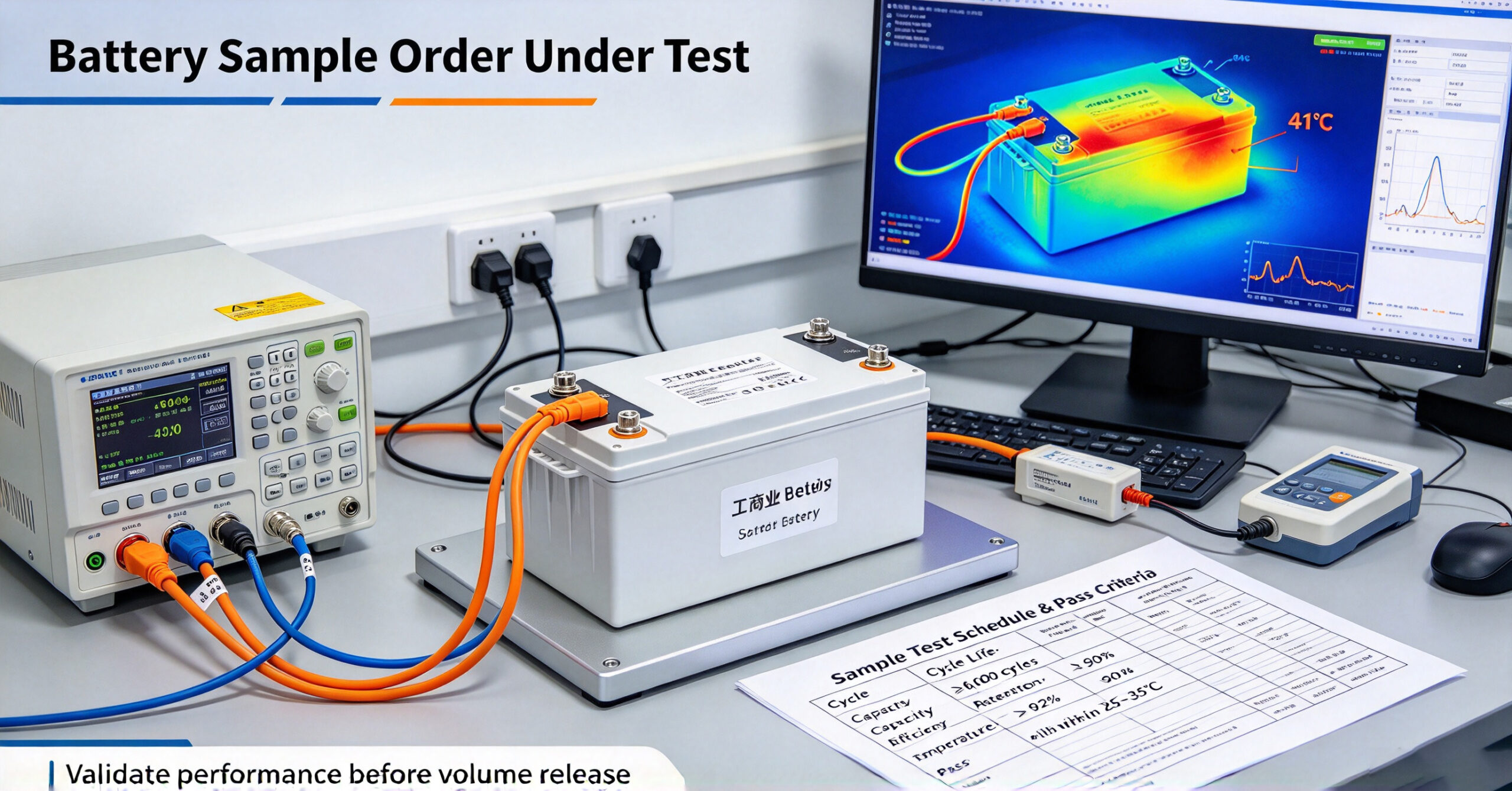
The equipment list is short and mostly standard: a cycler capable of the pack’s voltage and current, a milliohm meter for internal resistance, a data logger, and a thermal camera or a set of thermocouples. What matters more than the equipment is that the test conditions are recorded, because a capacity figure without the rate, temperature and cut-off voltages beside it cannot be compared with anything.
Write the pass criteria before the tests run, not after. For each check, the criterion should name a threshold and a condition — capacity at a stated rate and temperature, resistance spread within a stated band, trip points within a stated tolerance. Deciding whether a result is acceptable after seeing it is how a weak sample gets approved.
Keep the raw logs. They are the reference if a production batch later behaves differently, and they are the evidence if the argument is about whether the sample ever met the specification.
Golden sample risk in a battery sample order
The failure mode specific to this stage is a sample that was built differently from what will be produced — better cells, hand-matched, assembled by the most experienced operator on the line, sometimes with a BMS revision that never ships. The unit is genuine and the test results are real, and none of it describes the production batch.
Three controls reduce that risk. Ask which cell lot and which BMS firmware revision the sample carries, and require the same on the production order. Retain one tested unit as the physical reference, sealed and signed, so that a production sample can later be compared against it rather than against a photograph. And where the volume justifies it, repeat a short version of the test regime on units pulled from the first production batch.
How the supplier is assessed in the first place — and whether their process makes a golden sample likely — is covered in the how to evaluate battery manufacturers guide.
What belongs in the sample approval sheet
The approval document is what turns test results into a commitment. It should restate the configuration that was tested, including cell maker and lot, BMS revision, enclosure and label artwork; list the tests run with their conditions; record the measured results and the pass criteria applied; and state explicitly that the production order will match the tested configuration.
Two clauses are worth adding. One covering what happens if a specification changes after approval — the sample round is repeated for the changed item rather than waved through. And one naming the retained reference unit and where it is held. Both are uncontroversial at the time and invaluable later.
Release conditions from battery sample order to mass production
Release should be a decision against a written list rather than a feeling that the sample looked fine. Six conditions cover it: all tests passed against criteria written before they ran; the configuration recorded on the approval sheet; any deviations closed in writing rather than noted; certification scope confirmed for the destination market; the retained reference unit sealed and held; and the first production batch scheduled for a repeat of the short test regime.
Where a condition cannot be met — a test is marginal, or a change is still open — the honest options are to repeat the round or to accept the risk in writing with the consequence stated. Shipping on an assumption is the one option that never works out.
Once production starts, the comparable gate is the pre-shipment check on the finished batch, and the battery pre-shipment inspection guide covers what to inspect there and on what basis. For chisidal, the same six conditions are the release checklist used before any volume order is scheduled.
Q. battery sample order?
A battery sample order is a small, usually paid-for first batch that a buyer tests before committing to volume. It may be a catalogue unit, a modified version of one, or a newly developed pack, and it is the last stage at which a design problem is still cheap to fix.
Q. How many units should a battery sample order cover?
Enough to see spread across a batch rather than the behaviour of one unit, plus separate units for any abusive or semi-destructive checks. A single sample tells you almost nothing about consistency.
Q. What should I test on a battery sample order?
Delivered capacity at the rate the project will use, internal resistance per unit, spread across units, temperature rise under sustained load, communication with the intended inverter, and the protection trip points.
Q. Who pays for a battery sample order?
Usually the buyer, at a premium per unit because the line is interrupted rather than run. Whether that premium is credited against the first production order is worth agreeing in writing before the order is placed.
Q. How long does a battery sample order take?
A catalogue sample is the quickest, a modified sample takes longer, and a newly developed pack takes longest. Testing time on the buyer’s side is often comparable to the build time and should be planned for.
Q. What is a golden sample?
A sample built better than what production will deliver — better cells, hand-matching, or a firmware revision that never ships. Controlling it means recording the configuration and retaining a sealed reference unit.
Q. When can I release mass production after a battery sample order?
When every test passed against criteria written in advance, the configuration is recorded on an approval sheet, deviations are closed in writing, certification scope is confirmed, and a reference unit is retained.
Next step: define the test regime before the sample ships
Pass criteria written before the tests run are what make the round mean something. Send the configuration and the conditions.
- Write the request that starts the round in the battery rfq guide
- Settle the commercial side in the battery MOQ, lead time and payment terms guide
- For chisidal, send your usage and site details, and we will come back with product prices, lead time and warranty information.