An inverter charger combo is a single enclosure that both inverts DC battery power to AC and charges the battery from an AC source — shore power, a generator or the grid — often with a built-in transfer switch that hands the load over automatically when AC appears. This guide explains what the unit does, the sites where one box beats separate inverter and charger, and the specifications to check before you specify one.
Separate inverter and charger units do the same two jobs, but wiring them means two enclosures, two cooling paths and a manual or external switch to move the load between battery and AC. The inverter charger combo folds all of that into one product, which is a real simplification — and a real concentration of function — that suits specific sites better than others.
What the combo actually does
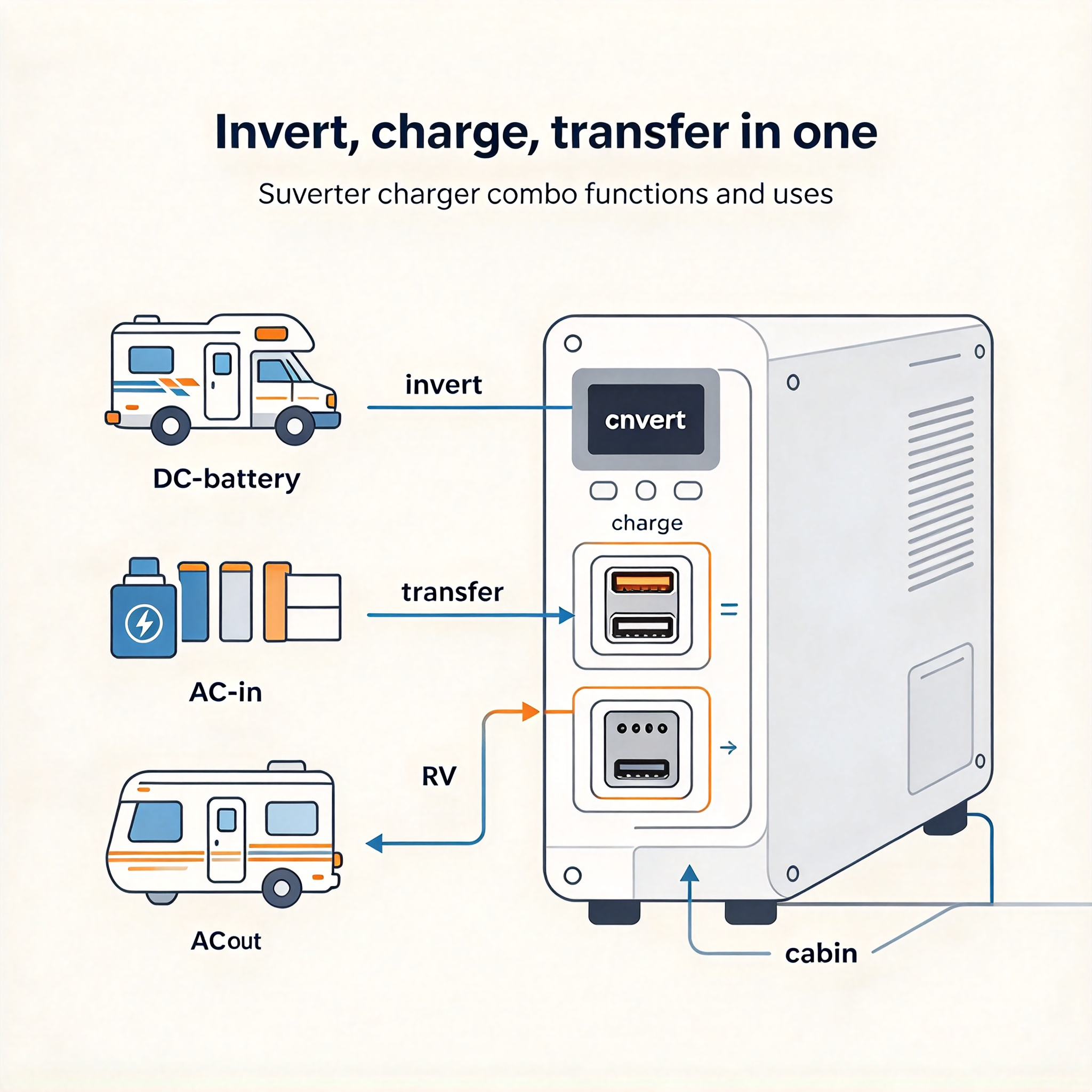
An inverter charger combo runs three functions in one box. As an inverter it makes AC from the battery; as a charger it makes DC from AC to fill the battery; and as a transfer switch it shifts the load from battery-sourced AC to incoming AC the moment shore power or a generator starts. The how an inverter works how-an-inverter-works piece covers the inversion stage, while the inverter dc to ac solar panel DC-to-AC guide describes the conversion the charger reverses.
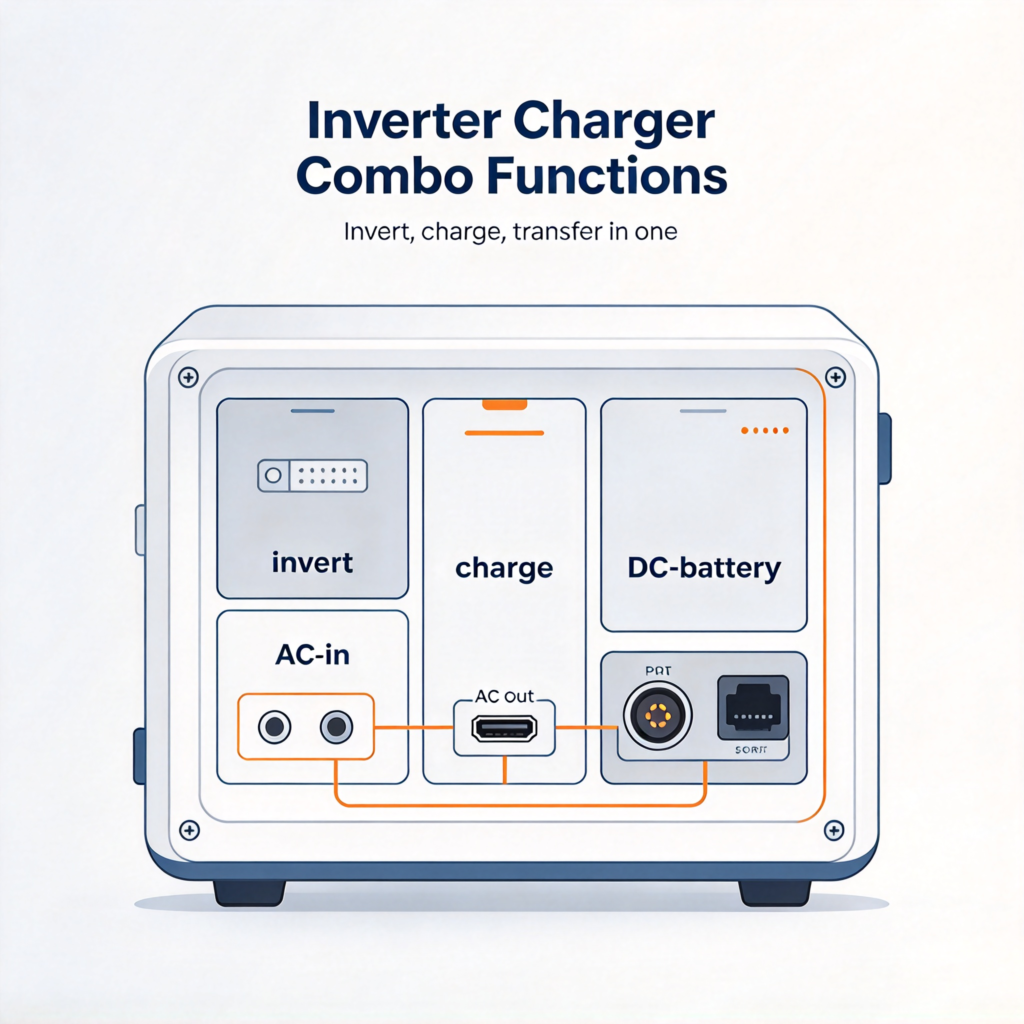
Where one box beats two
The inverter charger combo earns its place in mobile and standby roles: RVs and boats where space and wiring are tight, a small off-grid cabin where simplicity beats phased growth, and backup where the load must shift to generator or grid without a manual throw. It fits less well where the inverter and charger are upgraded on different cycles or where a single-outage risk is unacceptable and redundancy is specified. The all in one solar inverter all-in-one guide and the string solar inverters string-inverter guide show the broader inverter choices around it.
| Need | Combo | Separate |
|---|---|---|
| Space & wiring | One box, fewer runs | Two enclosures |
| Auto load transfer | Built-in switch | External switch |
| Independent upgrade | Replace the unit | Grow one stage |
Specs to check before you buy
When you specify an inverter charger combo, match the inverter’s continuous and surge AC power to the load, confirm the charger current against your battery class and AC source, and check the transfer time if the load is sensitive. Pair it with the right battery — the 48v inverter guide 48V guide and the 48v split phase inverter guide split-phase guide frame the voltage and phase — and the how to choose a storage hybrid inverter hybrid-selection guide covers where a combo sits versus a full hybrid. For chisidal projects, send the load, the AC sources and the battery class, then ask for the combo matched as one documented unit with the hybrid solar inverter vs off grid grid tied grid-tied-or-off-grid path planned.
Why it pays over separate units
A inverter charger combo pays in commissioning and support: one vendor, one firmware, one warranty, and a transfer function already validated inside the box rather than wired in the field. The trade is the same as any combo — a failure can take all three functions down, so weigh that against the simplicity for your uptime need. For chisidal projects, the matched unit ships as one documented order with the battery and AC sources specified up front.
How the charger and transfer sides work
An inverter charger combo does two jobs in one box: it makes AC from your batteries and it charges those batteries from shore, generator, or grid power. The charger side uses a multi-stage profile — bulk, absorption, float — to fill the bank safely, and a good inverter charger combo lets you set those stages to the battery chemistry so it is not over- or under-charged.
Transfer switching is the quiet hero. When external AC appears, the combo passes it through to your loads and diverts surplus to charging; when it vanishes, the inverter takes over with no manual throw. Pick a unit whose transfer time is short enough for your electronics, because a long gap reboots sensitive gear. Sizing ties the two halves together: the inverter must cover the peak AC load, and the charger must refill the bank faster than you draw it down. Watch the pass-through rating and neutral handling, since some combos need a bonded neutral and limit how much AC they pass through. For chisidal-supplied builds, the inverter charger combo is matched to both the load list and the battery capacity.
Programming the charger and source behavior
Program the charger to the battery, not to the box. Set bulk, absorption, and float voltages to the chemistry — lithium wants a tight constant-voltage finish, lead-acid wants a longer absorption — and set the absorption time so the bank fills without gassing. An inverter charger combo left on a generic profile either under-fills or stresses the battery.
Watch how it behaves on generator and shore. Some generators surge or drift in frequency, and a picky combo may drop the transfer or chatter the relay; a stable, clean source keeps the handoff invisible. Test the switchover with a load running, not on an empty bench, because that is the moment it actually matters. Keep the cooling and clearance the manual demands, since these combos run hot when charging and inverting at once. For chisidal-supplied builds, the inverter charger combo is pre-configured to the supplied battery so shore, generator, and stored power hand off without a settings deep-dive.
Neutral bonding and temperature compensation
Neutral and bonding are the details that bite. Some inverter charger combo units require a bonded neutral for part of the load, and some must not be bonded when another source already bonds it, or you create a ground loop or a shock hazard. Confirm the bonding scheme against your panel before you energize, because this is not something to discover with a meter in one hand.
Battery temperature compensation keeps charging honest as the bank warms and cools. A temperature sensor on the bank lets the charger trim the absorption voltage so a hot battery is not overcharged and a cold one is not underfilled. Skip it and the combo guesses, usually wrong, at the extremes. For chisidal-supplied builds, the inverter charger combo ships with the sensor and the bonding documented, so charging tracks the battery instead of the calendar.

A practical takeaway
Before you buy, list every AC load you will actually run, note which need clean surge, and hand that list to the spec. An inverter charger combo sized to a real list, not a wish, is the difference between seamless power and a relay that chatters under load, and it is cheaper to size once than to swap a box that was always too small.
Get the load list and the bonding right, and the combo disappears into the background, which is the highest praise a piece of power gear can earn.
Q. inverter charger combo?
An inverter charger combo is a single enclosure that inverts DC battery power to AC, charges the battery from an AC source such as shore power or a generator, and usually includes a transfer switch that moves the load to AC automatically when it appears.
Q. What does an inverter charger combo do?
It runs three functions: as an inverter it makes AC from the battery, as a charger it makes DC from AC to fill the battery, and as a transfer switch it shifts the load from battery AC to incoming AC automatically when shore power or a generator starts.
Q. When should I use an inverter charger combo?
Use one in RVs, boats, small off-grid cabins and backup where space, wiring and automatic load transfer matter more than phased growth. Avoid it where functions upgrade on different cycles or where a single-outage risk is unacceptable.
Q. What specs should I check on an inverter charger combo?
Match continuous and surge AC power to the load, confirm charger current against battery class and AC source, and check transfer time for sensitive loads. Pair it with the right battery voltage and phase.
Q. Is a combo better than separate inverter and charger?
For simplicity, space and auto-transfer it is better; for independent upgrade and redundancy it is worse. The right choice follows the site’s uptime and growth needs.
Q. Which certification applies to an inverter charger combo?
Safety and interconnection baselines such as UL 1741 and IEC 62109 set the compliance frame, with regional variations on top. Confirm the exact edition and local amendments for your market.
Next step: decide one box against two on purpose
The combo trade is a real engineering choice, not a default. Confirm the load, the AC sources and the battery class, then weigh shared simplicity against concentrated risk.
- Read the how to choose a storage hybrid inverter hybrid inverter selection guide before specifying
- For chisidal, send your usage and site details, and we will come back with product prices, lead time and warranty information.