
lithium ion cathode materials are the compounds on the positive electrode that host lithium ions during charge and discharge, and the choice of cathode sets a cell’s nominal voltage, its energy density, its cycle life and much of its thermal behaviour. This guide explains the main cathode families you will meet in storage specifications — LFP, NMC and LCO among them — what each one trades away, and how to read a cathode claim on a supplier’s data sheet.
When a battery quote lists a chemistry name, that name is almost always the cathode. Energy density, cycle life and thermal behaviour all follow from it.
What the cathode actually does
A lithium ion cell moves lithium ions between two electrodes through an electrolyte. The cathode is the host structure that accepts and releases those ions, and its crystal structure determines the voltage at which that happens. Different host compounds give different voltages, different capacities per gram, and different structural stability over thousands of cycles. The anode is typically graphite across most commercial cells, which is why the cathode carries the chemistry name.
That also means the cathode drives most of the cost and most of the safety story. A cathode that releases oxygen when overheated feeds a fire; one that holds its structure under heat does not. This is the single most important reason stationary storage has converged on one particular family, and it is why comparing lithium ion cathode materials matters more than comparing brand names. The li-ion rechargeable cell guide covers how the electrodes, separator and electrolyte fit together inside a single cell.
LFP: the storage default
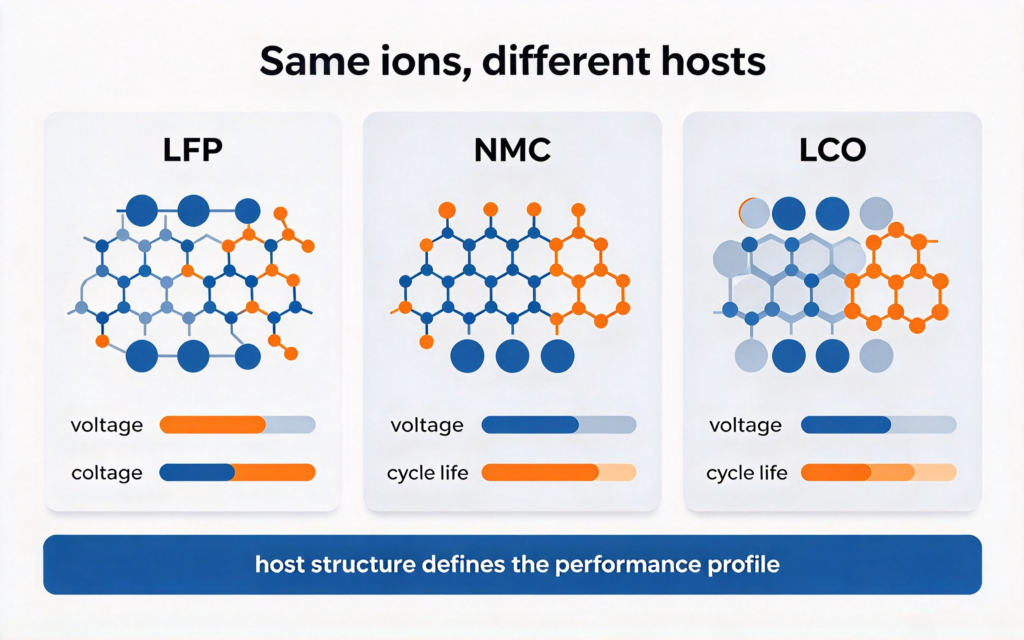
Lithium iron phosphate — LFP — uses an olivine phosphate host. It gives a lower nominal voltage than the other families and therefore lower energy density per kilogram, which is the trade everyone notices first. What it gives back is a very stable host structure: the phosphate bond holds oxygen tightly, so the cell resists thermal runaway far better than oxide cathodes, and the structure tolerates deep, repeated cycling with little strain.
For stationary storage those properties matter more than energy density. A battery that sits in a cabinet or a container is not being carried, so kilograms per watt hour is a secondary concern, while cycle life and thermal behaviour are primary. That is why LFP dominates residential and commercial storage, and why most lithium ion cathode materials used in stationary banks today are phosphate-based. The LiFePO4 versus lithium ion NMC comparison works through the practical consequences in shipped products.
NMC and its relatives
Nickel manganese cobalt oxide — NMC — and the closely related NCA pack more energy into the same mass, which is why they dominate electric vehicles where range per kilogram decides the design. The nickel contributes capacity, the manganese contributes structure, and the cobalt contributes stability — and the ratios are tuned per application, which is why you will see variants written with numbers.
The trade-off is thermal. Oxide cathodes release oxygen at elevated temperature, and that oxygen feeds combustion inside the cell. Modern cells manage this with coatings, electrolyte additives and pack-level protection, and NMC packs are safe in service — but the margin is narrower, and pack engineering has to be correspondingly more careful. For a stationary bank that cycles daily for a decade, that narrower margin is the reason most buyers choose otherwise.
| Cathode | Energy density | Cycle life | Thermal margin |
|---|---|---|---|
| LFP | Lower | Long | Wide |
| NMC | Higher | Moderate | Narrower |
| LCO | High | Shorter | Narrowest |
LCO and the families you should not specify
Lithium cobalt oxide — LCO — is the chemistry that made portable electronics thin and light, and it still appears in phones and laptops. It has high energy density and the shortest cycle life and narrowest thermal margin of the common families. It is not a stationary storage chemistry, and if it appears on a storage quote that is a signal to ask harder questions about the application the cells were designed for.
Manganese oxide spinel and a few blended formulations sit in the middle ground, often used where power density matters more than energy density. The solid state versus lithium ion comparison looks at what changes when the electrolyte rather than the cathode is the variable, and the lithium air versus lithium ion piece covers where the frontier sits.
Cathode choice also shapes what a pack can do in the cold and at high charge rates. Some families accept charge more readily at low temperature; others tolerate faster charging better. If your duty includes either, ask for the charge-rate and temperature limits alongside the energy figures, because those are the numbers that decide whether a chemistry actually works in your application.
Supply chain and cost exposure
Cathode choice is also a procurement decision. Cobalt and nickel prices move, and the concentrations used in NMC families expose the bill of materials to those swings. Iron and phosphate are abundant and far more stable in price, which is part of why LFP has taken share in stationary storage beyond its technical merits.
For a distributor or an EPC committing to a multi-year supply, that stability is worth quantifying alongside the cell price. Ask the supplier which cathode variant is being quoted, because two quotes that both say “lithium ion” can be entirely different products with different cost exposure. The lithium ion battery wholesale partnership guide covers what to pin down in a supply agreement.

What to verify before you specify
Confirm the cathode in writing, not just the marketing chemistry name. Ask for the nominal voltage per cell, the rated cycle life at a stated depth of discharge and temperature, and the safety certifications the cell and the pack each hold. Cell-level certification and pack-level certification are different documents, and a bank built from certified cells is not itself certified until the assembly is.
Ask how the battery management system is matched to the chemistry. Charge voltage limits, balancing behaviour and temperature cutoffs are chemistry-specific, and a controller configured for one cathode is not safe on another. The li-ion cell voltage guide explains the voltage windows, and a correct charge profile keeps the charger inside them. For chisidal-supplied systems, the cathode, the cycle-life rating and the certification set are documented together so the quote can be checked against the duty.
Why the cathode line decides the cell
Cathode choice is the decision that sets everything else in a lithium cell. For stationary storage, a wide thermal margin and a long cycle life beat energy density, which is why LFP has become the default — and why “lithium ion” alone is never a complete specification. When you compare quotes, compare lithium ion cathode materials first, then the cycle-life conditions, then the certification set, because everything downstream follows from that first line.
Q. lithium ion cathode materials?
Lithium ion cathode materials are the compounds on the positive electrode that host lithium ions during charge and discharge. The choice of cathode sets a cell’s nominal voltage, energy density, cycle life and much of its thermal behaviour.
Q. Why is LFP the common choice for storage?
The phosphate host holds oxygen tightly, so the cell resists thermal runaway and tolerates deep repeated cycling with little structural strain. Lower energy density matters far less in a fixed installation than in a vehicle.
Q. What is the difference between LFP and NMC?
NMC packs more energy per kilogram and is favoured where mass matters. LFP offers a longer cycle life and a wider thermal margin, which is why it dominates stationary storage. Confirm both against the stated test conditions.
Q. Is LCO used in solar storage?
No. Lithium cobalt oxide has high energy density but the shortest cycle life and narrowest thermal margin of the common families, and it is designed for portable electronics rather than daily deep cycling.
Q. Does the cathode affect safety certification?
Yes. Thermal behaviour differs by cathode, and certification is issued at cell level and again at pack level. A bank assembled from certified cells still needs its own assembly certification.
Q. How does cathode choice affect price stability?
Families that rely on cobalt and nickel are exposed to those commodity markets. Iron phosphate uses abundant materials, so its price has been comparatively stable — a factor worth quantifying on a multi-year supply agreement.
Q. What should I ask a supplier about the cathode?
Ask for the specific cathode in writing, the nominal cell voltage, the rated cycle life at a stated depth of discharge and temperature, and the cell and pack certifications. Confirm the BMS is configured for that chemistry.
Next step: pin the cathode down in writing
“Lithium ion” is not a specification. Confirm the cathode, the cycle-life conditions and the certification set before you commit to a model.
- Compare families against LiFePO4 versus lithium ion NMC before specifying
- Review lithium ion battery wholesale partnership guide for what to lock into a supply agreement
- For chisidal, send your usage and site details, and we will come back with product prices, lead time and warranty information.