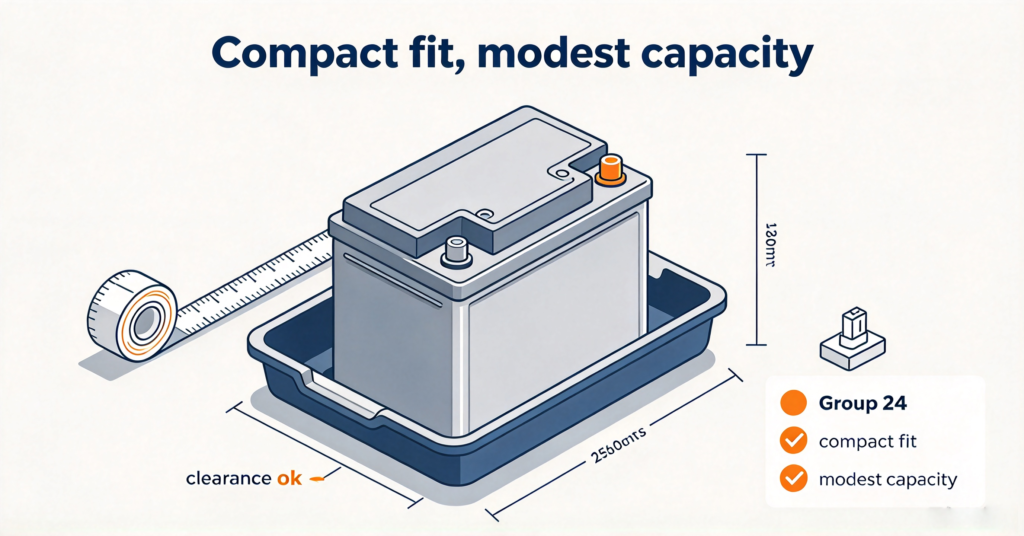
A group 24 deep cycle battery is a BCI group size — a standard case dimension and terminal layout — that is the most compact of the three common deep-cycle sizes, built to be discharged and recharged repeatedly rather than to crank an engine. This guide covers the dimensions you must check against a tight tray, the amp-hour range you should expect, the terminal and chemistry options, and the point at which you should step up to a larger group instead.
Group 24 is the size people buy when the space is fixed. It fits trays that will not accept a group 27 or 31, and the practical question is whether its capacity covers your daily draw.
What group 24 means as a size
Like every BCI group number, group 24 fixes the external dimensions, the terminal type and the terminal positions. It does not fix the capacity or the chemistry. A group 24 case is the shortest of the three common deep-cycle sizes, which is exactly why it appears in smaller boats, compact campers and any installation where the tray was designed around a starting battery and never changed.
Because the case is small, the capacity range is narrower than you will see on a group 31. Expect a meaningful spread between an entry flooded unit and a premium AGM or lithium unit in the same footprint, and read the ratings at the same discharge rate before you compare. The group 27 deep cycle battery covers the next size up when the tray has a little more room.
Capacity you should realistically expect
A group 24 deep cycle battery carries less amp-hour capacity than a group 27 or 31 in the same chemistry, simply because there is less volume for plate area or cell capacity. Reserve capacity follows the same pattern. That does not make it the wrong choice — it makes it the right choice for a load that matches it.
The gap narrows dramatically with chemistry. A group 24 in LiFePO4 can deliver more usable energy than a larger lead-acid case, because lithium tolerates a much deeper discharge without the same cycle-life penalty. If the tray truly cannot take a bigger case, chemistry is the lever that recovers the lost runtime rather than size. The lithium versus lead acid deep cycle comparison shows where that crossover sits.
| Choice | When it wins | Trade-off |
|---|---|---|
| Group 24 flooded | Tight budget, ventilated space | Needs maintenance, shallow usable depth |
| Group 24 AGM | Vibration, sealed requirement | Less usable depth than lithium |
| Group 24 lithium | Tight tray, deep daily cycling | Higher upfront cost |
Terminal layout and the fit check
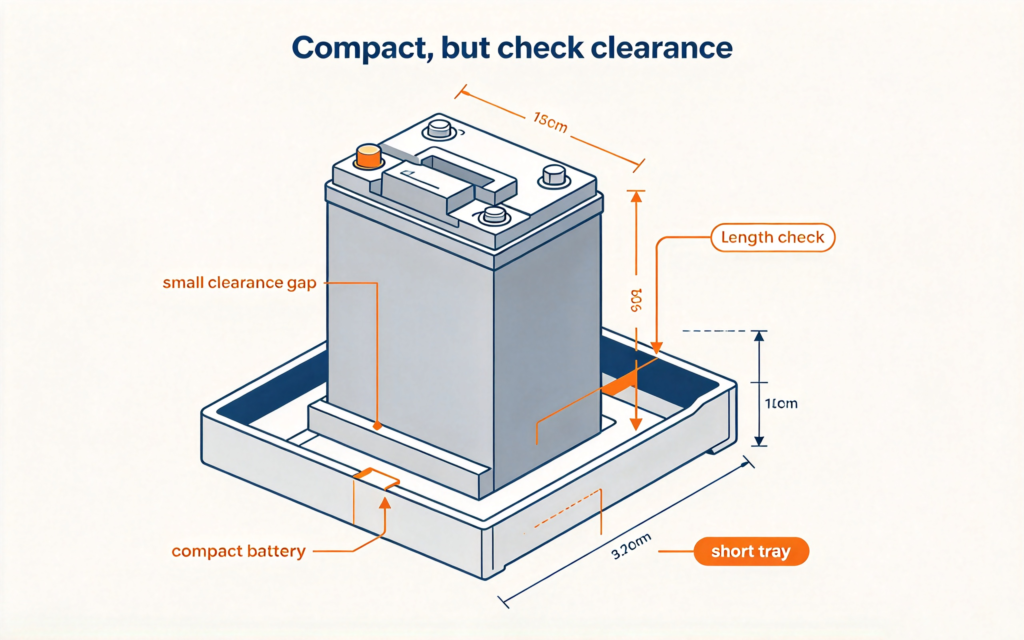
Group 24 cases commonly use automotive-style posts, and the terminal orientation — which corner the positive sits on — is the detail that most often defeats a like-for-like swap. Two batteries can share the group number and put the positive on opposite corners, which reverses your cable runs. Check the orientation in the data sheet, not just the group code, and confirm the hold-down will still clamp the case.
Height matters as much as length. A group 24 is usually the shortest case, but some lithium units in this footprint are taller per amp hour because of the internal layout and the battery management board. Measure the available height including any lid or seat above the tray before committing.
Where group 24 is the right answer
A group 24 deep cycle battery suits light, intermittent house loads: lighting, a water pump, a small fridge on a weekend trip, electronics charging. It suits installations where the battery is charged regularly rather than relied on for days of autonomy. Trolling motor duty on a small boat is another classic fit, because the runtime requirement is a few hours rather than overnight.
It is also the honest answer when the alternative is no battery at all. A correctly sized group 24 in good condition beats a larger battery that does not fit, is strapped in insecurely, or never gets properly charged. For chisidal-supplied projects, send the tray dimensions and the daily watt-hour draw, then ask for the chemistry that meets that draw inside the space you actually have.
Cycle life deserves a mention because it interacts with size. A small bank cycled deeply every day reaches its cycle limit sooner than a larger one cycled shallowly, so the cheapest group 24 is not necessarily the cheapest across five years. Compare on cost per usable cycle rather than on purchase price, and check the manufacturer’s stated cycle life at the depth of discharge you actually plan to use.
When to step up instead
Step up to a group 27 or group 31 deep cycle battery when the daily draw regularly takes the battery below roughly half its rating, when you need to run an inverter at a meaningful load, or when you want autonomy through more than one night. Deep, repeated discharge is what kills a small lead-acid battery early, and no amount of careful charging makes up for a battery that is simply too small for the duty.
If the tray cannot grow, stay in group 24 and move to lithium. The usable capacity gain usually outweighs the cost difference over the service life, because you are replacing the battery less often. The AGM versus LiFePO4 deep cycle upgrade guide works through that decision with real duty cycles.

Care, charging and replacement
Match the charger to the chemistry. A lead-acid group 24 needs a multi-stage profile with the correct absorption and float voltages; a lithium unit needs a lithium profile and a charger that will not try to equalise it. Charging a lithium battery with a lead-acid equalisation cycle is a common and expensive mistake.
Keep the terminals clean and tight, and re-torque after the first few thermal cycles. If you run the battery in a vehicle or boat, secure it against movement — a sliding case damages terminals and plates. Replace units as a matched set when they are wired in a bank, because mixing ages drags the new battery down to the old one’s behaviour. The deep cycle lead acid battery guide covers lead-acid care in depth, and the marine and RV deep cycle battery guide covers marine and RV duty.
Buying notes for a group 24 swap
A group 24 deep cycle battery is the compact answer for a fixed tray and a modest load. Check the terminal orientation and the height, match the chemistry to how deeply you will cycle, and move up a size the moment the daily draw outgrows the case.
Q. group 24 deep cycle battery?
A group 24 deep cycle battery is a BCI group size — a standard case dimension and terminal layout — that is the most compact of the three common deep-cycle sizes, built for repeated discharge and recharge rather than for cranking an engine. The group number fixes the size, not the capacity.
Q. How many amp hours does a group 24 battery have?
Less than a group 27 or 31 in the same chemistry, because the case holds less active material. The spread within group 24 is still wide, so read the rating at a stated discharge rate and use reserve capacity as the cross-check.
Q. Can I replace a group 24 with a group 27?
Only if the tray and the hold-down accept the extra length. Measure first — a group 27 is longer, and a case that does not fit will not be secured properly, which is a safety problem rather than a convenience one.
Q. Are group 24 batteries good for trolling motors?
Yes, for small motors and a few hours of runtime. For longer days or larger motors, step up in size or move to lithium in the same footprint to recover usable capacity.
Q. Does a group 24 lithium beat a group 27 lead acid?
On usable energy it often does, because lithium tolerates a far deeper discharge. Compare usable watt hours rather than rated amp hours, and confirm the manufacturer’s stated cycle life for the depth you plan to use.
Q. What terminals does a group 24 use?
Most commonly automotive-style posts, but the orientation varies — the positive can sit on either corner. Check the data sheet before ordering so your cables still reach.
Q. How long does a group 24 deep cycle battery last?
Service life depends on depth of discharge, temperature and charge quality. Shallow cycles and a correct charge profile lengthen it; deep daily discharge and heat shorten it. Confirm the rating against the manufacturer’s test conditions.
Next step: match the tray, then the draw
Group 24 wins on fit and loses on capacity, so the decision is whether its capacity covers your daily draw. Send the tray dimensions and the watt-hour figure.
- Compare against group 27 deep cycle battery if the tray has room to grow
- Review 12V LiFePO4 deep cycle battery hub to recover capacity without changing footprint
- For chisidal, send your usage and site details, and we will come back with product prices, lead time and warranty information.