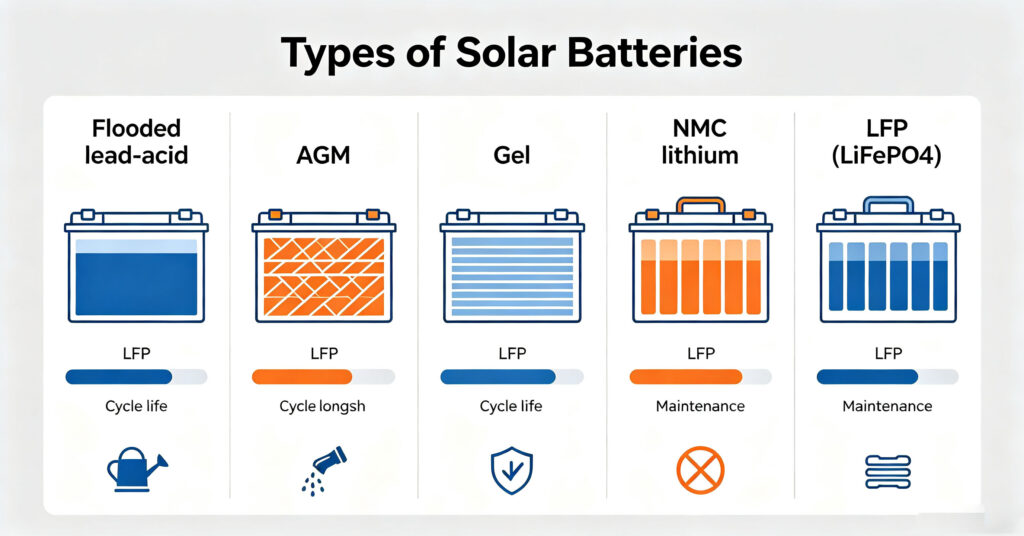
The types of solar batteries in use today fall into five chemistries: flooded lead-acid, AGM (absorbent glass mat) lead-acid, gel lead-acid, NMC lithium-ion, and LFP (LiFePO4) lithium iron phosphate. The differences that matter for a solar installation are cycle life, usable depth of discharge, maintenance requirement, temperature tolerance, safety behaviour, and cost per usable kilowatt-hour over the service life — not the headline price per unit. In most solar applications today LFP wins on total cost and safety, flooded lead-acid wins on lowest upfront cost, and AGM and gel survive in niches where specific charging behaviour or spill-proof construction matters more than cycle life.
The five chemistries at a glance
Read this table as a first filter, not a verdict. The types of solar batteries listed here are all shipping products you can buy today; the differences between them are differences in degree, not in availability. The values are typical ranges for solar duty and vary by manufacturer, model and operating conditions.
| Type | Usable DoD | Typical cycle life | Maintenance | Upfront cost | Best fit |
|---|---|---|---|---|---|
| Flooded lead-acid | ~50% | Hundreds to ~1,500 | High — watering, ventilation, equalisation | Lowest | Budget off-grid with a maintainer on site |
| AGM | 50–60% | ~500–1,500 | None (sealed) | Low–mid | Backup duty, cold sites, spill-sensitive locations |
| Gel | 50–60% | ~500–1,500 | None (sealed) | Mid | Slow deep discharge, high ambient temperature |
| NMC lithium | 80–90% | ~1,500–4,000 | None | High | Weight- or space-constrained installations |
| LFP lithium | 80–90% | ~3,000–10,000 | None | Mid–high | Daily-cycling solar, most residential and C&I |
Flooded lead-acid
The oldest technology still in solar service and still the cheapest per nameplate amp-hour. Liquid electrolyte, vented caps, and a requirement for periodic water top-up. It tolerates rough charging better than its sealed cousins and gives visible warning before failure — you can measure individual cell specific gravity, which no sealed battery allows.
What it costs you is labour and space: a watering schedule, a ventilated enclosure because charging generates hydrogen, and roughly double the nameplate capacity of an LFP bank for the same usable energy because of the shallow depth of discharge. In an unattended site those two costs usually exceed the purchase saving within a few years.
AGM and gel
Both are sealed valve-regulated lead-acid constructions that recombine the gases internally, so no watering and no hydrogen ventilation requirement under normal operation. AGM holds the electrolyte in a glass mat and has low internal resistance, which makes it good at delivering high current — the reason it is common in starter and backup roles. Gel suspends the electrolyte in a silica gel, charges more slowly, and tolerates high ambient temperature and deep slow discharge better than AGM.
Where they lose is the same place flooded does: shallow usable depth of discharge and a short cycle life relative to lithium. Both are sensitive to overcharging in ways lithium is not — a charger set to the wrong profile will dry an AGM or gel battery out irreversibly. For buyers coming from AGM and evaluating the switch, the full comparison is in #86 AGM vs LiFePO4 upgrade.
NMC lithium
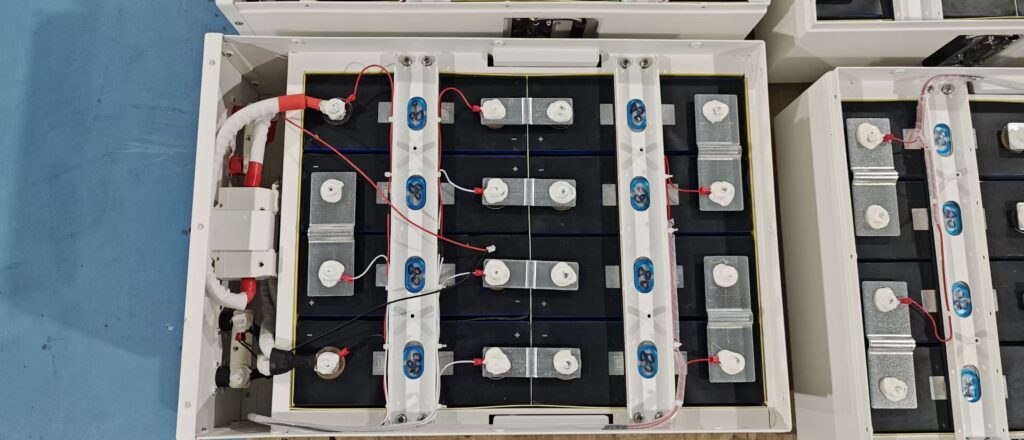
Nickel manganese cobalt oxide is the chemistry that built the electric vehicle industry, and its advantage is energy and power density: more watt-hours per kilogram and per litre than LFP. Where the installation is genuinely constrained by weight — a vehicle, a portable unit, a rooftop with a structural limit — that advantage can be decisive.
For stationary solar it usually is not decisive, and NMC pays for its density with lower thermal stability and a shorter cycle life. Cobalt content also adds supply-chain and cost volatility that a stationary project does not need to absorb. The head-to-head comparison is set out in #33 LiFePO4 vs lithium-ion NMC, and the wider lithium taxonomy is in #67 types of lithium-ion batteries.
LFP lithium iron phosphate
LFP trades perhaps a third of NMC’s energy density for a substantially longer cycle life, a flatter discharge curve, and the best thermal stability of the common lithium chemistries. For a stationary installation, where nobody cares that the battery is heavier and everybody cares how many cycles it delivers, that is the right trade.
Two practical characteristics explain its dominance in solar. The flat discharge voltage curve means the inverter sees a stable DC bus across most of the state-of-charge range, which simplifies system design. And the chemistry’s thermal runaway threshold is much higher than NMC’s, which is what makes it acceptable to insurers, fire authorities and building owners in occupied buildings. The safety engineering behind that is covered in #87 thermal runaway and fire suppression, and the codes that govern installation are in #44 BESS safety codes.
Comparing cost the way that matters
Price per amp-hour is the wrong unit, and it is the reason lead-acid looks competitive on a quote. Three corrections turn a quote into a comparison.
- Correct for usable capacity. Divide by the usable depth of discharge. A bank that can only use half its nameplate capacity costs twice what the sticker suggests per usable kilowatt-hour.
- Correct for cycle life. Divide the delivered cost by the number of cycles the manufacturer warrants at your depth of discharge. This is the number that separates chemistries by an order of magnitude rather than by a percentage.
- Correct for the replacement interval. A battery replaced three times over a twenty-year project costs three installations, three sets of labour and three disposal events. The cycle-life-versus-price arithmetic is worked through in #46 cycle life vs price.
A four-step selection sequence
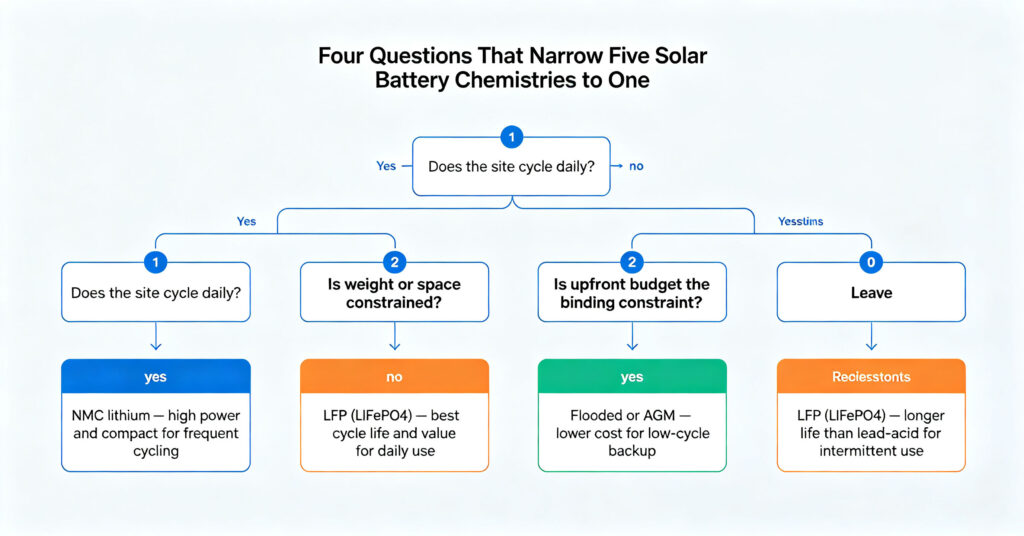
- Establish the duty profile. Across the types of solar batteries, the duty profile is what narrows the field fastest: Daily cycling, occasional backup, or seasonal use. This single answer eliminates half the field: daily cycling rules out lead-acid on cost per cycle, and pure standby rules out paying a premium for cycle life you will never use.
- Establish the binding constraint. Upfront capital, available space or weight, ambient temperature, or a regulatory and insurance requirement. Each constraint points to a different winner, and a project with two binding constraints needs the trade-off stated explicitly rather than averaged.
- Convert every quote to cost per usable kilowatt-hour over the warranted cycle life. Do this before comparing, not after; it changes the ranking in most cases.
- Check the system around the battery. The chosen chemistry must be compatible with the inverter or charge controller’s charge profile, the enclosure’s ventilation, and the local installation code. A chemistry that wins on paper and fails the compatibility check is not a candidate.
Installation environment and maintenance cadence both feed the last step, and both are documented elsewhere in this series: site requirements in #128 battery installation safety requirements, and the ongoing care schedule in #84 solar battery maintenance. When an existing bank is being replaced, the timing question is answered in #51 when to replace a solar battery.
Q. What type of battery is best for solar?
LFP (LiFePO4) is the best choice for most solar installations because it combines a long cycle life with a deep usable depth of discharge, high thermal stability and no maintenance. It is the right answer when the battery cycles daily and the installation is in or near an occupied building. NMC wins where weight or volume is the binding constraint, and lead-acid remains a rational choice where upfront capital is the only constraint and the site is rarely cycled.
Q. How long do the different solar battery types last?
In calendar terms and at typical solar duty: flooded and sealed lead-acid commonly last three to seven years, NMC around eight to twelve, and LFP ten to fifteen or more. The dominant variable is not calendar time but cycle count consumed, so a battery cycled deeply every day will reach end of life much sooner than the same model used only for occasional backup.
Q. Why is depth of discharge so important when comparing types?
Because it determines how much of the nameplate capacity you can actually use without damaging the battery. A lead-acid bank limited to 50% depth of discharge needs twice the nameplate capacity of an LFP bank run at 90% to deliver the same usable energy — which roughly doubles the effective cost per usable kilowatt-hour and the physical footprint.
Q. Can I mix battery chemistries in one system?
No, not on the same bank. Different chemistries have different charge voltage profiles, different end-of-charge behaviours and different internal resistances, so paralleling them causes one to carry most of the current and to fail early. Separate banks behind separate charge controllers are possible in principle but complicate the system for little gain.
Q. Are newer chemistries like sodium-ion worth waiting for?
Sodium-ion is reaching early deployment and offers cost and cold-temperature advantages, but supply, product availability and long-term field data are still limited. For a project being built now, choosing a mature chemistry with a proven supply chain remains the lower-risk decision. The emerging technology landscape is reviewed in #129 solid-state vs lithium-ion and #60 iron-air battery.
Next step: convert every quote to cost per usable kilowatt-hour
Comparing types of solar batteries gets easy once the comparison is done in the right unit. Nameplate price per amp-hour hides usable depth of discharge and cycle life, which are the two numbers that actually decide what you pay per delivered kilowatt-hour.
- Deep-dive the two lithium options in #33 LiFePO4 vs lithium-ion NMC
- Work through the replacement economics in #46 cycle life vs price
- Check the installation and code context in #44 BESS safety codes
- Ask leekooenergy for a chemistry comparison sheet for your duty profile that states usable depth of discharge, warranted cycle count at that depth, delivered cost per usable kWh over the warranty term, the charge profile required by your inverter or controller, and the compliance marks for your installation jurisdiction — so the ranking is done on your numbers rather than on a generic datasheet