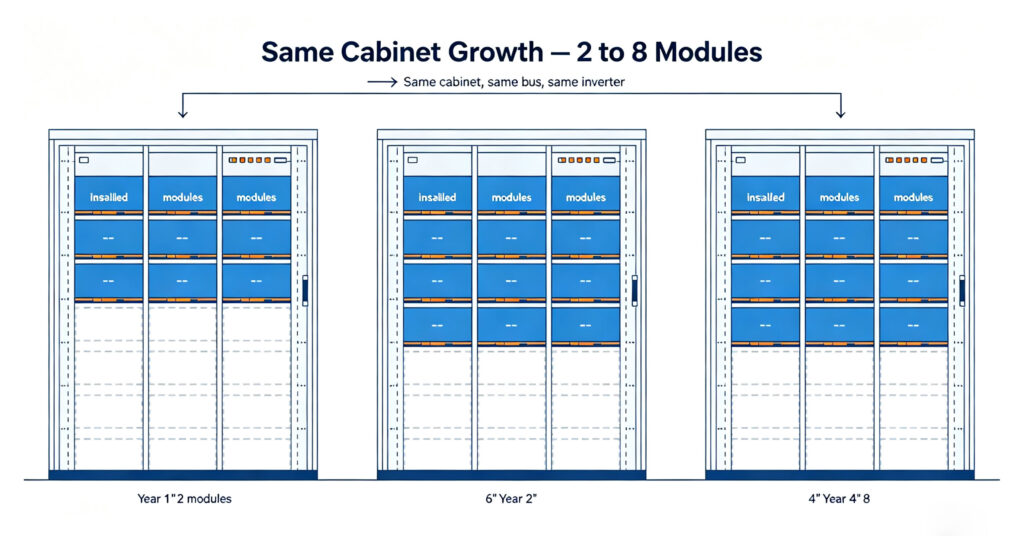
Modular solar power describes a solar and storage architecture built from repeating units — battery modules, inverter units, PV strings — that can be added over time without replacing the parts already installed. The point is not that the hardware comes in boxes; it is that the electrical bus, the enclosure, the inverter capacity and the control system were sized for a larger final configuration than the one being bought today. A modular system that was not designed for its future size is a small system with empty slots, and expanding it later turns into a redesign. The five interfaces that decide whether phase two is a purchase order or a project are: bus and protection capacity, inverter or PCS headroom, physical space and thermal envelope, control system and firmware compatibility, and module availability at the same specification.
What “modular” actually covers
The phrase modular solar power is applied at three different levels, and confusing them is how buyers end up with a system that cannot grow the way they expected.
| Level | What repeats | What must be pre-sized | Typical expansion step |
|---|---|---|---|
| Module level | Battery modules inside one cabinet or stack | Cabinet slots, DC bus rating, BMS parallel limit | One module at a time, smallest cost step |
| Cabinet level | Whole battery cabinets on a shared bus | Busbar or cable rating, switchgear, site space | One cabinet at a time, medium cost step |
| System level | Inverter plus battery plus PV as a unit | Grid connection capacity, transformer, approvals | One system at a time, largest step and often a new interconnection application |
Module-level expansion is the cheapest and the one most buyers mean when they ask for modular. It works only if the cabinet’s internal bus, the BMS’s supported module count and the thermal design all accommodate the final module count — not just the initial one. The physical form factors that enable this are compared in #45 rack vs stackable vs wall-mounted.
Why stage the investment at all
Four reasons appear repeatedly in commercial projects, and they are financial as often as they are technical.
- Capital sequencing. An owner with a fixed annual capital budget can install the enclosure, inverter and a partial battery bank this year and add modules in following budget cycles, avoiding a single large appropriation.
- Load growth. A facility that expects to add production lines, charging infrastructure or a building extension does not want to size storage for a load that does not exist yet.
- Uncertain duty. Where the actual consumption profile or the value of a tariff structure is not yet established, a first phase generates the operating data that makes phase two a better-specified purchase.
- Incentive and tariff timing. Where support schemes or grid connection rules have deadlines, a first phase secures eligibility while the full system is planned.
The discipline this requires is that phase one must be specified as a fraction of a known final design, not as an independent small system. That means the design work for phase two happens during phase one, even though the purchase does not.
The five interfaces to reserve
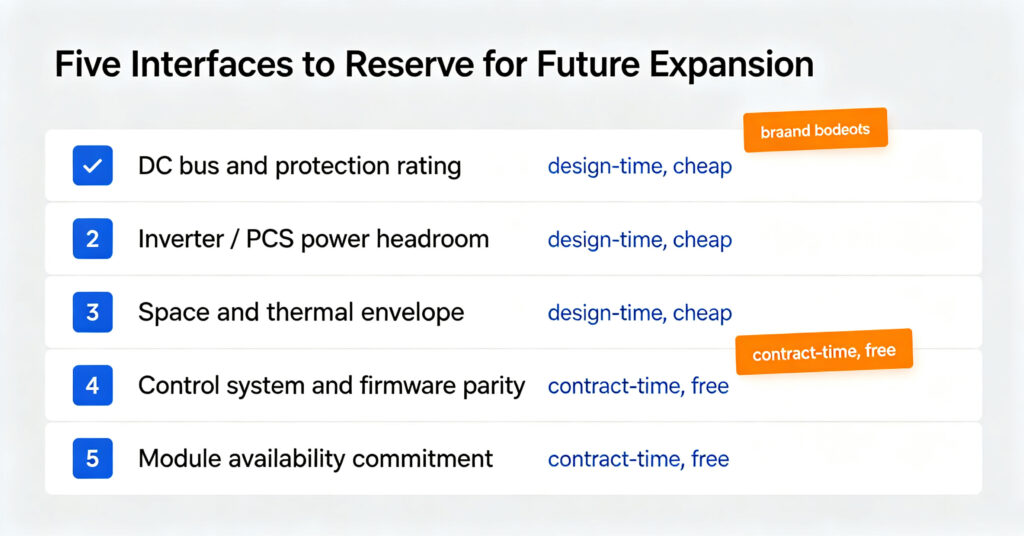
Each of these is cheap to include at design time and expensive to retrofit. Each one that is missed converts an expansion into a project.
- Bus and protection capacity. The DC busbar or cable, the main fuse or breaker and the disconnecting means must be rated for the final configuration’s current, not the initial one. Oversizing copper at installation costs a fraction of replacing it later.
- Inverter or PCS headroom. Power conversion is usually the least modular part of a system. If the inverter is sized exactly for phase one, adding battery capacity later adds energy but not power, and the system may not be able to deliver the additional capacity at the rate the application needs. Whether to buy the final inverter up front or plan a second unit is a decision that must be made in phase one.
- Space and thermal envelope. The room, container or enclosure must fit the final module count, and the cooling must handle the final heat load. Batteries that fit physically but push the room past its thermal design point will derate or trip.
- Control system and firmware. The BMS, EMS and monitoring platform must support the final module count and the final site topology. Firmware version consistency across batches is part of this: modules added two years later must run the same firmware and protocol revision as the originals.
- Module availability. The same module model must still be purchasable when phase two happens. This is a supplier commitment question, and it belongs in the phase one contract rather than in an assumption.
Parallel limits: the constraint that surprises people
Most modular battery systems expand by paralleling modules on a common DC bus, and the number of modules that can be paralleled is limited by more than slot count. BMS architecture sets a maximum number of modules per string or per controller; beyond that, modules must be grouped into separate strings with their own protection. The current-sharing behaviour of paralleled modules depends on their internal resistance and state of charge, so modules of different age or different capacity will not share load evenly.
The practical rule that follows is to keep expansion batches as similar as possible: same model, similar capacity, same firmware, and ideally a similar state of health. Mixing a two-year-old module with a new one in the same bank is the common cause of the balancing problems that show up after an expansion. The technical constraints and safe practices are set out in #93 parallel battery packs.
At higher power levels the same question moves to the bus architecture: whether to grow by adding modules to a low-voltage bus or by moving to a higher-voltage configuration is the decision covered in #89 high-voltage vs low-voltage storage, and the overall system design sequence is in #61 BESS system design.
Modular versus monolithic: an honest comparison
A single large battery unit is not automatically worse than modular solar power. For a project with a known, stable load and no staging requirement, a monolithic system is usually cheaper per kilowatt-hour, simpler to commission and has fewer connection points to maintain. Modularity costs something: extra enclosures, more connection hardware, a more complex BMS topology, and a somewhat higher cost per kilowatt-hour at the final configuration.
What modularity buys is optionality and repairability. A failed module in a modular bank can be replaced without taking the whole bank offline; a monolithic unit usually cannot. And a project whose load forecast turns out wrong can correct course by adding or not adding the next module — an option that a single large unit does not offer. The trade-off between integrated and separated architectures is examined in #42 all-in-one vs split systems.
Where the project starts with an existing inverter and adds storage later, the retrofit path and its constraints are covered in #78 adding a battery to an existing inverter.
Q. Can I add more battery capacity to my solar system later?
Yes, if the system was designed for it. Three conditions have to hold: the DC bus and protection are rated for the final current, the inverter has sufficient power headroom to use the additional capacity, and the BMS supports the additional module count. If none of these was reserved at design time, adding capacity later usually means replacing the inverter or the bus rather than just buying another module.
Q. How many battery modules can be paralleled?
It depends on the BMS architecture and the manufacturer’s specification, and the limit is usually stated as a maximum module count per string or per controller. The binding factors are communication and balancing capability rather than the physical number of slots. Always confirm the supported maximum with the manufacturer’s integration documentation before assuming the empty slots can all be filled.
Q. Can I mix old and new battery modules in the same bank?
It is possible but not advisable. Modules of different age differ in capacity and internal resistance, so they share current unevenly and the BMS has to work harder to keep them balanced, which shortens the life of the newer modules. If mixing is unavoidable, keep the modules at the same model and firmware revision and expect reduced usable capacity.
Q. Is a modular system more expensive than a single large battery?
Per kilowatt-hour at the final configuration, usually somewhat more: additional enclosures, connection hardware and a more complex control topology all add cost. The offset is that you only buy the capacity when you need it, that a failed module is replaceable in isolation, and that the system can be corrected if the load forecast changes.
Q. Do I need to size the inverter for the final system from the start?
Not necessarily, but you do need a documented plan. Either buy the final inverter capacity up front and accept the higher initial cost, or size for phase one and confirm that a second unit can be paralleled or added later with the same control platform. The mistake is sizing the inverter exactly for phase one without checking whether expansion is supported at all.
Next step: design phase two before you buy phase one
A modular system earns its cost only if the expansion path was engineered in advance. The five interfaces are cheap at design time and expensive afterwards, and none of them requires you to buy the hardware early.
- Check the parallel limits in #93 parallel battery packs
- Choose the physical form factor in #45 rack vs stackable vs wall-mounted
- Decide the architecture in #42 all-in-one vs split systems
- Ask leekooenergy for a phased expansion plan that states the final system size the design is rated for, the maximum supported module count and the grouping rules, the inverter headroom options with cost for each, the space and thermal envelope required at final build-out, and a written commitment on module availability and firmware parity for the follow-on order — so phase two is a purchase order placed against a design that already accommodates it