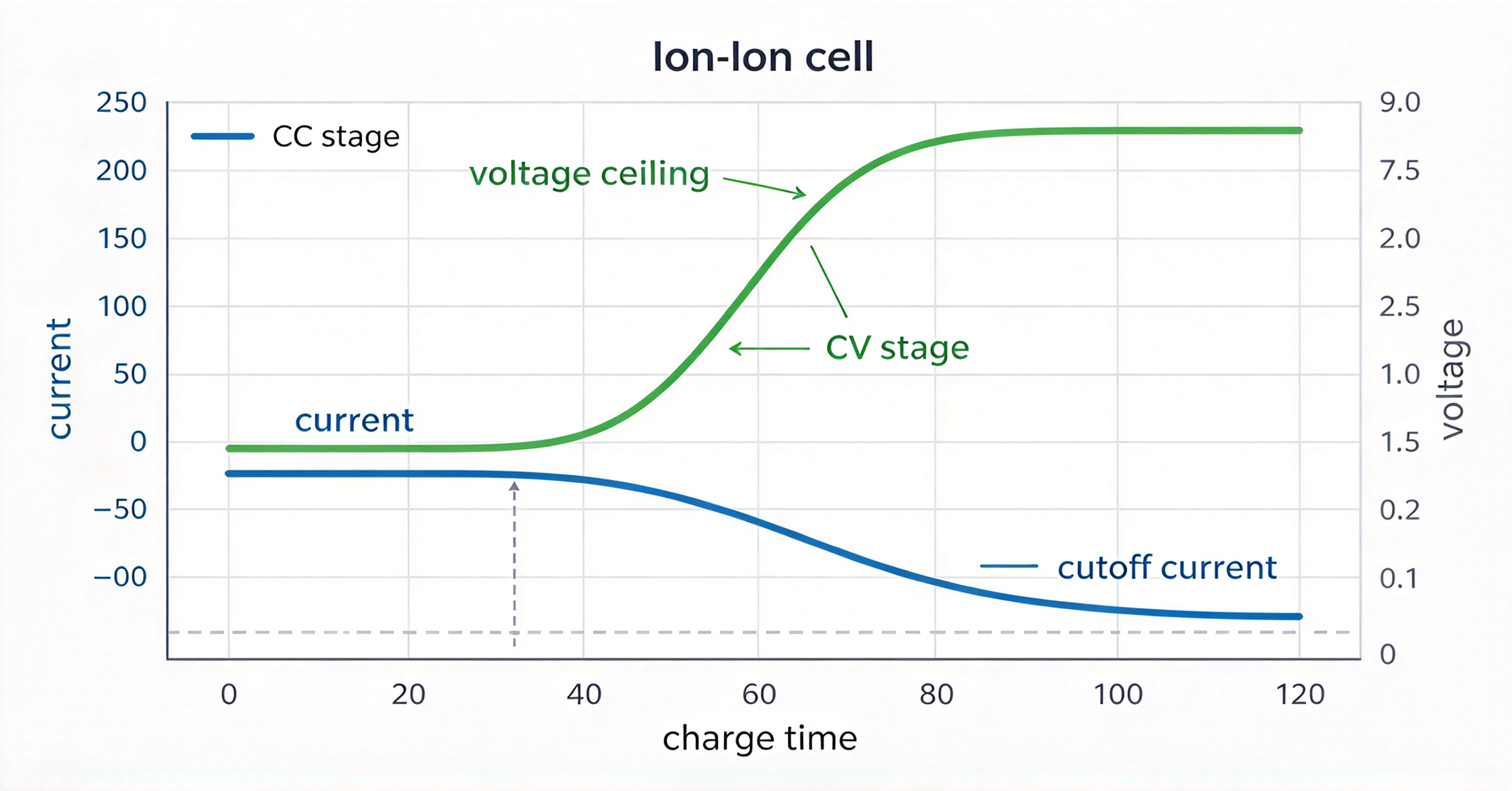
A lithium ion charge is not a simple fill-up but a controlled two-stage process: a constant-current stage pushes energy in quickly while voltage rises, then a constant-voltage stage holds the cell at its ceiling while the current tapers until it is small enough to stop. Doing it right means matching the charger and the Battery Management System (BMS) to the cell chemistry, respecting the per-cell voltage limit, and letting the taper end the charge rather than forcing a fixed time or a guessed full point.
Most damage blamed on “bad batteries” actually starts at the charger. The chemistry is forgiving only when the voltage and current limits are respected, so the charging method matters as much as the cells themselves.
What a lithium ion charge actually does
Charging moves lithium ions from the positive electrode back to the negative one, storing energy as chemical potential rather than as a tank you top up. The cell voltage is a state reading, not a fuel gauge, which is why a charger must watch both current and voltage instead of just switching off at a number. In practice the cell is happiest when the charge is gentle and the ceiling is exact.
This is where problems often start: a buyer picks a pack and assumes any power supply will do. It will not. The supply must follow the cell profile, or the BMS has to fight it, and a BMS is a protector, not a charger.
The CC-CV profile, stage by stage
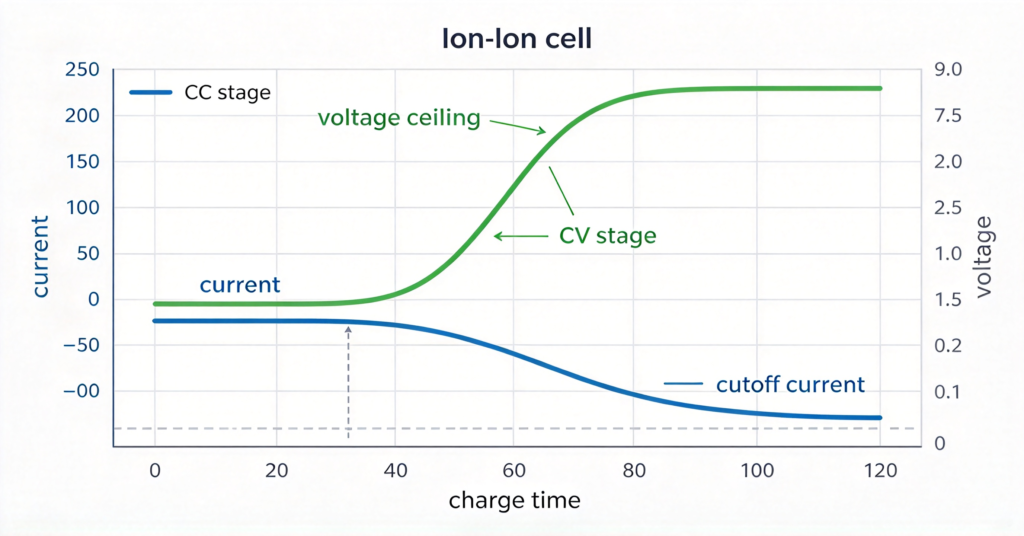
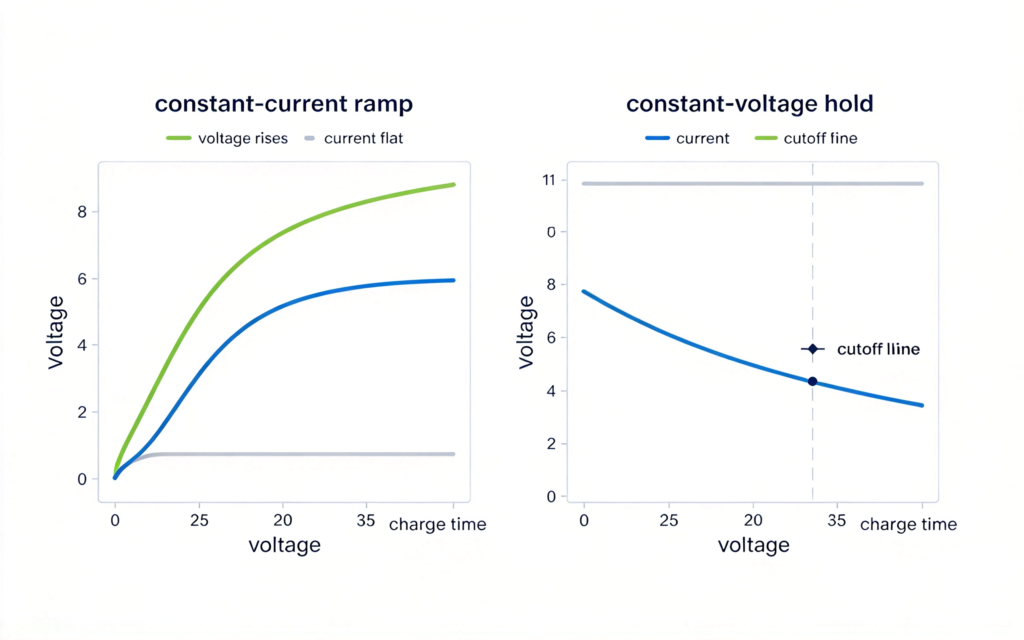
Stage one is constant current. The charger pushes a fixed current, often a fraction of capacity such as a C-rate in a typical range, and the cell voltage climbs. This stage does most of the energy transfer and is where charging is fastest. On paper the current can be high, but the safe value depends on the cell the maker specifies, so read the datasheet rather than copying a forum number.
Stage two is constant voltage. Once the cell reaches its per-cell ceiling, the charger holds that voltage and the current falls on its own as the cell fills. The charge ends at a cutoff current, often a small fraction of capacity, when the cell is considered full. A common mistake is to evaluate this in isolation; the two stages only make sense as one profile tied to one chemistry.
Why LiFePO4 charges differently from other lithium ion
Not every “lithium” shares a ceiling. A typical NMC or similar cell tops out near a higher per-cell voltage, while LiFePO4 (LFP) sits at a lower per-cell ceiling, so a 12V LFP pack reaches full at a lower pack voltage than a same-voltage NMC pack would. Use the wrong ceiling and you either underfill an LFP pack or overstress an NMC one. The lithium iron phosphate batteries guide gives the chemistry background, but the charge ceiling is set by the exact cell, so confirm it in writing.
For a small LFP build the compact lifepo4 battery 25 6v 15ah shows a 25.6V pack, and its full charge voltage is the 8-cell LFP ceiling, not a 12V number. The specification alone does not tell the whole story; the cell count decides the pack ceiling, and the charger must match the pack, not the label on the box.
Matching the charger and the BMS
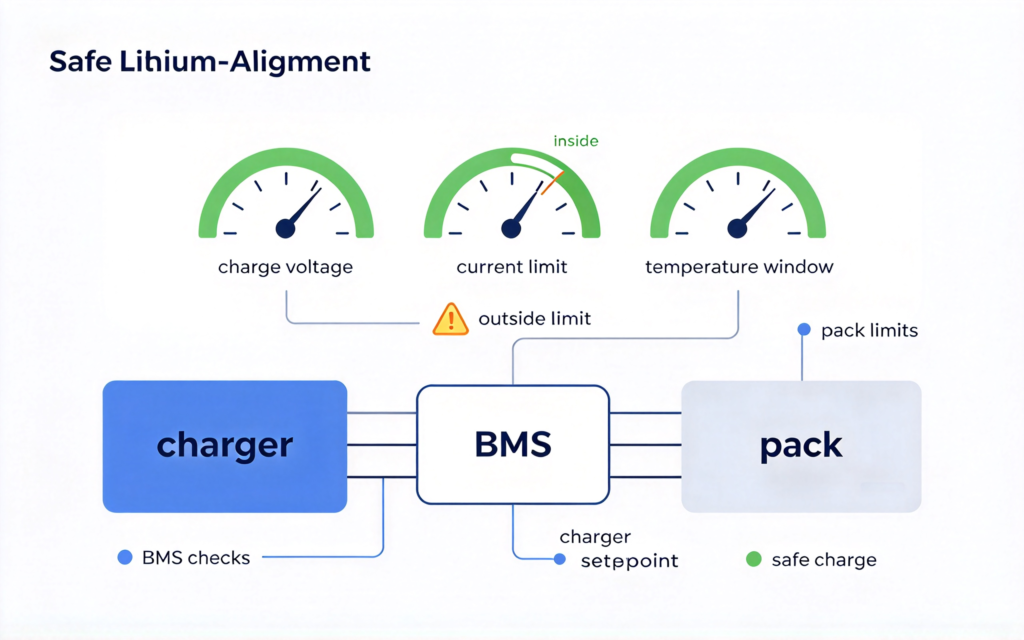
The charger sets the voltage and current; the BMS watches the cells and can disconnect if something strays. They must agree on the ceiling. A charger that overshoots forces the BMS to clamp, which trips protection and confuses the user into thinking the battery failed. A correct match lets the charge finish quietly at the taper.
Match on three numbers: the pack voltage at full, the maximum charge current the cells allow, and the cutoff the BMS expects. For a 12v lifepo4 deep cycle battery hub the charger should state the LFP profile explicitly, because a “lithium” mode tuned for another chemistry can still be wrong. When the source is an inverter or solar, the solar inverter troubleshooting battery not charging errors steps often come down to a profile mismatch rather than a fault.

Lithium ion charge versus lead-acid charge
Lead-acid wants a long absorption stage at a higher voltage and tolerates a finishing stage that lithium does not need, so a lead-acid charger on a lithium pack is the classic mismatch. It may push too high a voltage or never reach the lithium cutoff, leaving the pack partly full or tripping protection. The two chemistries are not interchangeable at the charger, and an “AGM” or “gel” mode is not a safe stand-in for a lithium profile.
In practice the safer move is a charger with a marked lithium or LFP mode, or a separate charge controller set to the pack’s profile. The how to choose a solar battery bank decision should already name the chemistry, because the bank and its charger are one system, not two products bought apart.
Safety limits an engineer actually watches
Three limits decide whether a charge is safe: the per-cell voltage ceiling, the maximum charge current, and the temperature window. Charge current above the cell limit heats the pack; voltage above the ceiling stresses it; charging outside the temperature window the maker allows can damage it or, in the worst case, create a hazard. None of these is optional, and all three should appear in the charger’s setting and the BMS limit.
A charge that “works once” is not proof it is safe. The risks build over cycles, which is why the specification and the BMS limits matter more than a first successful top-up. The solar battery kit how to choose note is worth re-reading here: a kit that states the charge profile removes the guess from the install.
What to confirm at the sample stage
Before a volume order, confirm the charge on a sample the way the field will use it. Ask the supplier for the per-cell ceiling, the allowed charge current, the cutoff current, and the temperature window, then run a full charge and watch where it ends. If the charger stops early or the BMS trips, that is the conversation to have now, not after a pallet ships. The evaluating inverter suppliers discipline applies: the written profile is the contract, and a vague “it charges fine” is not one.
For chisidal packs the charge profile is stated against the cell type, so the sample test is a confirmation of the paper, not a discovery. Keep the test record with the batch, because a charge that ends at the expected taper is the cleanest evidence the system was set up correctly.
Q. What is a lithium ion charge profile?
A lithium ion charge follows CC-CV: a constant-current stage that pushes energy in while voltage rises, then a constant-voltage stage that holds the cell ceiling while current tapers to a cutoff. The charger must match the cell chemistry, and the BMS protects the cells; the two work as one system rather than separately.
Q. What voltage should a LiFePO4 battery charge at?
An LFP cell reaches full at a lower per-cell ceiling than other lithium chemistries, so a 12V LFP pack fills at a lower pack voltage than a same-voltage NMC pack. The exact ceiling depends on the cell the maker specifies, so confirm the per-cell and pack voltage in the datasheet rather than assuming a generic “lithium” number.
Q. Can I use a lead-acid charger on a lithium battery?
Not safely as a default. Lead-acid chargers use a higher absorption voltage and a finishing stage lithium does not need, so they can over-voltage the pack or never reach the lithium cutoff and leave it partly full. Use a charger with a marked lithium or LFP mode, or set a charge controller to the pack’s profile.
Q. Why does my lithium battery stop charging early?
An early stop usually means a profile mismatch: the charger’s ceiling is below the pack’s, the BMS tripped on current or temperature, or the source inverter is not set to the lithium profile. Check the charge voltage and current limits against the pack specification; a protection trip looks like a full battery but is not one.
Q. How do I know a lithium charge is finished?
The charge is finished when the current tapers to the cutoff the cell maker defines while the voltage holds at the ceiling, not at a fixed clock time. A correct charge ends quietly at that taper; if it ends early or the BMS clamps, the profile is wrong and should be corrected before relying on the pack.
Q. What should I confirm on a sample before ordering?
Confirm the per-cell ceiling, the allowed charge current, the cutoff current and the temperature window, then run a full charge and watch where it ends. If the charger stops early or the BMS trips, fix the profile before a volume order ships, because a vague “it charges fine” is not a specification.
Next step: set the profile before you set the price
A lithium ion charge lives or dies on the numbers: ceiling, current, cutoff and temperature. Agree them in writing, then confirm them on a sample, and the field problems shrink.
- Start from the lithium ion battery pack buyers guide and name the chemistry before you pick a charger
- For chisidal, send your usage and site details, and we will come back with product prices, lead time and warranty information.