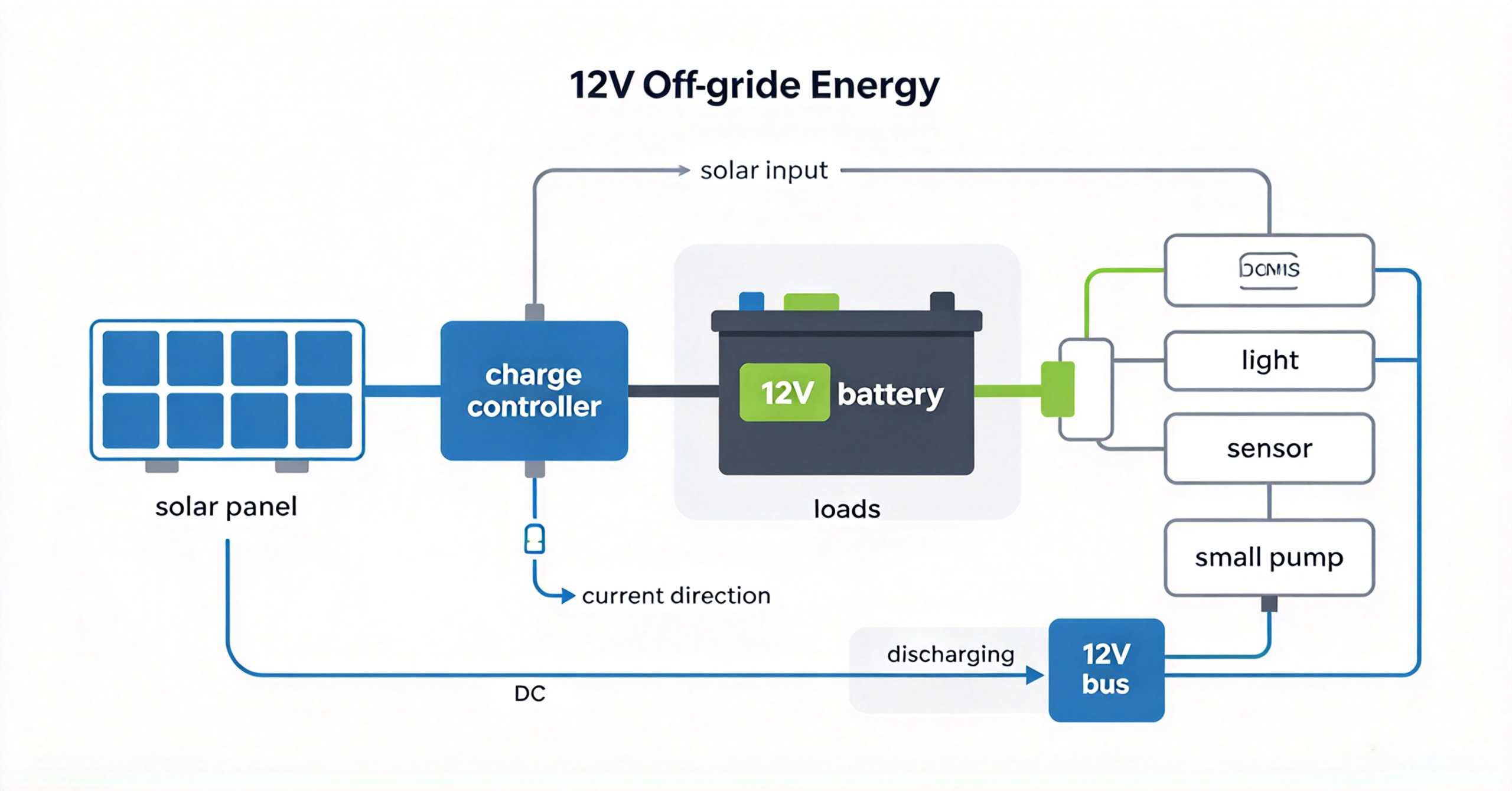
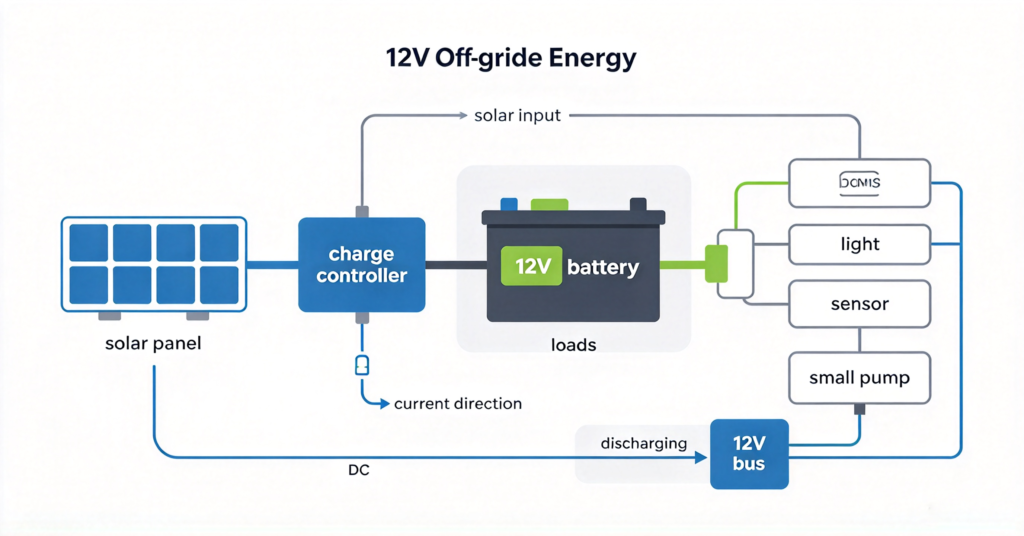
A solar powered 12v system is a small off-grid loop where a photovoltaic panel feeds a charge controller, the controller fills a 12-volt battery, and the battery runs lights, sensors, pumps and other low-power loads without a grid connection. It works because 12V is a safe, common DC voltage that matches most small off-grid appliances, so the job is to size the battery to your daily energy use and size the panel and controller to refill it before the next night.
The appeal is simplicity: one voltage, thin cables, and parts that are cheap to replace. The risk is the same simplicity tricking buyers into undersizing the battery, which is the single most common reason a 12V setup goes dark on day two of a trip.
What a solar powered 12v system is made of
Four parts do the work. The panel makes DC power from sunlight. The charge controller sits between the panel and the battery and stops the battery from overcharging. The 12V battery stores the energy, and a Battery Management System (BMS) inside a lithium battery protects the cells from over-discharge and short circuit. The loads are everything you plug in: lights, a router, a camera, a small fridge or a bilge pump.
Skip any one of those and the loop breaks. A panel without a controller cooks the battery; a battery without a BMS can be damaged by a deep drain; a controller sized too small leaves the battery half full. A matched kit lists these as one set, which is the easiest way to avoid a missing part.
How the charge actually flows
The panel voltage swings with light and temperature, but the battery wants a steady target, so the controller’s only job is to convert the panel’s variable output into the right charge for the battery. In practice the controller watches the battery and slows the current as the battery fills.
There are two controller types. A PWM (pulse-width modulation) controller is cheap and fine for small, matched systems, but it wastes the panel’s excess voltage as heat. An MPPT (maximum power point tracking) controller is dearer yet pulls more usable energy from the same panel, especially in cold or low light. For a lithium iron phosphate batteries guide based 12V bank, MPPT usually pays back on a system that runs daily.
Sizing the battery to your daily load
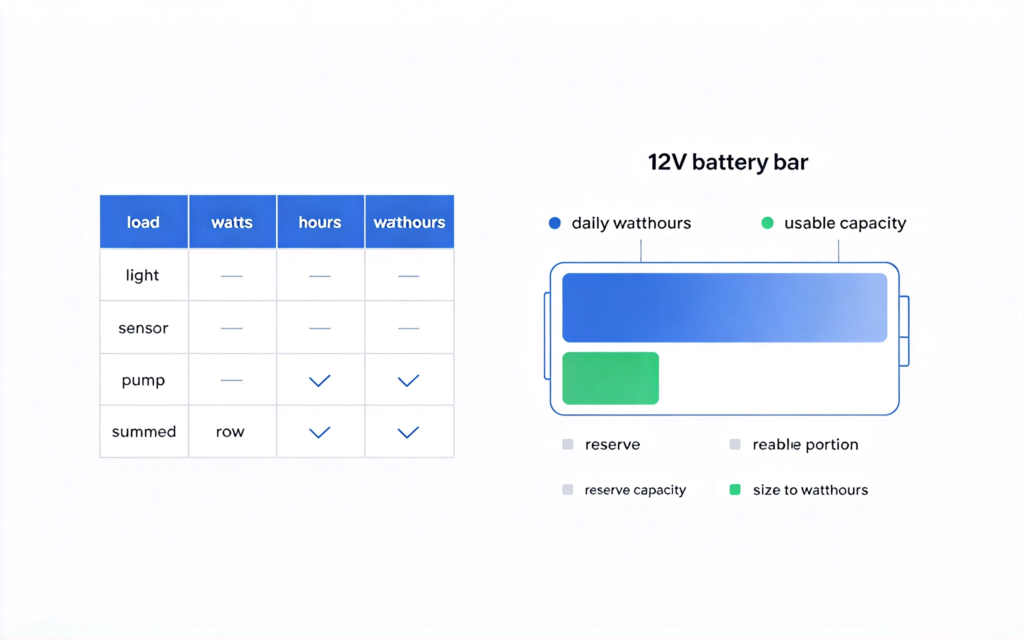
Start with watthours, not amp-hours, because watthours describe real energy. List each load, its watts and the hours it runs per day, multiply, and add the rows. A 10 W light for five hours is 50 Wh; a 5 W camera for 24 hours is 120 Wh. Add them, then add a margin, because real use rarely matches the estimate.
For a lithium 12V battery, do not plan to use all of it. A LiFePO4 cell tolerates deep discharge well, yet the bank lasts longer if you use the usable portion the maker defines rather than the full label. Match the result to a real product with the 12v lifepo4 deep cycle battery hub so the rated and usable capacity are the same line.
Sizing the panel and the charge controller
Once the daily watthours are known, the panel must replace them with a margin for cloudy days. A panel’s rated watts appear only in ideal sun, so divide the daily need by the peak sun hours your site gets and add a buffer. The controller must then handle the panel’s short-circuit current and the battery voltage without tripping.
As a rule of thumb the controller’s amp rating should clear the panel’s current into a 12V battery with headroom, and the MPPT versus PWM choice sets how much you harvest. When the load is a boat or a vehicle, read the marine rv deep cycle battery guide before fixing the mounting and ventilation, because motion and heat change the install.
Where a 12V solar setup fits best
Twelve volts suits small, steady loads more than big intermittent ones. A shed light, a gate sensor, a campsite phone charge, a trolling motor’s house bank and a CCTV camera are all natural fits because they draw modest current that a 12V battery can hold through the night. The voltage is also forgiving for first-time installers who want thin wire and simple fusing.
| Application | Typical daily load | Why 12V works |
|---|---|---|
| Camping / RV lighting | Low, intermittent | Thin cable, safe DC, easy spares |
| Boat house bank | Low to medium | Matches common marine DC appliances |
| Garden shed / gate | Very low, steady | Runs for days on a small battery |
| CCTV / monitoring | Low, 24-hour | Always-on small draw suits LiFePO4 |
| Street or cabin lighting | Low, dusk-to-dawn | Predictable cycle, simple control |
For a home that must ride through a grid outage without panels, the same 12V thinking does not scale well; the home battery backup without solar path uses a larger bank and often a higher voltage, so keep 12V for the small, off-grid jobs.
Common mistakes that drain a 12V system
The first mistake is sizing the battery to the panel instead of the load, which leaves the battery empty by morning. The second is mixing a PWM controller with a much larger panel, wasting the very energy you needed. The third is forgetting the reserve: a cloudy day is normal, so the battery should carry at least one low-sun day.
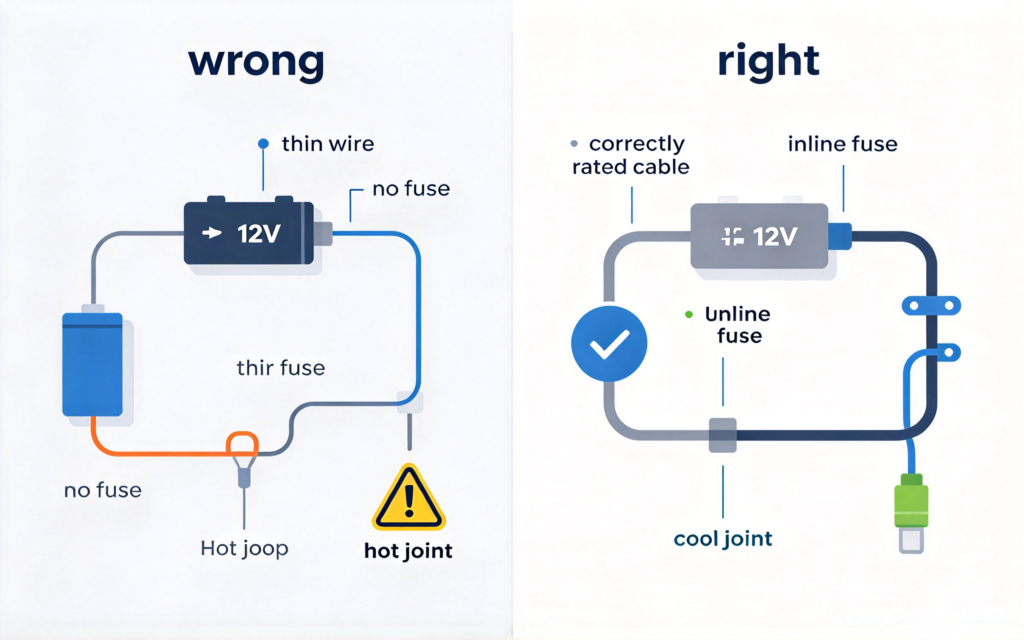
The fourth is cable and fuse neglect. At 12V the current is high for a given watt, so undersized wire heats and drops voltage, and a missing fuse turns a fault into a fire. The how to choose a solar battery bank checklist covers cable rating and fusing, and those rules apply to a 12V build.
When 12V is the wrong voltage
Twelve volts stops making sense once the load grows. A system above a few hundred watthours daily, or any load above roughly a kilowatt, pushes so much current at 12V that cable and loss costs outweigh the simplicity. At that point a higher bus such as 24V or 48V carries the same power with less current and thinner wire, and the inverter choice opens up.
For a compact higher-voltage build the compact lifepo4 battery 25 6v 15ah shows what a small 25.6V pack looks like, and it is the step up when 12V needs cable you cannot route. If the aim is backup rather than off-grid, the where to put a ups for home note matters more than the panel, because placement and ventilation decide whether the bank survives.
A solar powered 12v build stays reliable when every part shares the same 12 V rail, and a solar powered 12v kit should publish its controller, fuse, and cable ratings before you check out.
Q. How does a solar powered 12v system work?
A panel makes DC power, a charge controller regulates it into a steady charge for a 12V battery, and the battery runs the loads through the day and night. The controller stops overcharge and a BMS inside a lithium battery stops over-discharge, so the loop runs without a grid connection as long as the panel refills the battery each day.
Q. What size 12V battery do I need off-grid?
Add the watthours of every load: watts multiplied by hours per day, summed across all devices, then add a margin for real use and a cloudy day. For a LiFePO4 12V battery use the usable portion the maker defines, not the full label, and pick a product whose rated and usable capacity are stated on the same line.
Q. Should I use MPPT or PWM on 12V?
PWM is cheaper and fine for a small, matched system, but it loses the panel’s excess voltage as heat. MPPT costs more and harvests more from the same panel, especially in cold or dim conditions, so it usually pays back on a 12V system that runs every day. Size the controller to the panel’s current into 12V with headroom.
Q. Can a 12V solar system run a fridge?
A small 12V DC fridge can run on a correctly sized 12V bank, but a standard mains fridge needs an inverter and draws a high startup surge that empties a small battery fast. Confirm the fridge’s daily watthours and startup current before sizing, because a fridge is the load most likely to outrun a casual 12V design.
Q. When is 12V the wrong choice?
Twelve volts stops fitting once daily energy passes a few hundred watthours or any single load exceeds about a kilowatt, because the current at 12V forces thick cable and wastes energy as heat. Step up to 24V or 48V for larger systems, and keep 12V for lighting, sensors, pumps and other small off-grid loads.
Q. Why does my 12V system go flat overnight?
The usual cause is a battery sized to the panel instead of the load, leaving it empty by morning, or a PWM controller wasting panel energy on a larger array. Add a one-day reserve for clouds, match the controller to the panel current, and check cable size and the fuse, because loss and a missing reserve drain a 12V bank faster than the load alone.
Next step: size the load first, then the kit
A 12V system lives or dies on the battery size, not the panel wattage. Build the load list, then pick parts that match it rather than a bundle sized for someone else’s trip.
- Start from the solar battery kit how to choose checklist so the panel, controller and 12V battery arrive as one matched set
- For chisidal, send your usage and site details, and we will come back with product prices, lead time and warranty information.