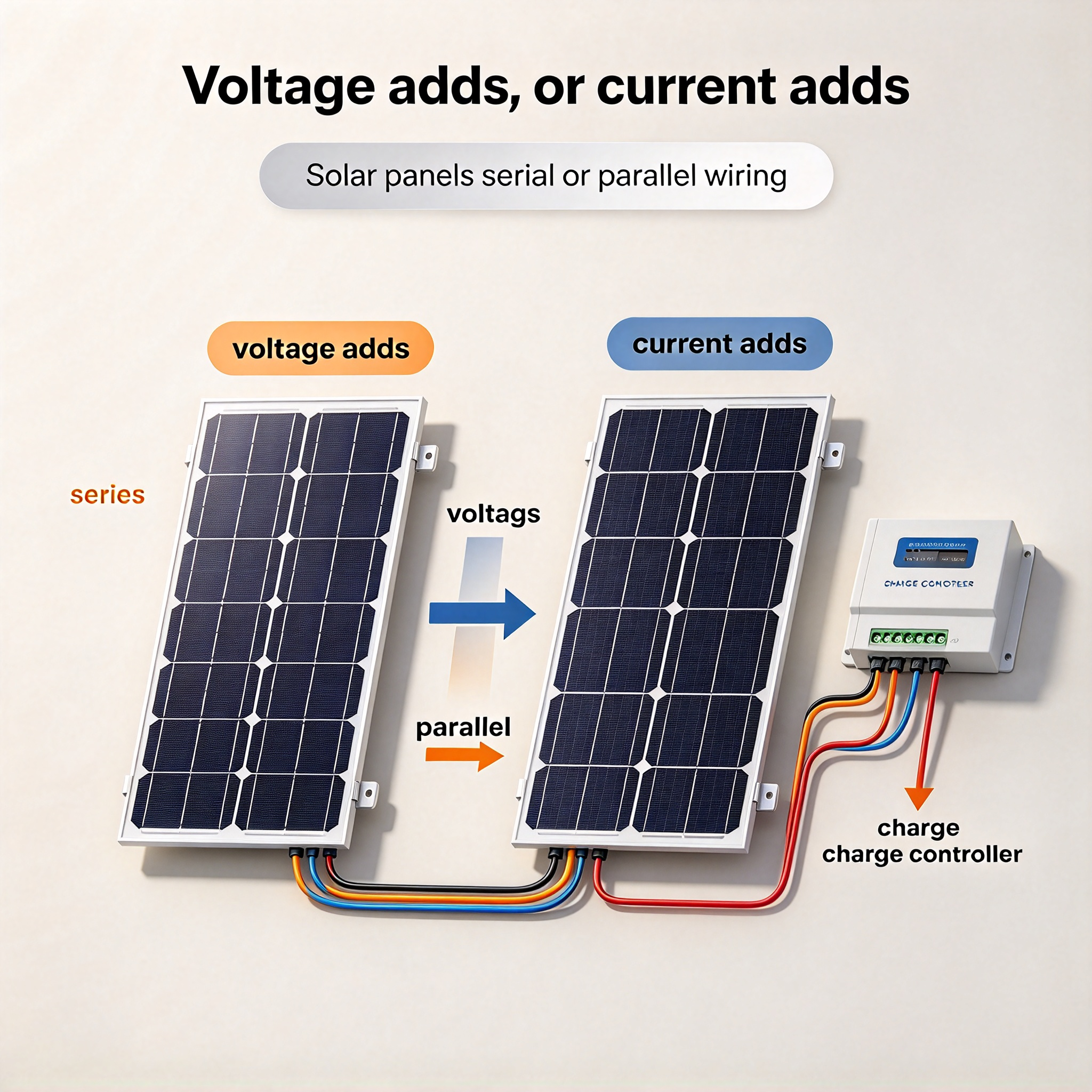
Wiring solar panels serial or parallel is the choice between raising system voltage or raising current: in series you link positive to negative and voltages add while current stays put; in parallel you link positives and negatives together and current adds while voltage stays put. This guide explains the series-versus-parallel trade, when each wiring makes sense, and how to match the string to your charge controller or inverter window.
The same panels can be wired two ways, and the way you pick changes every number downstream — the voltage your controller must accept, the wire gauge you must run, and the losses you must tolerate. Get the series-or-parallel decision right and the rest of the design follows; get it wrong and you either exceed a voltage limit or waste copper and yield.
Series versus parallel: the core trade
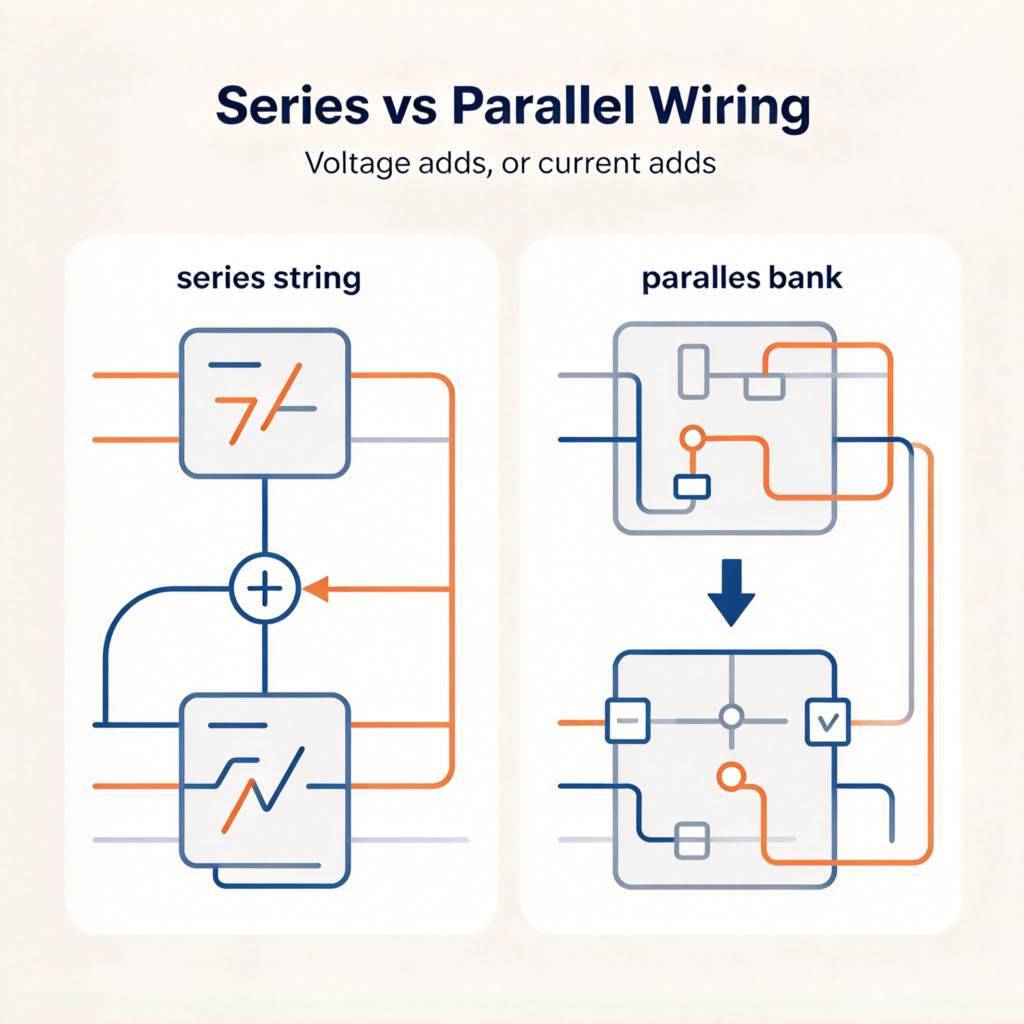
With solar panels serial or parallel, series wiring connects the positive of one panel to the negative of the next, so the string voltage is the sum and the current equals one panel’s. Parallel wiring connects all positives together and all negatives together, so voltage stays at one panel and current is the sum. Series is the default for long wire runs because higher voltage means lower current and thinner wire; parallel suits low-voltage systems where current is already manageable. The solar panel mc4 connectors guide MC4 guide covers the connectors that make these joins weatherproof.
When to wire panels in series
Choose series when the run to the controller or inverter is long, when the device’s maximum input voltage comfortably accepts the summed open-circuit voltage, and when you want thinner, cheaper wire. A solar panels serial or parallel string in series is the normal answer for grid-tied and larger off-grid arrays because it keeps current — and therefore loss and heating — down. The best pv module guide module guide and the solar panel dimensions guide dimensions guide set the panel numbers you are stringing.
| Wiring | Voltage | Current | Best when |
|---|---|---|---|
| Series | Adds | One panel | Long runs, high-voltage devices |
| Parallel | One panel | Adds | Low-voltage, matched-current needs |
| Series-parallel | Adds per string | Adds per parallel branch | Large arrays, both limits matter |
When to Use Parallel or Series-Parallel Connections
Parallel becomes necessary when a single panel’s voltage already fits a 12V or 24V battery system and you need more current, not more voltage, or when panels see different shading and you want them to fail independently rather than drag the whole string down. Large arrays combine both: strings in series, those strings in parallel. The solar panel drawing panel-drawing guide helps lay out the combiner, and the sol ark inverter installation guide inverter-integration guide shows where the strings land.
String sizing against the voltage window
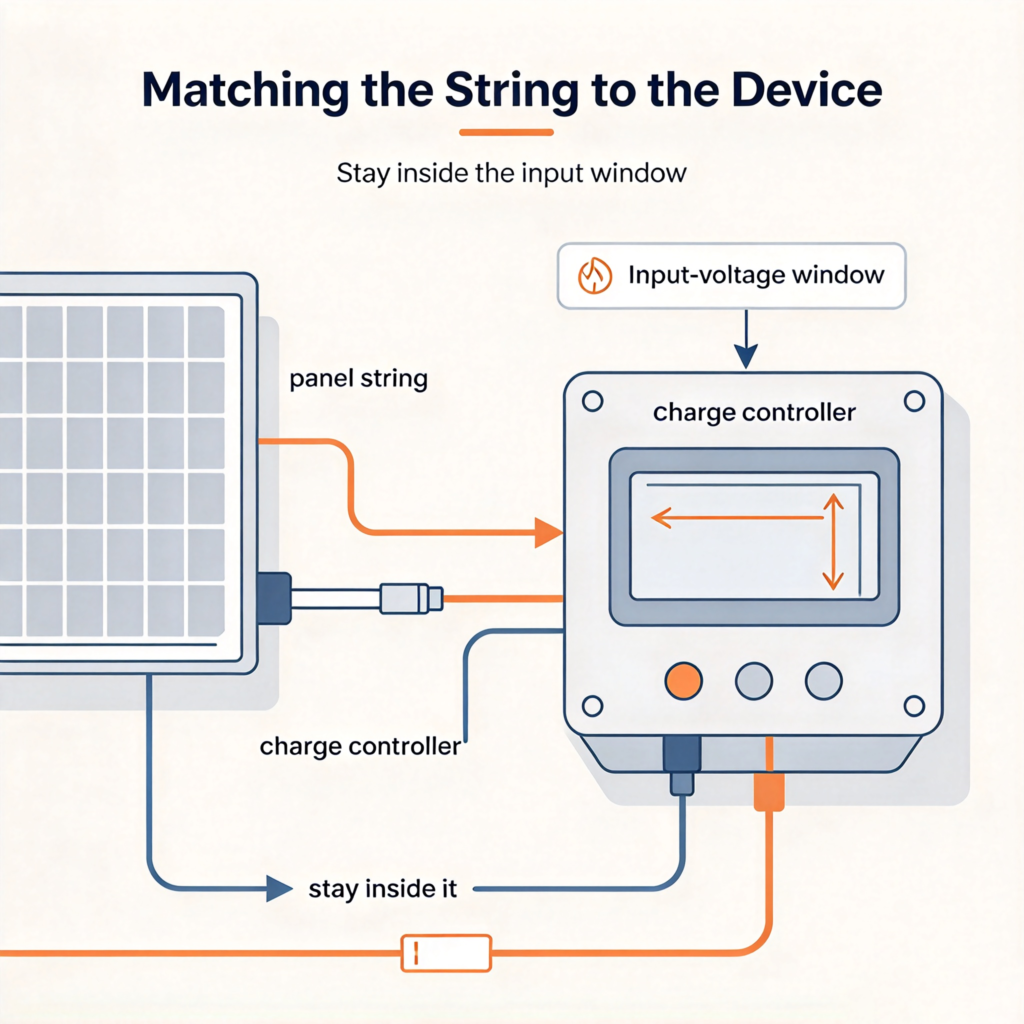
Whatever you choose, keep the coldest-day open-circuit voltage at or below the controller’s or inverter’s maximum input, and the operating voltage inside its MPPT window. Mixing panels of different wattage or cell count in one string causes mismatch loss, so keep a string uniform. The solar inverter troubleshooting battery not charging troubleshooting guide covers what goes wrong when the numbers are off, and the solar panel cleaning brush cleaning guide keeps the strings producing. For chisidal projects, send the panel model, the run length and the device window, then ask for the string plan as one documented layout with the matching diy solar panel kits complete guide kit path.
Choosing series, parallel or both
Wire solar panels serial or parallel by what the inverter or charge controller expects, not by habit. Series raises voltage and keeps current low, which suits long wire runs and MPPT controllers; parallel keeps voltage low and current high, which tolerates one shaded panel but demands thicker cabling.
A mixed solar panels serial or parallel layout — called series-parallel — is common on roofs where strings must match a controller’s voltage window while staying within its current limit. Map each string’s open-circuit voltage against the coldest-day coefficient, because voltage climbs as it gets colder, and a winter surprise can exceed the gear’s rating. Balance is the point: mismatched panels in the same string drag the whole string to the weakest member, so pair by voltage and current, not just by looks. Fuses and isolation belong at every junction — each parallel branch needs its own over-current protection, and the array needs a reachable disconnect.
For chisidal-supplied kits, the wiring diagram is built around the exact panels shipped, so solar panels serial or parallel decisions are made once, correctly, at design time.
Nameplate reading, string monitoring and sizing
Read the nameplate before you mix. Two panels that look alike can differ in open-circuit voltage or in the number of cells, and a mismatch inside one string quietly caps the whole string at the weaker panel’s output. Solar panels serial or parallel decisions start with the data plate, not the catalogue photo.
Monitor per string so a single shaded or failing panel shows up as one dip, not a mystery across the array. A cheap string combiner with per-branch indication turns a weekend of guessing into a five-minute fix. Keep the wiring diagram with the array; the next person to service it should not have to trace every wire. And do not oversize the controller to “be safe” — a unit far larger than the array never works in its efficient band and costs more for no gain. For chisidal-supplied kits, the solar panels serial or parallel map is printed on the shipment so the layout is self-documenting.
Commissioning the wiring
Before you call the array done, verify each string’s open-circuit voltage and short-circuit current against the design, because a reversed connector or a shaded branch hides until the meter comes out. A ten-minute commissioning check on solar panels serial or parallel wiring prevents a season of mysterious underperformance. For chisidal-supplied kits, the as-built map is compared to the measured values so the install closes clean.
Bottom line
Get the solar panels serial or parallel decision right at design time, verify it at commissioning with a meter, and monitor it afterward with per-string indication; the wiring is far cheaper to fix on paper than on a roof or in a field.
Controller limits and the shade trade-off
The charge controller or inverter sets the real ceiling on solar panels serial or parallel choices. It has a maximum input voltage and a maximum input current, and exceeding either damages the gear or clips your yield. Read both limits before you draw the string, and leave a margin for the cold-day voltage rise.
Shade tolerance is the other trade. Parallel strings keep a shaded panel from dragging its neighbors as hard as series does, but they push current up and demand thicker wire and more fusing. Series is cleaner for long runs but punishes partial shade. Match the topology to where the array actually lives — a tree-lined yard argues for parallel, an open field for series. For chisidal-supplied kits, the topology is chosen against the real shade map, not a generic default.
Q. solar panels serial or parallel?
Solar panels serial or parallel is the wiring choice between raising system voltage (series) or raising current (parallel). In series, voltages add and current stays at one panel; in parallel, current adds and voltage stays at one panel.
Q. Which is better, series or parallel solar panels?
Neither is universally better. Series wins for long runs and high-voltage devices because lower current means thinner wire and less loss; parallel wins for low-voltage systems or shaded, independent panels. Large arrays use both.
Q. Do solar panels in parallel increase current?
Yes. In parallel the positives and negatives are tied together, so the system current is the sum of the panels while voltage stays at a single panel. That is exactly what raises current and, with it, wire and loss considerations.
Q. How many panels can I put in series?
As many as keep the coldest-day open-circuit voltage at or below the controller’s or inverter’s maximum input and inside its MPPT window. The exact count depends on the panel’s voltage and the device limit — confirm both before stringing.
Q. Can I mix different panels in one string?
Avoid it. Different wattage or cell counts in one string cause mismatch loss because the weakest panel limits the others. Keep a string uniform; if you must combine, do it in separate, matched strings.
Q. Why does series use thinner wire?
Because series raises voltage and lowers current for the same power, and lower current means lower loss and heating in the wire. That lets you run thinner, cheaper cable over a long distance.
Next step: size the string to the device window
Series-or-parallel is a voltage-and-current decision first, a hardware decision second. Confirm the panel model, the run and the device limit before you wire.
- Read the solar panel mc4 connectors guide MC4 connectors guide before making weatherproof joins
- For chisidal, send your usage and site details, and we will come back with product prices, lead time and warranty information.