
A maximum power point tracking inverter is an inverter that continuously searches for and holds the voltage at which its PV input delivers the most power, rather than forcing the array to a fixed voltage. This guide explains why that point moves, how a tracker finds it, what separates MPPT from simpler PWM control, and the voltage-window and string-configuration checks that decide whether MPPT in a given unit will actually pay off.
A solar panel is not a fixed-voltage source. Where you operate it on its current-voltage curve decides the power you get, and that best point moves constantly. Understanding what a maximum power point tracking inverter does stops MPPT being treated as a badge.
Why there is a “maximum power point” at all
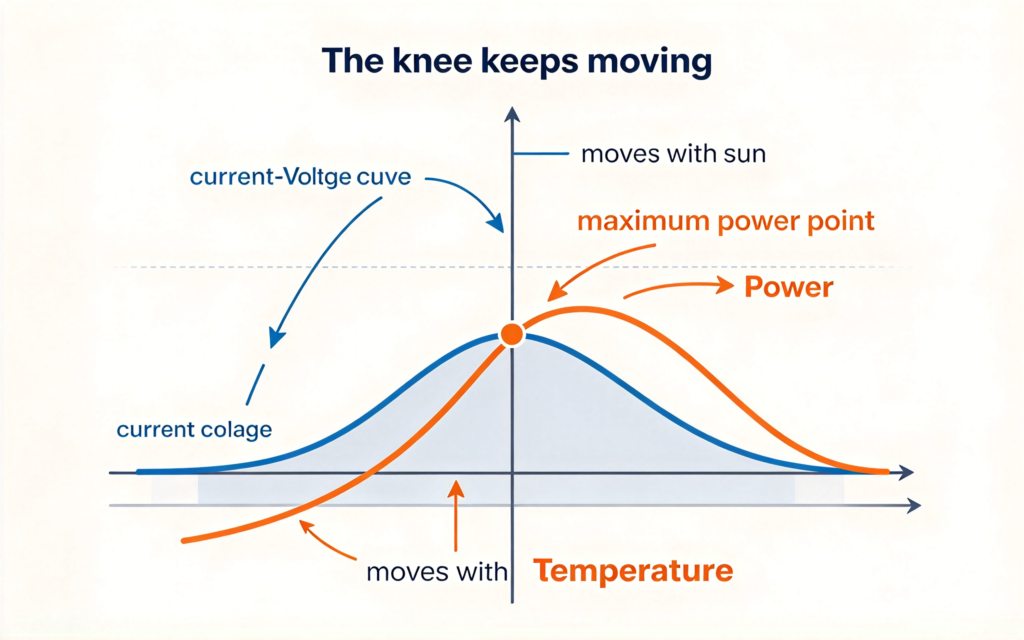
A PV cell produces current roughly in proportion to the light falling on it, while its voltage falls as it warms and rises as it cools. Power is the product of the two, so as you sweep the operating voltage from a short circuit to an open circuit, the delivered power rises to a single peak and then collapses. That peak is the maximum power point, and it is a narrow knee rather than a broad plateau.
The knee moves constantly. Cloud passing shifts the current; a hot afternoon shifts the voltage down; a cold, bright morning shifts it up. A fixed operating voltage therefore spends most of the day slightly off the peak. The tracker’s job is to keep re-finding that knee, and the difference between a good tracker and a poor one is measured in the percentage of available energy it actually captures across a real day.
How a tracker finds and holds the point
The common method is perturb and observe: the tracker makes a small change to the operating voltage, measures whether power went up or down, and continues stepping in the direction that increases it. Near the peak the steps get smaller, and the algorithm oscillates tightly around the knee. Better implementations vary the step size with conditions and re-scan periodically, because a rapidly changing sky can move the point faster than a fixed small step can follow.
Two practical consequences follow. First, tracking is not free — the converter operates slightly off-peak while it searches, which is part of why MPPT efficiency is quoted separately from conversion efficiency. Second, a tracker can be confused by partial shading, where a string can show more than one local peak. A tracker that settles on a local rather than the global peak leaves real energy unrecovered, which is why shaded sites deserve a unit with a documented global-scan behaviour.
| Behaviour | PWM control | MPPT tracking |
|---|---|---|
| Operating point | Pulls array to battery voltage | Seeks the power knee |
| Works best when | Array voltage matches battery | Array voltage is higher |
| Partial shading | No recovery | Can rescan if implemented |
| Typical gain | Baseline | Conditions dependent |
MPPT versus PWM, honestly
A PWM controller simply connects the array to the battery and pulls the array down to battery voltage. That throws away the difference between the panel’s peak-power voltage and the battery voltage, and the loss grows as the gap widens — which is exactly what happens in cold weather, when panel voltage rises. A maximum power point tracking inverter instead operates the array at its own knee and converts down to what the battery or the AC side needs, recovering that difference.
The honest caveat is that the gain is conditional. When the array’s peak-power voltage already sits close to the battery voltage — a small system with a well-matched array, or consistently hot conditions — the gap is small and so is the benefit. The gain is largest in cold climates, with higher-voltage strings, and where array and battery voltages are poorly matched. The solar charge controller guide covers where each approach belongs.
The voltage window is the specification that bites
Every MPPT input has a stated operating window and a maximum input voltage. The string’s open-circuit voltage must stay below the maximum in the coldest expected conditions, because panel voltage rises as temperature falls and a cold, clear morning is the worst case. Exceeding the maximum is not a reduced-performance event; it damages the input stage.
The lower end matters too. A string whose voltage sits below the window’s floor in hot conditions may not start, or may start late in the day. Practical string design therefore checks two numbers on the same string: cold open-circuit voltage against the maximum, and hot maximum-power voltage against the start threshold. Get both and the unit will behave; guess and it will fail at a seasonal extreme.
Where MPPT lives in the system
MPPT can sit in a charge controller between array and battery, or in the DC input stage of a hybrid or storage inverter. When it sits in the inverter, one stage handles both tracking and inversion, which reduces conversion steps but ties the array configuration to the inverter’s window. When it sits in a separate controller, the array and battery sides are decoupled and each can be specified independently.
The AC versus DC coupled storage comparison covers that architectural choice, and the all in one solar inverter guide guide covers units that combine tracking, inversion and charging in one enclosure. For retrofit, an existing PWM system is often upgraded by replacing the controller rather than the whole inverter, which is where the solar inverter repair guide guidance on assessing an existing unit is useful.

What to verify before you buy
Ask for the MPPT operating window, the maximum input voltage, the number of independent trackers and how strings may be paralleled, and the MPPT efficiency as a separate figure from peak conversion efficiency. Multiple trackers matter on roofs with more than one orientation, because a single tracker on mixed orientations forces both to a common voltage and loses the mismatch.
Ask about partial-shading behaviour and whether the unit performs a periodic global scan. Then confirm the string configuration against the cold-temperature open-circuit voltage for your site. The string solar inverters guide covers string layout, and the high efficiency inverter guide guide explains how to read efficiency claims. For chisidal-supplied systems, send the string configuration and the site’s temperature range, then ask for the MPPT window and tracker count confirmed against both.
What MPPT is worth in practice
A maximum power point tracking inverter earns its keep by keeping the array at its own peak instead of forcing it somewhere convenient. The gain is real but conditional, and the specification that decides whether the unit survives is the voltage window, not the MPPT badge.
Q. maximum power point tracking inverter?
A maximum power point tracking inverter is an inverter that continuously searches for and holds the voltage at which its PV input delivers the most power, rather than forcing the array to a fixed voltage. The peak moves with light and temperature, so tracking recovers energy that a fixed operating point leaves behind.
Q. How does MPPT work?
The usual method steps the operating voltage slightly, measures whether power rose or fell, and keeps stepping in the better direction. Near the peak the steps shrink and the tracker oscillates tightly around it.
Q. What is the difference between MPPT and PWM?
PWM pulls the array down to battery voltage and discards the difference between that and the panel’s peak-power voltage. MPPT holds the array at its own peak and converts down, recovering the difference — largest in cold weather and with higher-voltage strings.
Q. Is MPPT always worth it?
No. The gain depends on the gap between the array’s peak voltage and the battery voltage. Where they are well matched, or in consistently hot conditions, the benefit is smaller; in cold climates with high-voltage strings it is largest.
Q. What is the MPPT voltage range?
Every unit has a stated operating window and a maximum input voltage. The string’s cold-temperature open-circuit voltage must stay below the maximum, and its hot-condition voltage must stay above the start threshold.
Q. Does MPPT help with shading?
Partly. Shading can create more than one local peak, and a tracker that settles on the wrong one loses energy. Units that perform a periodic global scan handle this better, but shading is still best solved by layout.
Q. Do I need more than one MPPT tracker?
If the array spans more than one roof orientation, yes — a single tracker forces all strings to one voltage and loses the mismatch between them. One tracker per orientation is the usual answer.
Next step: check the window before the badge
MPPT pays off only if the string voltage fits the window at both temperature extremes. Send the string configuration and the site temperature range.
- Compare control approaches in solar charge controller guide
- Confirm layout against string solar inverters before specifying tracker count
- For chisidal, send your usage and site details, and we will come back with product prices, lead time and warranty information.