lithium battery shipping runs under dangerous goods rules, which is why a battery consignment is booked, packed and documented differently from ordinary freight. This guide covers the packaging and paperwork, how sea, air and express differ, why space is hard to secure, and what to check before dispatch.
A battery box is rarely refused at the port; it is refused at the booking desk, long before that. This guide follows the order a shipper actually meets, from packaging and paperwork through to the pre-dispatch check.
Why lithium battery shipping is classed as dangerous goods
A lithium cell carries both its energy and, internally, the chemistry to release it, so a cell that is crushed, punctured or internally shorted can heat, vent and ignite without anything external feeding the fire. That single property is why the transport rules treat these consignments as dangerous goods rather than as heavy electronics.
The classification is not a formality, because it changes who will carry the box, how it is packed, what marks appear on it, which documents travel with it and which ports or aircraft it can move on. Lithium battery shipping, in other words, behaves as a booking problem at least as much as a packing one.
The safety background sits upstream. How a cell reaches thermal runaway, and what separation and suppression codes require once a system is installed, is covered in the thermal runaway and NFPA 855 guide. This page stays on the freight itself.
Packaging, marking and the paperwork that travels with it
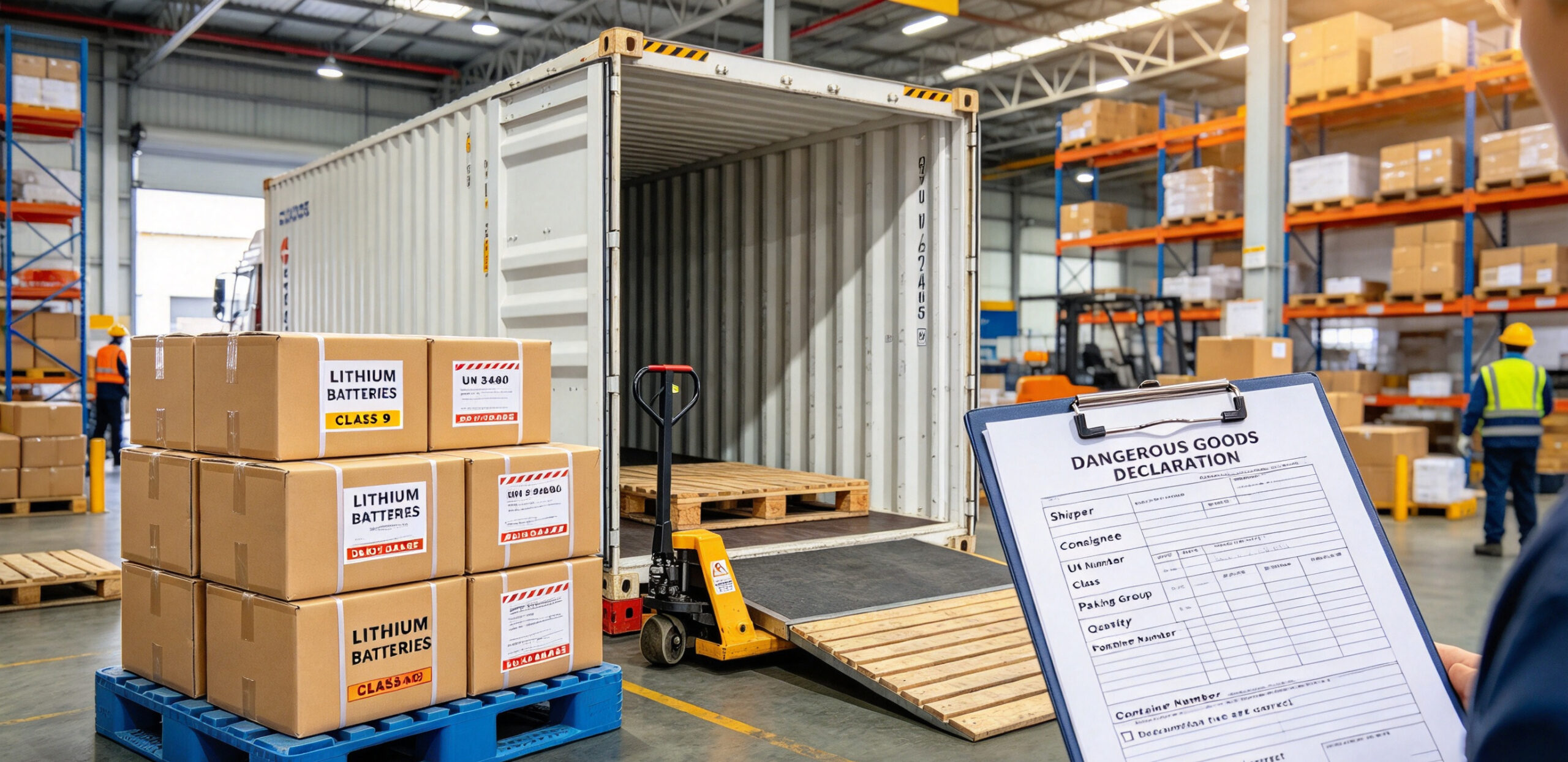
Packaging does two jobs at once. It must stop the terminals shorting against each other or against the case, and it must survive normal handling without deforming the cells, which usually means individual inner packaging, separation between units and a rigid outer carton with no loose movement inside.
The paperwork mirrors that. A test report or summary establishes that the cell design passed the transport tests, a safety data sheet describes the chemistry and the emergency response, and a dangerous goods declaration and transport classification document tell the carrier exactly what is in the box and how it is packed. Some routes also ask for a state-of-charge statement or limit.
Marks and labels are the part most often wrong, because they are applied last and checked least. The class label, the handling marks and the contact details have to be on the outside of the package in the form the current rules describe, and they have to agree with the declaration the carrier is holding.
Sea, air and express: how the three routes differ
Sea is the default for volume, and for lithium battery shipping it is the normal route for container loads. A full container of batteries moves routinely under declaration, subject to the carrier accepting the booking and the port and vessel allowing it, and the constraint is usually space and schedule rather than prohibition. Transit is slow and the paperwork lead time is long.
Air is faster and tighter. Acceptance depends on the operator and the aircraft, quantities per package are more restricted, and a booking that looks straightforward on paper can still be refused at acceptance. Express carrier networks sit between the two: convenient for small consignments, with their own packaging rules and their own list of what they will take.
| Route | Where it suits | The binding constraint |
|---|---|---|
| Sea freight | Container volumes, project cargo | Carrier and vessel acceptance, then schedule |
| Air freight | Urgent, high-value, smaller lots | Operator acceptance and per-package limits |
| Express network | Samples, spares, small parcels | Network-specific packaging and quantity rules |
| Any of the three | — | Documentation matching what is actually packed |
Why booking is harder than booking a box
Three things make battery bookings slow, and all three are specific to lithium battery shipping. Carrier acceptance is discretionary beyond the minimum rules, so a line that took a battery booking last quarter can decline the next one. Space is allocated against that acceptance, so a booking held without approval collapses at the cut-off. And some vessels, ports and airports simply do not handle the class, which removes routings rather than delaying them.
The practical consequence is lead time. A battery booking needs more days than a general cargo booking on the same lane, because the acceptance step sits in front of the space step. Quoting a customer a general-cargo transit time on a battery consignment is the most common way a delivery promise is broken.
What helps is giving the forwarder a complete declaration early: cell chemistry, pack configuration, watt-hour rating, packaging method, state of charge and the document set. Incomplete declarations are what send a booking back for resubmission, and each resubmission restarts the clock.
Consolidated versus full container on battery cargo
A full container gives control: one declaration, one shipper, one set of marks, and no question about what else is in the box. It also concentrates risk, because if the load is refused or held, the whole consignment is affected rather than one part of it.
Consolidation is cheaper for smaller volumes but adds a compatibility question: what the other cargo in the container is, who declared it, and whether the consolidator is actually authorised to accept dangerous goods. A battery box that is fine on its own can become a problem next to incompatible cargo, and the documentation has to cover the whole container rather than your cartons.
The deciding factor is usually whether the consolidator has a demonstrated dangerous goods process rather than a willingness to take the booking. Ask where consolidation happens, who signs the declaration, and what happens to the rest of the container if one shipper’s papers are rejected.
Insuring a dangerous goods consignment
Standard cargo policies often carry exclusions that bite on batteries, and the exclusion is usually discovered at claim time. Confirm in writing that the policy covers the cargo in its declared class, that the declared value covers replacement rather than invoice value alone, and that the transit includes the storage or transshipment legs where damage most often occurs.
Coverage has a behavioural condition too. Insurers expect the packaging and documentation to have been compliant; a claim on a consignment whose declaration did not match the packing is likely to fail on grounds that have nothing to do with how the damage happened.
Photograph the packed cartons before collection and keep the packing record with the file. That single habit is what turns a disputed claim into a documented one.
One more clause is worth asking about: whether the policy responds to damage discovered after delivery rather than only to damage evident on arrival. Battery damage from a handling shock often shows up electrically later, and a policy that requires notification at the point of delivery will not cover it.
What dangerous goods rules do to lead time and landed cost
The cost impact is not one line item. There is the packaging premium, the dangerous goods surcharge, the extra handling and documentation fees, and the insurance loading. None of these is unique to lithium battery shipping, but they stack, and there is also the schedule cost: longer booking lead time, fewer routing options, and a higher chance of rolling to the next sailing if acceptance is late.
Which term the shipment moves under decides who carries those lines, and that is a contract question rather than a freight one. The incoterms for battery orders guide covers which party owns the booking risk under each term, and the importing lithium batteries guide takes over once the cargo is discharging.
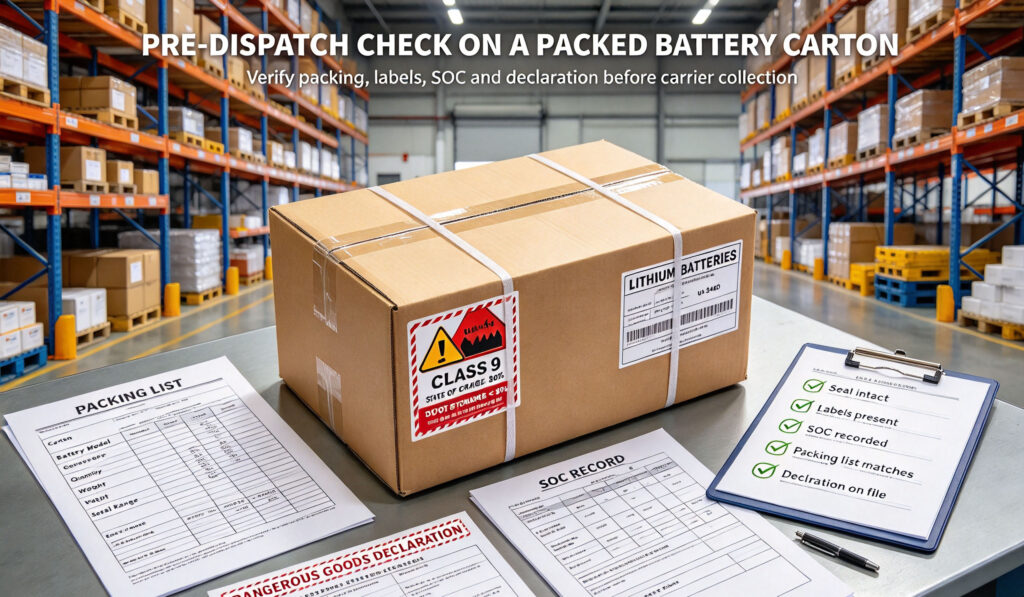
The pre-dispatch check for lithium battery shipping
A short routine catches most of what goes wrong at acceptance. Confirm the declaration matches the physical packing. Confirm the marks and labels on the carton are the current ones and are legible after handling. Confirm the test report and safety data sheet name the model actually being shipped rather than an earlier revision.
Then confirm the state of charge is where the carrier wants it, that the packaging shows no damage from staging, and that the emergency contact on the documents is reachable outside working hours. What lithium battery shipping failures at acceptance come down to is nearly always one of these rather than anything exotic.
Finally, confirm the supplier side. The lithium battery suppliers in China guide covers what to check about the factory packing the goods, and the battery export certification guide is where the test reports behind the declaration come from in the first place.
Q. lithium battery shipping?
Lithium battery shipping moves under dangerous goods rules, so the consignment is booked, packed, marked and documented differently from general cargo. Carrier acceptance, packaging and the declaration all have to agree before the box moves.
Q. Can lithium batteries be shipped by sea?
Yes, and sea is the normal route for container volumes, subject to the carrier, vessel and port accepting the declared class. The constraint is usually acceptance and schedule rather than a blanket prohibition.
Q. Are lithium batteries allowed on aircraft?
They are allowed under conditions set by the operator and the applicable dangerous goods rules, with tighter per-package limits than sea. Acceptance is at the operator’s discretion, so a booking can still be refused.
Q. Why do carriers refuse lithium battery bookings?
Often because the declaration is incomplete or inconsistent with the packing, because the vessel or aircraft does not carry the class, or because space was requested before acceptance was granted.
Q. What packaging do lithium batteries need for transport?
Individual inner packaging that prevents short circuits and movement, a rigid outer carton, and the class marks and labels the current rules specify. State-of-charge limits may also apply on some routes.
Q. Is cargo insurance different for battery shipments?
Check rather than assume. Some policies exclude or restrict the declared class, so confirm coverage in writing and expect compliance with packaging and documentation as a condition of the claim.
Q. How much longer does a battery booking take?
Longer than general cargo on the same lane, because carrier acceptance sits in front of space allocation. Budget extra days and avoid quoting general-cargo transit times.
Next step: declare it properly before you book it
Acceptance is won on the declaration, not on the rate. Send the pack configuration and the route you need.
- Then close the quality gate with the battery pre-shipment inspection guide
- Or settle the commercial terms in the battery MOQ, lead time and payment terms guide
- For chisidal, send your usage and site details, and we will come back with product prices, lead time and warranty information.