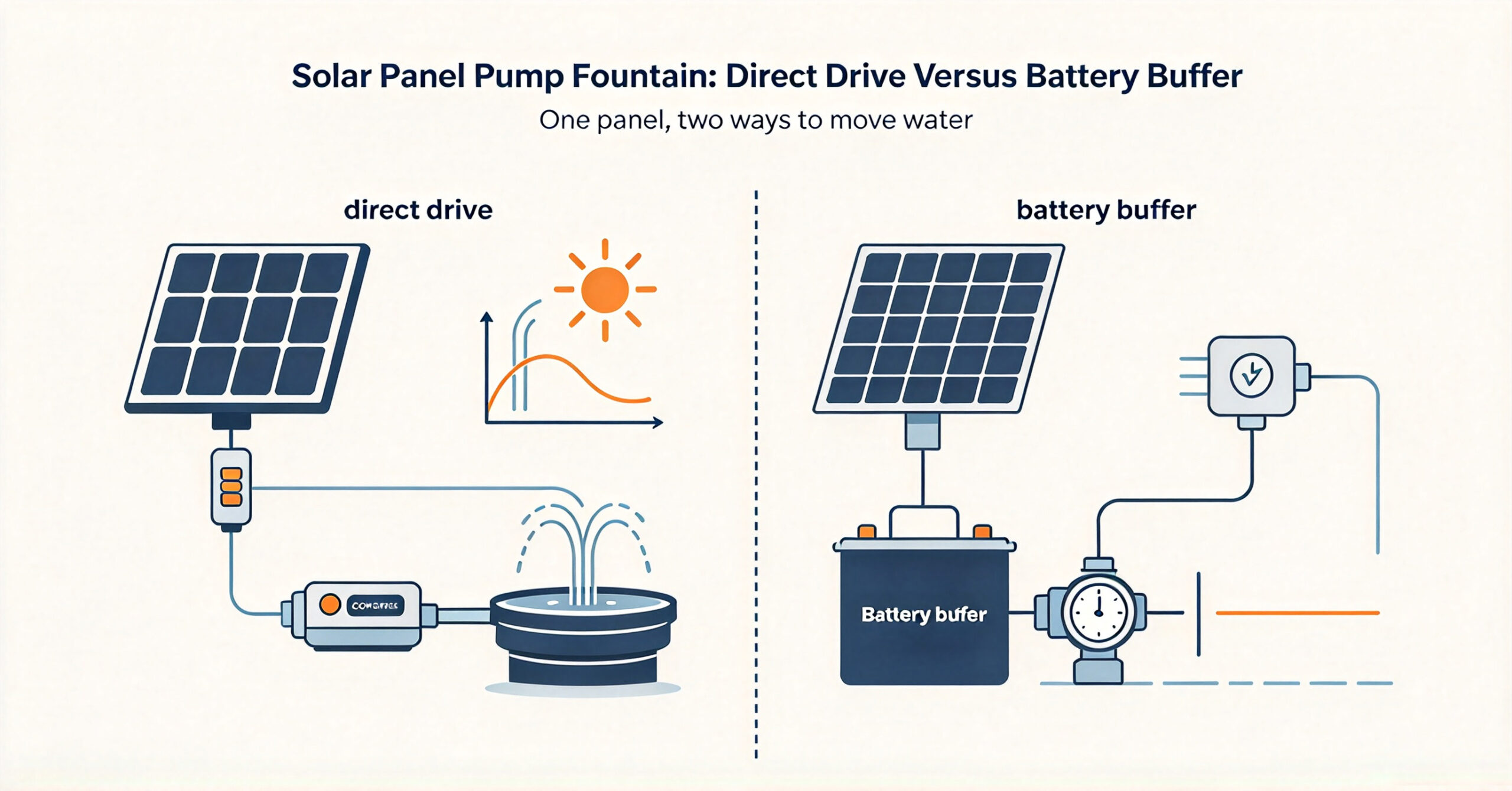
A solar panel pump fountain can be built two ways: direct drive, where the panel feeds the pump straight and flow rises and falls with the sun, or battery buffer, where a pack stores midday energy and releases it on a schedule. Direct drive is cheaper, simpler and quiet; a buffer costs more but runs at dawn, dusk, after dark and through cloud. This guide compares both on cost, available hours, fit and maintenance, shows how to size pump, panel and battery, and gives three worked configurations.
That choice is not cosmetic. It decides whether the water feature is a daytime ornament or a system that performs on a timetable, and it changes what you buy twice over — the pump class and the electronics that sit between the panel and the pump.
Start with the water schedule, not the panel
Direct drive is the honest name for what it does: the panel feeds the pump through a small controller, and the flow you see is the sunlight you have. Early morning gives a trickle, midday gives full height, and a passing cloud shows up instantly as a drooping nozzle. For a courtyard fountain nobody watches on a schedule, that behaviour is part of the charm and costs nothing to accept.
A battery buffer breaks that link. The panel charges a pack, and the pump draws from it on a timer, so the water does what the site needs rather than what the sky allows. That is the whole argument for spending more: you buy hours, not watts. Pool turnover that must finish before breakfast and an evening water feature in a hotel courtyard are cases where the schedule matters more than the panel.
Direct drive vs battery buffer: the four-way comparison
Every solar panel pump fountain lands somewhere on this table. Read it as a trade of money for hours: the buffer buys availability with extra parts, direct drive buys simplicity with dependence on the sun.
| Dimension | Direct drive | Battery buffer |
|---|---|---|
| Upfront cost | Lowest — panel, controller, DC pump | Higher — adds pack and charge control |
| Available hours | Daylight only; output tracks irradiance | Scheduled, including dawn, dusk and night |
| Flow consistency | Varies with cloud, season and panel angle | Steady at the set duty point |
| Best-fit scenarios | Decorative fountains, daylight ponds | Pool turnover, irrigation windows, evening features |
| Maintenance | Fewest parts, longest service interval | Pack adds cycle life and periodic checks |
| Control complexity | None needed beyond the controller | Timer, charge logic and protection to set |
The maintenance row is the one that surprises people. Direct drive has fewer parts, but the pump still starts every day and still runs dry if the water level drops. A buffer adds a pack whose life is measured in cycles, so the honest comparison is not “no maintenance versus maintenance” but one wear item versus two. Decide on the water schedule first and on the budget second.
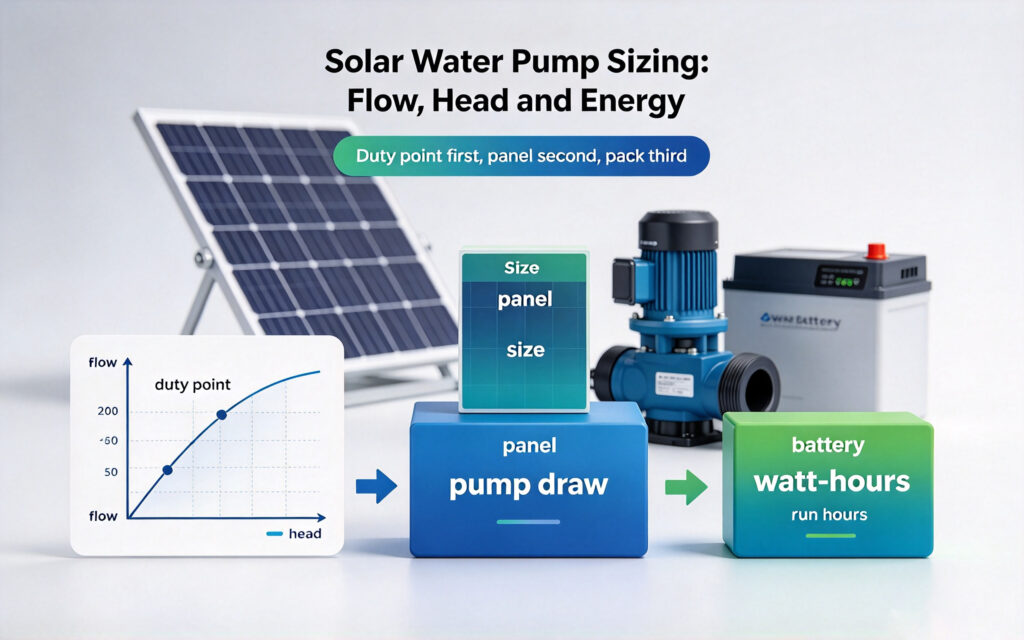
How to match pump, panel and battery
Solar water pump sizing starts with duty, not with a panel you already own. Take the flow you need in litres per minute and the total head in metres — static lift plus pipe friction — and the pump curve gives the power at that duty point. Multiply by daily run hours for the energy the system must deliver. Every other number follows.
Panel sizing is next. The array must cover the pump’s draw while it runs and, in a buffered design, also refill the pack the same day, so it is normally sized well above the pump’s nameplate wattage — a margin of several tens of percent is common, and more in winter. Check the panel’s open-circuit voltage against the controller’s input window at the coldest morning the site sees, because cold pushes voltage up.
Battery sizing closes the loop. Energy in watt-hours is roughly pump watts times run hours; divide by pack voltage for amp-hours, then divide again by the usable depth of discharge your chemistry allows, since a pack you only half use is a pack you paid for twice. The class choice follows from pump voltage and cable run, and it is worth reading how to choose a solar battery bank before you fix it. Where a pack sits in the loop, its charge behaviour matters too: a system that runs flat every evening has a fault, not a heavy duty, and the fault patterns in the troubleshooting guide for a battery that will not charge are worth knowing before commissioning.
Three configurations: fountain, pool, irrigation
Courtyard fountain — direct drive. The water only has to look right when people are around, which is daylight, and the head is modest. A direct-drive solar panel pump fountain with a small panel and a brushless DC pump is the cheapest honest answer: no pack to replace, no timer to set, and a jet that follows the sun. Add a strainer and a low-level float switch so a dropped water level does not burn the pump out.
Pool circulation — battery buffer. Turnover is a volume target: the whole pool has to pass through the filter within a set number of hours, and a pump that slows every time a cloud crosses will not hit it. Here the buffer earns its cost, either as a pack feeding a DC pump or as a solar-plus-battery system driving an AC pump through an inverter. Where an AC pump is specified, the inverter must handle the motor’s starting surge, and the commissioning sequence is laid out in the hybrid inverter installation guide.
Irrigation — buffer on a window. Drip and sprinkler zones want a fixed volume at a fixed time, often early morning to cut evaporative loss. A buffer sets that window independently of sunrise and lets a modest pump run longer at lower power. Livestock watering is the same case: the trough must be full when the animals arrive.
The boundary between the two answers is the phrase “must be done by”. A solar panel pump fountain with a deadline needs the buffer. If it only has to look alive in daylight, direct drive is better value and the simpler machine to own.

Selection notes before you buy
Pump class comes first. Brushless DC pumps tolerate the wandering voltage of a solar panel for pond pump duty far better than brushed types, and most carry dry-run protection that matters more than peak efficiency on a small feature. Confirm the controller’s enclosure rating for outdoor mounting, and where freezing is possible either drain the line or specify a frost-protected layout.
Then the electrical side. Cable distance decides voltage class as much as pump voltage does: a long run at 12 V wastes power that a higher-voltage bus would carry cheaply, so small features often sit well on a 12 V solar-powered layout while long runs justify the comparison of 48 V and 51.2 V battery banks, with 24 V battery bank options covering the middle ground. Panel-side selection is its own subject: array and kit choice belongs to the complete guide to DIY solar panel kits, and the wiring side to the solar panel connector and cable guide. Certification baselines such as IEC 61215 set the frame a durable array should sit inside, but the applicable edition must be confirmed for your market.
Q. Solar panel pump fountain: direct drive or battery buffer?
Choose direct drive when the water only has to perform in daylight — a decorative solar panel pump fountain is the classic case, and it costs the least. Choose a battery buffer when the water has a deadline: a volume by a given hour, or flow after dark. The deciding question is whether the schedule or the budget matters more.
Q. Can a solar fountain pump run without a battery?
Yes. A solar fountain pump with battery omitted runs straight from the panel through a small controller, and it is the simplest and cheapest configuration. The trade-off is that flow tracks the sun: weak in the morning, full at midday, and stopped at dusk.
Q. What size solar panel do I need for a pond pump?
Work from the pump’s duty point, not its nameplate. Find the power it draws at your flow and head, then size the array above that to cover starts, cloud and winter irradiance — a margin of several tens of percent is a common starting point. Buffered systems need more, because midday has to run the pump and refill the pack.
Q. How long will a solar water pump run each day?
A direct-drive pump runs for as long as there is useful sun, so daily volume swings with season and weather. A buffered system runs for as long as its stored energy allows at the set duty point, which is why the pack is sized from run hours rather than panel wattage.
Q. Do I need a battery for a solar pool pump?
Usually yes. Pool turnover is a fixed volume that must pass the filter within a set window, and a pump whose speed falls with every cloud will not deliver it. A buffer holds the duty point steady.
Q. Can I add a battery to an existing direct-drive solar pump?
Often yes, but check the controller first. A direct-drive controller is usually a simple maximum-power-point stage with no charge logic, so adding a pack means a controller that manages both pump and battery. Confirm the pump’s voltage range against the new pack first.
Q. What maintenance does a solar pump system need?
Clean the panel, clear the strainer and check the float switch routinely. Buffered systems add two checks — state of charge and cycle count — because the pack wears. Dry-run protection and frost drainage prevent most field failures.
Next step: match the pump to the duty before you buy the panel
The direct drive versus buffer call is a schedule question, and the sizing is a duty question. Confirm both, then ask for one matched set rather than three boxes that almost fit.
- Read the guidance on how to choose a solar battery bank before you fix the system voltage class
- For chisidal, send your usage and site details, and we will come back with product prices, lead time and warranty information.