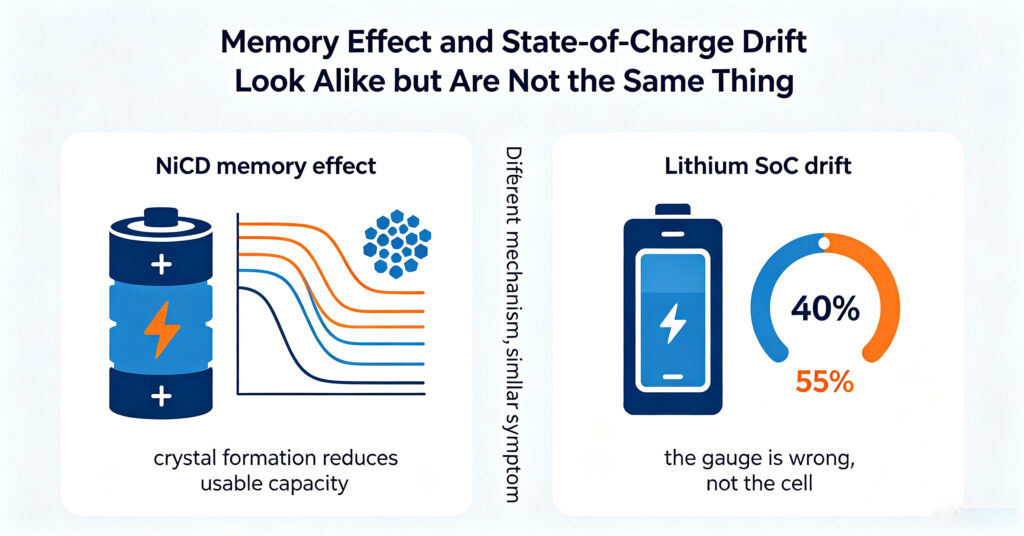
Do lithium batteries have memory? No. Lithium batteries do not have a memory effect. The memory effect is a real phenomenon, but it belongs to nickel-cadmium cells: repeated partial discharge followed by recharging caused cadmium crystals to form in the cell, which reduced the voltage and the usable capacity available on the next discharge. Lithium-ion and LiFePO4 cells use an intercalation mechanism with no such crystal formation, so charging a lithium battery from a partial state of charge does not reduce its capacity and does not need to be avoided. What lithium batteries do instead is lose accuracy in their state-of-charge estimate: the gauge drifts away from reality because the BMS is counting current in and out and the small errors accumulate. That drift looks like memory to the user, and unlike memory it is correctable with a calibration cycle.
Where the memory effect came from
The idea entered general knowledge during the decades when nickel-cadmium was the dominant rechargeable chemistry in power tools, portable electronics and early cordless equipment. The mechanism was physical: if a NiCd cell was repeatedly discharged only part way and then recharged, crystalline structures formed on the electrodes, and the cell behaved as though the shallower discharge depth were its full range.
The remedy at the time was equally physical — a deliberate deep discharge to break down the crystals. That remedy is the origin of the advice many people still carry, and it is the reason the belief survives for chemistries where it does not apply.
| Chemistry | Memory effect? | Mechanism | Deep discharge needed? |
|---|---|---|---|
| Nickel-cadmium (NiCd) | Yes, real | Crystal formation from repeated partial discharge | Occasionally, as a maintenance step |
| Nickel-metal hydride (NiMH) | Minimal | Voltage depression, weaker than NiCd | Rarely |
| Lithium-ion (NMC and others) | No | Intercalation; no crystal memory mechanism | No — deep discharge is harmful |
| LiFePO4 (LFP) | No | Same intercalation mechanism | No — deep discharge is harmful |
Applying a NiCd remedy to a lithium cell is worse than useless. Deliberately discharging a lithium battery below its minimum voltage can trigger the BMS cutoff, and taking cells below the safe floor can cause permanent capacity loss or make the pack unsafe to recharge. The protection logic that prevents this is described in #49 BMS protection functions.
So why does my battery seem to run out faster?
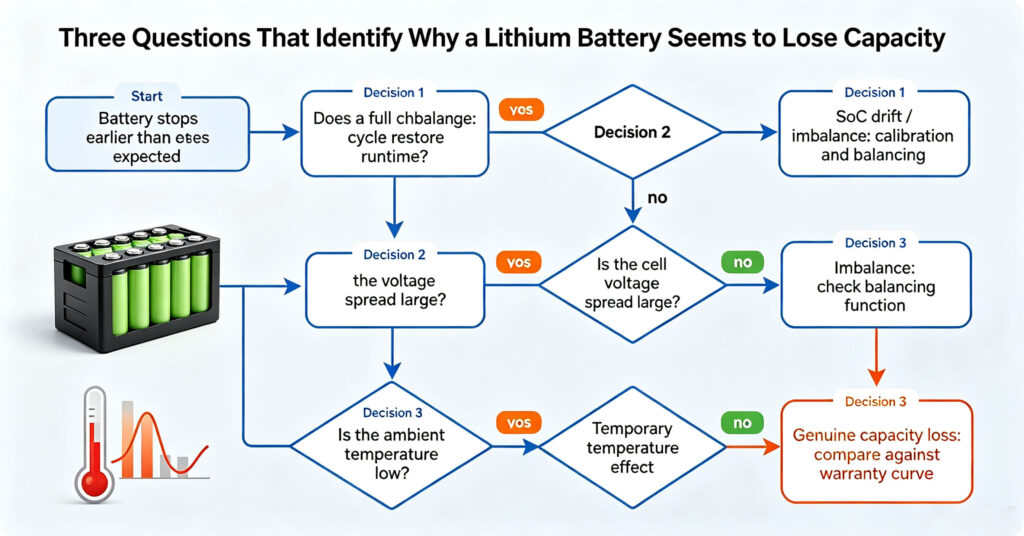
Four mechanisms produce the symptom, and only one of them is actual capacity loss.
- State-of-charge drift. The most common cause and the least serious. The BMS estimates state of charge largely by integrating current over time, and small measurement errors accumulate over weeks of partial cycling. After a long period without a full charge, the gauge can read substantially below the true value — the battery stops early because it thinks it is empty, not because it is. This is a measurement error, and a full charge cycle resets it.
- Cell imbalance. In a multi-cell pack, cells drift apart in state of charge over time because they are not perfectly identical. The BMS protects the weakest cell, so the pack stops discharging when the lowest cell reaches its floor and stops charging when the highest cell reaches its ceiling — capacity that is present in the pack but unusable until the cells are brought back into balance. Balancing is the fix, and the two approaches are compared in #106 active vs passive cell balancing.
- Temperature. A cold battery delivers less usable energy than the same battery at moderate temperature, because internal resistance rises and the voltage sags under load. The capacity returns when the battery warms; nothing has been lost. This is the reason winter range complaints appear and then disappear in spring.
- Real ageing. Capacity does decline over time and with use, through chemical side reactions that consume active lithium. This is genuine, irreversible, and the one cause that a calibration cycle will not fix. The rate depends on cycle depth, temperature history and time, and the economics are worked through in #46 cycle life vs price.
Telling these apart is the practical skill. Drift and imbalance are recoverable through charging behaviour; temperature is temporary; ageing is permanent. A battery that recovers after a full charge cycle was mis-reporting. A battery that does not, and whose cell voltage spread is small, has aged.
How to calibrate a lithium battery
Calibration corrects the state-of-charge estimate and gives the balancing circuit time to work. It is a charging procedure, not a deep discharge.
- Charge to full, uninterrupted. Use the manufacturer’s charger and let the charge complete without interruption, until the charger or BMS indicates termination.
- Hold at full if the charger supports it. A period at full charge gives passive balancing time to reduce cell voltage spread. This step matters more for packs that have not seen a full charge in months.
- Discharge normally, not to cutoff. Use the battery in its normal duty. There is no benefit to forcing a full discharge, and there is real risk in driving the pack down until the BMS cuts off.
- Recharge fully and repeat if the drift was large. A pack that has drifted a long way may need more than one cycle to converge.
- Record the before and after. A measured comparison of reported state of charge against delivered capacity tells you whether the problem was drift or genuine ageing.
For a fleet, the useful move is to make this a scheduled task rather than a reaction to a complaint: a periodic full charge for units that otherwise run on partial cycles, with the delivered capacity recorded. The maintenance schedule that this belongs in is set out in #84 solar battery maintenance, and the parameters worth tracking continuously are in #112 BMS monitoring.
What to do differently, and what to stop doing
Once the question of whether lithium batteries have memory is settled, the practical advice changes in several places.
- Partial charging is fine, and preferable. Charging from a partial state of charge causes no harm and, at moderate depth, is easier on the cell than a full-depth cycle. There is no need to run a lithium battery down before charging it.
- Stop doing deep discharges. There is no conditioning benefit and there is real risk. The BMS cutoff exists as a protection, not as a target to reach.
- Avoid sitting at full charge in heat. High state of charge combined with high temperature is the combination that accelerates calendar ageing — the one habit with a measurable cost.
- Schedule an occasional full charge. Not for the cell, but for the gauge and the balancer. Units in continuous partial-cycling service benefit from a periodic complete charge.
- Store at partial charge. For equipment that sits, a partial state of charge is better than full or empty. The storage guidance is set out in the warehouse and site rules in this series, and the deterioration mechanisms are summarised in #69 how long a lithium-ion battery lasts.
Reading the specification correctly matters here too: the rated capacity, the usable capacity and the warranted cycle count are three different numbers, and comparing the wrong one is how expectations get set incorrectly in the first place. That distinction is covered in #115 how to read LiFePO4 battery specs.
Q. Do lithium batteries have memory?
No. The memory effect is specific to nickel-cadmium chemistry, where repeated partial discharge caused crystal formation that reduced usable capacity. Lithium-ion and LiFePO4 cells store lithium by intercalation and have no equivalent mechanism, so partial charging does not reduce their capacity.
Q. Should I fully discharge my lithium battery before recharging it?
No. Deep discharge provides no conditioning benefit for lithium chemistry and carries real risk: it can trigger the BMS low-voltage cutoff, and repeatedly taking cells to the floor shortens their life. Charge whenever convenient; partial charging is harmless.
Q. Why does my battery report 20% and then shut down?
Because the state-of-charge estimate has drifted from reality, or because one cell in the pack is lower than the others and the BMS is protecting it. A full uninterrupted charge cycle usually corrects the drift; persistent early cutoff with a large cell voltage spread indicates a balancing issue worth investigating.
Q. How often should I calibrate a lithium battery?
Often enough that the gauge does not drift far, which in practice means a full charge whenever the unit has spent weeks on partial cycles, or on a scheduled interval for equipment in continuous service. Occasional full charges are also what give the balancing circuit time to work.
Q. Is losing capacity over time the same as the memory effect?
No. Memory is a reversible reporting and crystallisation phenomenon in nickel-cadmium cells. Capacity loss in lithium cells is chemical ageing from cycle use, time and temperature, and it is irreversible. A battery that recovers its runtime after a full charge cycle was mis-reporting; one that does not has aged.
Next step: calibrate the gauge, not the cell
Lithium batteries have no memory, so if a lithium battery seems to be running out sooner than it used to, the fix is usually a full uninterrupted charge cycle and a recorded comparison — not a deep discharge. Knowing which of the four causes you are looking at is what tells you whether to calibrate, rebalance, warm up, or plan a replacement.
- Check the balancing mechanism in #106 active vs passive cell balancing
- Track the right signals in #112 BMS monitoring
- Build the schedule in #84 solar battery maintenance
- Ask leekooenergy for a state-of-health assessment template for your fleet that records reported versus delivered capacity before and after a calibration cycle, cell voltage spread at full charge and at cutoff, operating temperature range, and the comparison against the warranted capacity curve — so a capacity complaint is diagnosed against measurements rather than assumed to be ageing