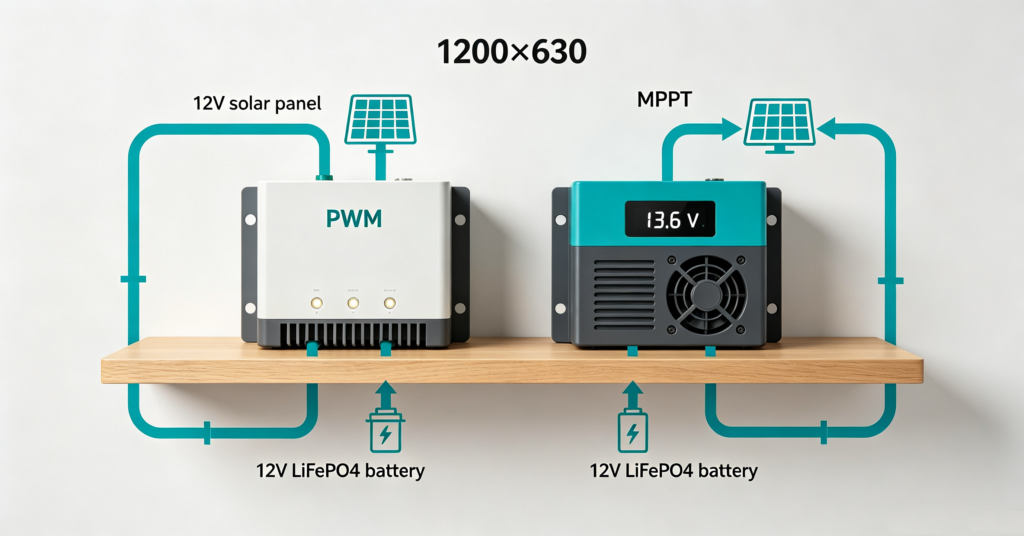
A solar battery charger for 12v battery is the controller that sits between a 12V photovoltaic panel and a 12V battery bank and regulates charge voltage and current so the panel can refill the bank without overcharging it. Two technologies dominate — PWM (pulse-width modulation, the cheaper option that essentially ties panel voltage to battery voltage) and MPPT (maximum power point tracking, the smarter option that converts excess panel voltage into extra charge current) — and the lithium vs lead-acid decision about the bank determines which charging profile the controller must deliver. The single sentence worth quoting: a PWM controller charges a lead-acid battery just fine; for a 12V lithium battery bank you almost always want MPPT, and the only question left is sizing.
This guide is for buyers specifying the charger as a component, not the end customer buying one off the shelf at a marina. It covers the four decisions that decide whether a charger actually charges a 12V battery in the field — PWM or MPPT, lead-acid or lithium profile, controller amp rating, and BMS compatibility — plus the OEM/ODM checks that matter when dozens of units ship in a container. The platform basics for the battery itself are in #70 12V LiFePO4 battery: the complete guide; this article stays on the charger.
What a 12V solar battery charger actually does
A solar panel produces a voltage that varies with sunlight and temperature — under bright sun a “12V nominal” panel may put out 18–22 V open-circuit, while a shaded panel may drop to 13 V or less. A 12V battery wants a controlled charge profile: bulk at constant current up to absorption, then constant voltage until current tapers, then float. A solar battery charger for 12v battery turns the panel’s wild output into that profile while protecting the bank from overcharge, reverse polarity and night-time back-flow. How well it does the first job — how much of the panel’s available power actually reaches the battery — is what separates PWM from MPPT.
PWM vs MPPT: the decision that drives everything else
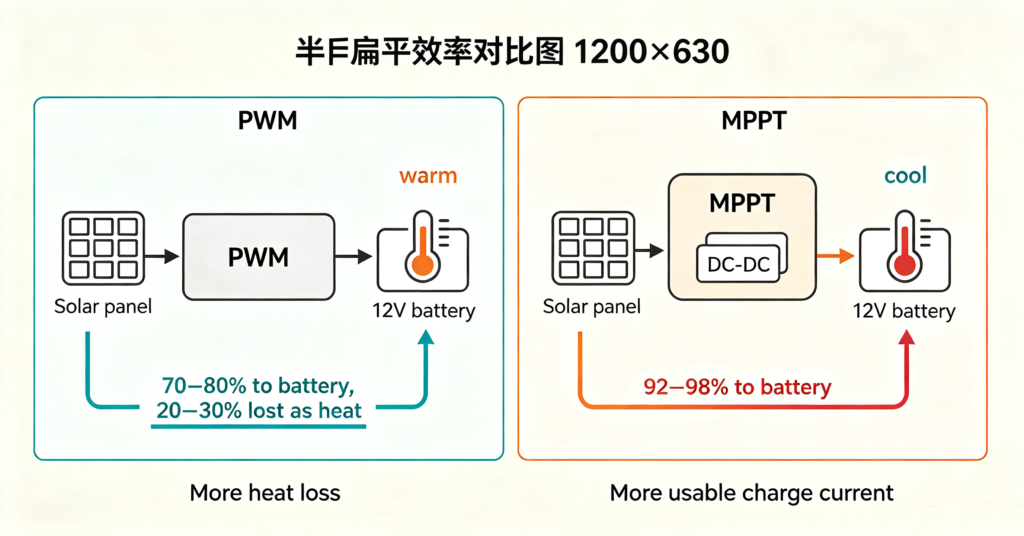
Both controller types regulate charge, but in different ways. A PWM controller effectively connects the panel directly to the battery through a switch, chopping current on and off to hold battery voltage — the panel voltage is dragged down to roughly battery voltage, and the difference is lost as heat. An MPPT controller inserts a DC-DC converter that finds the panel’s maximum power point and converts excess panel voltage into extra charge current at the battery’s target voltage — most of the panel’s power reaches the battery.
| Property | PWM controller | MPPT controller |
|---|---|---|
| Conversion efficiency | ≈70–80% in real conditions (panel voltage pulled down to battery voltage) | ≈92–98% (excess voltage converted to current) |
| Best panel match | 12V nominal panel (Vmp ≈17–18V) charging 12V battery | 20–60V nominal panel (Vmp ≈30–55V) charging 12V/24V/48V battery |
| Cost | low | medium to high |
| Heat in the box | noticeable at high current | low (DC-DC does the conversion) |
| Cold weather gain | minimal | significant (panel Vmp rises as temperature drops) |
| Lithium profile support | limited (most PWMs assume lead-acid) | standard (programmable absorption voltage) |
| Typical use case | small trickle systems, lead-acid banks, low-cost OEM kits | any size system, lithium banks, cold climates, higher-voltage panels |
The rule of thumb B2B buyers use: if the bank is lead-acid and the panel is a 12V nominal type (Vmp ≈17–18V), a PWM controller is acceptable and saves money; if the bank is LiFePO4 or the panel is a higher-voltage type (Vmp >20V), MPPT pays for itself in the first year from extra energy harvest. The deeper conversion-efficiency reasoning for the MPPT case is laid out in #43 AC vs DC coupled solar PV battery storage; the lead-acid decision is in #24 lithium vs lead-acid deep cycle.
Charging profile: lithium vs lead-acid
A solar battery charger for 12v battery must deliver the profile the bank actually wants. Lead-acid (flooded, AGM, gel) wants a multi-stage profile: bulk at constant current up to an absorption voltage around 14.4–14.8V, then absorption until current tapers, then float around 13.5–13.8V to keep topped up. LiFePO4 wants a simpler profile: constant current up to about 14.4–14.6V (3.6V per cell × 4), then stop — no float, no equalisation, and a strict upper voltage limit because pushing past 14.6V damages the cells.
Most MPPT controllers are programmable and can deliver either profile; most PWMs are hard-wired to a lead-acid profile and will over-charge a lithium bank if used unmodified. This pairing is the most common B2B field failure: the panel runs, the charger runs, the battery voltage climbs past the BMS high-voltage cutoff, the BMS disconnects, the controller sees no battery and trips. The fix is to specify a charger with a lithium profile (or at minimum a user-adjustable absorption voltage) when the bank is LFP; the BMS-side cutoff behaviour is in #49 BMS protection.
Sizing the charger to the panel and the battery
Two numbers decide whether a solar battery charger for 12v battery is correctly sized: the controller’s amp rating relative to panel short-circuit current, and the charger’s absorption voltage relative to battery type.
- Controller amp rating: ≥ panel short-circuit current (Isc) × 1.25 safety margin. A 200W panel at 12V nominal has Isc ≈ 11A; a 20A MPPT controller is the right fit.
- Panel-to-controller voltage: panel Vmp × number of panels in series must be within the controller’s PV input window. A 30V Vmp panel into a 50V-input MPPT is fine; into a 25V-input PWM it is not.
- Charge current vs battery capacity: 0.2–0.5C is typical for LiFePO4 (a 100Ah bank takes 20–50A charge). 10A into a 100Ah bank charges but slowly; 30A is more typical.
Both over- and undersizing are preventable at the spec stage; the broader inverter-to-battery sizing logic that decides what “enough” means is in #79 hybrid inverter sizing vs battery capacity.
BMS compatibility and communication protocols
For lithium banks, the BMS and the charger must speak the same language. At minimum the controller must respect the BMS high-voltage cutoff — stop pushing current when the BMS opens the charge FET — which most modern MPPTs do via a direct battery-voltage sense lead separate from the charge current lead. Beyond that, integration gets richer:
- Victron-style VE.Direct / VE.Can: charger tells BMS what it’s doing; BMS tells charger to throttle. Common in marine and off-grid builds; protocol integration in #34 Victron BMS integration.
- RS485 / Modbus RTU: industrial-grade integration with a third-party BMS or energy management gateway; common in C&I projects.
- CAN bus (CANopen / J1939): automotive-grade; common in OEM EV-adjacent and heavy-industry builds.
- Bluetooth / WiFi / cloud telemetry: data out, not control in — useful for fleet monitoring but does not replace the BMS handshake.
For a B2B shipment where the controller and the battery come from different suppliers, the safest spec is a charger that lists the BMS brands it has been validated with and documents the behaviour if the BMS disconnects the charge FET mid-cycle. The monitoring side of this pillar — distinct from the BMS itself — is in #83 battery monitoring system manufacturers.
Buying for OEM, dealer or fleet
When the order is dozens or hundreds of chargers, the questions move from “does it work” to “does it work the same way every time and can I get spares”.
- Firmware consistency: chargers shipped to the same project should ship on the same firmware version; MPPT charging profiles are firmware-defined.
- Certifications: UN38.3 for the lithium bank; CE-EMC / FCC / RCM for the controller; IEC 62109 for PV converter safety; UL 1741 if the charger is also an inverter/charger combo.
- PV input window: written on the datasheet, must cover panel Vmp × series count at coldest expected temperature (cold panels have higher Voc).
- Temperature compensation: a sensor that adjusts charge voltage for battery temperature; matters for lead-acid banks in outdoor enclosures.
- Warranty and RMA: who handles a failed unit in the field, and is the RMA process documented?
- Cost per amp: at OEM volumes the metric is dollar per amp of rated charge current at the relevant PV input voltage, not the headline price.
The OEM/ODM pathway for cells, packs and assembled BMS modules that sit on the other side of this controller is in #48 lithium cell wholesale; the matching commercial inverter angle that pairs with the charger in a hybrid system is in #50 evaluating inverter suppliers.
Q. Can a solar panel charge a 12V battery directly without a controller?
Technically yes for a small panel and a large battery, but it is not recommended. Without a controller, the panel will keep pushing voltage into the battery once it is full, which overcharges lead-acid (water loss, plate damage) and trips a LiFePO4 BMS high-voltage cutoff. A controller is the cheapest insurance against the most expensive failure.
Q. What size solar battery charger do I need for a 100Ah 12V lithium battery?
A 20A–30A MPPT controller is a common match for a 100Ah LFP bank charged from a 200–400W panel array. The exact amp rating depends on how fast the bank needs to refill and how much panel you can fit; the rule of thumb is 0.2–0.5C charge current for LFP, which is 20–50A for a 100Ah bank.
Q. Is MPPT worth the extra cost over PWM for a small system?
For a small 50–100W panel with a 12V nominal Vmp and a lead-acid battery, PWM is acceptable and cheaper. Once the panel is higher-voltage (Vmp >20V) or the battery is lithium, MPPT recovers enough extra energy — typically 20–30% more in real conditions — to pay back its price premium within the first year.
Q. Do I need a special solar charger for a LiFePO4 battery?
Yes. Lead-acid charging profiles push voltage up to 14.8V and then float indefinitely, both of which are wrong for LiFePO4. A lithium-compatible charger holds bulk at constant current to about 14.4–14.6V and then stops; no float, no equalisation. Most MPPT controllers are programmable to deliver this profile; most PWMs are not.
Q. Can I use a solar battery charger indoors or only outdoors?
The panel must be outdoors in sunlight; the controller and battery can be indoors. Most controllers are rated for indoor mounting (no direct rain), with ventilation space around the heat sink. For marine engine bays or outdoor cabinets, look for an IP rating on the controller datasheet — IP21 is a minimum, IP65 is better for marine duty.
Next step: match the charger to the chemistry, then to the panel
The right solar battery charger for 12v battery is the one that delivers the profile the bank actually wants, harvests enough of the panel’s power to refill the bank in real weather, and survives the environment it ships into.
- Confirm the platform basics in #70 12V LiFePO4 battery: the complete guide
- Check the lead-acid vs lithium switching economics in #24 lithium vs lead-acid deep cycle
- See the AC vs DC coupled architecture in #43 AC vs DC coupled solar PV battery storage
- Match the BMS to the charger in #49 BMS protection
- Scale inverter pairing in #79 hybrid inverter sizing vs battery capacity
- Ask leekooenergy for a charger specification that states PWM/MPPT type, lithium profile support, PV input voltage window, BMS handshake behaviour, temperature compensation and firmware version — a charger that fits OEM kits, marine builds and off-grid projects from a single component line