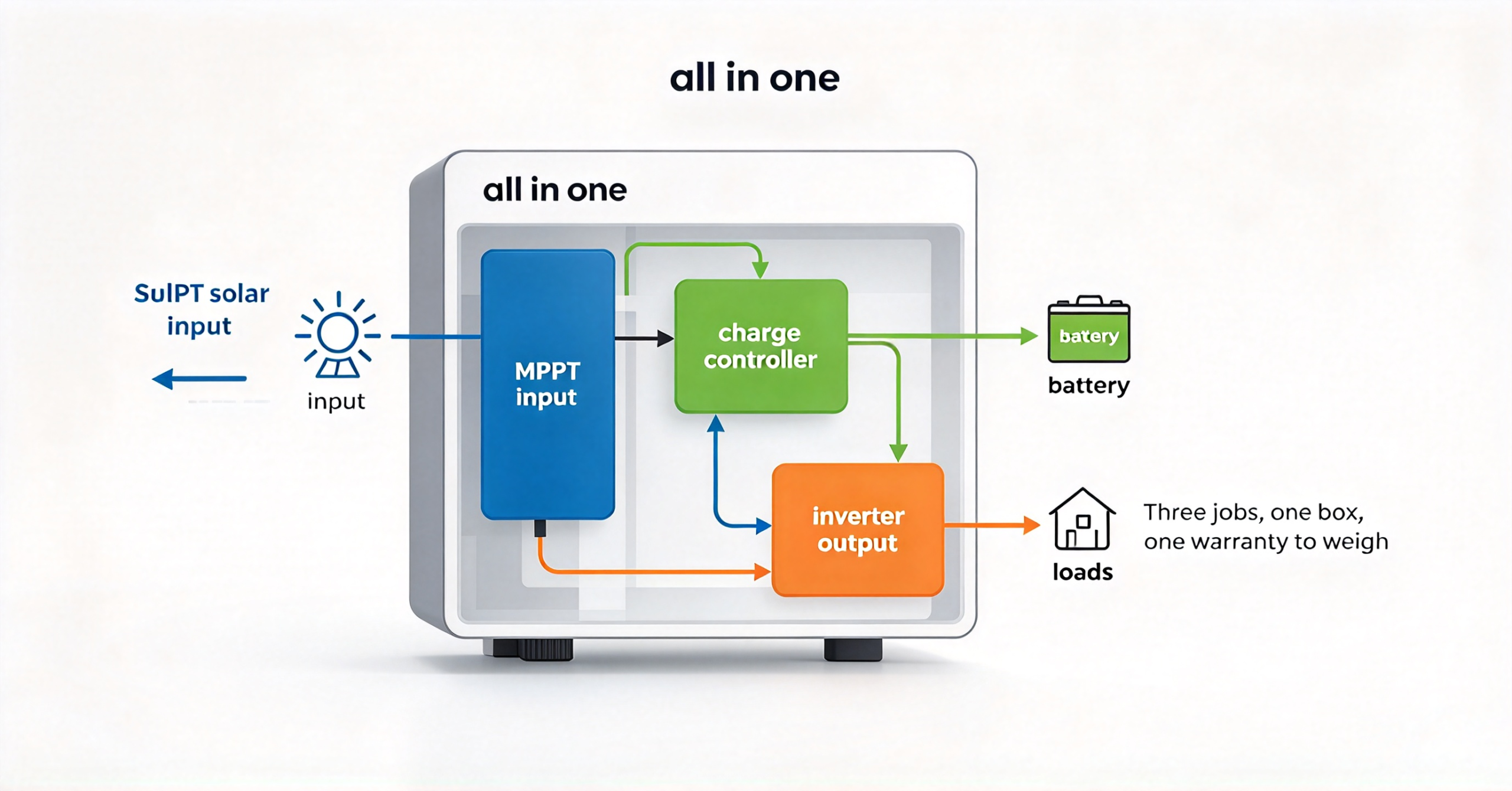
An all in one solar inverter is a single enclosure that combines the solar charge controller (usually an MPPT), the battery charge management, and the DC-to-AC inverter into one unit, instead of shipping those three functions as separate boxes. This guide explains what gets bundled, the off-grid and hybrid types on the market, the real pros and cons, the sites where one box beats three, and the selection points — battery class, phase, power and cooling — that decide whether the category fits your project.
The term gets used loosely, so the first job is to be precise: “all in one” describes the packaging, not the function. The same conversion still happens inside; it is just designed, cooled and warranted as a single product rather than as parts you assemble.
What an all in one solar inverter bundles
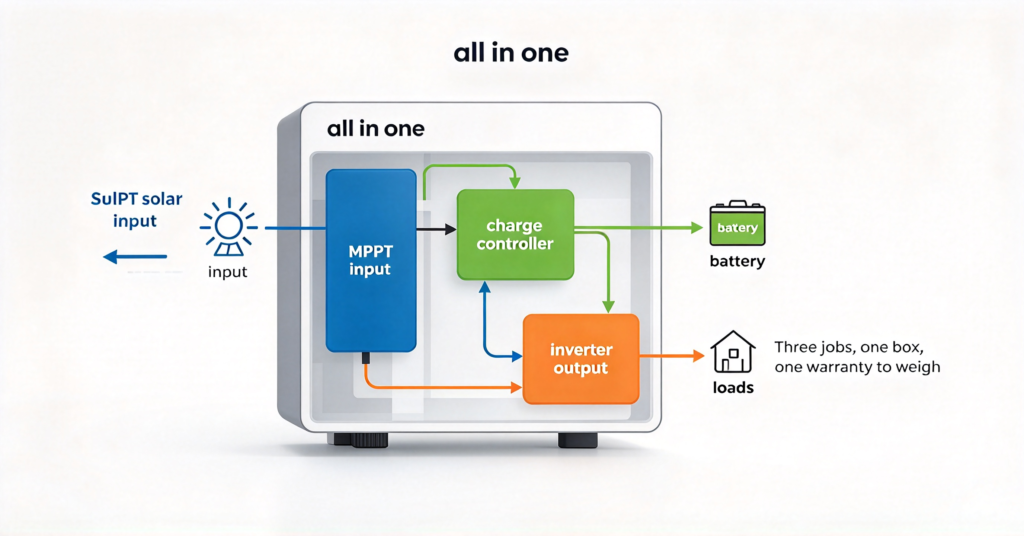
Start with the three roles. The MPPT — maximum power point tracker — is the stage that pulls the most power from the panel string by holding it at its optimum voltage. The charge controller manages how that energy fills the battery, protecting it from over-charge and balancing the cells. The inverter, as covered in the how to choose a storage hybrid inverter guide, turns the stored DC into AC for the loads. In a separate system these are three enclosures, three manuals and three warranty cards.
In an all in one solar inverter they share one housing, one cooling path and one controller board. That sharing is the source of both its appeal and its trade-offs, so it helps to judge the category by what the sharing costs as well as what it saves. A Battery Management System (BMS) link is usually built in too, letting the unit talk to the pack instead of guessing its state.
The types you will actually meet
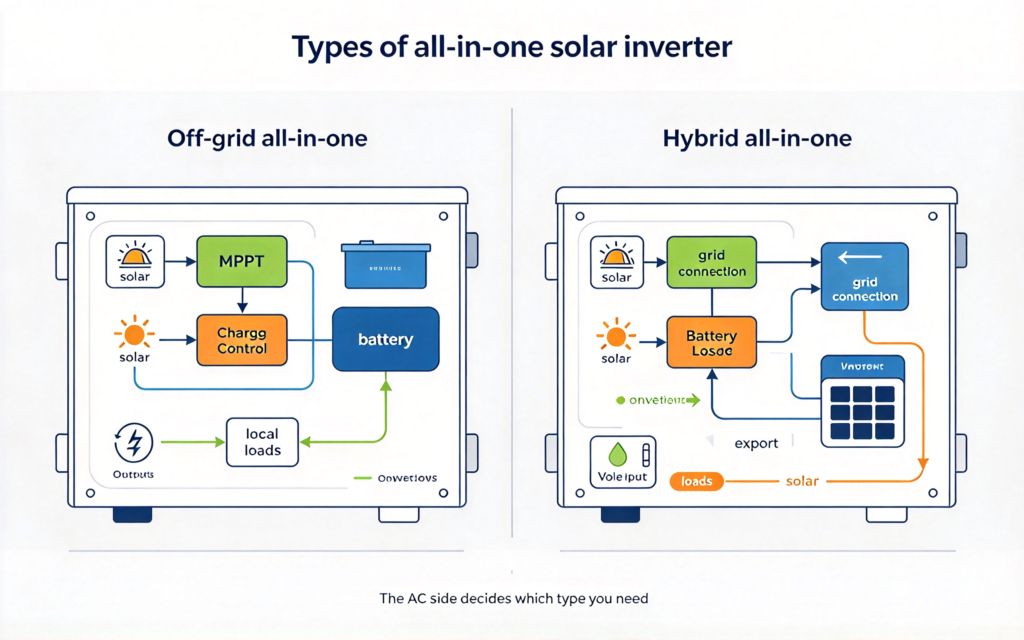
The all in one solar inverter category splits into two main lines by what sits on the AC side. Off-grid units stand alone: they take solar and battery and make local AC with no utility connection, sized for cabins, remote sites and backup. Hybrid units add a grid port, so they can pull from or export to the utility, charge the battery from either source, and ride through outages. The grid-tied nuance is worked through in the hybrid solar inverter vs off grid grid tied comparison.
Within those lines, power class and phase type vary. A small single-phase unit serves a home or a kiosk; a split-phase or three-phase unit serves North American or commercial feeds. The phase choice is its own decision, laid out in the single vs split phase vs three phase hybrid solar inverter piece, and it sets the wiring and protection around the whole install.
The pros: why buyers choose one box
An all in one solar inverter shines where simplicity pays. Fewer enclosures means fewer cable runs, fewer mounting points and a shorter commissioning checklist — the unit is broadly “wire the solar in, wire the battery in, wire the loads out”. For a distributor or an EPC that is less truck roll and less margin for wiring error on site.
Support is the second win. One vendor, one firmware, one warranty card means a fault has a single throat to choke, and the functions are validated together rather than assumed compatible. For the process, a proven all-in-one skips the integration risk of mixing brands across the three stages.
The cons: what the sharing costs you
The trade-off of an all in one solar inverter is concentration risk. Because the MPPT, charger and inverter share one cooling path and one board, a failure in any one function can take the whole unit offline — there is no swapping just the inverter while the controller keeps running. For a site where uptime is money, that single point of failure deserves a hard look.
Upgrade flexibility is the other cost. With separate boxes you can grow the inverter and keep the charge controller; in an all-in-one the capacity is the capacity, and a larger load usually means a larger unit, not an add-on. Cooling is shared too, so the inverter’s heat can warm the very stage you wanted cool. None of this makes the category wrong; it makes it a deliberate trade rather than a default.
| Dimension | All-in-one | Separate stages |
|---|---|---|
| Wiring & commissioning | Simple, fewer runs | More enclosures, more labour |
| Single point of failure | One box, whole outage risk | One stage can fail alone |
| Upgrade path | Replace the unit to grow | Grow one stage at a time |
| Support & warranty | One vendor, one card | Multiple vendors to coordinate |
Where an all in one solar inverter actually fits
The category earns its place at the small-to-mid end: a cabin or remote telecom site where nobody wants three boxes on a wall, a small commercial backup where speed of install matters more than phased growth, and rental or temporary power where a self-contained unit ships and returns as one. These are sites where simplicity and a single warranty beat the flexibility of separate stages.
It fits less well at the large end, where loads grow, where one function is upgraded on a different cycle than the others, or where a single-outage risk is unacceptable and redundancy is specified. There the separate-stage design is usually the deliberate choice. The sizing relationship between inverter and pack still applies either way and is covered in the hybrid inverter sizing vs battery capacity guide.
Selection notes before you specify one
Match the battery class first. Many all-in-one units target a 48 V class battery, and the exact window is detailed in the 48v inverter guide and the 48v split phase inverter guide. Confirm the MPPT input window against your coldest-string open-circuit voltage, the continuous and surge AC power against the load, and the phase type against the service.
Cooling and certification close the list. Ask how the shared enclosure is ventilated and what ambient it is rated for, because the inverter’s heat is now the battery stage’s problem too. Safety and interconnection baselines such as UL 1741 and IEC 62109 set the frame a compliant unit must sit inside, but the exact edition and local amendments must be confirmed for your market — treat those standard numbers as a starting point to verify locally, not as the final word. For chisidal projects, send the battery class, panel string voltage, load profile and target certification set, then ask for the all-in-one behind the path as one matched, documented unit.
Q. What is an all in one solar inverter?
An all in one solar inverter is a single enclosure that combines the MPPT solar charge controller, the battery charge management and the DC-to-AC inverter into one unit. It performs the same three functions as separate boxes but is designed, cooled and warranted as one product.
Q. All in one vs separate hybrid inverter: which is better?
Neither is universally better. An all-in-one simplifies wiring, commissioning and support with one vendor and one warranty, but concentrates failure risk and limits upgrade flexibility. Separate stages cost more labour and coordination but let one function fail or grow independently. The right choice depends on site size and uptime needs.
Q. What are the pros and cons of an all in one inverter?
Pros: fewer enclosures and cable runs, faster commissioning, and a single warranty and firmware to support. Cons: a failure in any stage can take the whole unit down, capacity is fixed at purchase, and the shared cooling path lets inverter heat warm the charge stage.
Q. When should I use an all in one solar inverter?
Use one at the small-to-mid end: cabins, remote sites, small commercial backup, and rental or temporary power where simplicity and a single warranty beat phased growth. Avoid it where loads grow often, where stages upgrade on different cycles, or where a single-outage risk is unacceptable.
Q. How do I choose an all in one inverter?
Match the battery class first, confirm the MPPT input window against the coldest-string voltage, size continuous and surge AC power to the load, pick the phase type for the service, and check shared-enclosure cooling and certification. Keep the inverter-to-pack sizing relationship in view before committing.
Q. Which certification should an all in one inverter meet?
Safety and interconnection baselines such as UL 1741 for grid-tied units and IEC 62109 for power converters set the compliance frame, with regional variations on top. The exact applicable edition and local amendments must be confirmed for your target market — treat the standard numbers as a starting point to verify locally.
Next step: decide one box or three on purpose
The all-in-one trade is a real engineering choice, not a default. Confirm the battery class, the load profile and the uptime requirement, then weigh shared simplicity against concentrated risk.
- Read the selection checklist in the how to choose a storage hybrid inverter guide before quoting
- For chisidal, send your usage and site details, and we will come back with product prices, lead time and warranty information.