Solar pv inverter repair is the work of diagnosing a failed or faulting inverter and returning it to service, either by clearing a software or comms fault or by replacing the component that died — most often a capacitor, a cooling fan or a power module. This guide covers what a repair engagement actually includes, how to read fault and alarm codes first, which parts fail most, where the warranty line sits, and the repair-versus-replace decision that decides whether you spend on a board or a whole unit.
A dead inverter is rarely a mystery if you start from the display instead of the screwdriver. The code on the screen usually points straight at the subsystem, and that single read changes whether the job is a free warranty swap, a paid board, or a replacement order.
What solar pv inverter repair actually covers
A solar pv inverter repair engagement is broader than swapping a part. At the light end it is a soft fault — a comms drop, a firmware trip, a settings mismatch — that a reboot or a parameter fix clears with no hardware touched. At the heavy end it is component-level work: opening the enclosure, isolating the DC and AC, and replacing a failed board or module. The line between “service” and “repair” matters because it changes who pays and how long the site is down.
Buyers should separate three scopes before quoting anything: remote diagnosis by the vendor, on-site board swap by a technician, and full bench repair at a service centre. They carry different lead times, different certification requirements, and very different costs, and mixing them up is how a simple fix turns into a month of downtime.
Read the fault and alarm codes before opening anything
Most modern inverters report a code or a short text string on the display and through their monitoring portal. A fault is usually hard — the unit has shut down to protect itself — while an alarm is a warning that operation continues. The distinction is not cosmetic: a fault you clear without fixing the cause will trip again, and an alarm you ignore will become a fault.
Build the habit of logging the exact code, the time, and the operating conditions (load, temperature, input voltage) each time it appears. A pattern — same code at the same afternoon temperature — points at thermal or cooling issues long before a component fully fails, and that log is also the evidence a warranty claim needs. Codes vary by brand and firmware, so the authoritative list is the maker’s manual for the exact model, to be verified locally.
Where the unit will not even report, the problem is upstream of the controller — no DC input, a tripped breaker, or a dead auxiliary supply — and that troubleshooting path is covered in the solar inverter troubleshooting battery not charging errors guide. A disciplined solar pv inverter repair process begins with that read, not with the enclosure.
The components that fail most
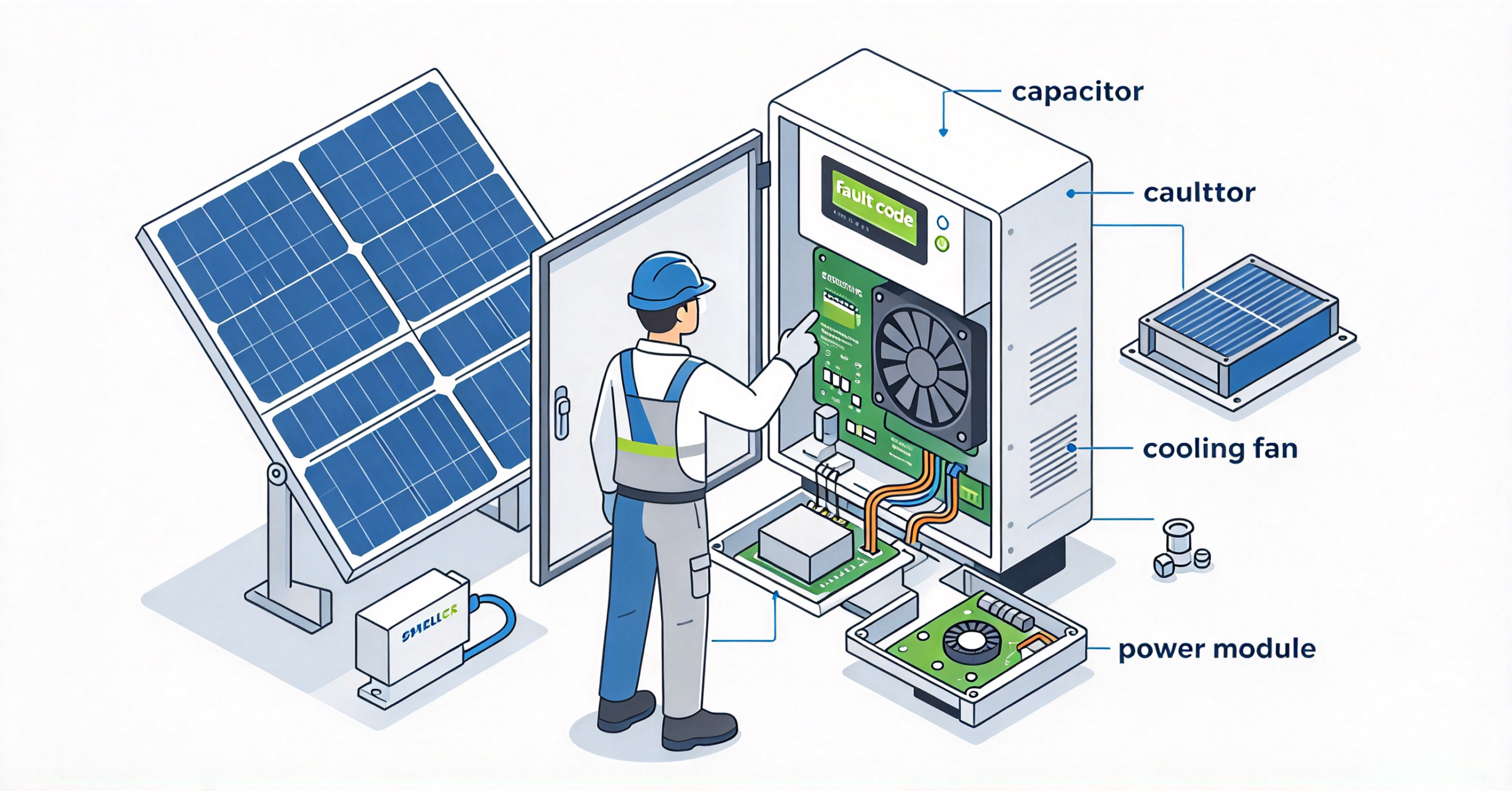
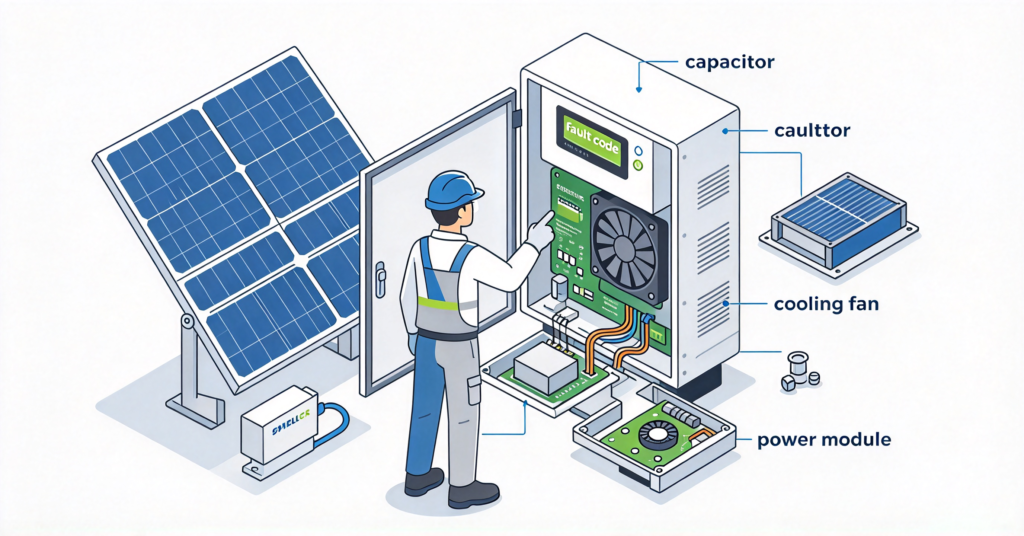
Inverter deaths are surprisingly concentrated. DC-link and output capacitors age with heat and ripple current, and they are the most common wear-out item past the mid-life of the unit. Cooling fans seize or throw bearings, and once airflow drops the whole box runs hot and accelerates every other failure. Power modules — the IGBTs and MOSFETs in the switching bridge — fail on surge, short or sustained overload. Relays and contactors wear at the contacts from repeated switching.
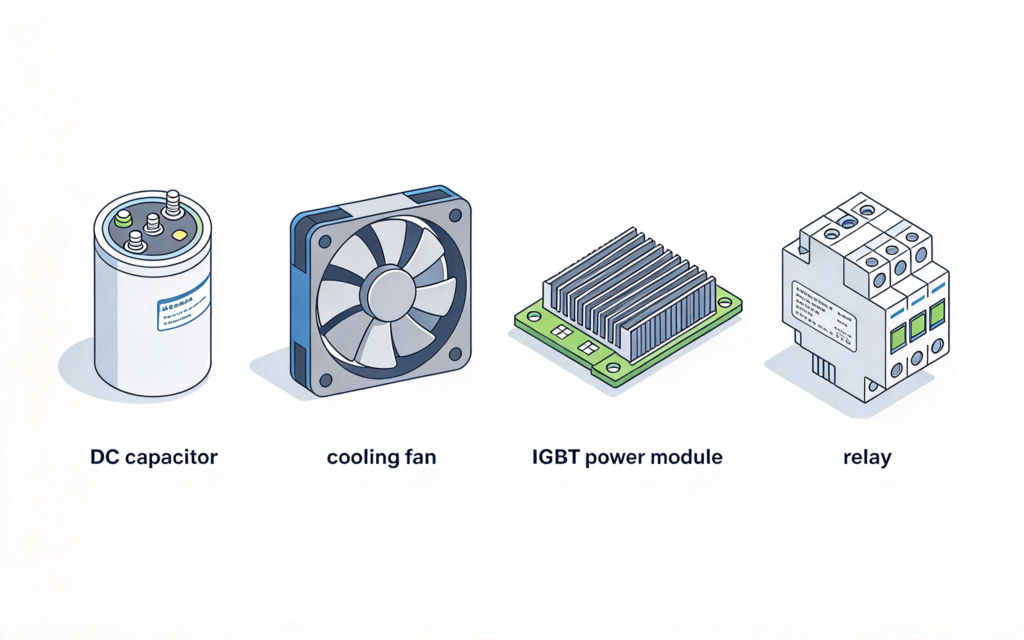
The bulk of solar pv inverter repair work is component-level replacement of exactly these items, which is why a service centre with boards in stock beats a vendor who can only ship a whole unit. Ask, before you buy, which of these parts the supplier stocks and at what lead time — that answer tells you more about real-world downtime than any brochure.
| Failed part | Typical symptom | Repair note |
|---|---|---|
| DC-link capacitor | Bus voltage faults, swelling, heat | Replace as a matched set; rating must match the design |
| Cooling fan | Over-temp alarms, thermal derating | Check airflow path, not just the fan itself |
| IGBT / power module | Short faults, no output, burn marks | Often a board swap; confirm surge protection upstream |
| Relay / contactor | Clicking, intermittent AC output | Replace the contactor; check the control drive |
Where the warranty boundary sits
The warranty boundary defines what solar pv inverter repair a vendor will do for free, and it is narrower than most buyers assume. Standard coverage handles manufacturing defects for a stated period — often a few years, extendable on some lines — but it usually excludes damage from surge, water ingress from poor installation, overload, or unauthorized opening of the enclosure. Open the box yourself and you can void the claim even when the part was defective.
For the buyer, the practical move is to read the exclusion list, not just the coverage period. A five-year warranty that excludes surge is thin protection in a lightning-prone region, and a unit rated for the environment but installed against its own manual is a denied claim waiting to happen. Keep the commissioning record and the fault log; they are the difference between a paid repair and a polite refusal.
Match the protection to the duty. The phase and voltage class of the unit, covered in the 48v split phase inverter guide and the single vs split phase vs three phase hybrid solar inverter comparison, changes both the failure modes and what the warranty will argue about.
Repair versus replace: the decision that matters
The repair-versus-replace call is where money is saved or wasted. Rule of thumb from the field: if the fault is a single wear part on a young unit under warranty, repair. If the enclosure has suffered water, fire or multiple cascaded failures, or the model is discontinued with no boards left, replace — a repaired corpse fails again. Age and availability weigh as heavily as the fault itself.
Quantify it before deciding. Compare the repair cost plus downtime against the remaining service life and the efficiency you would gain from a newer unit. A repair that costs a third of a new unit but leaves you with an obsolete, inefficient box may be the expensive choice over five years. The hybrid solar inverter vs off grid grid tied piece frames the system context, and the how to choose a storage hybrid inverter guide helps if replacement is the call.
Sourcing spares and what to confirm with the supplier
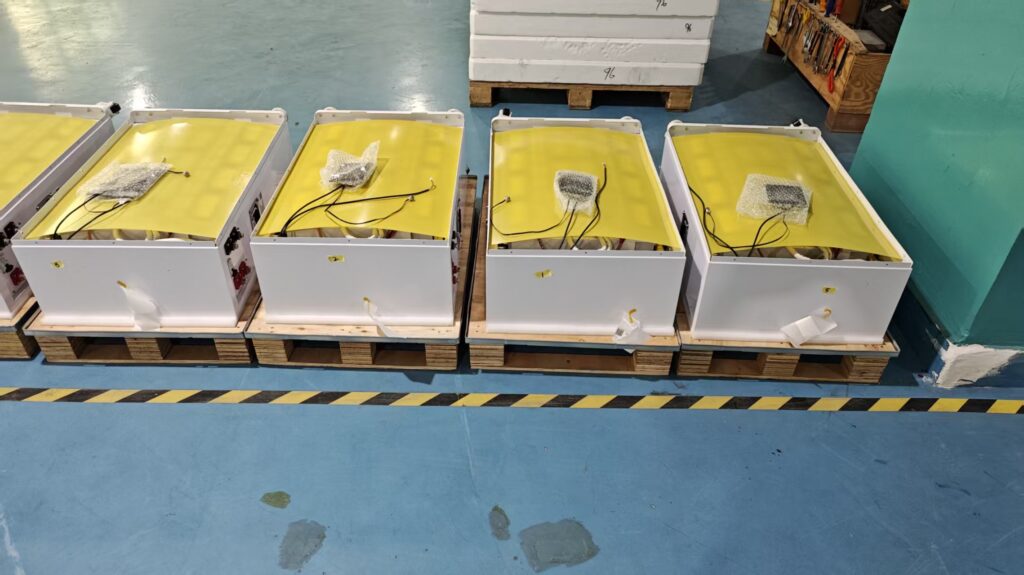
Spare parts are a procurement problem long before they are a repair problem. When you request a quote, ask for the fault-code list for the exact firmware, the stock status and lead time of the common boards, the MOQ for service-centre quantities, and whether repaired or refurbished units carry the same certification as new. Traceability matters: a board with no batch record is a board you cannot trust in a warranty argument.
For a storage-linked unit, confirm the spare matches the battery class and the DC input window — the sizing relationship is worked through in the hybrid inverter sizing vs battery capacity guide, and a mismatched replacement board is a second failure. For chisidal projects, send the model, firmware version, fault code and photos, then ask for the matched spare and the service documentation as one traceable package rather than hunting parts piecemeal.
Q. What does solar pv inverter repair include?
Solar pv inverter repair ranges from clearing a software or comms fault remotely to replacing a failed component such as a capacitor, fan or power module on site or at a service centre. The scope decides who pays and how long the site is down, so separate remote diagnosis, board swap and bench repair before quoting.
Q. How do I read a solar inverter fault code?
Read the exact code and any text from the display and the monitoring portal, then log the time and the operating conditions. A fault means the unit has shut down to protect itself; an alarm means operation continues with a warning. The authoritative code list is the maker’s manual for the exact model and firmware, to be verified locally.
Q. Which inverter parts fail most often?
The failures concentrate in four parts: DC-link and output capacitors that age with heat, cooling fans that seize, IGBT or MOSFET power modules that fail on surge or overload, and relays that wear at the contacts. Component-level replacement of these items is the bulk of real repair work.
Q. Is inverter repair covered by warranty?
Standard warranties cover manufacturing defects for a stated period but usually exclude surge, water ingress from poor installation, overload, and unauthorized opening of the enclosure. Read the exclusion list, not just the coverage years, and keep the commissioning record and fault log as claim evidence.
Q. When should I replace instead of repair an inverter?
Replace when the enclosure has suffered water, fire or multiple cascaded failures, or when the model is discontinued with no boards in stock. Repair makes sense for a single wear part on a young unit under warranty. Quantify repair cost plus downtime against remaining life and efficiency before deciding.
Q. What should I ask a supplier when sourcing inverter spares?
Ask for the fault-code list for the exact firmware, the stock status and lead time of common boards, the MOQ for service quantities, and whether repaired units carry the same certification as new. Require batch traceability, and confirm the spare matches the battery class and DC input window of the unit in service.
Next step: turn a fault into a traceable spare order
One read of the code, one check of the warranty line, and one confirmation of spare availability decide most repair outcomes. Do those before you open the enclosure.
- Keep the solar inverter troubleshooting battery not charging errors path handy for no-report faults
- For chisidal, send your usage and site details, and we will come back with product prices, lead time and warranty information.