A solar panel cleaning brush is a soft-bristled, non-abrasive tool — hand-held, pole-mounted or carried by a robot — used to lift dust, pollen and bird droppings off the glass without scratching the anti-reflective coating. Pick it by reach, tilt and soil type, not by bristle stiffness. This guide compares brush types, sets cleaning frequency by climate, gives a safe step-by-step method, and marks the damage and electrical limits. Soiling is site-specific, so both the tool and the interval are best decided on site.
Cleaning is the cheapest performance lever on a dirty array and the easiest way to void a warranty at the same time. The tool and the method matter more than the effort you put in. A stiff bristle or a cold rinse on hot glass costs more than the dust.
What soiling costs, and when cleaning pays
Soiling is not a uniform grey film. Dust settles fairly evenly, but pollen films, droppings, coastal salt haze and agricultural dust do not, and the uneven ones cause the real trouble: a droppings patch shades part of a cell string, the shaded cells stop producing and start dissipating power instead, and a hot spot can develop. That is a reliability problem, not simply a lost kilowatt-hour problem.
How much output is at stake is site-specific. Field programmes run by NREL and similar bodies treat soiling as something you measure locally: with regular rain the loss is often barely measurable, while an arid site through a dry season can surrender a meaningful share of seasonal yield. Your own monitoring data is the practical test.
Cleaning tool comparison: brush, pole, robot or washer
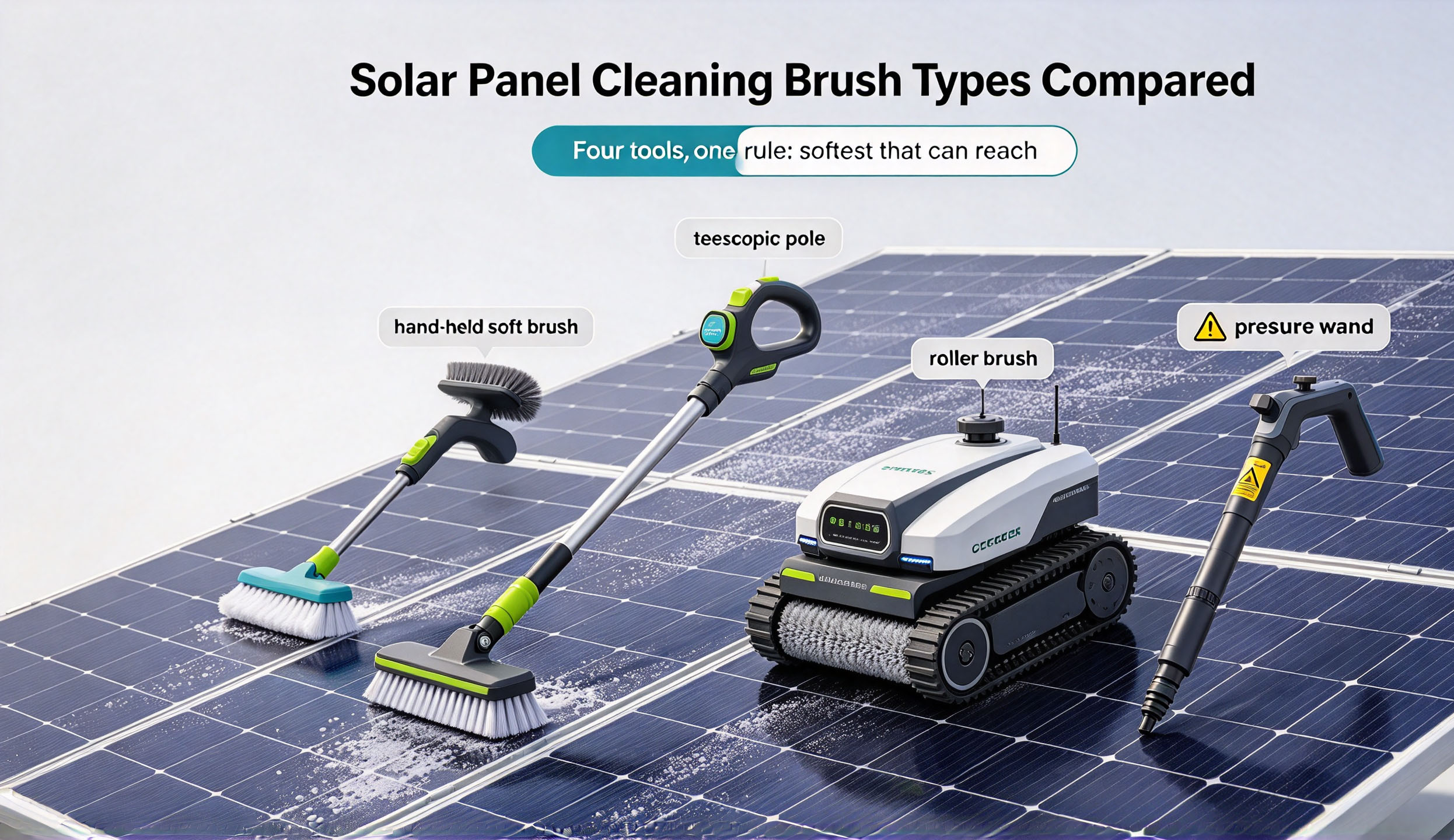
Four tool families cover almost every array. The right answer is usually the softest solar panel cleaning brush that can still reach the glass safely from the ground.
| Tool | Best for | Water use | Risk to the glass |
|---|---|---|---|
| Soft hand brush | Small ground arrays, spot cleaning | Low, bucket or hose | Lowest if bristles are soft |
| Telescopic water-fed brush | Roof and raised arrays from the ground | Moderate; deionised preferred | Low — no need to stand on the roof |
| Robotic roller brush | Large ground-mount rows, utility blocks | Low to none, depending on model | Low, on a smooth regular array |
| Pressure washer | Rarely the right tool | High | Highest — jet, grit and seal risk |
Bristle material is the detail that decides whether a solar panel cleaning brush helps or hurts. Soft synthetic bristles lift film without cutting the coating; anything stiffer trades one season of output for permanent haze. Water-fed poles work best with deionised water, because mains water in a hard-water district dries to a mineral film worse than the dust. A solar panel cleaning robot earns its place on long rows where labour hours dominate.
How often to clean: the frequency decision
Frequency is a decision, not a rule. Two things set it: how fast soil builds up at your site, and what a clean array is worth in the season that matters.
| Site condition | Typical interval | What to watch |
|---|---|---|
| Humid climate with regular rain | Once or twice a year | Pollen film in spring |
| Temperate urban or suburban | Twice a year, plus after pollen | Traffic film and droppings |
| Arid or dusty region | Quarterly is typical; monthly in dust season | Windblown dust, no rain to rinse |
| Coastal | Quarterly | Salt haze and gull droppings |
| Near agriculture or a bird roost | Monthly spot checks | Organic film, heavy droppings |
| Steep tilt | Intervals can stretch | Rain does part of the work |
| Low tilt or flat mount | More often | Soil does not self-rinse |
Read those as starting points, not as a schedule to obey. Log pre-clean and post-clean yield; after two or three cycles the interval finds itself. Cleaning is also the moment to look the array over — a new crack is cheaper to catch on a wash day than on a fault call.
The standard cleaning method, step by step
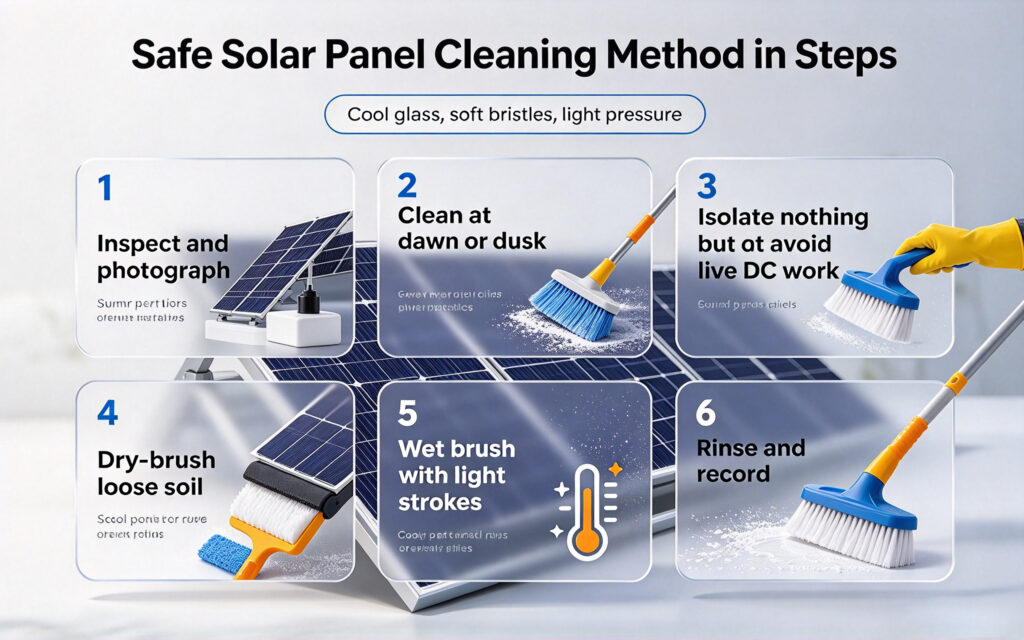
1. Inspect first. Review the monitoring trace and walk the array before wetting anything. Photograph cracked glass or damaged cable and leave those modules alone — that is a warranty and safety matter, not a cleaning task.
2. Choose the cool hours. Clean at dawn, at dusk or under full overcast. A module producing at midday sits well above ambient, and cold water on hot glass is the most common way a wash turns into a cracked panel.
3. Keep it a surface job. The array carries DC voltage whenever light falls on it, whether or not the inverter is running. Do not open enclosures, pull connectors or spray into junction boxes; that work is covered in the solar panel connector and cable guide.
4. Remove loose soil dry. Brush off loose dust before wetting, so you are not dragging grit across the glass under a wet bristle.
5. Wet and brush lightly. Rinse with low-pressure clean water, then work the cleaning brush in overlapping strokes at light pressure. Pressing harder only speeds up coating wear.
6. Rinse, dry and record. Rinse the frame channel so dirty water does not dry at the lower edge, let the glass air-dry, then record the date and the yield change. That record turns a guess about frequency into a number.
Where cleaning turns into damage
Thermal shock comes first. A cold rinse on a hot module drops the surface unevenly, and tempered glass does not enjoy that; the crack may not appear until the next hot day. Use water at roughly ambient temperature and keep midday out of the plan.
Abrasives and chemicals come second. Scouring pads, steel wool, stiff bristles, household powders and degreasers cut the anti-reflective coating or attack the frame finish and edge seal, and coating damage cannot be polished out. Water, or a mild detergent the module maker approves, is the entire chemistry set.
Pressure and feet come third. A narrow jet at close range drives water past the frame seal and pushes grit across the surface, and standing on a module loads the cells hard enough to start microcracks. Reach the glass with a pole or a robot, never with your weight.
The last boundary is scope. Cleaning never justifies unmounting a module — taking a panel off its rail is a separate operation with its own handling and electrical rules, set out in the solar panel removal and transport guide. Cracked or delaminating glass is a warranty question, handled with a technician and the best PV module guide, not with a brush.
Clean it yourself or hire it out
The decision is mostly about access, not about cost per wash.
Clean in-house when the array is ground-mounted, reachable standing and small enough for one person to finish in an hour. A pole-fed cleaning brush, cool hours and a logged yield check are the whole toolkit.
Hire it out when the array is on a roof, on a steep pitch, two storeys or more up, or covered in moss — the fall risk and the liability are worth more than the invoice.
Use robotics or a contractor for large ground-mount rows, where throughput per labour hour decides the economics. Where rows are tight or the geometry is unusual, check the array layout against the solar panel dimensions guide before assuming a unit can travel.
Stop and call a technician if any module has cracked glass or a discoloured connector. That is a fault, not a cleaning job. If output stays low after a clean, look beyond the glass: the comparison of 48 V and 51.2 V battery banks is one place that investigation starts, and persistent low yield often appears in the troubleshooting guide for a battery that will not charge.
Q. Solar panel cleaning brush: which type do I need?
A solar panel cleaning brush with soft synthetic bristles suits most small arrays: hand-held for ground reach, pole-mounted for anything raised. Large uniform rows justify a robotic roller brush. What matters is soft bristles, a tool that reaches the glass without anyone standing on the module, and low water pressure.
Q. How often should solar panels be cleaned?
It depends on the site rather than the calendar. Twice a year suits a temperate rooftop with regular rain; quarterly is typical in dusty or coastal regions, and monthly spot checks make sense near a bird roost. Log yield before and after each clean.
Q. Can I use a pressure washer on solar panels?
It is rarely worth the risk. A narrow jet at close range pushes water past the frame seal and drives grit across the glass. If pressure is used at all, keep it low, use a wide fan nozzle, hold a generous stand-off distance and never aim at the frame edge.
Q. What is the safest way to clean solar panels without damaging them?
Clean when the glass is cool, use soft bristles at light pressure with water at roughly ambient temperature, remove loose grit dry before wetting, and avoid abrasives, solvents and high pressure. Keep the work to the surface: no walking on modules.
Q. Can I clean solar panels in full sun or when they are hot?
Not with cold water. A module producing at midday sits well above ambient, and a cold rinse creates thermal shock that can crack tempered glass. Wait for cool hours, or use water at ambient temperature.
Q. Do I need to switch the solar system off before cleaning?
Cleaning is a surface task and needs nothing opened, so the array can normally stay in service. Do not touch live DC parts: the array still carries voltage while lit, even with the inverter off. Connector work belongs to a qualified technician.
Q. Is rain enough to keep solar panels clean?
On a steeply tilted array with regular rain, often yes for light dust. It is not enough for pollen film, droppings, salt haze or a long dry season, and it does nothing for a flat mount where soil sits.
Next step: set the interval from data, not from a calendar
Pick the softest tool that reaches the glass, clean only when the panel is cool, and log every wash so the frequency proves itself. Where access or damage is in question, bring in a technician before anyone climbs.
- Start with working with a solar panel installer for roof arrays, fall protection and the inspection that should come with every wash
- For chisidal, send your usage and site details, and we will come back with product prices, lead time and warranty information.