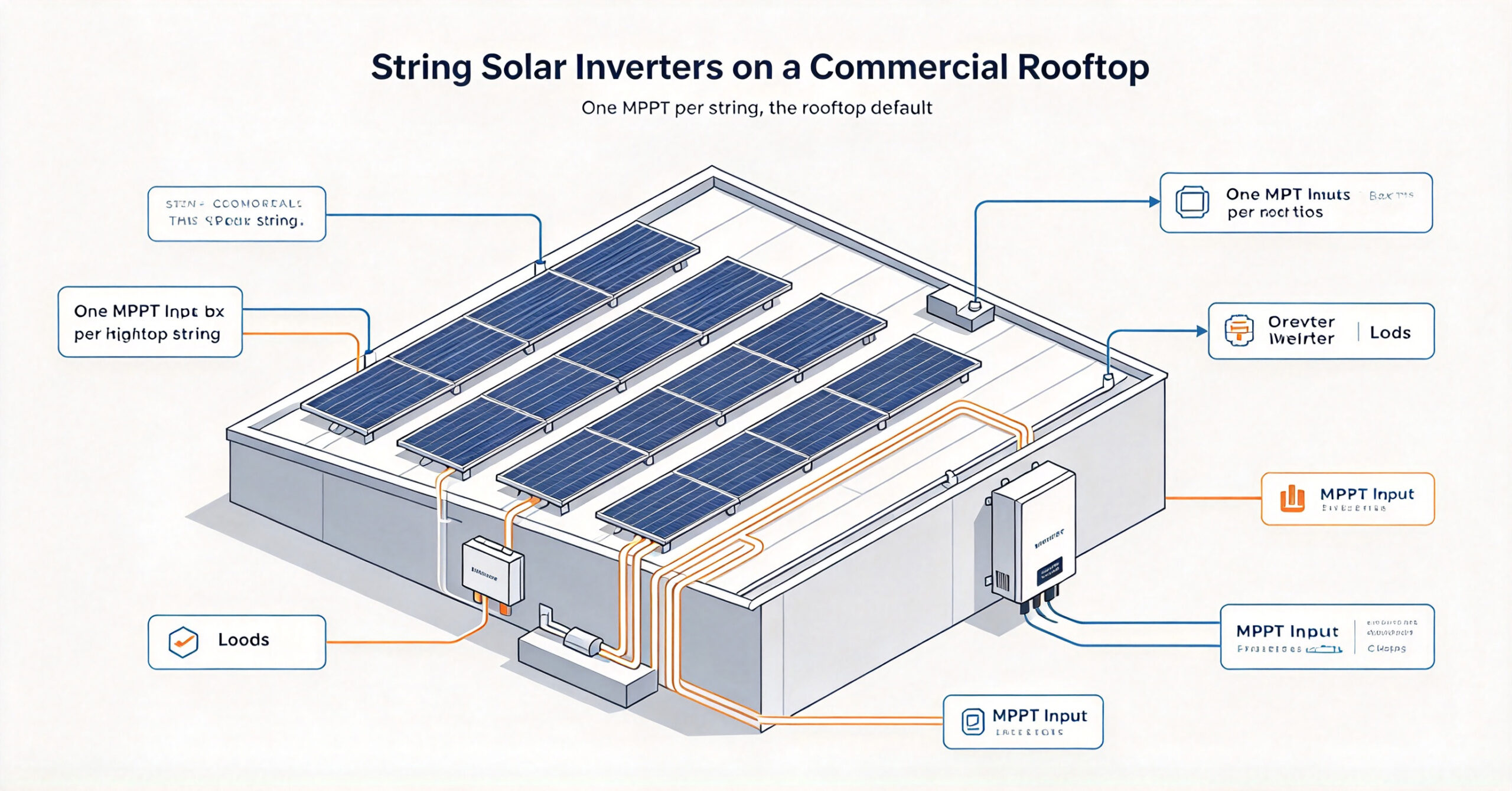
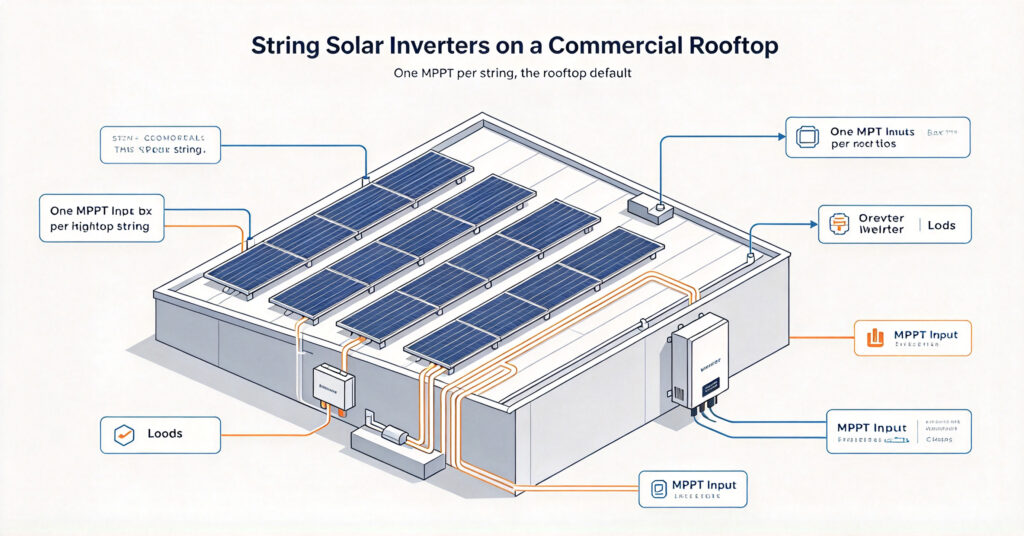
A string solar inverters is a topology in which one MPPT channel of the inverter manages a single series string of panels as one electrical branch. The DC of that string flows into one input, so the inverter tracks one operating point for the group rather than per panel. This guide covers where the string approach beats micro and central designs, the rooftops it suits, the selection points that decide a good match — MPPT count, series voltage window and mismatch loss — and the sites where a different topology fits better.
The string layout is the default for most grid-tied and hybrid rooftops because it balances cost, wiring and per-string control. Before comparing it with micro and central designs, it helps to be exact about what a string means and what the inverter actually does with it.
What a “string” means in inverter design
The core unit in a string system is the series string itself: panels wired positive to negative in a line so their voltages add while the current stays equal to one panel. A string solar inverters unit accepts several of these strings at its MPPT inputs and converts the combined DC to AC. Because the panels in a string share one current path, the weakest panel sets the ceiling for the whole string’s output.
The MPPT stage is what makes the topology work. It sweeps the string’s voltage to find the point where power is highest and holds there as light and temperature move. A single MPPT channel therefore manages one operating point for every panel on its input. More channels mean more independent points, which is the lever you use later to limit mismatch between rows that see different conditions.
String vs micro vs central — three topologies compared
Solar inverter design splits into three approaches that differ by how finely they manage the DC. string solar inverters put one MPPT on a whole string. Microinverters put one converter on each panel. Central inverters put one very large converter on the whole plant. The right choice is less about which is newest and more about which granularity matches the site.
| Management unit | Best fit | Mismatch handling | Typical scale |
|---|---|---|---|
| String solar inverters | One MPPT per panel string | Per-string point; row-level shading hurts | Small homes to large C&I roofs |
| Microinverters | One converter per panel | Per-panel point; shading isolated | Shaded or mixed-orientation roofs |
| Central inverters | One converter per plant | Whole-plant point; needs uniform array | Utility and large ground mounts |
The table is a starting point, not a verdict. A rooftop with uniform rows and no shading gets little from per-panel control, so microinverters rarely pay back there; on a shaded or mixed-orientation roof, the micro inverter options usually win. A uniform ground mount may not need per-string granularity either, which is why large plants lean central. Most string units ship as grid-tied or hybrid builds, and the hybrid solar inverter vs off grid grid tied comparison explains the AC side you need.
Where string solar inverters fit best
String solar inverters are the strong default on rooftops that share three traits: little or no shading across the day, a single or few array orientations, and a load or feed size that sits in the small-home to large-commercial band. Under those conditions the per-string operating point is a good approximation of every panel on that string, so you get most of the available energy without paying for finer control.
Commercial and industrial rooftops are the classic win for string solar inverters. A warehouse roof is one big plane facing one way with nothing in the path, so a handful of long strings covers it cleanly. Most of these sites also need the right phase class, covered in the single split and three phase hybrid inverter guide.
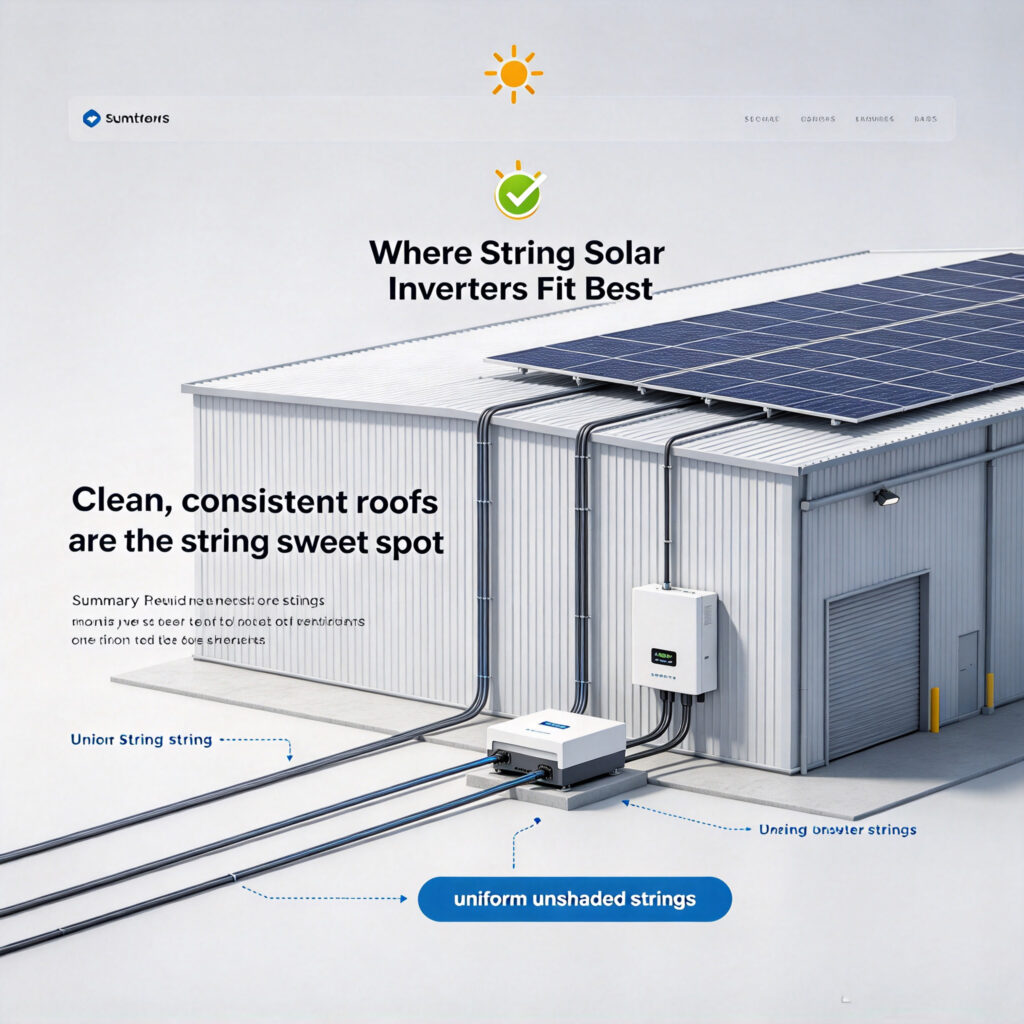
The economics follow the geometry. Because string units are modular, a growing site adds another unit rather than rebuilding the plant, which suits businesses that expand in phases. For procurement, the modularity means smaller, more frequent orders instead of one large capital block — a pattern the evaluating inverter suppliers guide weighs against bulk buys.
Selection points that decide a good match
For string solar inverters, three numbers and one behaviour drive whether the design is sized right. MPPT channel count sets how many independent strings you can tune. The series voltage window of each input sets how many panels fit in a string. Mismatch behaviour sets how much energy you lose when strings disagree. Get these wrong and the array is either capped, unsafe in cold, or quietly leaving energy on the table.
Start with MPPT count. A unit with two channels lets you run two strings with different orientations or light profiles on independent points, which trims mismatch between them. A unit with more channels costs more but pays off when the roof has two or three faces. As a practical rule, match the channel count to the number of distinct roof zones rather than to the total string count, then add one spare where the budget allows.
Voltage window is the one that bites in winter. Panel open-circuit voltage rises as temperature drops, so the coldest morning of the year is what the input must survive, not the mild lab figure. Size the string so its lowest-temperature open-circuit voltage stays inside the window with margin, and its hottest operating voltage still clears the inverter’s minimum. When a unit still faults, the solar pv inverter repair and solar inverter troubleshooting battery not charging guides cover the next steps.
| Point | What it sets | What to check |
|---|---|---|
| MPPT channel count | Independent operating points | Match to distinct roof zones, keep one spare |
| Series voltage window | Panels per string | Coldest open-circuit voltage stays within input range |
| Mismatch loss | Energy left on table | Limit mixed orientations on one channel |
Mismatch loss is the quiet one. When two strings on the same channel see different light — one row shaded, one clear — the channel tracks the weaker point and the stronger string gives up energy. The fix is not a bigger inverter but more channels, or moving the stray string to its own input.
How many panels per string
The short answer depends on two voltages from the module datasheet and one range from the inverter. Take the panel’s open-circuit voltage, apply the temperature coefficient down to your coldest expected temperature, multiply by the panel count, and keep the result under the inverter’s maximum input voltage. Reverse the check at the hottest operating point to stay above the minimum. Residential strings run shorter than commercial ones; the colder check always sets the ceiling.
Do not max out the count just because the window allows it. Leaving headroom protects against voltage rise from aging, soiling and the panel-to-panel spread that no datasheet prints. Treat the window as a keep-out zone with margin rather than a target to fill.
When not to use string solar inverters
String designs are not universal, and naming the wrong-fit cases is as useful as naming the right ones. Skip them when the roof is heavily shaded through the day, when panels face three or more directions that you cannot separate into clean zones, or when a single panel failure should never pull down its neighbours. In those cases per-panel control or a different granularity serves the site better.
Very large ground-mounted plants are the other boundary. Once the array is a single uniform field at utility scale, the overhead of many small string units and their combiner wiring can cost more than the lost per-string flexibility is worth, so a central topology often wins on pure economics.
Q. String solar inverters?
String solar inverters are a topology where one MPPT channel of the inverter manages a single series string of panels as one branch, tracking one operating point for the whole group. They sit between microinverters and central inverters in granularity, and they suit clean, consistent rooftops.
Q. How many panels per string?
It depends on the panel’s open-circuit voltage, its temperature coefficient and the inverter’s maximum input voltage. Size the string so its coldest-morning open-circuit voltage stays inside the inverter window with margin, and its hottest operating voltage clears the minimum. Residential strings typically run in a low-to-mid panel count; commercial strings run longer. The colder of the two voltage checks always sets the ceiling.
Q. String inverter vs central inverter: which wins?
Neither wins outright. String units give per-string operating points and scale from homes to large rooftops with modular units. Central units win on pure economics at utility-scale uniform ground mounts where per-string flexibility is worth less than combiner and balance-of-system savings. The site’s scale and uniformity decide. For shaded or mixed-orientation rooftops, also weigh microinverter options.
Q. What is MPPT string sizing?
MPPT string sizing is matching the number of panels in a series string to one MPPT input’s voltage window, using the coldest expected temperature for the upper limit and the hottest for the lower. It also means choosing how many MPPT channels you need so distinct roof zones get independent operating points. Get the channel count and the voltage window right and mismatch loss stays small.
Q. When should I avoid string solar inverters?
Avoid them on heavily shaded roofs, on arrays with three or more orientations that you cannot group into clean zones, or where one panel failure must not drag down its neighbours. Also avoid them at utility-scale uniform ground mounts where a central topology usually wins on cost. In those cases per-panel control or a central unit serves the site better.
Q. How do I choose a string inverter?
Match the MPPT channel count to your distinct roof zones, size each string’s voltage window for the coldest morning with margin, and confirm the unit’s phase fits the service. Check safety and interconnection baselines such as UL 1741 and IEC 62109 for your market. For chisidal projects, send the roof layout, panel model and target certifications, then ask for a matched string unit as a documented package.
Next step: confirm the string fit before you quote
String solar inverters are the right default for clean, consistent rooftops, but the win is in the sizing. Confirm the roof zones, the coldest-morning voltage and the channel count, then weigh them against shaded or utility-scale cases where another topology fits better.
- Read the micro inverter options guide before ruling them out on a shaded roof
- For chisidal, send your usage and site details, and we will come back with product prices, lead time and warranty information.
- See the solar inverters wholesale sourcing guide for volume and supply planning
- Review the all in one solar inverter overview if a single-enclosure build suits the site