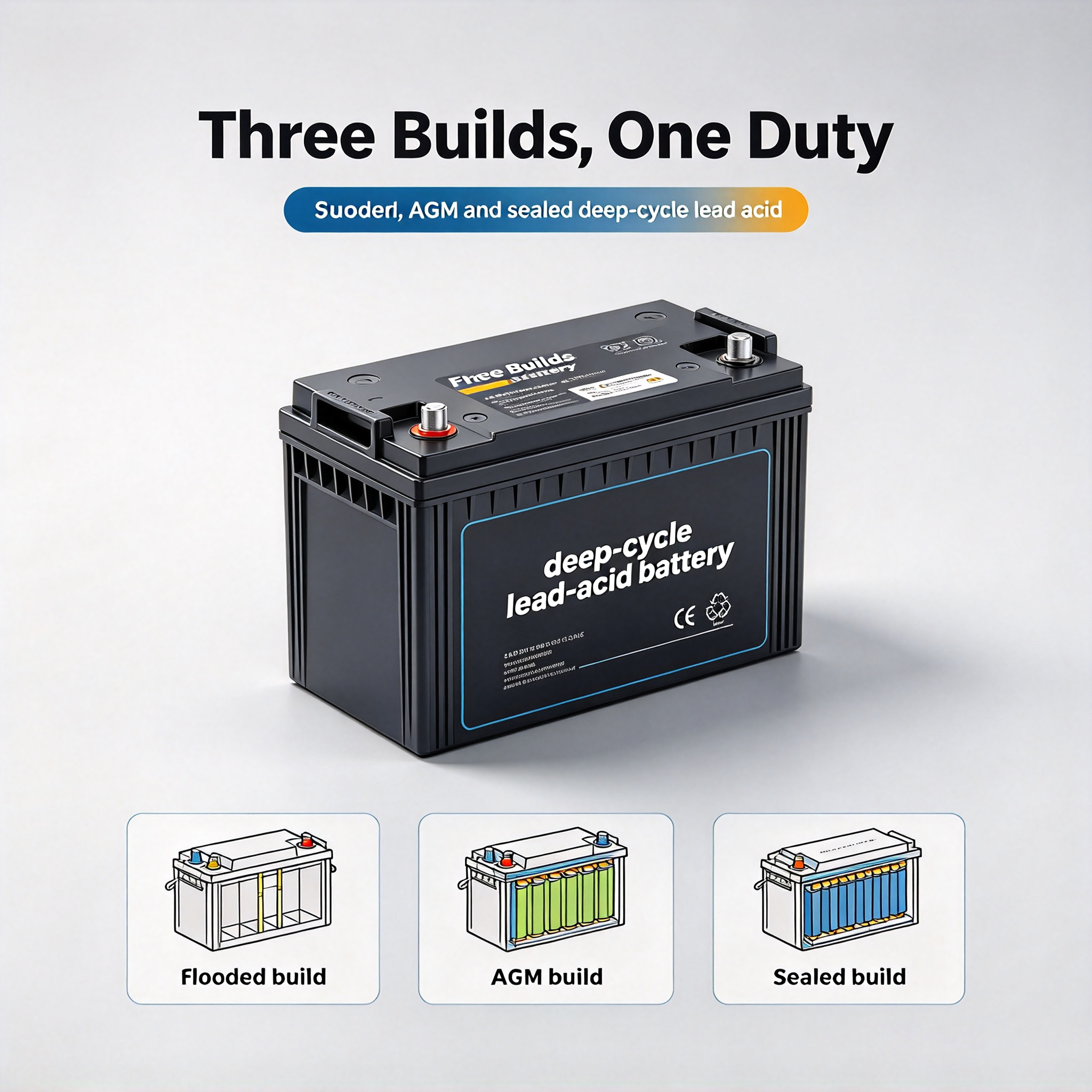
A deep cycle lead acid battery is a lead-acid battery built to be discharged deeply and recharged repeatedly — unlike a starter battery made for short, high bursts — and it comes in three builds: flooded (FLA), absorbent glass mat (AGM) and other sealed lead-acid (SLA) forms. This guide covers the three types side by side, the cycle-life trade you accept with lead-acid, and the situations where lead-acid is still the right deep-cycle choice despite lithium’s rise.
“Deep cycle” describes the duty, not the chemistry. A deep cycle lead acid battery trades the thin, cranking plates of a starter battery for thick plates that survive being run down and filled back up hundreds of times. Knowing the three lead-acid builds and their real limits is what stops you from over-paying for lithium where lead-acid is perfectly adequate.
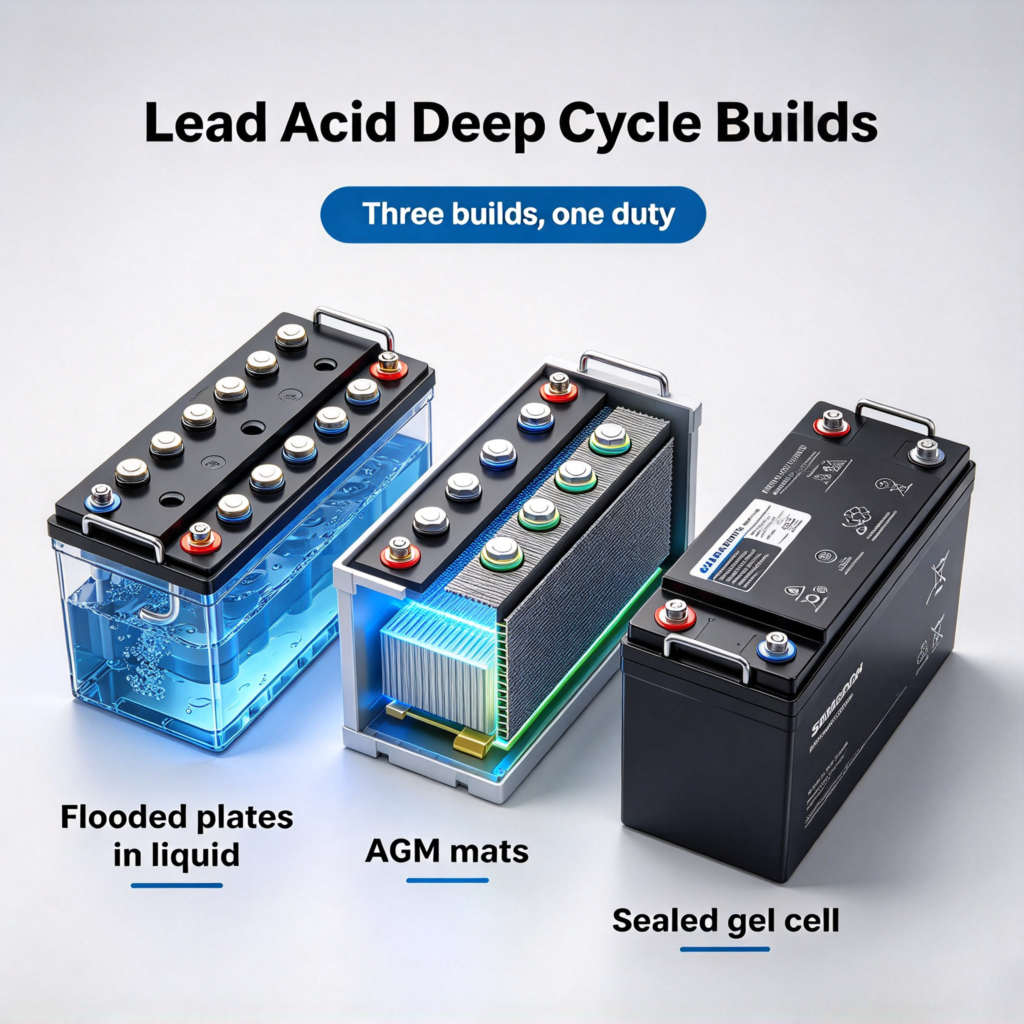
Flooded, AGM and sealed lead-acid explained
The deep cycle lead acid battery family starts with flooded lead-acid (FLA), the vented, lowest-cost build you water and mount upright. Absorbent glass mat (AGM) is a sealed variant that holds the acid in fiber mats, so it is spill-proof and vibration resistant; the agm vs lifepo4 deep cycle upgrade piece works through the AGM versus lithium upgrade in detail. Other sealed lead-acid (SLA) forms, including gel, extend the sealed idea further. AGM and SLA need no watering and tolerate more abuse, which is why they dominate mobility and backup. The lithium vs lead acid deep cycle lithium versus lead-acid comparison frames where each chemistry wins.
Cycle life and the depth-of-discharge trade
A deep cycle lead acid battery lives or dies by how deep you discharge it. Flooded and AGM units typically deliver more cycles when you stop at about 50% depth of discharge than if you drain them to 80%, because deeper discharge stresses the plates. Expect a cycle-life band in the low hundreds to a thousand-odd cycles at moderate depth; the exact number is on the datasheet. Lithium lasts longer at depth, which is the main reason to switch, covered in the how long a lithium ion battery lasts battery-life guide.
| Build | Maintenance | Cycle life at moderate depth | Best use |
|---|---|---|---|
| Flooded (FLA) | Watering, upright | Lower band | Lowest cost, vented boxes |
| AGM | Sealed, spill-proof | Mid band | RV, marine, mobility |
| Sealed (SLA/gel) | Sealed, no gas | Mid band | Backup, sealed enclosures |
When lead-acid still beats lithium
A deep cycle lead acid battery is the rational pick when upfront cost dominates, when the bank is rarely cycled deeply, or when a simple, field-serviceable unit beats a smarter one. Golf carts, budget solar buffers, and standby backup in a vented space are classic cases. The deep cycle vs starting battery deep-cycle versus starting guide and the 12v deep cycle marine battery marine piece keep those duties distinct. You pay in weight and cycle life, and you must respect the depth-of-discharge limit.
Charging and maintenance that protect life
Treat a deep cycle lead acid battery with a charger sized to its stage and a temperature-compensated setpoint where possible. Keep FLA topped and watered, store it charged, and avoid chronic partial state that sulphates the plates. The 12v lifepo4 battery 12V lithium guide and the 12v lifepo4 deep cycle battery hub 12V deep-cycle hub show the alternatives once you leave pure lead-acid. For chisidal projects, send the duty, the available venting and the target capacity, then ask for the FLA, AGM or SLA unit matched to that service as one documented product.
Flooded, AGM or gel, and how care differs
A deep cycle lead acid battery comes in three flavors — flooded, AGM, and gel — and they are not interchangeable in care. Flooded needs watering and upright mounting; AGM is sealed and vibration resistant; gel tolerates slow, deep discharge but is sensitive to charge voltage. Pick by where it sits and how it is mounted before you weigh price.
Lifespan tracks depth of discharge: a deep cycle lead acid battery that is only drawn to 50% will outlast one drained to 80% by a wide margin, so size the bank so daily use stays shallow. Keep terminals clean, torque the connections, and store at a maintenance float charge in cold months. Watch temperature, too: capacity rises in warmth and falls in cold, so a rating taken at 25°C understates winter performance, and the charge source should match the battery’s absorption and float setpoints. For chisidal-supplied banks, the right deep cycle lead acid battery is sized to the load and the recharge source as one planned system.
Equalization, charging profile, and cost per cycle
Flooded deep cycle lead acid batteries benefit from an occasional equalization charge that stirs the electrolyte and reverses stratification; AGM and gel generally do not, and forcing it shortens them. Know which you have before you press the button, because the same charger setting helps one chemistry and harms another. Set the absorption and float voltages to the battery label, not to a generic default.
Compare on cost per cycle, not on price per unit. A dearer AGM that survives three times the cycles often beats a cheap flooded unit that you replace twice, once you add the labor of swapping a heavy box in a tight bay. Recycle lead-acid through a proper stream — the material is valuable and the acid is not something to pour. For chisidal-supplied banks, the deep cycle lead acid battery is quoted with an expected cycle count so the true cost is visible up front.
Signs it is time to replace
A deep cycle lead acid battery tells you when it is tired: longer charge times, a voltage that sags faster under the same load, and a specific gravity that will not equalize across cells. Catch these early and you replace on a schedule, not in a failure; ignore them and the bank quits on the coldest, darkest night. For chisidal-supplied banks, the expected cycle count is documented so replacement is planned, not surprised.
Bottom line
In short, treat the deep cycle lead acid battery as a system component, not a box: match the chemistry to the mount, the charge profile to the label, and the bank size to the load, and it will return the cycles you paid for.
Sizing the bank and accounting for temperature
Size the bank from the load, not from the brochure. Add up the watt-hours you draw in a day, divide by the usable fraction — about half for lead-acid — and add a day or two of reserve for cloudy or busy periods. A deep cycle lead acid battery sized this way rarely surprises you; one sized by guesswork always does.
Temperature quietly rewrites the numbers. Capacity falls as it gets cold and rises as it warms, so a rating taken at room temperature overstates winter performance in a shed or boat. Either add headroom for the cold or move to a chemistry that tolerates temperature swing, and keep the charge setpoints matched to the temperature if your gear supports it. For chisidal-supplied banks, the sizing worksheet already folds temperature into the recommendation.
Q. deep cycle lead acid battery?
A deep cycle lead acid battery is a lead-acid battery built for repeated deep discharge and recharge rather than short cranking bursts, and it comes as flooded (FLA), AGM or other sealed lead-acid (SLA). The duty, not the chemistry, defines it.
Q. What are flooded, AGM and sealed lead acid?
Flooded lead-acid is the vented, watered, lowest-cost build; AGM is sealed with acid held in glass mats so it is spill-proof; other sealed lead-acid (including gel) needs no watering and gases less. AGM and SLA suit mobility and backup.
Q. How long does a deep cycle lead acid battery last?
Life depends on depth of discharge: stopping near 50% gives more cycles than draining to 80%. Expect a cycle-life band from the low hundreds to a thousand-odd at moderate depth; the exact figure is on the datasheet.
Q. Is a deep cycle lead acid battery better than lithium?
For lowest upfront cost, rare deep cycling, or a simple field-serviceable unit, lead-acid is still rational. Lithium wins on weight and cycle life at depth. Match the chemistry to budget and duty, not to trend.
Q. How should I charge and maintain one?
Use a charger sized to the stage, keep FLA topped and watered, store it charged, and avoid chronic partial state that sulphates plates. Temperature compensation helps where supported.
Q. What is a deep cycle lead acid battery used for?
Typical uses are golf carts, budget solar buffers, RV and marine house banks, and standby backup in vented spaces where simplicity and cost beat weight and cycle life.
Next step: keep lead-acid on purpose, or plan the switch
Lead-acid is not obsolete — it is the right cheap, simple duty for many banks. Confirm the cycle depth and the venting before you buy or upgrade.
- Read the how to choose a solar battery bank solar battery bank guide before sizing a deep-cycle bank
- For chisidal, send your usage and site details, and we will come back with product prices, lead time and warranty information.