A whole house battery backup system is a battery bank, a hybrid inverter and a transfer device that together hold up every circuit in the panel during an outage. Most homes do not need that much: a critical-loads sub-panel covers refrigeration, lighting, network and the well pump on a fraction of the capacity. This guide sets out the three configurations, shows the capacity maths on a worked load list, and covers the phase and paralleling rules that decide how units are stacked. Costs and payback are left out on purpose.
Capacity is the part people get wrong, and the reason is almost always the same: they size from the average draw instead of the peaks and the hours. The order below fixes that, and it keeps the electrical decisions separate from the financial ones.
Three configurations: critical circuits, partial home, whole home
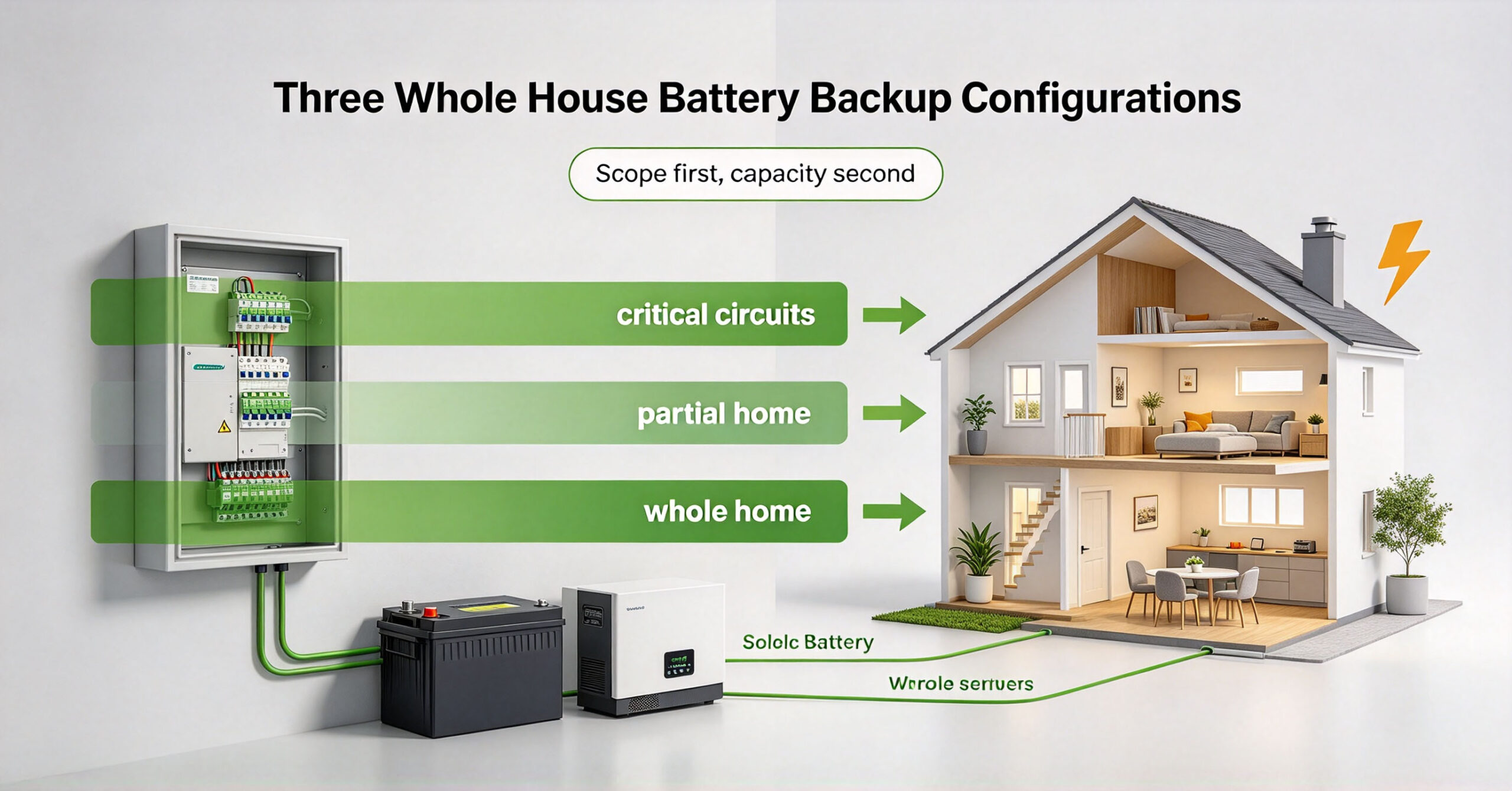
A whole house battery backup is defined by scope before it is defined by capacity. The three configurations differ in which circuits move behind the transfer device, and that choice drives both the energy target and the inverter rating. Moving one more circuit across the boundary is cheap when it is a lighting circuit and expensive when it is a range or a dryer.
| Configuration | What stays on | Transfer arrangement | Capacity implication | Inverter implication |
|---|---|---|---|---|
| Critical circuits | Refrigeration, lighting, network, medical devices, well pump | Dedicated sub-panel fed from the backup output | Smallest energy target, longest runtime per kWh | Sized to the largest motor surge on the sub-panel |
| Partial home | The above plus selected socket circuits, garage, home office | Sub-panel plus a monitored main feed | Mid-range target; runtime falls as scope grows | Surge headroom needed for mixed loads |
| Whole home | Everything on the main panel, including large appliances | Whole-panel transfer, often with load management | Largest target; resistive loads drain it quickly | Highest continuous and surge rating, sometimes more than one unit |
The practical reading is that scope and capacity trade against each other. A battery backup for whole home use at a modest capacity gives a short runtime; the same capacity behind a critical-loads panel gives many hours. Decide which circuits matter first, and only then does the energy number have a meaning.
Sizing the capacity: a worked example
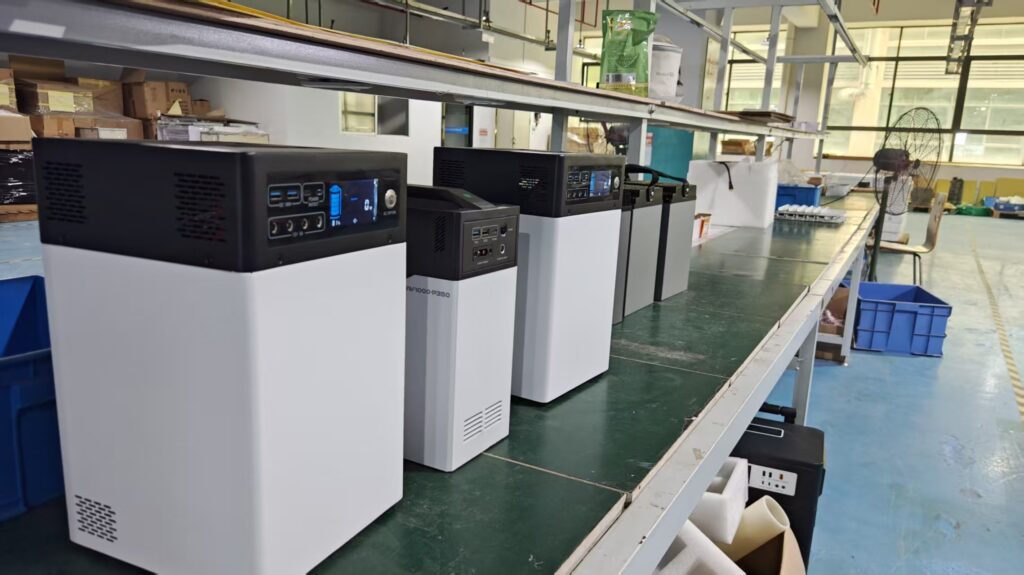
The calculation has four steps. List the loads. Separate the running watts from the starting surge. Multiply the running watts by the hours each load must run to get energy. Then divide by the usable fraction the battery management system allows, because a pack never gives you its whole nameplate. The surge figure does not enter the energy sum — it sizes the inverter instead.
| Circuit | Running W | Surge W | Hours targeted | Energy |
|---|---|---|---|---|
| Refrigeration | 150 W | 800 W | 24 h at part duty | about 1.4 kWh |
| Lighting and network | 250 W | 250 W | 6 h | about 1.5 kWh |
| Well pump | 1,200 W | 3,000 W | 1 h | about 1.2 kWh |
| Total | — | 3,000 W peak | one day | about 4.1 kWh |
Now apply the two multipliers that catch people out. First the duration: one day of that list needs roughly 4 kWh of usable energy, so a two-day target is roughly 8 kWh, before losses. Then the usable fraction: if the system allows most but not all of the nameplate to be used, the nameplate has to be larger than the usable target. At a 51.2 V nominal pack, a 10 kWh usable target works out at roughly 200 Ah of nameplate charge, and slightly more once the usable fraction and inverter losses are applied.
That is the whole of home backup battery sizing: energy from the hours, capacity from the voltage, and nameplate from the usable fraction. The same arithmetic, written as a repeatable procedure, is the how to size a home battery guide, and the wider selection logic around it sits in how to choose a solar battery bank. Solar is not required — the home battery backup without solar route charges from the grid and waits.
Phase: single, split and three phase
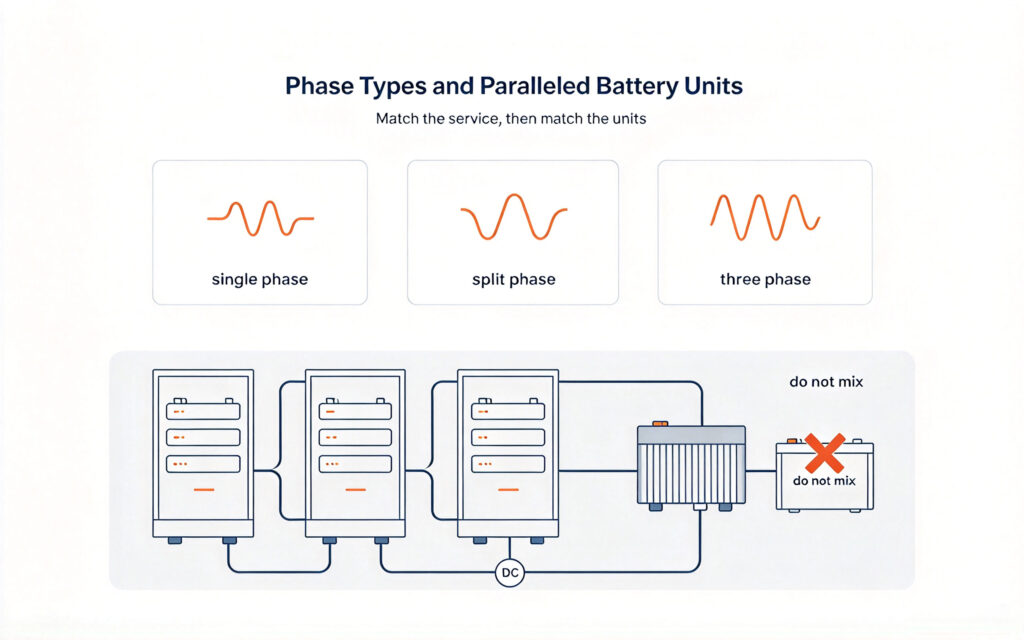
Phase is the constraint that quietly decides the equipment list. A single-phase 230 V service, common across Europe, the UK, Australia and much of Asia, needs an inverter with a matching single-phase output. A split-phase 120/240 V service, standard in North America, needs an inverter that produces both legs, because 240 V appliances span them and 120 V circuits sit on one leg each. A three-phase service needs a three-phase machine, or one unit per phase in some designs.
Get this wrong and nothing downstream works, no matter how much capacity is installed. Two related points follow from it. Balanced loading matters on three-phase systems, since a large single-phase load can unbalance the output and derate the machine. And the DC side has its own naming trap: 48 V and 51.2 V describe the same lithium class from different conventions, which is why the 48V vs 51.2V solar battery distinction is worth settling before the capacity arithmetic is finalised.
Paralleling units: what to check
Capacity grows by adding units, and paralleling is where well-intentioned designs fail. Units should be the same model, the same capacity and the same firmware revision, because mixed packs share current badly and the battery management systems will disagree about state of charge. Cable lengths from each unit to the common bus should be equal, so the resistance — and therefore the current sharing — is equal. Each unit needs its own protection, and the combined short-circuit current sets the rating of the main device.
Confirm what the manufacturer actually permits: how many units may be paralleled, whether they must share a common DC bus, and whether the inverter sees them as one pack or several. Going from a partial-home design to a whole house battery backup is mostly a capacity and current question at this point, and the residential capacity classes are catalogued in the residential 51.2V LiFePO4 battery reference, with the smaller pack classes listed in the 12V lithium battery capacity guide. Where one string is paralleled, note that parallel strings add amp-hours while series strings add voltage — the arrangement changes the current, not the stored energy.
Installation and safety notes
The transfer device is the safety-critical part of any whole house battery backup. It must isolate the home from the utility during an outage so no energy is exported onto a line that crews are working on, and it must reconnect cleanly when the grid returns. Automatic transfer equipment, a gateway, or a manual changeover all achieve isolation, but they differ in how much of the home they move and how seamless the switch feels.
Bonding and protection follow local code, and they are not interchangeable between markets: the neutral-to-earth bond must sit in the right place for the topology, and getting it wrong creates a fault path rather than a convenience issue. Beyond that, observe clearance and ventilation rules around the battery cabinet, torque the DC terminations to the stated value, and label the backup circuits so the next person knows what is protected.
Commission the system under load rather than on paper. Run it on battery with the largest motor starting, verify the surge is absorbed without a trip, and confirm the runtime against the load list before signing off. Standards such as IEC 62619 for battery safety, UL 1973 for stationary packs and UL 1741 for interconnection set the compliance frame, though the applicable edition and local amendments must be confirmed for each market — treat the numbers as a starting point rather than a final answer.
Two closing checks keep the design honest. A whole house battery backup also has to survive simultaneous surge, not just the largest single motor, so add the base load to the worst starting event. And where the system is expected to run for days rather than hours, the configuration question returns to scope: fewer circuits running longer usually beats everything running briefly. Where a whole house battery backup is quoted, ask for the surge rating, the usable energy figure and the permitted paralleling count as three separate numbers.
Q. What size whole house battery backup do I need?
List the circuits that must stay on, multiply running watts by the hours each must run, then divide by the usable fraction of the pack. A critical-loads list often lands in single-digit kWh per day; whole-home scope at the same capacity would cover far fewer hours. Surge sizes the inverter, not the battery.
Q. Can one battery backup power a whole house?
Yes, but scope and capacity trade against each other. A whole-home configuration needs a larger inverter for simultaneous surge and more usable energy for the same runtime. Many homes get better results from a critical-loads panel at a smaller capacity.
Q. What is the difference between critical circuits and whole home backup?
Critical circuits move only selected loads — refrigeration, lighting, network, medical devices, pumps — behind a sub-panel. Whole home moves the entire main panel. The first gives long runtime from modest capacity; the second gives full convenience for a shorter window.
Q. Do I need a split phase inverter for a whole house battery backup?
If the service is 120/240 V split phase, yes: the inverter must produce both legs so 240 V appliances and 120 V circuits both work. Single-phase 230 V services need a matching single-phase machine, and three-phase services need a three-phase design or one unit per phase.
Q. How many battery units can be paralleled?
Whatever the manufacturer permits, and it should be read from the documentation rather than assumed. Units should match in model, capacity and firmware, share a common DC bus with equal cable lengths, and each needs its own protection sized for the combined current.
Q. How long will a whole house battery backup run during an outage?
It depends on scope and capacity: critical circuits on a modest pack can run for many hours, while whole-home coverage with large resistive loads drains the same capacity much faster. Estimate from the load list and hours, not from the nameplate alone.
Next step: confirm scope, capacity and phase before you order
Send the circuit list with running and surge watts, the target hours, the service type and phase, and the specification can be confirmed against the load rather than guessed.
- Check the arithmetic against the how to size a home battery guide before you commit to a capacity
- For chisidal, send your usage and site details, and we will come back with product prices, lead time and warranty information.