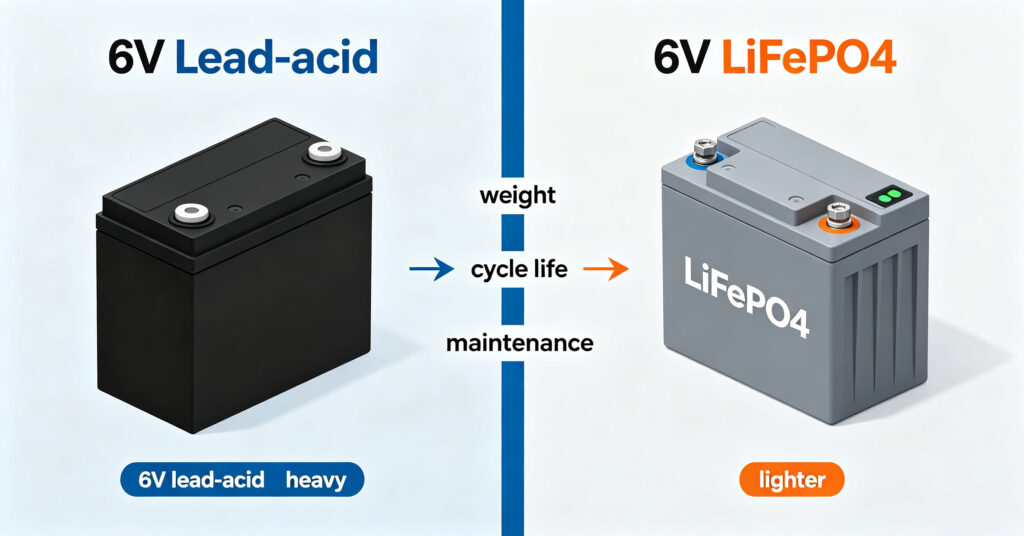
A lithium 6 volt battery is a 6V-nominal lithium pack — usually two lithium iron phosphate cells in series — sold as a drop-in replacement for the 6V lead-acid blocks used in golf carts, fish finders, ride-on toys, backup lighting and legacy industrial gear. The appeal is straightforward: a lithium 6 volt battery weighs a fraction of the lead-acid block it replaces, delivers a much larger share of its nameplate capacity before the voltage collapses, needs no water and no equalisation, and lasts for thousands of cycles instead of hundreds. The catch is that 6V lithium almost always lives in a series string, and a series string is only as good as its weakest, least-matched member. The one-line version worth quoting: the chemistry upgrade is easy; the wiring discipline is what decides whether the pack lasts three seasons or ten.
This guide is for anyone replacing 6V lead-acid with lithium, or specifying a 6V lithium pack for new equipment. It covers where 6V still wins, how the swap is sized, how series strings behave, and the charger question that catches people out. The 12V platform and its capacity classes are in #141 12V lithium battery comparison; the 24V and 48V decisions are in #157 24V solar battery and #12 48V vs 51.2V.
Why 6V survives
Six volt persists for three practical reasons rather than any electrical advantage.
- Installed base. Golf carts and a long tail of legacy equipment were designed around 6V blocks, and the battery compartment dimensions are set by the original design.
- Serviceability. A 6V block is small enough for one person to lift, which matters for equipment that is maintained by hand rather than by a forklift.
- Granularity. Six of them in series give 36V, eight give 48V — a voltage that a 12V-only product range cannot reach as neatly in the same compartment shape.
Where 6V loses is current. For a given power, a 6V system draws four times the current of a 24V system and eight times that of a 48V system, which means thicker cable, heavier-duty contactors, and more voltage sag under load. That is why stationary storage moved to 48V and why 6V is now mostly a replacement market rather than a design choice. The reasoning is set out in #89 high-voltage vs low-voltage storage.
| Dimension | 6V lead-acid block | 6V LiFePO4 replacement |
|---|---|---|
| Nominal voltage | 6 V (three lead-acid cells) | 6.4 V (two LFP cells) |
| Usable capacity | Roughly half the nameplate Ah in practice | A large majority of the nameplate Ah is usable |
| Weight for the same usable energy | High | Substantially lower |
| Cycle life in deep duty | Hundreds of cycles | Thousands of cycles at moderate depth of discharge |
| Maintenance | Water top-up, terminal cleaning, ventilation | None beyond visual and terminal checks |
| Charging | Tolerant of a simple charger | Needs a lithium-compatible profile and low-temperature protection |
Three typical applications
The sizing logic differs by device, and mixing them up is how people buy the wrong capacity.
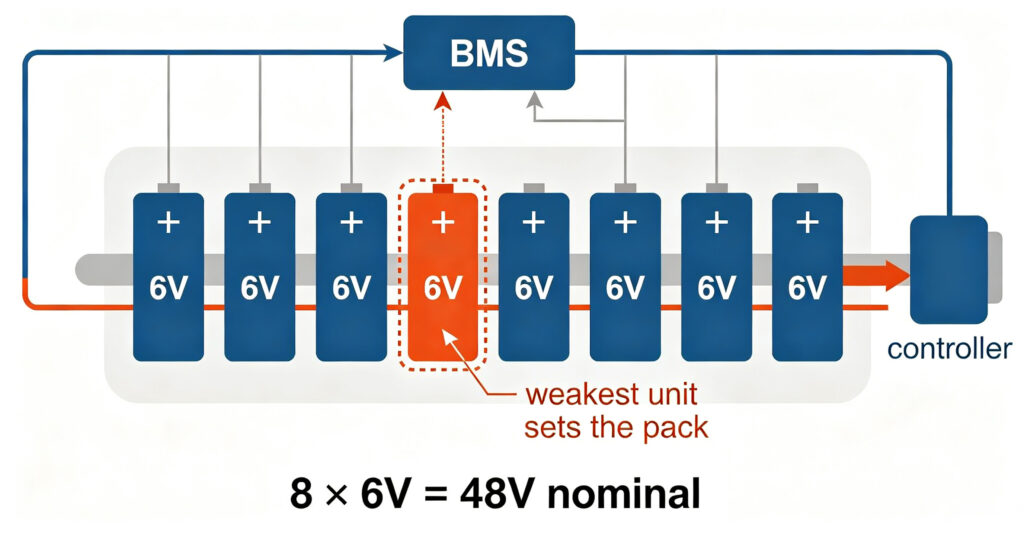
- Golf carts and low-speed vehicles: the load is a motor with a high surge and a long run time, and the pack is a series string — typically six units for 36V or eight for 48V. Capacity is set by the round length in amp-hours; the surge is handled by the battery’s discharge rating. Buying one weak unit in a string of eight is a false economy, because the management system will cut the whole pack on the weakest member.
- Fish finders and outdoor electronics: the load is small and continuous over a day on the water, so the requirement is watt-hours rather than surge. A single small lithium 6 volt battery can often replace a much heavier lead-acid block and run a sounder and a navigation light for a full day.
- Legacy and industrial gear: backup lighting, alarm panels, access control and older mobility equipment often specify 6V. Here the replacement is driven by compartment dimensions and terminal type as much as by capacity, and the usual mistake is buying on Ah alone without checking the physical fit and the terminal orientation.
For marine and trolling applications the comparison against sealed lead-acid is worth reading before ordering, because the duty profile of a trolling motor is closer to deep cycling than to standby; that comparison is in #147 gel cell trolling motor batteries, and the wider marine angle is in #75 12V deep cycle marine battery.
Four rules for a series string
Every lithium 6 volt battery installation with more than one unit in series follows the same four rules.
- Buy the whole string at once, from one batch. Capacity and internal resistance drift between batches, and mixing batches is how a string goes out of balance within a season.
- Charge the string as a string, or balance regularly. Cells in series share one current; without balancing they drift apart, and the drift is cumulative. The balancing approaches are compared in #106 active vs passive cell balancing.
- Use one management system for the pack. Per-unit protection is good; a pack-level view is what prevents a single unit from being driven to cutoff repeatedly.
- Torque every link and re-check it after the first month. A loose link in a high-current string heats, and heat is what ages a lithium pack fastest.
The charger question
This is the step that most often goes wrong in a lead-acid to lithium swap. Three checks before reusing an existing charger.
- Profile. A lead-acid charger applies voltages and, in some cases, an equalisation or desulphation mode that a lithium pack should never see. Confirm the charger has a lithium profile, or replace it.
- Float behaviour. Holding a lithium pack at a continuous float voltage is unnecessary and ages it; a charger that shuts down or trickles lightly is preferable.
- Temperature behaviour. Charging below freezing damages lithium cells, so a pack used outdoors or in an unheated shed needs low-temperature charge protection. The protection logic is described in #49 BMS protection.
Two more checks close the swap: the physical fit, including terminal orientation and hold-down arrangement, and the state of the equipment’s wiring. Old cable that was fine for a lead-acid pack’s sag tolerance may be undersized once the lithium pack can actually deliver its rated current. The specification reading exercise is in #115 how to read LiFePO4 battery specs.

What to ask a supplier
Five questions separate a credible 6V lithium product from a rebadged cell in a box.
- Cell count and configuration: two LFP cells in series for a 6V nominal pack, with the cell capacity stated.
- Usable capacity and discharge rating: amp-hours to the cutoff, and the continuous and surge current the pack can deliver.
- BMS functions: over-voltage, under-voltage, over-current, short-circuit and temperature protection, plus balancing.
- Cycle life stated at a depth of discharge and rate, not a bare number.
- Terminal type, dimensions and weight, so the replacement fits the compartment before it is ordered.
For fleet and OEM buyers the questions extend to batch consistency and spares; the quality and traceability expectations are in #133 OEM quality control and traceability, and the commercial terms are in #124 MOQ, lead time and payment terms.
Q. What is a lithium 6 volt battery?
A lithium 6 volt battery is a 6V-nominal lithium pack, usually two lithium iron phosphate cells in series, built as a drop-in replacement for a 6V lead-acid block. It delivers a much larger share of its rated capacity, weighs substantially less, needs no maintenance and lasts for thousands of cycles rather than hundreds.
Q. Can I replace 6V lead-acid with lithium?
Usually yes, provided three things check out: the charger has a lithium profile without an equalisation or desulphation mode, the physical dimensions and terminal orientation fit the compartment, and the whole series string is bought as one matched set. Reusing a lead-acid charger is the most common cause of a failed swap.
Q. How many 6V batteries make 48V?
Eight, for a nominal 48V string, since each 6V lithium unit is roughly 6.4V nominal. A 36V golf cart typically uses six. The count is fixed by the vehicle’s motor voltage, so the capacity choice is made per unit rather than by adding units.
Q. Do I need a special charger for a 6V lithium battery?
Yes. Use a charger with a lithium charging profile that does not apply a lead-acid equalisation or desulphation mode, does not hold the pack at a continuous high float voltage, and ideally includes low-temperature charge protection if the equipment is charged in the cold.
Q. Why is my 6V lithium pack cutting out early?
Almost always one of three causes: an unbalanced series string where one unit reaches the cutoff first, a loose or corroded inter-unit link causing voltage drop, or a load drawing more current than the pack’s discharge rating allows. Check the links and the per-unit voltages before assuming the battery has failed.
Next step: match the string, not just the voltage
A lithium 6 volt battery swap succeeds on four checks: fit, charger, matched string and torque. Miss one and the pack ages early.
- Read the specification in #115 how to read LiFePO4 specs
- Check the protection logic in #49 BMS protection
- Compare platforms in #141 12V lithium battery comparison
- Tell leekooenergy your device voltage, compartment dimensions, terminal type and daily amp-hour draw — and ask for a replacement that states the usable capacity, the continuous and surge discharge rating, the charger requirement, and whether your series string should be replaced as one matched batch