Solar battery companies that build lithium and LiFePO4 storage are best compared on what they actually make, which certifications they hold for your market, how much they can produce, and what warranty and service they back it with — not on a “reliable” label in a brochure. This guide sets out the dimensions a cautious buyer should check, why chemistry splits the field, and how to put two makers side by side so the shortlist rests on evidence rather than on a sales call.
The category looks crowded, and many names sound similar. The useful question is not “which company is best” but “which one can prove the claims your project depends on,” because a storage purchase is a decade-long relationship, not a one-time part.
What solar battery companies actually sell
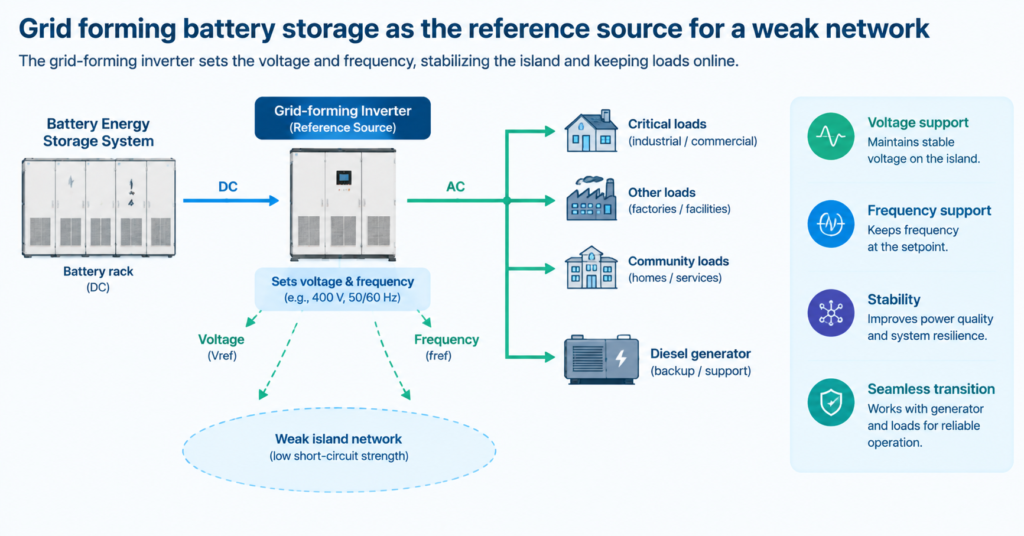
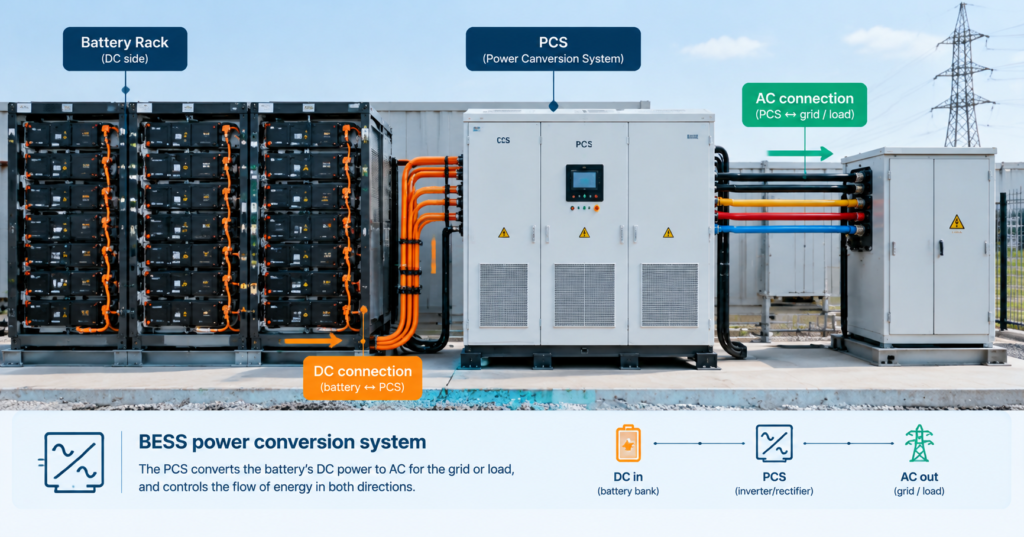
The term covers three different scopes. Some make cells, some assemble packs and racks, and some deliver a full storage system with inverter, BMS and monitoring. A buyer comparing a cell maker with a system integrator is comparing two different businesses, so the first check is which scope a candidate sells before any price is read. The what is battery storage bess explainer maps those scopes if the boundary is unclear.
For a buyer the scope decides risk. A pack assembler sourcing cells openly is a different supply risk from a cell maker, and both are legitimate; the point is to know which one you are contracting and to ask for evidence that matches the scope, not a generic company profile.
Why chemistry splits the field
Lithium-ion is an umbrella, and LiFePO4 (LFP) is one branch under it with a lower per-cell voltage and a longer cycle life at the cost of energy density. A maker that leads on LFP is not the same as one built around higher-energy chemistries, and the right choice depends on whether your project values cycle life or compact energy. This article stays on lithium and LFP, because sodium-ion is a different route with its own trade-offs and its own set of makers.
The chemistry also sets the safety baseline and the certification story. Read the lithium ion battery pack buyers guide for the chemistry background, then confirm which one a candidate actually builds at volume, because a maker’s headline chemistry and its high-volume line are not always the same.
Certification and market fit to verify
Certification is the claim you cannot verify on site, so it leads the check. For stationary lithium and LFP storage the common references are IEC 62619, UL 1973 and UN38.3, but the required set depends on the destination market, and a certificate for one model does not cover a sister SKU. Ask for the issuing body, the exact certified model and the date, and confirm the certified model is the one you are buying.
The commercial battery storage guide cites these as entry requirements, yet the exact list is market-specific, so name your countries in the RFQ. Treat any standard name as “to be verified by a human” before you rely on it, because a mismatched certificate is discovered at customs, not at the quote stage.
Production scale and what it tells you
Scale is evidence of stability, not of quality by itself. A larger maker may hold steadier lead times and spare parts, while a smaller specialist may offer tighter support on a custom build. Ask for the output of the specific product line, not the group’s total, and for whether cells are made in-house or sourced, because those two facts shape both price and supply risk.
Verify with a factory video, a recent production record for a comparable order, and a reference buyer in a similar market. The how much is a solar battery cost answer depends on volume, so the capacity you confirm sets the volume break you can rely on, not the one printed in a quote.

Warranty and service you can verify
A warranty stated only as years is incomplete. Read the clause behind it: the throughput or cycle definition, the capacity fade threshold that triggers replacement, and whether labour and shipping are included. Two makers offering “ten years” can mean two different obligations once the clauses are read, so ask for the text rather than the headline.
Service is the part most buyers skip and most later regret. Confirm the spare-parts list, the response time for a technical query, and whether firmware or BMS updates are supported. The how to choose a solar battery bank choice should already account for these limits, because a bank run outside the stated window is a refused claim, not a defect.
How to compare two solar battery companies
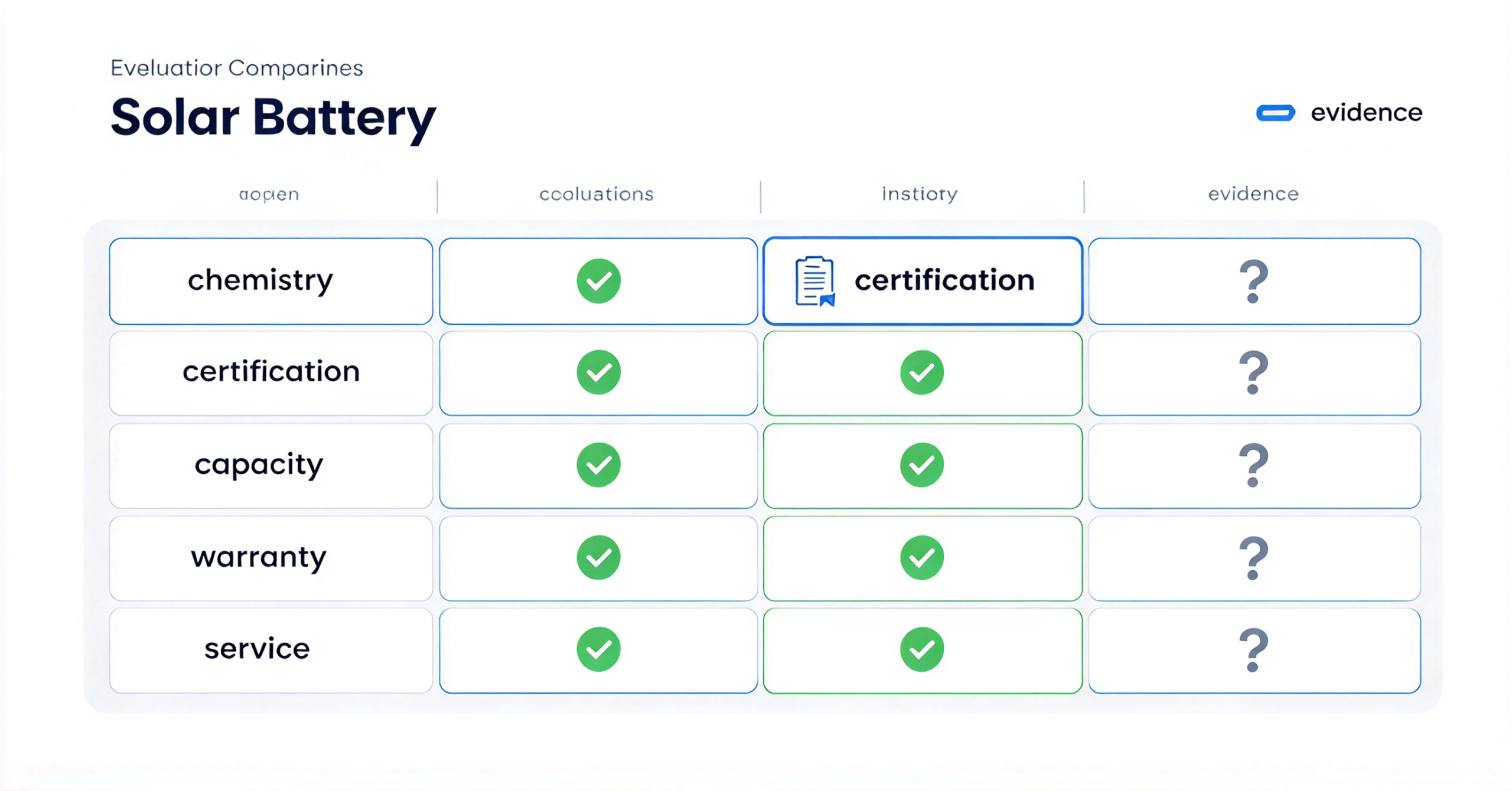
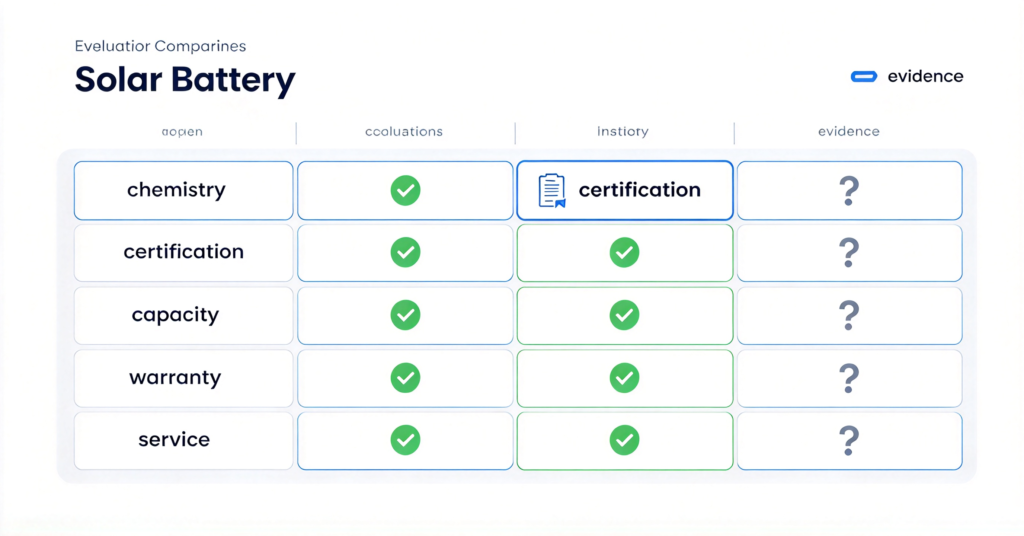
Put every candidate on one table with the same columns, because memory drifts and PDFs pile up. Score them on certified model, chemistry and cell source, usable capacity, lead time at your quantity, warranty clause and named support contact. A maker that answers precisely with evidence outranks one that answers fast and vague, and the gap widens once the project is live.
| Dimension | What to confirm | Why it decides |
|---|---|---|
| Chemistry and cell source | LFP or other lithium; made in-house or sourced | Sets safety baseline and supply risk |
| Certification | Exact model, body, date, market | Decides customs and compliance |
| Capacity and lead time | Usable capacity; time at your quantity | Decides fit and delivery |
| Warranty clause | Cycle definition and fade threshold | Decides true obligation |
| Service | Spares, response time, updates | Decides years-two-through-ten |
Red flags a cautious buyer notes
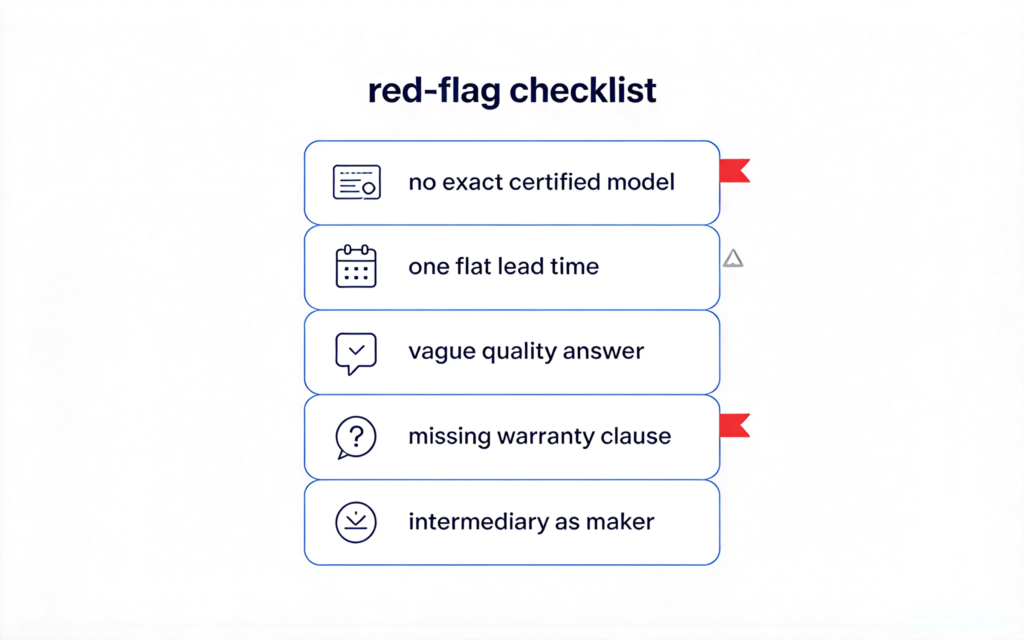
Some signals deserve a pause. A maker that cannot name the exact certified model, that quotes one flat lead time for every configuration, that answers “high quality” where a number was asked, or that avoids the warranty clause is showing you the limit of its evidence. None of these is proof of a bad product, but each is a reason to ask harder before you commit budget.
A trading intermediary presenting as a manufacturer is another. The custom battery packs oem odm design guide explains the ownership split, and the same caution you apply when evaluating inverter suppliers applies here: the equipment maker and the integrator should name each other without hesitation.
Build a shortlist without over-trusting the brochure
A shortlist earns its place only when every candidate answered the same questions with evidence. Prepare one RFQ stating application, specification, quantity, environment, chemistry, customization and target certification set, then score replies on the dimensions above. The goal is not the cheapest line but the maker whose evidence survived the same questions your own customer will ask.
For chisidal projects the chemistry, certified model and support contact are stated up front, so the comparison is against the same line rather than against a brochure default. Keep the scorecard with the batch record, because a decision backed by certificates and production evidence is one you can defend later.
Q. How do I compare solar battery companies?
Compare them on one table with the same columns: certified model, chemistry and cell source, usable capacity, lead time at your quantity, warranty clause and named support contact. A maker that answers precisely with evidence outranks one that answers fast and vague, because the gap widens once the project is live.
Q. What should I check before choosing a battery maker?
Confirm the exact certified model and market, the chemistry and whether cells are made in-house, the usable capacity and lead time at your quantity, the warranty clause behind the year count, and the spare-parts and support path. Ask for certificates, a production record and a reference buyer rather than a company profile.
Q. Lithium or LiFePO4 — which maker do I pick?
LiFePO4 trades energy density for longer cycle life and a lower per-cell voltage, so it fits projects that value lifespan and safety margin; higher-energy lithium fits where space matters more. Pick the maker built around the chemistry your project needs at volume, not the one with the louder headline.
Q. Are overseas solar battery companies reliable?
Reliability is not a country but a set of evidence: valid certification for your market, verified production, a clear warranty clause and a real support contact. Judge each maker on those, and treat any “reliable” claim without a certificate or reference as unproven rather than as a fact.
Q. What are red flags when selecting a battery supplier?
Pause when a maker cannot name the exact certified model, quotes one flat lead time for every configuration, answers “high quality” where a number was asked, avoids the warranty clause, or presents as a manufacturer while acting as an intermediary. None proves a bad product, but each is a reason to ask harder first.
Q. Why does chemistry split the maker field?
Lithium-ion is an umbrella and LiFePO4 is one branch under it with different voltage, cycle life and density, so makers optimise for different strengths. The right maker depends on whether your project values cycle life or compact energy, and sodium-ion is a separate route with its own makers outside this comparison.
Next step: one RFQ, one scorecard, no assumptions
The crowded field narrows fast once every maker answers the same questions with evidence. Build the scorecard before you read the quotes, and the shortlist builds itself.
- Before you shortlist, read how to choose energy storage integrator supplier so the equipment and the integrator name each other without hesitation
- For chisidal, send your usage and site details, and we will come back with product prices, lead time and warranty information.