
A group 31 deep cycle battery is a BCI group size — a standard case dimension and terminal layout — that carries more capacity than group 24 or group 27 and is built to be discharged and recharged repeatedly rather than to crank an engine. This guide covers the dimensions you must measure against, the amp-hour and reserve-capacity ratings you will actually see on a label, the terminal and chemistry choices, and how to decide whether group 31 is the right size for your load.
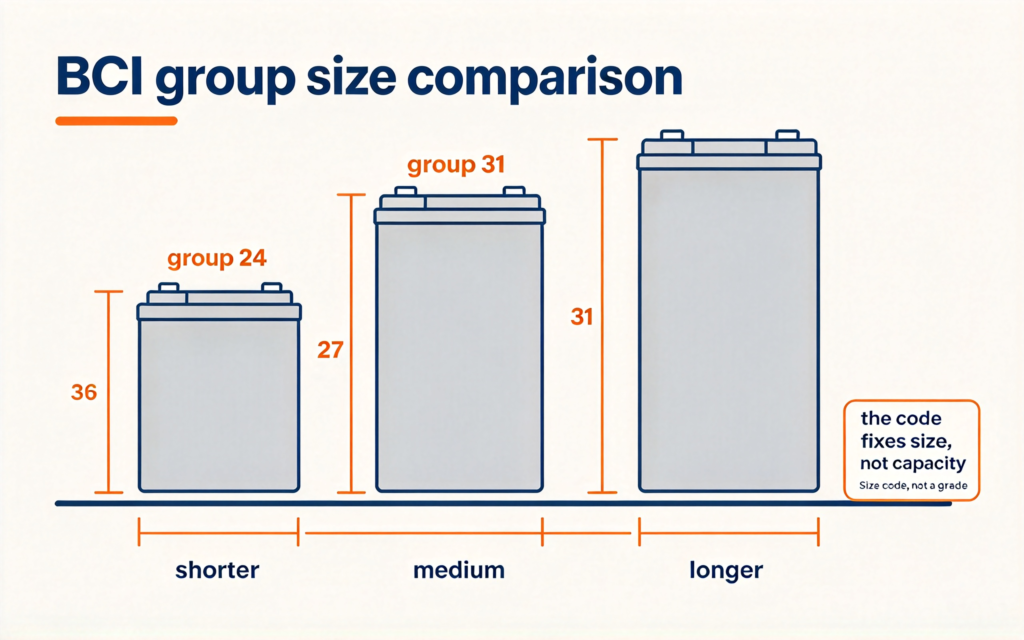
Battery group numbers are not performance grades; they are a size code. Choosing between group 24, 27 and 31 is then a question of how much energy you need and whether the case physically sits in the tray.
What the group number actually tells you
The Battery Council International (BCI) group number fixes the outside dimensions, the terminal type and the terminal positions. It does not, on its own, tell you the capacity, the chemistry or whether the battery is a deep-cycle or a starting unit. Two batteries can share a group 31 footprint and differ by a wide margin in amp hours and cycle life, which is why the size is the starting constraint and never the whole specification. If you are deciding between sizes rather than between brands, the group 27 deep cycle battery covers the next size down and the trade-offs that come with it.
In practice, a group 31 case is longer than a group 27 and noticeably longer than a group 24, and it is usually the tallest of the three as well. That extra volume is what buys the additional plate area and electrolyte — or, in a lithium build, the additional cell capacity. Confirm the exact millimetre dimensions against the tray before ordering, because the group code fixes the nominal size and manufacturers still vary within a small tolerance.
Amp hours, reserve capacity and what each means
Two numbers dominate a deep-cycle label. Amp hours (Ah) is the charge the battery can deliver over a stated number of hours — commonly a 20-hour rate for deep-cycle units — so a 100 Ah rating means a small, steady draw for twenty hours rather than a large draw for one. Reserve capacity is the number of minutes the battery can run a fixed moderate load before the voltage falls to a cutoff. Reserve capacity is often the more honest comparison between two group 31 units, because it is measured at a realistic load instead of an idealized slow discharge.
Be careful about the rate. The same physical battery can be quoted at a 20-hour rate and at a 100-hour rate, and the slower rate will show a larger number. Comparing two quotes that use different rates is the most common way buyers overestimate what they are getting, so normalise the spec sheet before you compare.
| Rating | What it measures | How to use it |
|---|---|---|
| Amp hours (Ah) | Charge over a stated hours rate | Compare only at the same rate |
| Reserve capacity | Minutes to a voltage cutoff | Best real-world comparison |
| Cold cranking amps | Short burst for engine start | Not the spec for deep cycle |
Chemistry and terminal choices
A group 31 deep cycle battery comes in flooded lead acid, AGM, gel and LiFePO4. Flooded is the cheapest per amp hour and needs venting and periodic water checks. AGM is sealed, tolerates vibration well and charges faster, which is why it dominates marine and vehicle installations. Gel handles deep discharge gracefully but dislikes aggressive charging. Lithium costs more upfront, weighs roughly half as much for the same usable capacity, and tolerates a far deeper discharge without shortening its life.
Terminal style matters more than buyers expect. Group 31 cases appear with stud terminals, threaded posts and, on some units, a combination layout for auxiliary connections. Match the terminal to the cable lugs you already have, or budget for new lugs and a crimping tool. The AGM versus LiFePO4 deep cycle upgrade walks through the chemistry decision in practical terms, and the lithium versus lead acid deep cycle comparison covers the lifecycle economics.
How much usable capacity you really get
Rated amp hours are not usable amp hours. Lead-acid chemistry should not be routinely discharged past roughly half its rating if you want a reasonable cycle life, and the manufacturer’s own guidance is the number to follow. Lithium can be discharged far deeper without the same penalty, which is why a smaller lithium group 31 can outlast a larger lead-acid one on the same daily duty. The 12V deep discharge battery guide covers depth of discharge and why the label overstates what you can actually use.
Discharge rate changes the answer as well. Draw a battery hard and the available capacity falls below the rating; draw it gently and you may see more than the rating. That is the reason a group 31 specified for a slow, steady house load behaves differently from the same battery asked to run an inverter at near its continuous limit.
When group 31 is the right call — and when it is not
Choose a group 31 deep cycle battery when the tray accepts the extra length, when runtime is the binding constraint, and when the added weight is not a problem. It is the usual answer for larger house banks, for vessels with an inverter load, and for off-grid installations where the battery has to carry the load through a night or a cloudy stretch.
Choose a smaller size when the tray is fixed, when the load is light, or when the battery has to be lifted by one person on a regular basis. A group 24 or 27 in lithium chemistry will often beat a group 31 in lead acid on usable energy and weight, so “bigger” is not automatically “more runtime”. For chisidal-supplied projects, send the tray dimensions, the daily watt-hour draw and the peak load, then ask for the size and chemistry that meets the duty rather than the largest case that fits.

Installation and replacement checks
Before you order a replacement, measure the tray, note the terminal orientation, and confirm the hold-down style. A battery that is a few millimetres too long, or that has terminals at the wrong corner, turns a simple swap into a modification. Secure the case against movement: vibration is a leading cause of early failure in vehicle and marine service, and a loose battery damages its own plates and the terminals it is wired to.
Size the cabling to the load, not to the battery, and protect the positive run with a fuse or breaker close to the terminal. Torque the terminals to the manufacturer’s figure — under-tightened connections heat, and over-tightened studs strip. If you are replacing multiple units, replace them as a matched set: mixing an aged battery with a new one in the same bank drags the new unit down to the old one’s behaviour. The deep cycle lead acid battery guide covers lead-acid care in more depth and the marine and RV deep cycle battery guide covers marine and RV duty.
Buying notes for a group 31 swap
A group 31 deep cycle battery is the right choice when you have the space and the load demands the runtime. Treat the group number as the size constraint it is, compare capacity at the same discharge rate, and pick the chemistry on duty cycle rather than on sticker price.
Q. group 31 deep cycle battery?
A group 31 deep cycle battery is a BCI group size — a standard case dimension and terminal layout — with more capacity than group 24 or group 27, built for repeated discharge and recharge rather than for cranking an engine. The group number fixes the size, not the capacity or chemistry.
Q. What are the dimensions of a group 31 battery?
Group 31 is the longest of the three common deep-cycle sizes, longer than group 27 and markedly longer than group 24, and usually the tallest. Manufacturers vary within a small tolerance, so measure the tray against the exact data sheet before ordering.
Q. How many amp hours is a group 31 battery?
It varies by chemistry and construction, and it must be read at a stated discharge rate. Compare two units only at the same rate — usually the 20-hour rate for deep cycle — and use reserve capacity as the practical cross-check.
Q. Is group 31 better than group 27?
Group 31 holds more capacity for the same chemistry, so it runs longer, but it is larger and heavier. If the tray is fixed or the load is light, a group 27 — particularly in lithium — can deliver more usable energy per kilogram.
Q. Can I use a group 31 battery for starting an engine?
Some group 31 units are dual-purpose and carry a cranking rating alongside a deep-cycle rating. A true deep-cycle unit is optimised for sustained draw, not for the short high-current burst an engine starter needs, so check the label for both ratings.
Q. Which chemistry should I choose for a group 31?
AGM suits vehicle and marine duty where vibration and sealed construction matter. Lithium suits deep daily cycling where weight and usable depth of discharge matter. Flooded suits a ventilated, budget-sensitive fixed installation with someone willing to maintain it.
Q. How long will a group 31 deep cycle battery last?
Service life depends on depth of discharge, temperature and charge quality. Shallower cycles, moderate temperatures and a correct charge profile lengthen it substantially; deep daily discharge and heat shorten it. Confirm the rated cycle life against the manufacturer’s stated test conditions.
Next step: confirm the tray, then the duty
A group 31 only pays off if it physically fits and the chemistry matches how deeply you cycle it. Send the tray dimensions, the daily watt-hour draw and the peak load.
- Compare sizes against the group 27 deep cycle battery before you commit
- Review 12V LiFePO4 deep cycle battery hub if weight and usable depth matter
- For chisidal, send your usage and site details, and we will come back with product prices, lead time and warranty information.