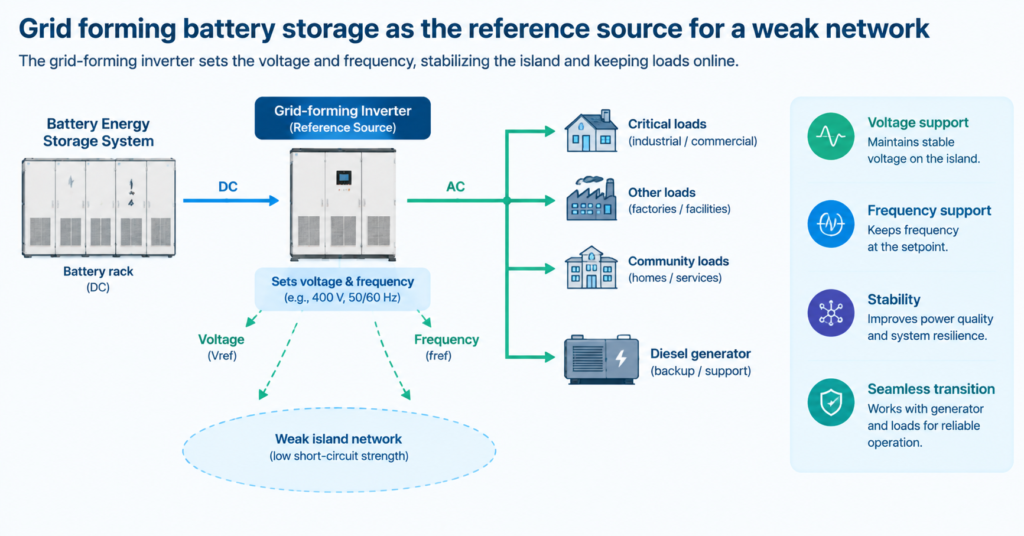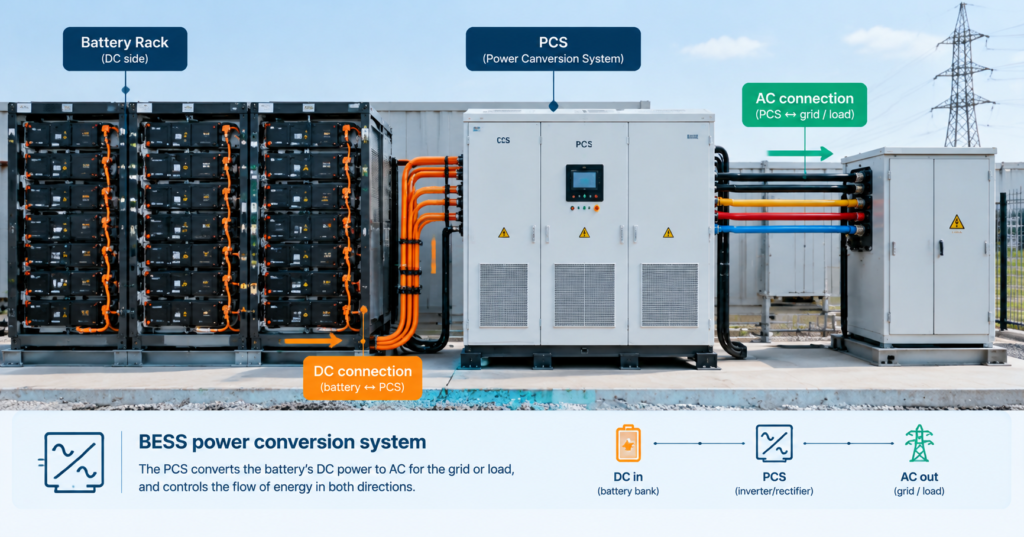
A 12v deep discharge battery is a 12-volt pack rated for repeated deep discharge cycles — drawing a large share of its stored capacity before recharge — rather than only shallow, partial draws. Depth of discharge (DoD) measures how much of that capacity you use per cycle as a percentage of total. This guide defines deep discharge and DoD, shows how deeper draws shorten cycle life, compares usable DoD across chemistries, and sets a practical low-voltage cutoff for 12V solar and backup systems.
The term is easy to confuse with deep cycle, but the two are not the same. Deep cycle names a battery class built for repeated discharges, while deep discharge is the act of using a high percentage of capacity. This article stays on that discharge depth, the figure that actually wears the cells.
What “deep discharge” and “depth of discharge” mean
A 12v deep discharge battery is designed to give back most of what it stored, yet deep discharge and depth of discharge are two ideas that get mixed up constantly. Deep discharge is the event: you pull a large fraction of nameplate capacity out before recharging. Depth of discharge, written DoD, is the number — the percentage of total capacity removed at any moment. If a 100 Ah pack has delivered 80 Ah, its DoD is 80 percent, whatever the load happened to be.
The companion figure is State of Charge (SoC), simply 100 minus DoD. A pack at 80 percent DoD sits at 20 percent SoC. For planning, DoD is the more useful figure because it is the one tied to wear. Running to 90 percent DoD means you used 90 percent of nameplate energy; the leftover 10 percent is the reserve the maker expects you to leave to protect the cells. That reserve is not wasted capacity, it is the buffer that lets the pack survive thousands of cycles instead of a few hundred. And a “depth of discharge battery” is just any pack described by how deeply it may be drawn — a rating statement, not a separate chemistry.
How depth of discharge drives cycle life
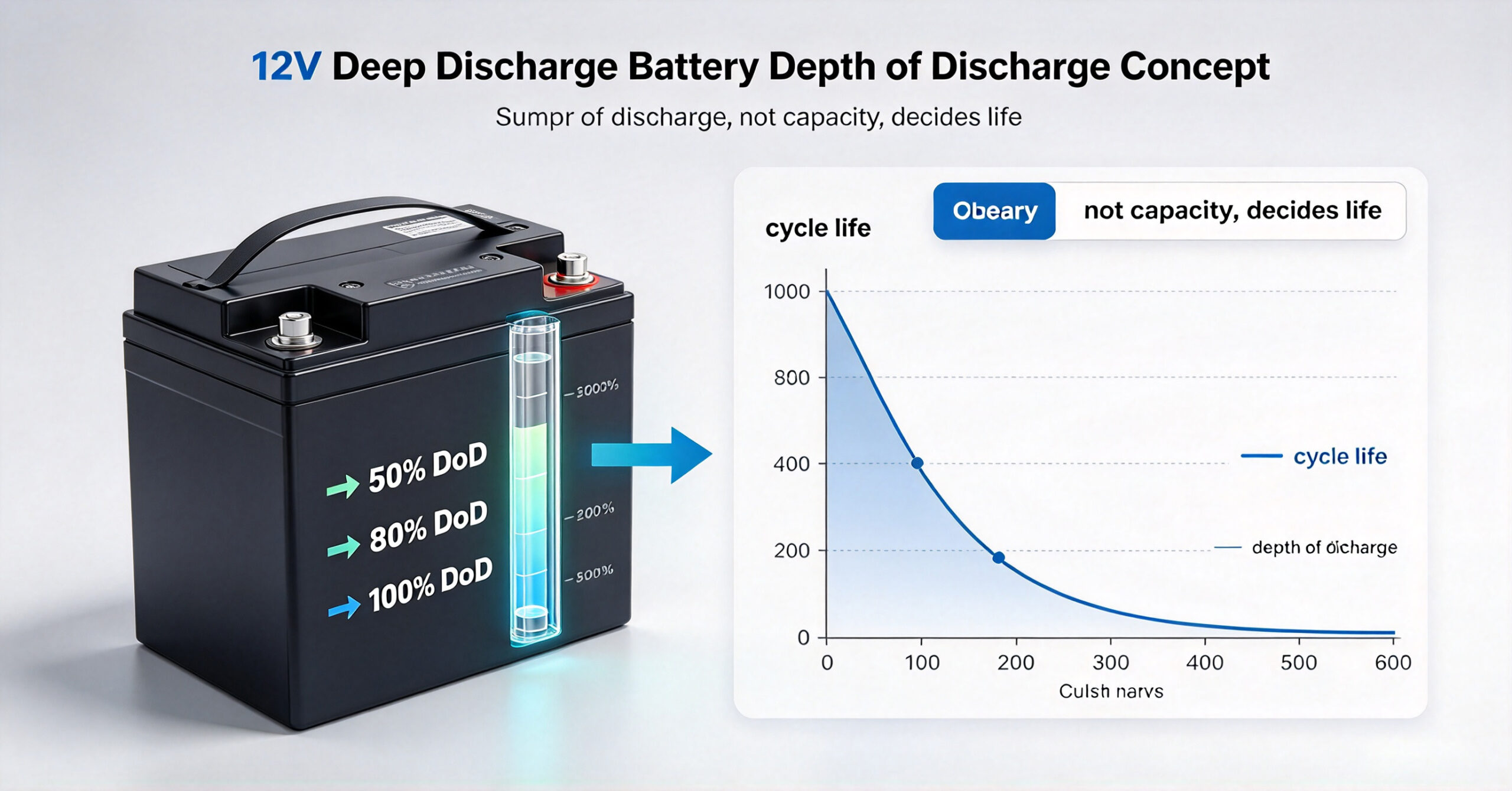
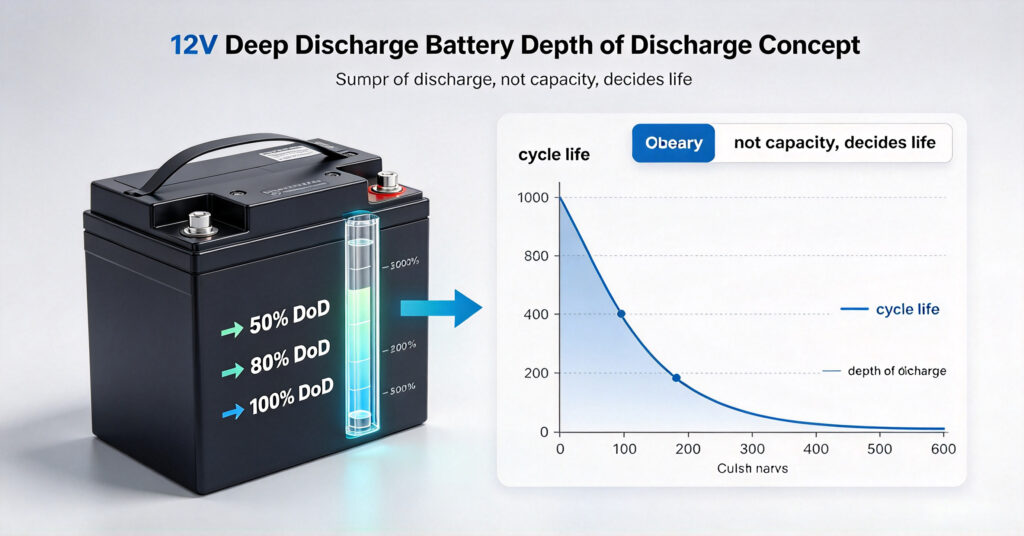
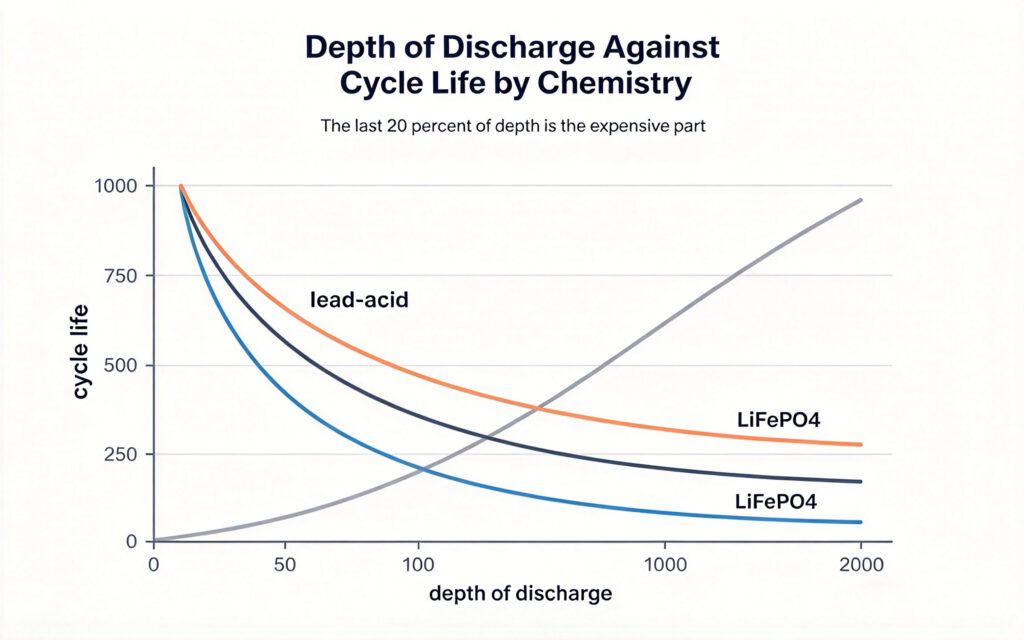
Cycle life is always quoted at a defined DoD, and the count falls as you go deeper. A LiFePO4 cell rated for roughly 3,000 to 6,000 cycles at 80 percent DoD may drop toward 1,500 to 2,500 cycles at 100 percent DoD every cycle, while a shallow 50 percent DoD can stretch life past the headline figure. The relationship is not linear: the last 10 to 20 percent of depth costs far more cycle life than the first half, because the cell lingers near the low-voltage knee where stress concentrates.
This is why a sensible cutoff matters more than a bigger battery. A 12v deep discharge battery sized so daily draw is only 40 to 50 percent of capacity will outlive the same pack run to 90 percent DoD by a wide margin, often doubling or tripling service life. The trade is a larger nameplate up front, but cost per cycle usually drops, which is the metric that matters for ownership. Lead-acid pays more steeply: a flooded or AGM unit rated 500 to 1,200 cycles at 50 percent DoD can collapse below 200 cycles if drained to 80 or 100 percent DoD repeatedly, because deep draws accelerate sulfation and plate stress. The full life picture is in the how long lithium ion batteries last guide, but the lever is the same everywhere — turn the DoD dial down on purpose.
Usable depth of discharge across battery chemistries
The table lists general usable DoD ranges by chemistry. These are reference values for healthy cells at room temperature, not one model’s spec, and the exact rated DoD should always be confirmed on the maker’s datasheet. Lithium tolerates deep draws far better than lead-acid, which is the main reason it leads new 12V solar and backup installs. Per-cell windows behind these pack figures are detailed in the Li-ion cell voltage guide.
| Chemistry | Typical daily usable DoD | DoD for rated cycle life | Note |
|---|---|---|---|
| Flooded lead-acid | 50% | 50% | Below 50% risks sulfation and fast wear |
| AGM / GEL (sealed lead-acid) | 50% | 50% | Similar limit to flooded, no watering |
| LiFePO4 (LFP) | 80–90% | 80% | Flat voltage, robust to deep draws |
| NMC / standard Li-ion | 80% | 80% | Check per-cell window in the cell voltage guide |
| Sodium-ion (emerging) | 80–90% | 80% | Newer chemistry, verify maker spec |
For a 12V LiFePO4 bank the 80 to 90 percent daily usable DoD is what makes a compact pack practical: you can plan around most of the nameplate without shortening life badly. Lead-acid’s hard 50 percent ceiling means you need double the nameplate to deliver the same usable energy, which is the hidden cost behind its lower sticker price. See the 12V LiFePO4 deep cycle battery hub for how that plays out across the deep-cycle range.
Why a cutoff beats a bigger battery
It is tempting to fix short runtime by buying a larger pack and still draining to empty, but the cheaper lever is usually the cutoff. A 12v deep discharge battery protected at 80 percent DoD outlasts the same pack run to 100 percent DoD by a wide margin, often doubling or tripling service. The reserve you leave is what lets the cells recover and stay balanced cycle after cycle. The topic sits inside the wider 12V LiFePO4 battery guide, where capacity and cutoff are designed together.
Setting the cutoff also keeps the rest of the system predictable. An inverter, a charge controller and a BMS all assume a known floor; when it is enforced consistently, the load never sees a brownout and the BMS never hard-trips mid-cycle. That consistency is worth more than the extra amp-hours from a deeper draw, especially on an unattended site where a surprise shutdown is the real cost — the same logic behind the solar powered 12V system guide class of installs.
Setting the discharge floor on a 12V system
For a 12V nominal bank the floor has two forms: a State of Charge percentage and a pack voltage. A 12V LiFePO4 pack should generally stop around 10.0 to 11.0 V under load — roughly 2.5 to 2.75 V per cell — for long life, even though the cells reach lower. Lead-acid wants a higher floor, about 11.8 to 12.0 V, because its voltage collapses faster near empty and going lower invites sulfation that is hard to reverse.
The practical rule for a 12v deep discharge battery in solar or backup duty is to set the low-voltage disconnect (LVD) at the voltage for your target DoD, not at the chemistry minimum. Want 80 percent DoD on LFP and your LVD lands near 11.0 V under load; prefer 50 percent DoD for maximum life and set it nearer 12.0 V. Temperature shifts the floor too: cold packs hold higher voltage at the same SoC, so a fixed LVD cuts off early and wastes capacity, while heat lowers voltage and risks over-discharge if unadjusted. Capacity sizing that sets this floor is compared in the 12V lithium battery capacity comparison.
You do not tune this by eye. A BMS or a controller with a configurable LVD enforces the floor, and it should pair with a coulomb counter — an amp-hour SoC meter — not voltage alone, because loaded voltage is a poor SoC proxy near the knee. For chisidal projects, size the bank so daily draw stays inside the chosen DoD band, then let the BMS hold the line so the cutoff is consistent every cycle.
12v deep discharge battery
A 12v deep discharge battery is a 12-volt pack rated to give back a large share of its stored capacity before recharge. The phrase describes how deeply the pack may be drawn, not a separate chemistry. Depth of discharge (DoD) is the percentage of capacity used per cycle, and that percentage, not the capacity itself, sets how long the pack lasts.
Q. How deep can you discharge a 12v battery?
It depends on chemistry. A 12V LiFePO4 pack is comfortable to about 80 to 90 percent DoD in daily use, while lead-acid should stop at 50 percent to avoid fast wear. The safe floor also has a voltage form: roughly 10.0 to 11.0 V under load for LFP and 11.8 to 12.0 V for lead-acid. Set the low-voltage disconnect to your target DoD rather than to the chemistry minimum.
Q. Deep discharge vs deep cycle: what is the difference?
Deep discharge is the act of using a high percentage of capacity in one cycle; depth of discharge is the number that measures it. Deep cycle describes a battery class built to survive many such discharges. A deep cycle battery can perform deep discharges, but the two terms are not interchangeable — one is a usage pattern, the other a product class.
Q. Does a higher depth of discharge always shorten battery life?
In general yes, and the effect is non-linear: the last 10 to 20 percent of depth costs far more cycle life than the first half. LiFePO4 tolerates deep draws far better than lead-acid, but even LFP loses cycles as DoD climbs toward 100 percent. Keeping daily DoD modest is the single biggest lever on service life.
Q. What voltage should a 12V LiFePO4 battery cut off at?
For long life, set the under-load low-voltage disconnect near 10.0 to 11.0 V, which maps to roughly 80 percent DoD. If you want maximum cycle life, raise the floor toward 12.0 V to hold daily DoD near 50 percent. Use a BMS or configurable LVD with a coulomb counter rather than relying on voltage alone, because load and temperature shift the reading.
Q. Does temperature change the safe 12V discharge floor?
Yes. In cold weather a pack holds higher voltage at the same SoC, so a fixed LVD can cut off early and waste capacity; in heat, voltage runs lower and a fixed LVD may let the pack over-discharge. Adjust the cutoff for the operating temperature band, or use a temperature-compensated BMS, rather than applying one room-temperature number year round.
Next step: set the 12V cutoff on purpose, not at the minimum
The depth of discharge dial decides both runtime and service life, so pick a target DoD first, then size the bank and set the low-voltage disconnect to match. A consistent cutoff protects the cells and keeps the rest of the system predictable.
- Compare the usable DoD of lithium against lead-acid in the lithium versus lead acid deep cycle comparison before sizing
- Start from the 12V LiFePO4 battery guide to see how a 12V LFP pack is rated for deep draws
- For chisidal, send your usage and site details, and we will come back with product prices, lead time and warranty information.