Solar battery installers are the contractors who design, mount, wire, commission and warrant a battery system at a home or small commercial site — and they are the variable that decides whether an installation performs the way the datasheet promised. The hardware two installers quote may be identical; the difference shows up in the cable sizing, the termination quality, the commissioning tests actually performed, whether the monitoring is connected, and whether the company still answers the phone in year seven. The one-line version worth quoting: you are not buying a battery from an installer, you are buying a decade of someone answering the phone — check the company as carefully as the equipment.
This guide is for an owner or small-business buyer with two or three quotes in front of them. It covers the six entry checks, how to read a quote so that two offers are genuinely comparable, the red flags that should end a conversation, and the handover pack to insist on. The technical side of the install itself is in #13 home battery installation; larger commercial and utility projects need a different kind of contractor, described in #127 how to choose a BESS installation company.
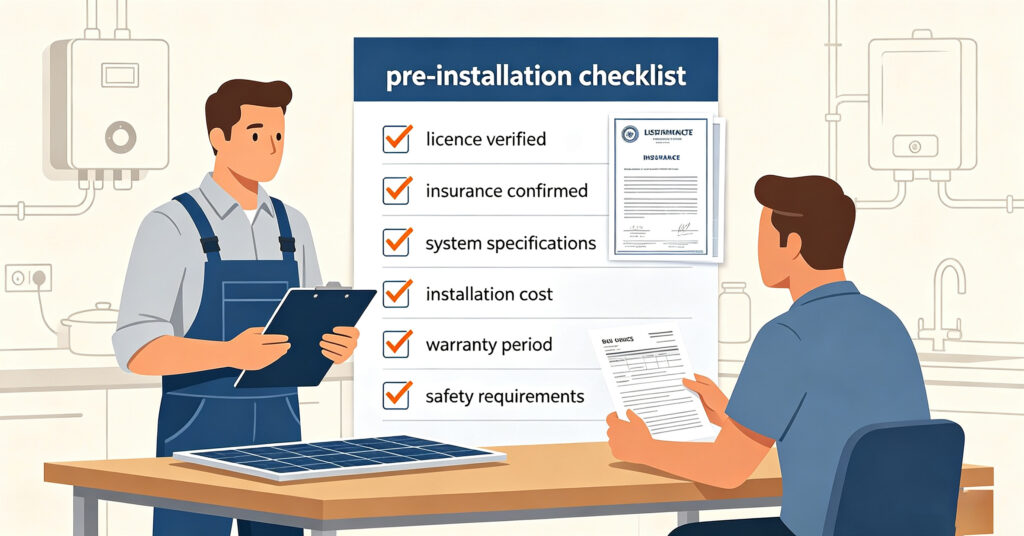
Six checks before you sign
| Check | What to ask for | Why it matters |
|---|---|---|
| Licence | The electrical licence number and the name it is issued to | Battery work is live electrical work; an unlicensed install voids insurance and often the equipment warranty |
| Insurance | Public liability and, where applicable, professional indemnity, with current dates | Covers damage to the building and to your existing electrical installation |
| Manufacturer approval | Confirmation the installer is approved or trained by the battery maker | Some warranties are conditional on approved installation; some makers will not support a third-party install |
| Reference installs | Two or three jobs of similar size you can contact | The only evidence that survives a sales pitch |
| Commissioning evidence | The test sheet they hand over at completion | Without it there is no record of what was actually tested |
| Aftercare terms | Who answers a fault call, in what time, at whose cost | The warranty on the box and the warranty on the labour are different documents |
Two of these are worth slowing down on. Manufacturer approval is not a formality: some battery warranties explicitly require installation by a trained or approved party, and a system installed outside that programme can lose support even when nothing is wrong with the hardware. Aftercare is the other one, because the most common failure in year three is not a dead battery but a monitoring connection that stopped working and nobody is contracted to fix.
Reading the quote line by line
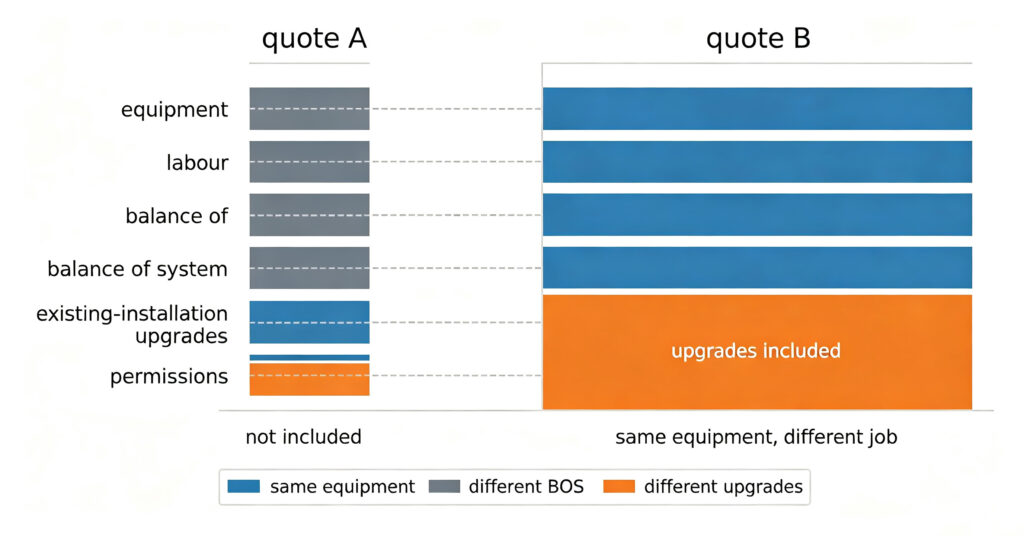
Two quotes from different solar battery installers can differ by a wide margin, and most of the difference is in lines that are easy to miss. Ask for the quote split into five parts and compare each one separately.
- Equipment: battery model and usable capacity, inverter or hybrid inverter model, and whether monitoring hardware is included.
- Installation labour: how many people and how many days, and whether commissioning is inside that number or billed separately.
- Balance of system: cable, isolators, protection devices, enclosures, conduit and consumables. This is the line most often under-quoted.
- Upgrades to the existing installation: consumer unit changes, earthing upgrades, or a meter change the utility requires.
- Permissions and paperwork: permit fees, utility application, and the certification issued at completion.
A quote that is missing the third line is not cheaper, it is incomplete, and the difference will arrive as a variation order once the work has started. A quote that is missing the fourth line means the installer has not looked at your switchboard, which is worth knowing before you sign rather than after. The material detail behind the third line is itemised in #161 solar installation kit checklist, and the survey that should have produced the fourth line is in #110 installation site assessment.
Five red flags
Any of these is a reason to slow down or walk away, whichever of the solar battery installers you happen to be speaking to.
- No site visit before a firm quote. The switchboard, the roof condition and the cable route cannot be assessed from photographs.
- Sizing without asking about your load. An installer who quotes a battery size before seeing consumption data is guessing, and the guess is usually too big or too small.
- Reluctance to provide the licence number or an expired insurance certificate.
- A price far below the others with no line-item explanation. The gap is in the lines you have not been shown.
- No written commissioning procedure. If there is no test sheet, there was no test, and the first sign of a problem will be yours to find.
Sizing is worth a specific question, because it is the decision that will shape the next ten years. Ask the installer to show the calculation: the evening and overnight energy the battery is meant to cover, the usable depth of discharge assumed, and the resulting usable kilowatt-hours rather than the nameplate figure. A professional answer takes two minutes; a vague one tells you what you need to know. The sizing method is set out in #09 how to size a home battery.
The handover pack to insist on
Six documents should change hands at completion, and asking for them before the work starts is the easiest way to make sure they exist.
- As-built documentation: the final layout, the string or battery configuration, and any deviation from the design.
- Test results: insulation resistance, polarity and voltage checks, torque values, and a full charge-discharge cycle observed. The test sequence used on larger systems is in #111 BESS commissioning.
- Electrical certification: the certificate required by the local authority, issued in your name.
- Warranty documents: the manufacturer’s warranty for the equipment and the installer’s written workmanship warranty, with both durations stated.
- Monitoring access: accounts created, app installed, and a demonstration that data is actually arriving.
- Maintenance schedule: what to check, how often, and who to call. The ongoing tasks are listed in #84 solar battery maintenance.
Installation safety is worth one more question before work begins: who is responsible for isolation, and what is the procedure while the system is energised. The expectations are set out in #128 installation safety requirements, and the tools a professional crew arrives with are listed in #119 battery installer toolkit.
When the project is bigger than a house
Above roughly a few tens of kilowatt-hours, or whenever the work involves three-phase distribution, a transformer, or a grid-interactive controller, the selection criteria change. At that scale you are hiring an engineering contractor rather than a local installer, and the questions move toward design responsibility, grid-compliance experience and project delivery. That selection process is in #127 how to choose a BESS installation company, and the delivery phases are in #134 BESS project delivery. Adding storage to an inverter that is already installed has its own path, described in #78 adding a battery to an existing inverter.
Q. What qualifications should solar battery installers have?
A current electrical licence covering the work, public liability insurance, and training or approval from the battery manufacturer. Where the system is grid-connected, the installer also needs to be able to issue or arrange the electrical certification and the utility permission the local authority requires.
Q. Do I need a certified installer to keep the warranty?
Often yes. Several battery manufacturers make the warranty conditional on installation by a trained or approved installer, and some will not provide technical support for a system installed outside their programme. Ask the installer to confirm their approval status in writing before you sign.
Q. How do I compare two installer quotes?
Ask both to split the quote into equipment, labour, balance of system, upgrades to the existing installation, and permissions. Compare each line separately. A quote that omits the balance-of-system or upgrade lines is incomplete rather than cheaper, and the difference usually appears as a variation once work has started.
Q. What should I receive when the installation is finished?
As-built documentation, commissioning test results, the electrical certificate, both warranty documents, working monitoring access, and a maintenance schedule. Ask for this list before work begins so the documents are produced as part of the job rather than after a dispute.
Q. How long does a home battery installation take?
Typically one to three days on site for a standard residential system, plus the time needed for permits and utility approval beforehand. Retrofitting storage to an existing solar inverter is usually at the faster end; work that involves replacing the consumer unit or upgrading earthing takes longer.
Next step: ask for the sizing calculation before the price
Good solar battery installers will show you how the battery size was derived. That single question separates the professionals from the rest faster than any other.
- Check the sizing logic in #09 how to size a home battery
- Review the commissioning tests in #111 BESS commissioning
- Plan the aftercare in #84 solar battery maintenance
- Ask leekooenergy for an installation brief that states the usable capacity at the depth of discharge assumed, the cable and protection specification, the commissioning tests to be recorded, and the workmanship warranty period — so your installer is quoting to the same document you are reading